It’s a special day thanking the brave men and women who served out country.
More than 100 veterans traveled around Traverse City Tuesday for the first Hometown Heroes Veterans Appreciation tour.
It’s a special day thanking the brave men and women who served out country.
More than 100 veterans traveled around Traverse City Tuesday for the first Hometown Heroes Veterans Appreciation tour.
Presented October 6, 1998 to The Central Mass. Chapter, VBOB, by Cliff Duxbury, historian
Frank Wooldridge is among a few WW II veterans who upstaged the draft by at least 4 years. It was in 1939 that he joined the National Guard’s 181st Infantry, 26th “Yankee” Division in Worcester and became a medic. It was a time when the Guard had limited finances, a modicum of equipment, and something less than a formalized training program.
Following the attack on Pearl Harbor on December 7, 1941 the status of Worcester’s Guard unit changed. By December 7, 1941 the 26th Division was as Federalized and Frank’s medical detachment was sent to Camp Edwards for basic training and soon after was mobilized for assignment to Coast Patrol duty to keep a watchful eye on the East Coast ranging from the Cape to Northern Maine. It was at Edwards that Frank was raised in rank to a staff sergeant. Later moving to Sacco, Maine, Frank was among a group that established an infirmary there. He moved again to Camden, Maine where he was assigned sergeant-in-charge of another infirmary.
In October 1943, he left the 181st and was sent to Camp Kilmer, New Jersey where he joined the 315th Medical Battalion, 357th Regiment, 90th Texas-Oklahoma Division. Departing New York in March 1944, the 90th reached England and Cardiff, Wales by April 9.
Intensive training followed for the infantry covering mine detection, village fighting, road marches and obstacle courses. “Invasion Fever” gripped the 90th and true to the nature of their preparation, the division moved across the Channel on June 6, 1944 —“D Day.”
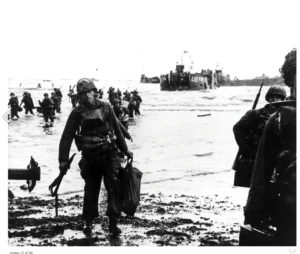
Frank recalls that it took 5 long hours from Southampton before he touched down on Utah Beach with the 357th Regiment. On arrival Frank commented that the opposition on the beach was minimal but the intensity of German shelling in his landing zone continued and the medical ranks too casualties. On D plus 1, the 315th Medical Battalion set up a temporary aid station about 1/2 mile inland where casualties kept them fully occupied.
In the earliest days of the invasion, the 90th was given the mission of containing German forces trapped in the northern tip of the Normandy Peninsula. Fighting was heavy and casualties were many. The 315th Medics were kept overworked. By the end of June, however, Cherbourg, the major Normandy port in the upper peninsula, fell and the area was cleared of Germans.
At the end of July, one month later, St. Lo, Coutance and Avranches were behind the 90th. The Germans were pushed from Normandy totally and the 90th was among several divisions that reached the plains of France where a “war of Movement” began and continued almost without interruption.
Movement, heavy fighting and land advances followed for American forces when the formidable events of the Falaise Gap took place. In mid-August, 1945, it was at Falaise that German forces of the 7th Army began a full retreat and attempted to squirm through a narrow valley remaining open. The only remaining door located through the French castle town of Chambois was their chosen route. It was here that the 90th Division established road blocks to keep the Germans contained. Divisional artillery, 11 battalions strong, fired relentlessly on the bogged down Germans—inflicting heavy casualties, disrupting counter-attacks and simply pouring a hail of steel on the reeling German remnants.
And into this storm the unarmed medics of the 315th Medical Battalion performed their tasks under fire, evacuating American casualties as well as enemy wounded. A truce was eventually called in order that the wounded might be attended under less harrowing conditions and removed from the field of battle. Frank’s 315th, in spite of sniper fire, (clearly a violation of the truce terms) carried out their mission with gallantry. Working with unit doctors, Frank administered morphine to settle casualties in severe pain and administered plasma, as well, to those men who were suffering continuing blood losses. Additionally, his duties involved general first aid to GI’s preparatory to their movement to rear area hospital for more specialized handling.
By August 20, 1 944 – the Falaise Gap was closed on the bulk of the German 7th Army. 13,000 Germans surrendered to the 90th in a period of 4-days.
When in mid-December, the “Bulge” began in Belgium and Luxembourg, the 90th was ordered to disengage from the Saar River. On January 5, 1945, the division made a 50- mile convoy trek to an assembly area in Luxembourg. And in bitter, bitter cold began an assault along the perimeter of the attacking 7th German Army’s salient on the extreme southern flank of their offensive line. Fighting in an area just south and east of Bastogne, the 90th’s speed and power of assault surprised the Germans. On the 4th day of battle, the T/O division had fought their way onto Belgium soil along with the 35th and 6th Armored Divisions at their sides. The salient had been liquidated.
By January 16, the 90th straightened out their lines looking Eastward and by the 29th of January, 1945 stood on German ground for the 2nd time.
From the Bulge, battles bristled along the Siegfried Line, across the Rhine in March to points along the Czech border. On May 7 a final combat mission set to rescue Prague, the Czech capitol, was postponed when Divisional Headquarters was notified that the German High Command had surrendered.
Frank was returned to the States in Fall, 1945 to Ft. Devens where he was discharged on October 26. He rejoined the National Guard 7 years later when the Guard was looking for experienced veterans to fill their ranks. He served an additional 3 years and left the military behind him for good.
Our thanks to Frank Wooldridge for his long, faithful and vital service to his fellow GIs during World War II.
—Submitted by John McAuliffe, President, Chapter 22
by Lou Cunningham, VBOB President 2001-2003
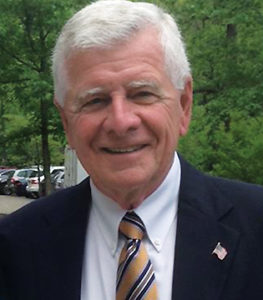
When Ralph Bozorth attended a meeting of the Delaware Chapter of the Veterans of the Battle of the Bulge with a friend VBOB member, he instantly became deeply interested, although not a veteran himself. He joined as an Associate and was soon driving a few of us older suburban members in to meetings at the Naval Yard in Philadelphia and became actively involved, bringing his vitality and expertise to the group. The new electronic age had left most of us behind, so we instantly relied on him. He enrolled all the chapter veterans in the WWII Registry of Remembrances (as well as many more veterans over the years) and created a slide presentation containing veterans’ photos which he presented at reunions.
Recognized for his abilities, he was elected as a Trustee on the Executive Council of National VBOB. Later, taking on the responsibilities of Treasurer, he worked diligently to solve the IRS problems and to get VBOB incorporated. If he himself couldn’t do something, he found someone who could. At reunions, he was seen rushing around organizing bus trips, showing film presentations, and sometimes handling all the other responsibilities of chairman.
But much of his activity for VBOB was behind the scenes and with our website, bringing in his stepson Kevin Diehl to revamp it, making it more accessible and complete, including a searchable digital archive of all issues of The Bulge Bugle. They added the website’s VBOB store, where one can buy QM merchandise, and added online Reunion Registration and a photo gallery of BOB veterans. Ralph posted many photos and news stories to the website on an almost daily basis for years.
Letters were sent by him to all of our member authors who have had their battle stories printed in The Bulge Bugle, to get permission to reprint them in a book. Through his efforts, the book called “The Battle of the Bulge: True Stories from the Men and Women Who Survived” is now printed upon demand and is sold on Amazon’s and Barnes and Nobles’ websites. We receive royalties from the sales of the book. [Click here for how to purchase the book.]
When no longer able to attend reunions because of his wife’s illness, he continued working quietly in the background, helping to edit the Bugle, and became Editor upon the death of George Chekan, who had been editor for many years. Now he has retired, and the website and publication are being handled efficiently by Kevin and Tracey Diehl, VBOB Member Services. His accomplishments on behalf of VBOB have been too numerous to list here. Our best way of summing up is that Ralph brought VBOB into the 2lst Century. We at VBOB thank him for that.
For a half century, Howell Dulaney would not talk about World War II. He tried to shut it out. He didn’t want to think about the horrors he experienced in the war, and he wanted the nightmares to stop.
“It just gets so real. It leaves you with an uncomfortable feeling,” he said.
“It was 50 years after the war before I thought about talking about it,” he said.
That happened after he joined the George S. Patton, Jr., Chapter of the Battle of the Bulge in Birmingham, an exclusive group of veterans of that battle.
Read the entire story here: http://discoverstclair.com/remembering-veterans/d-day-veteran/
My dad, William J Flynn, was a Staff Sergeant with the 106th Infantry Division, HQ Co. I wanted to share some of the material I found related to his war experience.
Here is an excerpt of a letter William sent to his brother Ed, dated February 8, 1945 and titled “SOMEWHERE IN BELGIUM.”
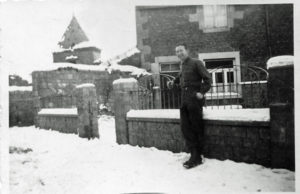
“After the big German Dec. offensive had been stopped, we pulled into a village in Belgium and it has been more of a rest area than anything else. Man, we really appreciated it. As Mother has probably told you, a buddy of mine and myself are sleeping in a home on a feather bed. Man, I mean it’s the best go! It won’t last long, though, as we will probably move back again in a few days. They don’t let a combat infantry division rest very long. There were a couple of girls in the home where we stay and I really have a lot of fun. These Belgian gals are not bad at all . . . .
“Oh well it’s a lot of fun and we sure needed a little of it after the hell we went through during the German offensive. Ed, everyone was called on to help stop that big push. We were taken to a hillside at night and had to dig foxholes in the dark. You couldn’t see a thing and you couldn’t even think of lighting a match or flashlight or anything else. We spent several nights in those holes and I’m telling you I [almost] froze. We also knew the Germans were all around us, and that didn’t make you feel any better. Buzz bombs going over, airplanes fighting, artillery and machine guns firing, the sky full of flares and tracer bullets. It was like nights in hell. I saw sights, Ed, I can’t write about and I may see more before this mess is over, but I hope not. Believe me, Ed, when I say “war is really Hell.” When fellows you have known a long time are killed, wounded and taken prisoner, it really gives you a funny feeling. You will never know until I come home how close I was to being among some of those. Ed, the Germans are just as bad as the Japs. There isn’t anything they won’t do. I know, I’ve seen what they have done. I’ve talked to these Belgian civilians and heard their stories. I’ve seen dead Germans laying around frozen stiff, but it just doesn’t affect you like it would seeing a dead person in the States. Especially when you know what they have done to your buddies and then, too, if it wasn’t for them, I wouldn’t be over here. I could tell you a lot of stories about them, but I guess I had better not.” The letter is signed “Love to a swell brother, Bill.”
And here is an excerpt from another letter Dad sent from Germany on April 28, 1945. His Division had been assigned POW duty in the Bad Ems area. The Bulge was over, of course, but I found the first person observations to be interesting:
“Well Ed, I am now in Germany. It is really pretty through the rural districts, but a lot of their towns and cities are really leveled. The country reminds me of the States, with the pretty farms and neat homes. We do not associate with the civilians in any way. We do not even speak to them. We have to be on the lookout all the time and we always travel in pairs. The people try hard to be friendly but we know that in their hearts they hate us, and we are not taking any chances with these babies. Every one of their books and magazines has Hitler’s picture in it. Yesterday we raised Old Glory over this place and our band played “The Star Spangled Banner.” They just stopped and stared as our Flag waved in the breeze where the swastika once flew. They really thought they were a super-race, and it hurts their pride when we have conquered them and then just ignore them. They just gaze in amazement as tanks, trucks, jeeps, guns and other vehicles of war rush by, while overhead great fleets of bombers roar. They all symbolize the might of America and the downfall of Germany. These people don’t look like the people of France and Belgium. They are well fed, well dressed, and seem to have plenty of everything. Their homes are nice and are nearly all modern. We often take over one that is intact, with all the furniture, including dishes in the kitchen and coal in the basement. We build a fire, cook a meal, and take a bath. In this particular place, there is a washing machine in the basement and that comes in handy for laundry. As we pass through towns and cities, there are white flags hanging from the windows. Germany is really getting a taste of what She dished out to other countries. She will be a long time recovering from this.”
—Submitted by Bill Flynn, Associate
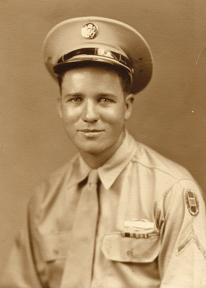
Claude Motley’s record from the Official Roster of South Carolina Servicemen and Servicewomen in World War II documents his brief participation in World War II. What it does not do is capture the details of this short but eventful period in Claude’s life on Earth. The record notes that he was born in Blaney (now Elgin), South Carolina on 1 November 1922. He still lived near Blaney when he entered active duty in the Army on 8 August 1944. He served overseas in the European-African-Middle Eastern Theater from 8 January 1945 until 12 June 1945. He was awarded the Good Conduct Medal, the Combat Infantryman Badge, the American Campaign Medal, the European-African-Middle Eastern Campaign Medal with service stars for the Rhineland Campaign and the Central Europe Campaign, and the World War II Victory Medal. He was honorably discharged as a corporal from Company M, 119th Infantry Regiment, 30th Infantry Division on 13 February 1946.
And now, the rest of the story: Claude enlisted in the Army on August 8th, 1944. Claude went to basic training at Camp Blanding near Starke, Florida and arrived on August 18th. He trained as a member of a heavy weapons company and trained on heavy infantry weapons, the heavy machine gun, the 81 millimeter mortar, the rifle, the carbine, the pistol, and grenades. Claude completed his training and moved to Fort Meade, Maryland to await transportation to Europe in early January of 1945. In Europe on January 8th, he was assigned to Company M, 119th Infantry Regiment, 30th Infantry Division. He was assigned to a machine gun platoon. When he joined the 30th Division, they were engaged in the final days of the Battle of the Bulge. On January 13th, the 30th Division launched a counteroffensive and began their push east toward Germany. On February 23rd, the 30th Division crossed the Roer River. On March 24th, they crossed the Rhine River in Germany. On April 12th, the 30thDivision reached the Elbe River forty miles Southwest of Berlin in eastern Germany. On April 13th, Company M crossed the Elbe River near Grunewalde. The Germans mounted a counterattack and captured 22 members of Company M including Claude, his Company Commander, Captain Romulus Mann, and his platoon sergeant, Technical Sergeant Paul Schreck, as they took cover in the basement of a farm house. Claude was imprisoned in Stalag IIIA near Luckenwalde, Germany. Like other prisoners at the end of the war, Claude suffered from poor nutrition and care. Rumor in Stalag IIIA was that the Russians were about to liberate the prisoners. Claude managed to get a map of Germany and he and a friend, Wilton Outlaw, escaped on May 5th. Their plan was to reach a crossroads and to use the map to find their way west to American lines. The plan hit a snag when they reached the first crossroads, because the Russians had come through the area and had changed all the road signs to Russian, which was unintelligible to Privates Motley and Outlaw. They revised their plan, put the map away, and simply headed west. They were given a ride for part of the way on a wood burning truck by people they could not communicate with. Claude returned to the 119th Infantry. Victory in Europe was achieved on May 8th when Germany surrendered. On 12 June, the 30th shipped back to the United States aboard the RMS Queen Mary ocean liner. After a visit home, Claude was stationed at Fort Lewis, Washington ,where he served as a driver until his discharge on February 13th, 1946.
Post war, Claude returned home and to logging and farming. He also taught agriculture in a veterans program for a couple of years. He raised a family, was active in his community and his church. He was truly one of America’s greatest generation.
—Submitted by his proud son-in-law, Nelson McLeod, Associate
by Julian Lee Gelwasser, 90 INFD, 358 INF REG, CO B
World War II started in 1939 when I was 13 years old. When Pearl Harbor was attacked Dec.7, 1941 I was in high school, age 15. Our home room teacher said it would be over in 6 weeks. Sure. Three years later in 1944 I turned 18, graduated and the draft board was waiting. Before that my classmates formed a Victory Corp. , bought “uniforms” and tried to prepare ourselves for service. There was an urgent need for trained riflemen in the army so I was inducted at Ft. Meade and took basic training at Camp Fannin, Tx. I quickly learned to use the M1 rifle, Mi carbine, BAR, 60mm mortar, 30cal MG, Bazooka, grenades and bayonet. We marched 25 miles with full packs in 100 degree weather. It was perfect training for the future snow and cold of the bulge. We should have trained in Alaska. In a matter of months I was on a troopship that landed in Marseilles, France. The bulge started Dec.16th and I was sent north as a needed replacement to the 358th of the 90th INFD. I became a platoon runner for LT. Julius Hebert. He and his non-coms were a wonderful group of men. My teenage mind was still active when Lt. Hebert let me carry his Thompson SMG. Wow, a Tommygun just like the ones carried by G-Men! I also carried his handy talkie radio.
There was much slogging through snow and cold. Food came in small K ration boxes. We were lucky to replace our boots with waterproof shoe pacs.
I was soon introduced to the nearness of death and I began to wonder if I would ever see my 19th birthday. At one time shots were zinging overhead. Lying prone next to a soldier, I poked him to get his attention. I got no response and realized he was dead. Another time, we were working our way through a wooded area in a fire fight when I was blocked by a smoking Jeep. The driver was lying on the hood bare footed. The Germans had taken his boots to replace their own.
After weeks of this we were near Wiltz, Luxembourg pushing the Germans out of a large farm house. To get out of the snow and cold we entered the barn. Big mistake. The Germans had zeroed it in and dropped a mortar shell on top of us. A large piece hit me in the left leg and another one of our men in the platoon was hit in the arm. We both started shouting, “MEDIC!” (I had a compound comminuted fracture and went into shock.)
I was soon covered with a blanket and put on a litter which went onto the fender of a Jeep. First stop was an aid station in ArIon, Belgium. I just missed an amputation. Next I was sent to a hospital in Paris where a Red Cross lady wrote a letter to my parents. This followed with a cross channel boat trip to England on the St. Olaf. At a hospital in Cheltenham I was put in traction for over a month, after which I returned to the US via a C54 hospital plane by way of the Azores, Newfoundland and Mitchel Field, LI. Months of rehab followed in Virginia until I could walk again.
I thought the medical treatment was very good, for those times. I was one of the first to get penicillin in the field.
Sad note: I had written Lt. Hebert a letter and it came back marked “DECEASED.” Nice man — I still think of him.
I received my Honorable Discharge just as the war ended in 1945. The GI Bill was in effect, so I received a college education.
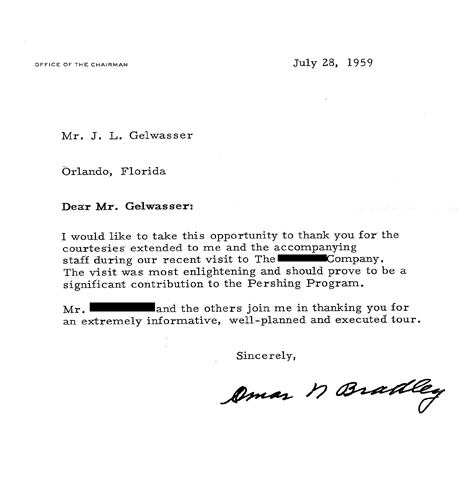
There is an interesting side note to my story. Some 14 years after the war ended, I was 33 and had risen to a mid-level position in the defense industry. I became involved with a major sub-contractor whose chairman of the board was Five Star General Omar Bradley. So former PFC me had a friendly chat in his office with the general. I invited him down to the Cape in Florida to witness a test firing of a prototype missile, after which he sent me a very nice thank you note [shown below] which I have kept all these years.
In retrospect, we 18-year-olds were very patriotic. We loved our country and were ready to fight for it, in the face of fanatical German Nazis who were terrorizing so many people. We did what we had to do to end their threat and end the war.
Hard to believe. Those of us still around are in our 90’s.
VBOB member Richard Brookins, 28th Infantry Division, whose 1944 appearance as St. Nicolas in a Luxembourg town has been commemorated there for 70 years, is featured in a book and documentary, “American St. Nick.” And on July 7, 2016, Brookins was presented with the Luxembourg Military Medal, Luxembourg’s highest military honor, by the Consul General of the Luxembourg Consul in New York at a small ceremony in Rochester.
“American St. Nick” tells the remarkable TRUE story of a handful of American soldiers who during the chaos of war, help bring Christmas back a small Luxembourg town, and unknowingly create a holiday tradition that continues to this very day!
Read all about it here: http://www.americanstnick.com/
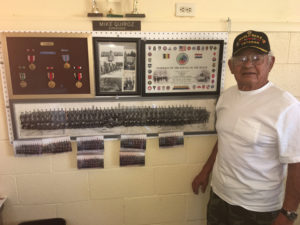
In September 2016, on Mike Quiroz’s 92 birthday, his son recorded him recalling his World War Two memories in the United States Army with the 134th AAA Gun Battalion, at the Battle of the Bulge.
by E. Peter Hornburg, 5 INFD 10 INF CO F
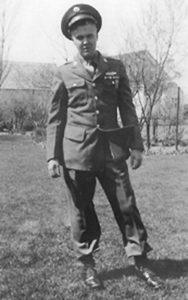
It was dawn on December, 23, 1944 in Luxembourg and we, Co F, 10th Inf. 5th Div, were about to attack in the Ardennes. The German breakthrough had been stalled and they were dug in.Most German troops wore camouflage uniforms. It was another cold day and our company had just spent a miserable night in a farmer’s barn that had little hay and was ready to collapse. We were one of the divisions that General Patton had pulled out of the line farther south and trucked to the Ardennes. This former farm, I believe called the Michaelshaft farm, was at the edge of the forest.
I had spent nearly 5 months with the 5th Division, fighting across Northern France, but still hardly knew anyone. I’d had several foxhole partners—all casualties of one kind or another. At least two were taken out with frozen feet. November and December had been extra brutal months in Northern Europe.
I was picked as one of the scouts who went ahead of the main body of infantrymen. Surprisingly, one of our Sergeants volunteered as the other scout. We had no artillery or tank support. Obviously, no tanks could operate in the forest. I did not see a tank in my nearly five months at the front. So we walked into the forest, the other scout and I, about 50 yards ahead of the others. I recall a few inches of snow on the ground. All was quiet for a while, when two shots rang out. Both the other scout and I went down.
I was shot through the side of my knee, just grazing the bone, but had very little pain. But our other scout got hit in the stomach. Any combat vet will tell you this is unbelievable pain and almost always fatal. I slithered back to a depression in the ground and saw the most unbelievable act of bravery and futility I have ever witnessed. First the medic, then at least two other soldiers, rushed over to try to help the wounded sergeant.
All were hit! Not only could our troops not advance, but now artillery and mortar rounds started coming in.
Eventually an order to withdraw was issued. I stood up and immediately was hit again …. this time a bullet through my lower jaw. Again, I had little pain yet, but I was choking on a mouthful of blood, flesh, bone and teeth. I was in shock. Two guys ran over, put my arms around their shoulders, and we headed back. Shells were exploding in the trees overhead, and the shrapnel was hitting several of our guys at a time. Chaos surrounded us. We were nearly to the edge of the woods …. I could see the farmhouse from where we had started, when a shell hit the tree above us.
I woke up a few seconds later, face down, blood running down over my forehead. I reached up, removed my helmet, and saw two holes about three inches apart. The shrapnel had left a nasty gash in my scalp. Only a fraction of a different angle would have killed me.
Still no pain—just in shock, I guess. The two men assisting me were gone. I’m sure they thought I was dead. I read later that 2/3 of my Company was either killed or wounded that day. Along with lots of others, I was taken back to a tent field hospital, where the Army somehow managed to bring up a rather special Christmas meal the next day (the 24th). I could only watch. The plans were to put me and other seriously wounded on a plane to England, but extremely bad weather stopped those plans.
I was put on a hospital train that took forever to reach the coast, then cross the Channel, and on another train to an Army Hospital in central England. I spent nearly 15 days living on grapefruit and tomato juice through a straw.
by Jan Ross, Associate Member
We, Jan Ross and Brad Peters, have created and maintained a comprehensive web site (www.300thcombatenginersinwwii.com) over the past ten years to recognize Jan’s father’s unit that fought in the Battle of the Bulge.
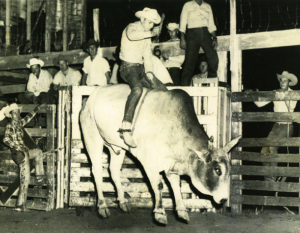
Tech. 5 Kenneth Morris was a Company A truck driver with the 300th Engineer Combat Battalion in the Battle of the Bulge. He still carries the nickname “Cowboy” because of his time after the war on the international rodeo circuit as a champion bull rider. He continues to live in his home town of Watts, Oklahoma. He attends reunions of the 300th with his extended family in some cases with four generations. His grandson, Congressman Markwayne Mullin represents the Second Oklahoma District in the United States Congress. What follows are some of Cowboy’s recollections from interviews with him at the 300th reunions and transcribed for the 300th web site.
They had us in this old château in Belgium owned by a cousin of the King of Belgium. They made us move out of the castle. It had a moat all around it with all those fish in it and a drawbridge which was stationary. So they kicked us back out into the mud. As we went across this drawbridge, we had those hand grenades and percussion grenades. So I took a percussion grenade and got right by the rail and dropped that thing into the moat. When it hit and exploded those fish just came up to the top, all dead. That old man was really mad. About a week or so later Lt. Taylor [1 Lt. William H. Taylor, Jr.] said, “Morris, why did you kill the old man’s fish?” I said, ‘What made you think I did it?” He said, “I couldn’t think about anyone else but you that would do it.”
We had two bridges to blow, a railroad bridge and a road bridge. The 84th Division was coming out of there and they had a tank destroyer attached to them. They were supposed to tell us if we were to get cut off and we were supposed to blow the bridges and follow them out. About three o’clock in the morning on the 24th [December] the 84th just left and left us unguarded. Then there was a column of German tanks coming down our road. About a half mile before they got to us they turned to the right and all hell broke loose. Whoever was building a bridge up there really got shot up. A truck of ours later came through and they had run into an ambush and some of them got killed.
Our platoon commander, Lt. Taylor, was one of our best liked officers. I said to him, “Let’s blow these damn bridges and get the hell out of here.” He said, “Let’s wait.” So later I said, “Let me take your jeep and drive and see if I can find a way out of here.” He said, “No, we are staying right here.” Finally, way later, and I shouldn’t have done it, but I said, “Lt. Taylor, I’m responsible for my truck, I’ll load the men up and try to get them out of here. And if you don’t let me do that, I’m going to burn it up, because if we stay till morning we all will be dead. We have to get out of here now.” So he finally said, “Okay blow the bridges.”
I was driving the lead truck when we left and told my men, “If I get hit you jump up here and keep driving.” It was real dark, black, and we just had the cat eyes. I could see the horizon and just kept driving until we got out of those trees. Somebody must have been helping us. The rest of the platoon followed me and we came to another crossroad. We could see a bunch of cat eyes, so we stopped. It was about a dozen of our tanks. So, I said to the Captain of the tank unit, “Where are you guys going.” He said, “There are some engineers cut off in there and we’re going to get them.” I said, “We’re the engineers and we are getting out. There’s no one else up there but Germans.” He said, “We’re coming to fight a war.” And I said, “It would be suicide – those Sherman tanks are no match for those Tigers, don’t do it.” But they followed those tanks up there and I’ve always wondered what happened to them.
Cowboy remembers Ray Gordon. Ray was raised in a little town called Watts in Oklahoma and I was raised in a little town just 10 miles apart. I knew Ray for years before we ever came to the Army. Ray was easy to make mad. You’d tease him a little bit but he’d get over it right quick. One time, we’d been following the tanks all night through a wooded area in Germany. One of the boys built a little old fire. It was cold and wet. We had some cans of gas on the end of the truck and this guy went and got some gas in his steel helmet. Ray had his back to the fire and the guy tried to throw a splash of gas on the fire but it went all over Ray’s back. Ray was on fire. It scared him and he started running. I started after him. I had some blankets in the truck and it took three of us to get him down and throw them blankets on him to get out the fire. He never got burned anywhere but he sure was on fire. He was pretty scared.
One time Ray got mad. We had just gotten packages from home and it was after Christmas. We were stopped and everyone was opening up his packages. I was opening mine and it had a safety razor. It had a little handle that screwed into it. The handle broke off so the razor was no good. I didn’t say nothing and put it back in the box. We got to swapping boxes and I swapped with Ray. When Ray opened it up and saw it was broke he was really mad and jumped up. I said, “Ray, if you was smart, dammit, shut your mouth like I did and you’d have swapped it off to somebody else.” That was Ray. I liked Ray.
We were on this trip south to southern Germany and the war was practically over. We had gone over to the Third Army. It was 1 May and it was snowing. There was this general there and you could tell he had not been there long. He had this red board up there with two big stars shining. So he stopped right beside me and said, “Soldier where are you going?” I thought this must be some kind of joke or something. So I said, “We are attached to this armored division.” So he said again, “Where are you going?” I said, “Hell, I don’t know we are just following those tanks.” So he said, “Have you got a trip ticket?” So I knew he had just got up there because you know damn well you don’t have any trip tickets in a combat mission. So I said, “We haven’t had a trip ticket since we left England.” So he said, “Don’t you have a map?” So I said, “What would we be doing with a map?” So I said, “You got a map?” He said, “No we are just following you boys. We are lost.” And I said, “Obviously if you’re lost I guess we are lost also.” A two-star general asking a truck driver where to go.”
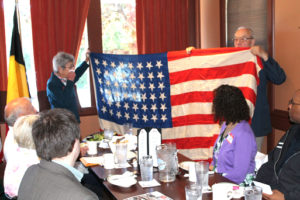 The annual Chapter 22 Luncheon was held this year on Flag Day at The Mill Restaurant in West Boylston, Massachusetts. The event, as usual, was spearheaded by Commander John McAuliffe. It was great seeing some old friends and new friends alike. One of our guest speakers was Denis Hambucken, who is writing a book on the Bulge. Over the past year, we lost many great veterans. The accounts of the men and women who served during these trying times is amazing.
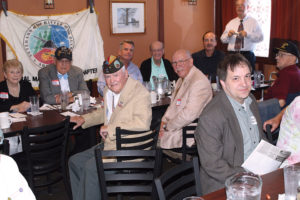 My Dad served in the 5th Armored Division, and I am proud to be an Associate Member of Chapter 22.
—Submitted by Elisha Mallory Grant Jr.
The Spring luncheon meeting of the Battle of the Bulge Chapter #62 had 7 stars in attendance. The guest speaker was Joseph DeSalvo, Lt General and Military Commander of the United States Southern Command (3 stars), Pete Osmond, Lt General (3 stars) and our Commander Al Irzyk (Brig General (l star). The local press published a picture with a big headline “7 STARS AND ONE STRIPE.”
As a PFC, I never had the opportunity to speak with, or take a picture with, a general!
The event was well-publicized, and we had 98 veterans and family enjoy the camaraderie and program. As always, we introduced returning veterans from Iraq and Afghanistan as our guests. They received a standing ovation. Commander Al Irzyk celebrated his 99th birthday and was presented with a cake. All sang the traditional Happy Birthday song. It was a most enjoyable afternoon.
VBOB National has 35+ active chapters and ours is the largest, with the most veteran members, 195 total.
—Submitted by George Fisher, Chapter 62 President
Recently our Mississippi VBOB Treasurer, Ms. Mary Ellen Stanley, called to say she had received a second substantial check from a supporter of our scholarship project of 2015. The check was sent to honor and remember her late husband who was a combat veteran of the BOB. The Mississippi scholarship project for students related to Miss. veterans will now be continued in 2016, and we are at the moment preparing the necessary papers of announcement and applications, etc. Our Miss. Chapter is blessed to have older members who really care about the education of our young people and are happy to support it, even if it is a sacrifice.
Now we hope it is time for the National group of VBOB to have a scholarship project for young people of college age who are related to our wonderful B.O.B. Vets. We can truthfully say that it has energized our group and made us feel positive about what we can still contribute to society… even in our “ last quarter.” At the same time, we are educating students and their parents about this critical battle of WWII … lest we forget … We think the time is now.
—Submitted by Dr. James W. Hunt, Chapter 33 President, and Jane Hunt
CHAPTER 33 PRESIDENT SPEAKS AT MSU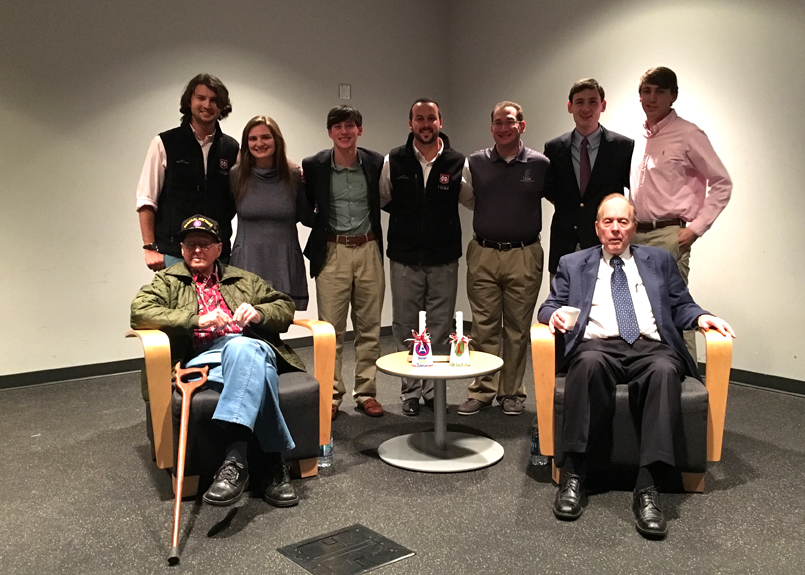
On March 21, 2016, Hillel, a student organization at Mississippi State University, hosted Dr. Jim Hunt, VBOB Chapter 33 President, and veteran Joseph Johnson, to speak about their service during World War II. They spoke in the Union Dawg House to a packed house of roughly 95 people. Both Mr. Johnson and Dr. Hunt were given Cowbells with their Division patch painted on them, and posed for requested photos afterwards. Spectators who came to hear these two men were a mixed group of young and older patrons. This event couldn’t have been done without the help of Jacob Craig, who was newly elected as the next president of Hillel. Seated (l-r:): Joseph Johnson and Dr Jim Hunt. Standing (l-r): Andrew Shamaskin, Alexx Lux, Jacob Craig, Hillel President Joseph Metz, Scott Sincoff, Will Leonard, and Jake Grogan.
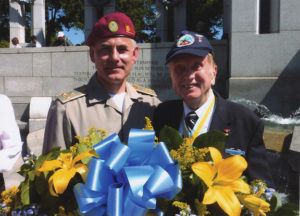
by J. David Bailey, Past VBOB President (2010-12)
Seventy-two years ago, more than 160,000 Allied troops stormed the beaches of Normandy. On January 6, 2016 at the World War II Memorial in Washington DC, veterans in their 90s, and the families of fallen soldiers, commemorated the epochal D-Day, gathering to honor those who fought during the invasion.
The ceremony was traditional in nature—there was a public wreath-laying event to remember those who died. I was indeed honored, representing the Veterans of the Battle of the Bulge, to lay a wreath at the Atlantic Arch of the World War II Memorial. This was in memory of 9,000 Allied soldiers killed or wounded during the invasion. I was accompanied by Col. Andrew Ordynovych, the Military Attache of Ukraine.
David O’Sullivan, The European Union Ambassador to the United Sates, was the main speaker, and also presented a wreath during the event. Josiah Bunting III, chairman of the Friends of the WWII Memorial, delivered special remarks, and the Military District of Washington provided support for the event.
The sound of trumpets playing “Taps” concluded the ceremony.