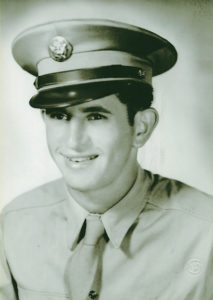
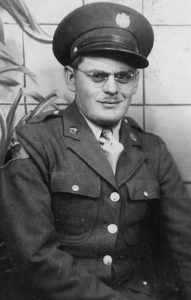
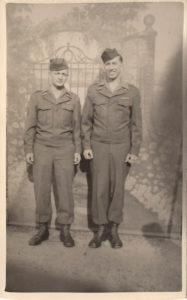
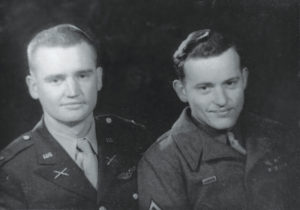
I was one of the original members of the 87th Division, which had been reformed in December 1942, and started basic training at Camp McCain Mississippi in February 1943. We were mostly 18 – 19 year-olds from all over the country. By the time we sailed for Europe in October 1944, many of the original members had left us to go over as replacements, and we had received an infusion of Air Force and ASTP members for infantry basic training. Below is an account of a memorable experience: “An Unforgettable Night.”
I was a squad leader in a rifle platoon of C Co. 34Sth Inf. Reg’t., 87th Inf. Div. in Dec. 1944. We were engaged in the Alsace region, poised to attack the west wall about Dec.16th or 20th, when the break-through occurred up north on Dec. 16th. We were one of the Third army divisions that Patton swung 90 degrees north to attack the underbelly of the Bulge. We were pulled off the line and after a long freezing ride of about 200 miles, settled into a bivouac outside the city of Rheims.
On the 29th of Dec., we were trucked to an assembly area near Libramont, Belgium, arriving late afternoon in a pitch black forest. Seems that we had barely finished digging in, when we were called to “hit the road until you run into Germans.” Our officers were upset because we were not given time for a reconnaissance. We were in a column of companies in the approach march, when contact was made with elements of the German Panzer Lehr and 26th Volksgrenadier divisions. As we approached the village of Moircy, we came under machine gun and artillery fire. In the ensuing action, a flanking movement to the left, my platoon was ordered to clear a hill on our right flank. We no sooner got there when we came under mortar fire that wounded myself and several others. When the firing lifted, the wounded were helped back to a farm house in the village. Battalion medics were able to evacuate some of the wounded as fighting continued in the village, and we were counter attacked by tanks. Unknown to us, our Battalion commander had ordered a withdrawal of all elements in Moircy, and he called for heavy artillery including corps (the big stuff), in an attempt to break up the counterattack. We had lost contact with Battalion, so we were trapped in the farm house, and for what seemed like forever, underwent a heavy and lengthy barrage, which did break up the counterattack. Medics returned early the next morning and evacuated those of us who had remained overnight.
My unit endured heavy fighting in the following days, and on January 6, some of my platoon were captured and spent the remaining months in a German prison camp, while I luckily spent 3 months in a hospital in England. On my release from the hospital in early April of 1945, I was classified for limited duty and never returned to my unit.
by Arnold Cascarano, 291 Infantry Regiment, 75 Infantry Division
Recently I have read many stories by veterans of World War II explaining how the battles were fought and of troop movements. I was only a PFC so Generals Eisenhower, Bradley, Smith, Hodges and Patton never called me into their meetings and asked me how to move armies. All I knew about our progress was what I read in the Stars and Stripes. It wasn’t until years after the war that I was informed how the war was fought. When you are in the infantry, you are confined to your immediate area. So I only knew of 50 yards to my right and left, and 50 yards behind me. That was all.
There has been a lot said about The Battle of the Bulge. Books have been written, movies made, and documentaries have appeared on television, etc. Being a veteran of The Bulge, I know well the carnage that took place, and we should NEVER forget this great battle that cost us so many lives.
However, there were other battles we fought that did not get the attention of The Bulge. As a former infantryman, I can tell you if someone is shooting at you with artillery, mortars, machine guns, etc. it is a big battle.
During the last part of The Bulge, about January, 26, 1945, my division, the 75th Infantry, was shipped to Rhineland, France, to support The American Seventh Army and The French First Army. We were in need of rest, replacements, and equipment, but we were not given rest. We boarded the box cars called “The Forty and Eights.” (I believe this term was first used in World War I). They put 40 men and 8 horses in one box car. Remember, the horses were not housebroken. We traveled for two days to arrive in Alsace-Loraine in the bitter winter. We had no time to really dig in and we had many casualties. This became known as The Colmar Pocket.
We fought with the 28th Infantry Division and the 3rd Infantry Division. We finally pushed the enemy across the Rhine. By the way, this is the battle for which Audie Murphy earned his Congressional Medal of Honor.
While waiting to get shipped to Holland, for some reason my company was given the worst detail, which had a profound effect on me. It still stays with me to this day. We had to go into areas and pick up American bodies and bring them out to the grave registration people at their trucks.
It was then that I realized how many stories will never be told about our very brave boys. We found four Americans’ bodies that were close to each other, and there was one body draped over a machine gun. The other soldiers had a M1’s. As we went further out, we discovered about 40 dead enemy soldiers. Of course we had no way of knowing what took place here, but we tried to piece this together. It seems these four men killed about 40 enemy soldiers and then were killed themselves. What bravery!! This is only one of the many stories we will never know about. There have been many stories like this one.
So the Battle at The Colmar Pocket, as it was called, took many casualties. The mission may not have been spectacular, but the fighting was. I do remember how well the French First Army fought to take back the City of Colmar. That was their city, and they wanted it back from the Germans.
Chevalier Cascarano earned two Bronze Stars, Combat Infantry Badge, three Battle Stars, Victory Medals, and Army of Occupation.
Member Clearsy Mullins was going through the papers of her late husband Chester Mullins, 7 ARMDD, 38 AIB, Co A, and came across this startling letter, dated May 28, 1998:
Chester Mullins, 7 ARMDD
Dear Mr. Mullins:
I just received my May [1998] issue of The Bulge Bugle and was reading it, when I came to page 13 and your [inquiry] concerning the 7th Armored Division and the Malmedy incident. I was there, and so was my brother Edward, who was with the 291st Combat engineer Battalion.
First, let me tell you about myself: I was a communication sergeant with Company C, 33rd Armored Engineer Battalion, 7th Armored Division, with CCR. We were through the bulge from December 17, when we came from Holland, and pushed the Germans back to Germany until the end of the war. VE Day was my birthday! It was a long push, but we did what we were supposed to do, and we lost a lot of our buddies.
About the Malmedy incident, I can tell you where I was and what I saw. We were moving around in the bulge to many places. One day we got orders to move, so we’re on the move and came to this crossroad, continued about 100 yards or so until we saw this field to our right. We saw all these GIs laying there, and couldn’t figure out what that was. We took a good look and saw that they were all dead. One guy said it was a graves registration collecting point, but we had seen such points before, and they had laid out all the dead GIs side-by-side in rows. What we saw here were the GIs laying in a scattered manner in an open field. We couldn’t make out what had happened.
Sometime later, we were walking through snow that had fallen the night before, and we recognize the same field. We saw that the bodies were covered with snow, and saw a hand or two sticking out of the snow.
I am one of five brothers who served in World War II—three of us were in Europe. My brother Edward, 291st Combat Engineer Battalion, was in Trois Ponts when the bulge began. His company was called to the Malmedy Massacre site to help the graves registration. When they started to move the bodies, they found that some bodies were booby-trapped, so they called for the engineers to help them. My brother was one of those who had to sweep the snow off of the bodies, and tie a rope to the leg to drag them to a safe place, so that the graves registration could examine them and tag them for removal. A few days later, we found out all about the Malmedy incident; how they were brought to that field and stood there to be machine gunned, killed in cold blood. It got us scared and had us thinking about what it would be like to get captured; to have to stand there and be machine gunned by the enemy. But I guess the Lord was with us, and it didn’t happen. Thank you Lord.
So Mr. Mullins, I hope my little story would be of use to you. Bye for now.
by Bill Armstrong, Service Battery, 263rd Field Artillery Battalion, 26th “Yankee” Division, Third Army
BELGIUM, 1944. Bob Zelmer (co-driver of our ammunition truck) and I had a chance to go back to Service Battery for a hot meal because the guns (105 howitzers) were not going to move that night. But, when the 1st Sgt (Laing) saw me, he told me that I had guard duty from midnight to 4 AM and to take “Porky” with me. (Porky was one of our cooks.) The temperature was well below zero, which meant I had to put on every stitch of clothing I had. Also, I knew that Porky wasn’t going to be very reliable—he’d often wander off, claiming he had to go to the toilet, but I’d find out later that he’d been hiding. (I knew he was afraid of the dark).
When I heard the sound of a jeep coming from the East, Porky said, “I’ll cover you from the barn,” and he hustled off. I knew he wouldn’t be able to see me from any part of the barn but it was too late to say anything—he had already disappeared. I stopped the jeep, but when I saw the American Officer’s uniform and the glint of medal on the
“Officer’s” shoulder, I knew immediately that they were Germans in our uniforms. Our officers never wore metallic symbols of rank in combat, because it would be too easy for a sniper to see. There was someone in the back seat, who had a cover pulled up to his neck and I strongly suspected that there was a gun under that cover—a gun that could be used on me. Knowing Porky was out of sight and not able to cover me, I was faced with either being a dead man or letting them go. But before I let them go, I needed to challenge them, because if they were truly Americans, they might think I was the German.
I first asked for the password. The “Officer” in the front seat said that he wasn’t able to learn it before he left “Headquarters.” I asked him who won the World Series in 1940, but he claimed he didn’t follow baseball. I was anxious to get rid of them before I got shot, so I asked him where he was from. “Oakland, California” he replied. “My gosh,” I exclaimed, I’m from right next door—Berkeley!”
For some stupid reason that puzzles me still, I asked him where the best place to go in Oakland for a hot dog. “Why?” he asked. Then he said, “Casper’s, across from the roller rink on Telegraph Ave, down by Lake Merritt and out on East 14th!” I knew he was right, because I had gone to those places myself. “Heck,” I said, “Go ahead, you’re Americans!” “What, did you think we were—Krauts?” Then they drove off. The driver never looked at me once. It was obvious he didn’t speak English.
Later that night, a bridge over a stream was blown up. I bet my Oakland “friend’ and his companions had something to do with that.
Also later that same miserable night, Porky thought he saw something coming toward us past the barn. I thought it was simply a fence post or a stump of a tree, but Porky kept insisting that it was moving toward us and kept saying, “Shoot it! Shoot it!” At night when there’s snow on the ground, dark objects really stand out. Finally, Porky had me believing that the thing was moving. I called out “Halt!” the required three times and then took aim and fired three shots. The dark object didn’t fall down!
Our Captain came running out of the farm house wearing his long johns, untied boots and with his ’45 in his hand. “What the hell is all this firing about?” he demanded. “Sir,” I replied, “We thought that object out there was refusing to halt at my command, so I shot it!” “You idiot,” the Captain shouted, “That’s a fence post! I don’t want to hear any more shooting tonight!” and he turned around and stomped off.
I got a lot of ribbing the next morning: “Yah, yah, yah, Armstrong shot a fence post!” I had the pleasure of pointing out that I hit it with all three shot—and in the dark too!—and from at least 100 yards! I was the only member of the Battery to ever fire his weapon in ‘combat’!
After leaving Easton, PA for basic training at Fort Eustus VA, I was sent to England with the 1st Army, 634th AAA BN. Next, I landed at Omaha Beach on D-day.
It was around the 3rd day of December, 1944, about a week and a half before the Battle of the Bulge. We had just cleaned the 40mm gun. The weather was clear on a beautiful day when Cpt. Wilmount and Col. Rachs came to me and asked me to be the Col’s aid. At first I said, “No sir, I want to stay with my gun crew.” But, after more conversation, I accepted the offer.
This decision saved my life. My gun crew were all killed by Tiger tanks, and D Battery was captured. Later, when going through Malmedy, we came upon a field where a massacre had taken place. It may have been the men of the 634th D Battery who were killed there. This was my miracle at St. Vith.
Afterwards came the bridge at Remagen, where we crossed before the bridge came down.
Later, I was in northern Germany, and with the 3rd Army, 443rd AAA BN in southern Germany, where another soldier and I captured 60 high-ranking soldiers of the German Army.
Brothers V. L. Auld and Joe Bailey Auld, in Piccadilly Square, London.
When Joe Bailey Auld entered the Army, he was trained at Sheppard Field, Texas, as a glider mechanic to serve in the 434th Troop Carrier Group, a C-47 transport unit for operations with the Ninth Air Force.
In August 1943, when he was stationed at Alliance Army Air Force Field in Alliance, Nebraska, his Group moved to Camp Kilmer, New Jersey, and prepared for overseas assignment. They boarded the Queen Mary and sailed from New York on 9 October 1943 for the British Isles, landing in Scotland. All their supplies and the Gliders (in boxes) were loaded on trucks and moved to RAF Fulbeck, England, and they were assigned to the 53rd Troop Carrier Wing, 71st Troop Carrier Squadron, 434th Troop Carrier Group.
From November 1943 through 14 May 1944, they engaged in an intensive training program with the 101st Airborne at RAF Aldermaston, England, in preparation for the invasion of northern France. On 3 March 1944, Joe received flying status, serving as glider co-pilot.
In February 1945, Joe’s unit moved to Mourmelon-le-Grand Airfield, northeast of Paris, France, where they were stationed until the end of the war. His list of battles and campaigns included Normandy, Northern France, Ardennes, Rhineland, and Central Europe.
Joe’s brother, V. L. Auld, served as Liaison Pilot with the 909th Field Artillery Battalion of the 84th Infantry Division. His training began at Ft. Sill, Oklahoma, where he received basic training and completed the Field Artillery Officer Candidate School. After completing the Liaison Pilot Course at Pittsburg, Kansas, his training continued at Ft. Sill and at Camp Howze, Texas. Then, the Division participated in the “Louisiana Maneuvers.”
In September 1944, the 84th Division received orders to report to Camp Kilmer, New Jersey, for overseas embarkation. The 335th Infantry and units of the Division Artillery boarded the Sterling Castle, an English ship. They were in a collision with another ship at sea during the first night out and had to return to port for repairs. The accident ripped a hole in the bow about 40 feet high, and all 7,000 soldiers went back to Camp Kilmer while the ship was being repaired. Then, they re-boarded the ship and headed for Southampton, England.
Since Joe was still serving in England when V. L. arrived, they met in London for one weekend. They stayed at the Savoy Hotel and managed to locate the Piccadilly Square, the Queen’s Palace, and other points of interest. They did not see each other again until they returned to Tishomingo, Oklahoma, at the end of the War.
After arriving in England, Liaison Pilots became the Air Section of the Division Artillery Headquarters, and V. L.’s job changed from Battalion Air Officer to Assistant Division Artillery Air Officer. The Liaison Airplanes (L-2s) arrived in England in crates. After assembling, they had only ten airplanes, but they had eleven pilots. The Division Air Artillery Officer, Major Paschall, did not want to ride an LST across the English Channel, so they gathered up parts from all over the United Kingdom and put together the eleventh airplane so all could fly across together.
First units of the 84th Division landed on Omaha Beach, France, on 1 November 1944 with the remainder arriving the next three days. The Germans had put up long poles on the beach to prevent the L-2s and gliders from landing. The L-2s landed on a road. However, the wind was too strong for V. L.’s plane to land, so two jeeps were sent out to help. They ran along beside his plane and grabbed the struts to pull the plane down.
Most of the units of the 84th moved through France into Belgium in less than 48 hours. They became a part of the Ninth Army and worked with the British, the 2nd Armored, and 102nd Infantry Division in the capture of a section of the Siegfried Line. After breaching the Siegfried Line, the 84th was closing in on the Roer River when the Germans launched their biggest offensive, the Battle of the Bulge.
The air strip for the L-2s was moved several times during this battle. At one point, they moved back from the front to a place just outside of Liege, Belgium, and occupied a chateau with about 20 bedrooms. The Germans were trying to hit the big ammunition dump close to Liege, and this chateau turned out to be right in the line of fire of the buzz bombs. The chateau was not hit, but one bomb landed about 15 feet from V. L.’s plane and twisted it up like you twist a newspaper.
From the Roer River to the Rhine River, it was move, shoot, and communicate. V. L.’s air strip moved several times, reaching the Rhine about 5 March 1945. Then, the plan was for the 5th Armored to drive toward the Elbe River, with the 84th Division close behind. As they moved forward, German POW Camps and camps for displaced persons were literally starving to death. General Eisenhower had made an agreement with the Russians to allow them to take the territory on the other side of the river, so the 84th sat there for several days, since they beat the Russians to the Elbe.
The war ended 8 May 1945, and the Division moved to an area near Heidelberg, Germany, and began a phase of military occupation. The Air Section (L-2s) became a courier service, more or less. In November 1945, V. L. was assigned about 200 men, and they were sent to Frankfort, Germany. From Frankfort, they traveled in boxcars to Marseilles, France, where they boarded a ship for home.
V. L., as Liaison Pilot, took part in three major battles, including the Battle of the Bulge. With an observer, he flew over the frontlines, spotted targets, and directed Artillery fire, flying 123 missions over the enemy lines.
—Submitted by Mrs. V. L. (Lorene Walker) Auld, Member
The 71st Annual Reunion of the 83rd Infantry Division Association will be August 2-6, 2017 at the Cleveland Renaissance Hotel (located at 24 Public Square) in the heart of downtown Cleveland, Ohio.
The Association plans to honor our living veterans and memorialize those of the Greatest Generation who sacrificed so much. We welcome new members, living veterans of the 83rd and attached units, retired 83rd reservists, active 83rd AARTC members, family members, descendants, and European friends.
As part of our reunion, we will celebrate the 100th anniversary of the raising of the 83rd Infantry Division and its origins as the “Ohio Division.” A focal point of the reunion will be a public historical exhibit highlighting the history of the 83rd and those who proudly wore and continue to wear the insignia of the 83rd. Many activities and educational workshops are planned.
Hotel accommodations may be made by calling the Cleveland Renaissance at: 216-696-5630; or online here at the 83rd Association’s website. The reunion registration information and form may be found through the same link. For any additional questions, you may email info@83rdassociation.com.
A month before his tragic death in an automobile accident, General George S. Patton sent the following letter to the Officers and men of the Fifth Infantry Division on their return home. At the time, he no longer commanded the Third Army, but was postwar commander of the Fifteenth Army and all US Forces in Europe.
HEADQUARTERS FIFTEENTH U. S. ARMY Office of the Commanding General A P O 408 17 November 1945
To the Officers and men of the Fifth Infantry Division:
Nothing I can say can add to the glory which you have achieved. Throughout the whole advance across France you spearheaded the attack of your Corps. You crossed so many rivers that I am persuaded many of you have webbed feet and I know that all of you have dauntless spirit. To my mind history does not record incidents of greater valor than your assault crossings of the Sauer and the Rhine.
Concerning the former operation, I showed the scene of your glorious exploits to a civilian for whom I have the highest esteem. After looking at it for some time he said, “I did not believe there was enough courage in the world to achieve such a victory.” Knowing the Fifth Infantry Division, I was sure you would achieve it and you did. Now that peace has been re-established I am sure all of you will continue through the remainder of your lives to stand for those great qualities of America which in war you so magnificently demonstrated.
With affectionate regards and sincere congratulations, I am as ever; Your devoted commander, General G. S. Patton, Jr.
Crossing of the Sauer,
by the Fifth Infantry division
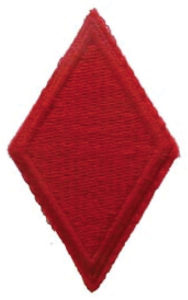
Roland Gaul is the founder and recently retired Director/Curator of Luxembourg’s National Museum of Military History in Diekirch on the River Sauer. He is a professional military historian and Battle of the Bulge guide and has written an expert battlefield study of the 5th ‘Red Diamond’ Infantry Division’s Sauer River Crossing which so impressed General Patton. So he was just the right person to explain it to me. Here is a summary of our discussion. If you visit the National Museum, you can see a dramatic recreation of the “Sauer River Crossing” in the form of a life-size diorama. (Note: A 5th ‘Red Diamond’ Infantry Division tour is being planned for 2018. See “Tours,” p. 13)
On December 16, 1944, three German armies invaded the Belgian and Luxembourg Ardennes and soon created a 70 mile westward ‘Bulge’ in the Allied front. The Battle of the Bulge had begun.
But Third Army Commander, General George Patton, had already anticipated the German attack and was able to react fast. On December 20, in a technically difficult and very daring maneuver, Gen Patton swung six Third Army divisions northwards from France to attack the southern shoulder of the German Bulge. He sent three divisions to liberate and secure Bastogne in Belgium from the German Fifth Panzer Army, and three divisions, one of which was 5th Inf Div, to contain and push back the German Seventh Army in Luxembourg. At that time, 5th Inf Div was on the French-German border in the middle of attacking Saarlautern in Saarland, about 50 miles southeast of Luxembourg. The 5th Inf Div immediately disengaged and within 24 hours was in Luxembourg.
After initial tactical successes and territorial gains in southeastern Luxembourg December 16-22, German Seventh Army units were stopped in their further advance by 5th “Red Diamond” Inf Div and 4th “Ivy Leaves” Inf Div, and had to retreat to the northern bank of the River Sauer (or Sûre), which flows eastwards through central Luxembourg. 5th Inf Div and 4th Inf Div then formed an unbroken line of defense along the southern bank of the Sauer. Its pleasant river valley among forested hills is a formidable natural barrier along which the German-American frontline and southern shoulder of the Bulge was stabilized in late December 1944. Winter 1944-45 was the coldest in 100 years, and the temperature dropped to minus 15 degrees Celsius (minus 5 Fahrenheit) during the day, and even to minus 22 Celsius (minus 7.6 Fahrenheit) at night. There was thick snow everywhere.
But once Bastogne (Belgium) had been liberated and secured, it was time for Third Army to break through the southern shoulder of the Bulge in Luxembourg. Since the 5th Inf Div was considered the expert river crossing unit, it was tasked with crossing the River Sauer, recapturing towns in the river valley such as Diekirch and Bettendorf, retaking the heights on the northern side and cutting the Germans off from reaching the Our River (the Our is a tributary of the Sauer) and thus the safety of the Siegfried Line and Germany.
The Sauer River crossing was a nighttime action by 5th Inf Div’s three infantry regiments, 2nd, 10th and 11th, jumping off at 0300 on January 18, 1945, without any artillery preparation (not to take away the element of surprise). They were augmented with specialized battalions, namely, Engineers for bridging and ferrying, Field Artillery, Medics, Tanks and Tank Destroyers and Chemical Mortars. 2nd Regt’s crossing sector was Ingeldorf – Diekirch. 10th Regt’s crossing sector was Diekirch – Bettendorf. 11th Regt was held in reserve on two-hour call.
By nightfall on January 18, the 5th Inf Div’s bridgehead was 1.5 kms (about 1 mile) deep with a front of 6.5 kms (about 4 miles). Each regiment had successfully crossed all its battalions. The Germans had been caught by surprise. Despite enemy fire and the terrible winter weather with its snow and mud, the Engineers had been able to throw one treadway bridge, two Class 40 bridges, two assault boat bridges and two foot bridges across the river, enabling Sherman tanks and M-10 tank destroyers to cross the icy waters of the Sauer.
By January 28, all the assigned regimental objectives had been achieved. After a few days of much needed rest, 5th Inf Div changed sectors in early February to take part in Patton’s Third Army strike into Germany on an 8 km (about 5 miles) front northwest of Echternach, once again across the Sauer River, but this time its lower reaches, directly facing Germany. This was the beginning of the official “Rhineland Campaign” on February 7, 1945, and the invasion of Germany.
—Submitted by Patrick Hinchy, Military Historian and Tour Director
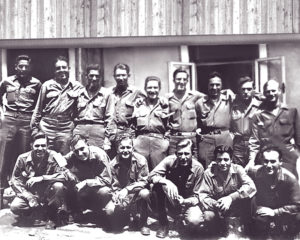
Front row, left to right: Albert Daigle, Herbert Scheinberg, John Warzasz, Edward Geisler, George Trabucco, Samuel Melnicoff. Back row, left to right: Milky (?), Martin Cohen, Angelo Nicolo, Frank Valiga, Daniel Chacchia, James Rullo, Henry Menard, Charles Touchette, Walter German.
They are medics of the 1st Battalion aid station of the 328th Infantry Regiment in the ETO at Bohmisch Rohren, Czechoslovakia, probably in 1945. The 328th regiment was part of the 26th Infantry Division (Yankee Division) that was part of Patton’s Third Army. My Dad, 1st Lt Robert T Marshall, and Staff Sgt Walter German, wrote a frontline account of their work from Normandy Beach through the Battle of the Bulge. I am publishing their story as a book, Healers and Heroes, scheduled for Fall 2017 release. I welcome contacts and/or information about any of these men. Contact: thea@thea-marshall.com or go to: www.facebook.com/HealersandHeroes/
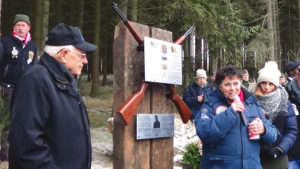
Colonel Doug Dillard (front left) on the walk of remembrance in the Ardennes, January 2017.
Family and friends of the 551st Parachute Infantry Battalion, attached to the 82d Airborne Division during the Battle of the Bulge, just completed its ‘walk of remembrance’ in the Ardennes. The purpose of the walk was to honor and remember the combat history of the Battalion. The Salm River chapter, C-47 club sponsored the event, a totally Belgian-sponsored event by the local citizens in the Ardennes, who know the history of the Battalion. While expecting about 80 participants, 180 people attended, making the event outstanding. Colonel Doug Dillard, the only 551st veteran present, was accompanied by family members and arrived in Belgium on 5 January and drove to the Ardennes from Brussels. On 6 January, the group visited Bastogne and the headquarters building that the 101st used during the siege of Bastogne. Colonel Dillard was honored by the placing of his photo on the wall with other veterans of the Bulge. On 7 January, the walk of the 100-plus participants started at the point from which the 551st began its part in the counterattack on 3 January 1945. The walk continued, as the weather changed to snowy, freezing temperatures much like it was in 1945. At each significant point along the attack route, Colonel Dillard explained to the participants what had actually happened, and answered many questions about the action. At the location where a monument stands to honor Company A for its bayonet charge, the mayor of Vielsam addressed the group to honor the sacrifice of the men of the 551st. Nearby is the residence of a City Councilwoman who lives in the same building that was the 551st Battalion Medical Aid Station, where Colonel Joerg died from his wounds. She provided a delightful lunch for the group. The walk continued down through the wooded area where a monument was dedicated to honor Richard Field of Company B, who passed away in November. Field’s daughter Ginni and granddaughter Rachel attended the event, and after the dedication of the monument, Ginni spread some ashes of her father over the field where his company had fought. On 8 January, the group visited a farm at Noirfontaine, where the 551st infiltrated the lines of the 1st and 9th SS Panzer division defenses, to conduct a reconnaissance in force to collect information needed for the forthcoming attack on January 1945. The infiltration began at midnight 27 December 1944. A German company commander was captured, about 100 soldiers killed, and a captured US half track destroyed. The battalion returned to friendly lines before dawn…mission accomplished! The 551st was awarded the Presidential Unit Citation for its actions in the Bulge, but it paid dearly from a starting force of 800 paratroopers to only 98 left on 7 January 1945 attacking the fortified village of Rochelinval. Airborne all the way…and then some!
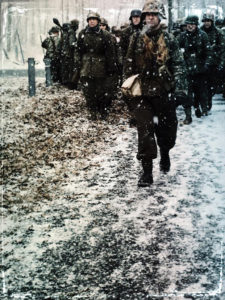
Battle of the Bulge reenactors at Fort Indiantown Gap, January 2017, taken with a vintage 1940’s era camera.
On January 26-29, 2017 elements of the WWII Historical Association (WWIIHA), dedicated to promoting, preserving and respecting the spirit and memory of the World War II soldier, met at Fort Indiantown Gap, a National Guard Training Center northeast of Harrisburg Pennsylvania, to recognize and recreate the service and sacrifice of both Allied and German soldiers who fought during the Battle of the Bulge. Reenactors from all over the east coast, mid-western states and even a few “Tommies” from the United Kingdom, gathered on a windy and cold weekend. Beginning on Thursday night, the troops stayed in WWII-era barracks—although modernized since the ’40s—and throughout the weekend, they operated in WWII vehicles, both German and American, and Jeeps, Half-tracks and a Sherman tank. Thankfully for the Allies, Tiger tanks were unavailable.
Chow halls hummed with activity to feed the troops, which numbered near 1000, and included U.S. Army, German and civilians dressed in uniforms or other clothing of that era. Armed Services Radio provided (FCC- approved) radio broadcasts consistent with the times. A USO called the “Drunken Monkey,” the GIs “home away from home” offered appropriate refreshments to all Allied soldiers, just as long as they had their approved passes! The MPs were on patrol.
For a fee, various vendors supplied troops with all types of equipment, clothing, and other sundries. To boost morale, “Classic Pin-up” girls stopped by to boost the sagging morale of those frontline troops returning for R&R. They were every bit as welcomed as Jane Russell, Rita Hayworth, and Betty Grable would have been in their day.
After breakfast and necessary equipment and vehicle checks on Friday morning, Allied units departed for the field at 0800. They received their safety briefing and either mounted assigned vehicles or where bused to the training area. Upon arrival, the troops disembarked, formed up according to their assigned command, and then stepped off into history.
Friday’s event consisted of small-scale troop movements and focused on securing three bridges by elements of the 82nd, including the 327th Glider Infantry Regiment and 101st Airborne, who were reinforced by the 28th and 106th Divisions. All three bridges changed sides several times that afternoon, with a final—and, of course countered—assault by German infantry, supported by light armor, resulting in the surrender or capture of the attacking units. The great movie directors John Ford and John Huston wouldn’t have had it any other way.
Saturday’s event involved all attendees, and fitting of January weather and of the conditions during the Bulge, snow began to fall. Many motorized units of the American defenders became lost due to the lack of road signage, and at one point ran into a German patrol: “Nuts!” Yet, due to the heavy snowfall, most units were able to escape. As the morning dragged on, the weather began to clear enough to allow the Allied forward observers to spot enemy armor and infantry in the open. A platoon of the 327th GIR, equipped with three mortar teams, were able to drop sufficient HE rounds, resulting (according to the ground empires) in a 500% casualty rate of the enemy, halting any more armor or infantry advances in their sector. Many more engagements continued throughout the day.
By 1430 hours, the event was declared over and both Allied and Axis troops began to assemble in the roadway for the long march out of the training area.
Thus concludes another successful “Battle of the Bulge” at the “Gap” re-enactment. Many participants remarked that this was the best event they’ve ever attended, and in the end, we achieved our objective to honor and remember those who served and sacrificed at the Battle of the Bulge.
—Submitted by Chris Hennen, Member; story by John Cronin and Joe Colombo; photo by Marc Herman
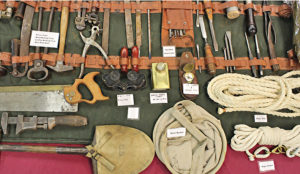
Some of the many military tools on display at the museum.
The mission of the Military Honor Park and Museum, located at the main entrance of the South Bend International Airport, is to recognize, acknowledge and pay tribute to all veterans, living and deceased, from each of the five military branches.
The Military Honor Park began as a dream of a few in 1995. A mounted RT-33 Lockheed trainer jet marked the visual beginning of the park. A “pentagon” design would be used, representing each branch of military service, with five bronze service plaques and flags. Also on display, a five-sided black granite monument. As the park grew, a collection of other military hardware was integrated. They would include: Mark 14/17 WWII submarine torpedo; single 3” anti-aircraft gun; twin 3” anti-aircraft gun; AM General 2 1/2 ton utility truck; M60 Patton tank; M42 “Duster” tank; 155MM Howitzer; Hummer “Humvee”; Tartar missile; UH-1 Huey helicopter; and two Talos missiles. There are also 3,500 bricks naming military personnel.
The Honor Park Museum is home to military artifacts representing the five military branches and all U.S. conflicts. Uniforms, weapons, and objects as small as buttons, to as large as motorized vehicles, are on display. The museum also houses a research library and video room.
The Park also includes a granite Veterans of the Battle of the Bulge Monument, dedicated in May 2011, with the financial assistance of late BOBA member Geza Csapo, 32 CAV RECON SQD.
For information, go to: honorpark.org, or call 574-232-4300.
I am a member of BOBA and a son of BOB veteran who was wounded there. I tried many times (without any luck), up until his death several years ago, to get him to share with me what he went through in the war.
My father was Roy M. Hershock, 8th Infantry Division, 13th Infantry Regiment, Company G, and all I know is that he was an foot soldier.
I would like anyone having information about my father, or his units’ combat experience in the Bulge, to please contact me. Sincerely, Bob Hershock
58 Quaker Hills Rd; Lancaster PA 17603; 717-871-9919; herke16@comcast.net
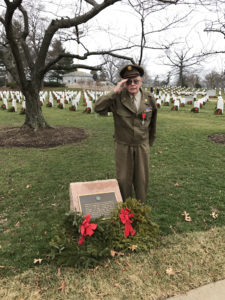
John A. Pildner, Sr. saluting at the memorial marker for the Veterans of the Battle of the Bulge at Arlington National Cemetery.
Submitted by John A. Pildner, Sr., 75th Infantry Division, 290th Regiment, Anti-Tank Company
John A. Pildner, Sr., a veteran of the United States Army who fought in the Battle of the Bulge, attended the Inauguration of President Donald J. Trump, Sr. He was accompanied on this trip to Washington D.C. by his son, John A. Pildner, Jr., a veteran of the United States Navy and daughter, Pamela J. St. Angelo.
The Pildners’ experience of attending a Presidential Inauguration Ceremony together was a rare opportunity to witness a piece of American history that occurs once every four years. There were many who helped make this trip happen: family members, friends, and even a stranger who was also present at the rally in Geneva.
This trip started when Pildner, Sr. and his daughter Pam attended a Trump rally at the Spire Institute located near Geneva, OH. A memorable moment here was when, at the conclusion of the campaign speech, Mr. Trump saluted Pildner, Sr., to which he offered a return salute.
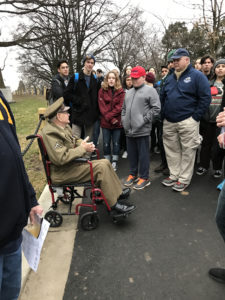
John A. Pildner, Sr. addresses a group of visitors at the memorial marker for the Veterans of the Battle of the Bulge.
The Pildners’ trip to Washington, D.C. was highlighted by a side trip to Arlington National Cemetery. They visited the Tomb of the Unknown Soldier, where the Pildners witnessed the changing of the guard. Here the Pildners were greeted by Marty McFarlin, a Tomb Guard who served in 1973 – 1974, and who emotionally thanked Pildner, Sr. and all of the WWII veterans who fought to preserve, protect, and defend the freedoms of many around the world.
Another highlight of this occasion was locating the burial spot of Dalton Raze, who was a platoon leader in the 290th Anti-Tank Company of the 75th Infantry Division. He rose through the ranks from a 2nd Lieutenant to a Full Colonel at the time of his retirement from the military. At one time during his military career, Raze had carried the codes for the U. S. President.
Pildner served in the mine platoon of the 290th Regiment Anti-Tank Company of the 75th Infantry Division. This was the same company in which Dalton D. Raze served during WWII.
This trip to the Presidential Inauguration of Donald J. Trump, Sr. was a great experience!