The first sign of something big that was on the menu began on December 19th at the
noon-day meal.
Our Colonel of the 39 Signal Company was looking for wire – one hundred miles by the reel.
We six truck drivers were called aside for a ride to the airport in Metz,a waste of time with no answers to the Colonel’s request.
Back at the barracks, a headquarters’ lieutenant had news of a German breakthrough in our defensive line.
From December 16th into the 23rd Nazi tanks and infantry had successful time.
The 106th and 28th Infantries felt the heat of this punch taking the brunt of a fall
A forty mile trek was the result of the German’s call.
We drivers were on the road again for a blackout ride to a depot for that wire,
Communications for the 20th Infantry Division were dependent mile reels for orders
given at Headquarters’ desire.
Sixteen miles per truck were secured before the slow drive back
A twenty mile drive without directions in the murky black.
Over coffee we heard our objective to stop the Germans was Bastogne, a city that had been reached that day,
Bastogne would become famous whenever the term “The Bulge” came into play.
After four hours sleep by eight AM, we started a seventy mile trek, mostly bumper to bumper for most of the way.
If Hitler had only known for forty road-clogged miles the U.S. 3rd Army was moving with General Patton, the top Command,
He’d show those S.O.B.s how this three division force would change the German’s battle plan.
It was stop and go through the towns of northern France with villagers showering us with schnapps, cookies and pie,
An early Christmas greeting before the snows descended upon us in the Ardennes from a darker sky.
On December 22nd the 26 Infantry Division met the German panzers near Grosbus, the southern flank’s first forces connection,
Then a steady pursuit through Eschdorf and over the Sur River toward Wiltz, the Division’s objective.
The Bulge by mid-January had made the Wiehrmacht into a crippled disaster in theEuropean west,
After five years of Nazi domination the Americans at the Bulge put their battle
superiority to rest.
The United States’ fighting forces stepped in the mantel of equality and justice for all
showed the world our way of life is still the best.
Jacob G. Zimmerer 39th Signal Company 26th Infantry Division
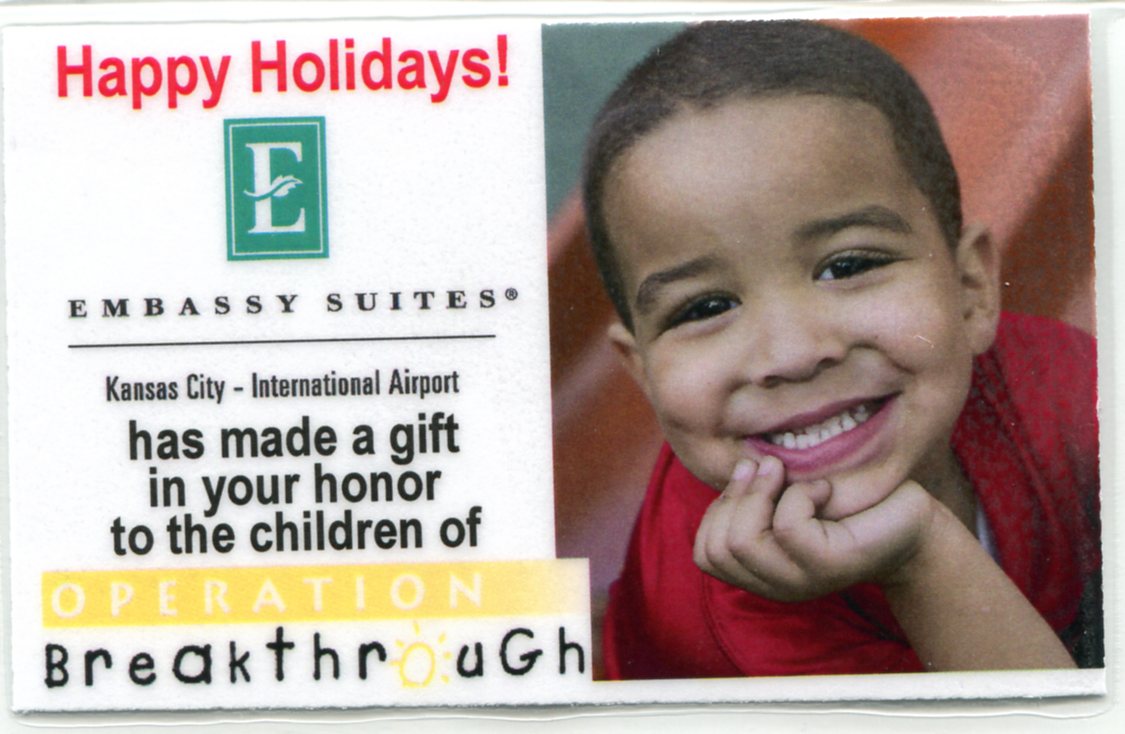
The Embassy Suites Hotel Kansas City-International Airport has made a donation in honor of VBOB to Operation Breakthrough , a social and service agency that serves 400 plus children from low income families.
This is the hotel where VBOB held their annual reunion in 2013.
VBOB gratefully acknowledges the donation made on their behalf.
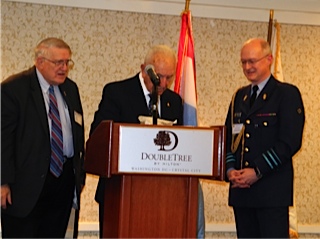
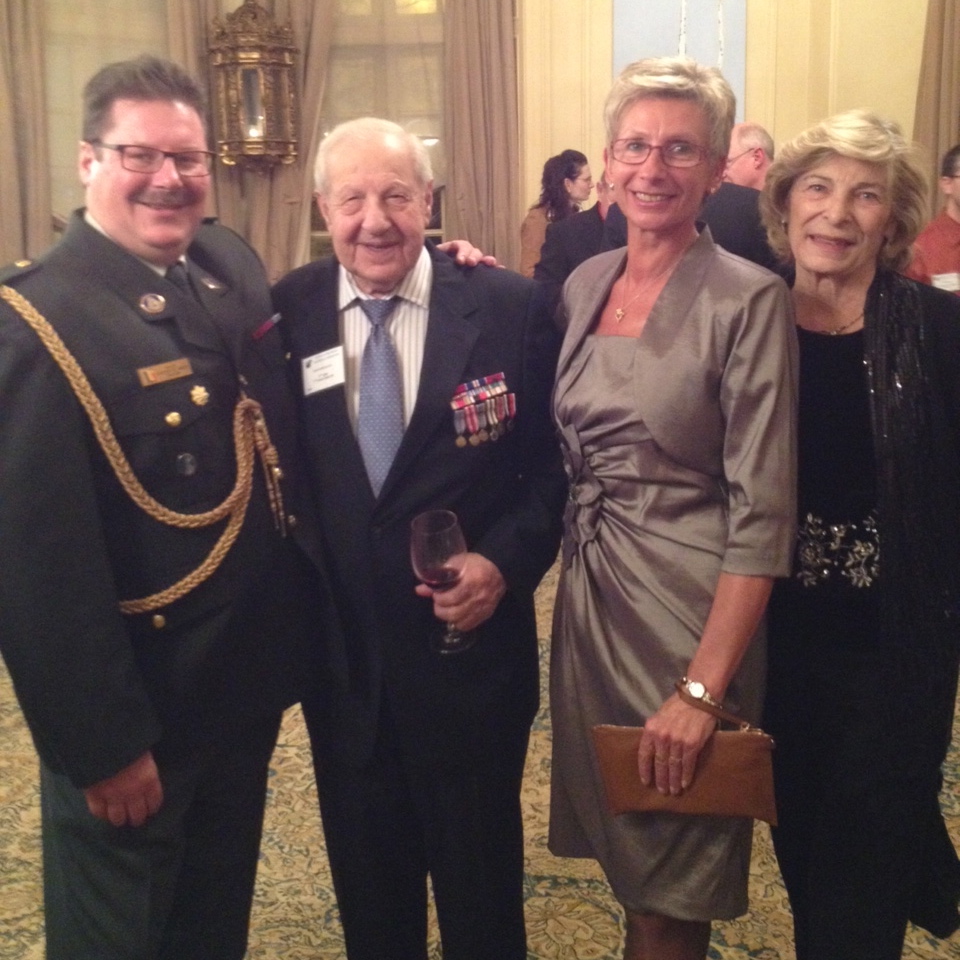
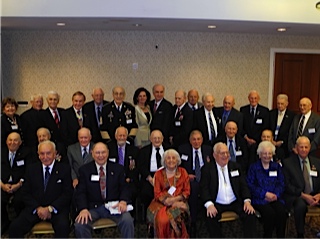
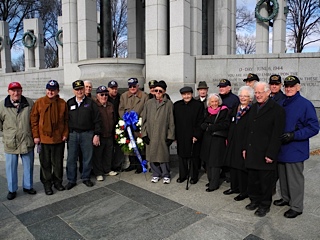
l-r John Bowen, Associate, Alfred Shehab, 38th Cavalry, Gen Mike Delobel, Belgium Embassyl-r Patrick De Smedt, Belgium Embassy, Dan Santagata, 5th ID Regina De Smedt, Adrienne Hopkins, Associate
I feel like a lucky bystander, being a target several times, but always missed. I thank God for bringing me home safely. The following are excerpts taken from my WWII Memoirs written in 2004 for the Veterans’ History Project at the Library of Congress, Washington DC. Operation. Nordwind was the last major German assault, roughly two weeks after Dec.16.
After Basic Training and a furlough at home in San Antonio, Texas, I was sent to Europe with 5,000 others on the Queen Mary, converted into a troopship, leaving New York on Columbus Day, 1944. After about one month in Replacement Depots in England and France, I was in the 44th Infantry Division Replacement Depot in an orchard near Luneville, in Alsace France. It rained much of every day, making the ground very muddy. My combat boots were always wet and my feet were swollen.
On November 19th at assembly an officer called for everyone having trouble with their feet to step forward. The eight of us who responded were assigned to KP duty in the 44th Division headquarters kitchen, in Luneville. This got us out of the mud and rain and our feet improved rapidly. Being on KP while preparing and serving Thanksgiving dinner had both advantages and disadvantages. Just before Thanksgiving the 44th Division liberated the city of Saarbourg. After serving Thanksgiving Day dinner, the headquarters, including the kitchen and KPs relocated to Saarbourg, on the Saar River, Nov. 24th. The kitchen, supply depot and post office were all located in the Saarburg Town Hall, where we slept on the floor.
One night the replacements with whom I would have been, if not on KP, were quartered in another building and were killed by a shell from long range German artillery. (I never complained about KP after that.) The KP detail were issued a new shoe type, shoe-packs, consisting of a rubber bottom shell which turned up to be sewn to the leather top, supposedly to keep our feet drier; they were at least two sizes too wide for my size 11AA feet, requiring me to wear both pairs of wool and cotton socks (all four pair I was issued) at the same time, in an attempt to fill up the shoes. This left me with no change of socks to dry out.
After two weeks on KP, Dec. 5, 1944, I left the 44th Division Headquarters kitchen by truck to be assigned to a rifle company. As we entered a small village Northeast of Saarbourg, a German fighter plane strafed the two-truck convoy I was in. We all bailed out of the trucks and headed for the shelter of the buildings. No one was hit, and the plane did not make a second pass. About 30 minutes later in the next town, Sarralbe, I was introduced to the 1st Platoon, Co. G., 2nd Battalion, 71st Infantry Regiment. I was replacing one of the two casualties, which they suffered in combat during the previous week. I spent that night with the rest of my squad, sleeping on the concrete floor of one of the houses in the small town. This would be as good as it got for the next month, except when we were lucky enough to sleep in a barn, on hay.
We marched from town to town, in a northeasterly direction, with the Germans retreating, offering only occasional resistance. One day we advanced toward a town about 1/2 mile ahead. Two P-47 Thunderbolts dived over the town and dropped bombs, probably on German tanks in the town. They flew around and started a strafing run, with the second plane close behind and to the right of the first. I commented “They’re too close together” and a couple of seconds later the first plane was hit, went up and to the right, into the path of the second plane. They both went down, killing both pilots. I didn’t know at the time that these would be the only deaths I saw in WWII, and I really couldn’t see the pilots at that distance.
Another regiment of the 44th Division was the first U.S. unit to reach, and send a patrol across the Rhine River when they and a French Division captured the Alsacian city of Strasbourg. The 44th Division commander wanted to cross the Rhine and advance north along the east bank of the river, cutting off the German army’s retreat. But our supply lines, already too long, would have been unable to keep up, leaving the 44th Division stranded behind enemy lines.
Our advance was turned toward the back side of the French Maginot Line, near the German border, at the Ensemble de Bitche. These pill-box forts protected each other with overlapping fire and were supported by military farms which had supplied food and dairy products. On Dec. 14th the Battalion made an afternoon Infantry assault on the masonry buildings of the Freudenberg military farm, defended by German snipers and mortars. We took all buildings of the farm, with no casualties that I knew of. The pill boxes of the Maginot Line, just a hundred yards or so beyond the farm buildings, were shelled repeatedly by our 105mm and 155mm artillery, only occasionally chipping off very small pieces of concrete. This artillery barrage continued for two days, supplemented by an air strike of fighters dropping 500 pound bombs, still only chipping small pieces off the concrete.
Early in the morning of Dec 17th our squad attacked the pillbox nearest to the farm, receiving machine gun fire from the left flank where I was assigned. The Kraut bullets were falling short, but kicking dirt onto my shoulders and helmet as I was lying flat on the ground. I couldn’t see the other pillbox because of a low ground fog. Two old German soldiers, about the age of my grandfather, surrendered the pillbox after a smoke bomb and a fragmentation grenade were dropped down the air vent. Our platoon sniper, with his Springfield bolt-action rifle & scope, climbed into the steel turret of the pill box and shot several Germans who attempted a counter-attack.
G Company went into reserve, and celebrated Christmas in Saarguemines, France, a city at the German border. The town had been liberated from the Germans, only during the previous week by the Third Army. We were quartered in homes with the French families. The family living in the two-story house my squad was assigned to spoke no English and none of us spoke any French or German. They weren’t too happy about our taking over their home. On Christmas Eve we started singing Christmas carols, beginning with “Silent Night”; but because that was a German carol the French family didn’t look too happy about it. But “O Come All Ye Faithful” became their “Adeste Fidelis” and they joined in, singing in Latin. Because I had taken Latin in high school and had learned Adeste Fidelis, I switched to the Latin words and the French family really beamed with joy, we were now mon ami !
A turkey dinner on Christmas Day was served from kitchen jeep-drawn trailers in the middle of the street, with the temperature in the 30s, with no sun. The watching civilians thought our white bread was cake. All parts of the meal went into our mess gear, the roast turkey, dressing, mashed potatoes, gravy, carrots, greens, with apple pie on top of it all. We enjoyed it anyway, since it was much better than the usual C rations. What little was discarded in garbage cans was sought after by the civilians who had little to eat. After eating Christmas dinner, that evening we moved back to the front.
Operation Nordwind:
After taking pillboxes of the Maginot Line, the mission of the 44th Infantry Division was changed from offensive to setting up new defensive positions about ten miles West. When the Battle of the Bulge started on December 16, 1944, many units of the Third Army were moved from the left flank of the Seventh Army to rush to Bastogne to stop the German advance. The Seventh Army spread out to the West to fill the vacancy left by the Third Army’s move. The Seventh was now occupying much of a two army front, with only two thirds the number of Divisions which had been there just a day before. Each division defended over a 15 mile wide front. A cold front brought bitter cold and snow to the Vosges Mountains in northern Alsace just after Christmas. The ground was frozen, under about a foot of snow, making it almost impossible to dig a foxhole with only our entrenching tools. It was well below freezing during the day and near zero during the nights, with a strong North wind.
The 2nd Battalion was spread thin along the border, across what should have been a regimental front, with almost everyone on the line, along a series of ridges overlooking the France-Germany border. Our intelligence warned us that a German attack in force was probable. Unlike the Huertgen Forest assault, where the Germans did not use radio communications when building up their forces, they did use radio when assembling units for Operation Nordwind and we were expecting the assault.
On the morning of Dec. 31st, from Brandenfingerhof Farm, 12 men of the First Platoon of Company G were sent as an outpost near Obergailbach near the border with Germany, on the battalion’s forward left flank, in existing fox holes about 100 feet apart along a thin hedgerow, with my hole on the open left flank; about 150 feet farther to the left was a reconnaissance jeep with a radio and 50 caliber air-cooled machine gun. We were probably at least 300 yards in front of the nearest U.S. forces. Each foxhole had 2 riflemen and a third with an automatic weapon, either a BAR or a submachine gun.
In the afternoon I was assigned to a 4-man patrol to see if the Germans had evacuated the town of Obergailbach, behind the ridge in front of us. The patrol found no German soldiers in the town, only civilians. Back in our foxhole we ate our dinner K rations, which included a can of beef & pork loaf with carrot and apple flakes, and a bar of dark chocolate. I shaved the chocolate bar into tiny flakes onto a piece of paper to make hot chocolate the next morning. It got dark about 1630 (4:30pm) and daylight around 7:00am.
About 2200 (10:00 PM) we could hear a train enter Obergailbach, behind the ridge in front of us. With the wind blowing from the North, the frigid air carried the sounds of German commands, whistles, etc. as they unloaded troops and marched up into the woods on the ridge about 300 yards in front of us.
After all units had reached the ridge, our artillery opened up on the woods with continuous fire for what seemed like about an hour, then, as the Germans advanced out of the woods, at about 2345, the artillery followed them with high explosive and white phosphorus shells which lit up the hillside, creating quite a fireworks display for a New Years Eve celebration! We could not see the enemy, who were dressed in white against the snow, but their use of tracer ammunition gave their positions away, bringing more U.S. artillery fire. Just as dawn was breaking the reconnaissance jeep fired several machine gun bursts and after a few quick words on their radio, they pulled back. We hadn’t seen anything to shoot at. There was frequent U.S. rifle, BAR and machine gun fire over 300 yards to our right-rear, coming from F Company’s area, but from our 3-man foxhole we saw no positive enemy target within range to shoot at with our BAR, grenade launcher and M-1 rifles, and none of the other members of the outpost had fired their weapons, even as daybreak illuminated the valley before us.
A couple of short bursts from a German machine pistol, or “burp-gun”, several 100 feet behind us, was our first indication the Germans had gotten behind our outpost. About that time Sergeant Gasperino ran up behind our hole yelling to follow him, the outpost had been pulled back over 15 minutes earlier, but the orders hadn’t been passed on to us in the last foxhole. I grabbed my M-1, with its grenade launcher, and grenades and took off, cussing because some @#$%&#$ German soldier was going to get my chocolate bar shavings which were left behind! As we ran in retreat through a wooded area we heard another burst from the machine pistol, but we were not hit, and we returned the thousand yards back to Brandenfingerhof Farm.
We later learned that, as part of “Operation Nordwind” a full regiment of the 17th SS Panzer Grenadier Division had attacked our Second Battalion front, attempting to reach Saarbourg and Nancy, the railhead about 50 miles to our rear. Over half of the Germans were killed or wounded by the artillery barrage before they even started the attack on that first night. Our artillery had just been issued proximity fused shells which, instead of hitting the ground before exploding and having little effect on prone soldiers, exploded at about 30 feet above the ground, spraying shrapnel down onto the prone soldiers. The U.S. 44th Division was attacked by the 17th SS Panzer Grenadier Division, 36th Volks Grenadier Division and 19th Volks Grenadier Division. New faster firing machine guns and semi-automatic assault rifles had been issued to the German units. Operation Nordwind, ordered by Hitler as a follow-up of their Heurtgen Forest breakthrough, involved about 15 German divisions against six U. S. divisions and one French division along a front extending along the French-German border from Saarguemines east to the Rhine River and south along the Rhine passed Strasbourg to near Colmar.
We moved to defensive positions, a secondary line of resistance, behind E and F Company and H Company, which caught the main force of the German attack, with E and F Company withdrawing and elements of H Company being surrounded. Other platoons of G Company had been moved up to help F Company during the night. With attacks and counterattacks, using tanks and other armored vehicles, by both sides, the battle moved back and forth during most of January 1st. U. S. machine guns, mortars and artillery killed and wounded several hundred Germans, with U.S. battalion losses less than two dozen killed or wounded.
We marched back to Moronville Farm. The First Platoon joined a force of at least 100 men of G Company, six 81mm mortars from H Company, with three Sherman tanks and three tank destroyers in support, defending the Moronville farm compound, consisting of two-story buildings continuous around a square, about 200 feet across, with gates on opposite sides. Many families lived here, with each living quarters next to their barn, with hay stored on the concrete second floor. F Company was driven back to the farm by repeated German attacks. The Germans attacked the farm after midnight, setting the hay in the buildings on fire with their tracers, 20mm cannon and mortars. The second floors of the whole community was on fire when we were ordered to pull out; my squad was assigned to accompany the last two tanks who covered the retreat. We were warned as we climbed aboard, not to touch the tanks with bare hands, only gloves, because our skin would freeze to the cold metal. We moved back to a new line of resistance about 800 yards south of Moronville Farm.
In the afternoon of Jan. 2nd, the First Platoon, with support from two tanks and a tank destroyer (with 90mm gun), retook a ridge overlooking the town of Gros Rederching, which the 44th Division had previously taken but was now occupied by the Germans. Several foxholes had been dug along the bare ridge; three German soldiers jumped out of one hole and ran down the other face of the ridge, with about 5 of the nearest GIs firing quickly at them but there were no hits. The other holes were empty. We spread across the top of the ridge, using available holes, but all I could find on the left flank was a shallow shell hole, not more than 8 inches deep in the center. An L-1 artillery spotter plane hovered overhead to direct artillery fire onto resistance from the town. Sporadic rifle fire came from the town, about 200 yards away in the valley. We were ordered to return the fire, without any specific targets. I fired three rounds at various windows, selected at random (the only shots I fired during the war). The Germans ran a rolling mortar barrage from one end of the ridge to the other and back again, with shells hitting about 50 feet apart. They got closer and the next one would be very close; I heard it coming in, but with an unusual fluttering sound. Instead of coming in straight it was spinning end over end. It landed within three feet of my head, kicking dirt and snow over me from the impact, but it did not explode! Every other shell in the barrage had exploded on impact with the ground.. When the barrage ended we pulled back off the ridge, apparently with no one injured. My feet hurt from blisters on my heels as we marched back to our line of resistance.
My squad spent that night in a snow covered clearing, in deep fox holes which had been dug by a supporting artillery unit; they and their guns had been pulled back to a safer location. The bottoms of the holes had been lined with empty brass 105mm shell casings, which offered a little protection from the icy bottom of the holes, that is until the ice broke, the shell casings sank and our shoes were 4 inches into the icy water. It was really hard to get to sleep standing up, with cold, wet feet I could hardly feel the blisters on my heels.
The next morning, Jan. 3rd, I complained to Sergeant Gasperino of the blisters on my heels where all four socks on each foot had worn through (the seam between the rubber bottom and the leather top of the shoepacks was in a bad location). He sent me to the aid station in Rimling, about a 1/4 mile walk. As they treated my blistered heels I asked where I could get more socks. The medic answered, “In the hospital; you have trench foot,” and put me on a stretcher and into an ambulance with another trench foot and two yellow jaundice cases. During this period the U. S. forces had more casualties from trench foot and yellow jaundice than from enemy action.
During the night of Jan. 3rd, F Co. was moving into Gros Rederching, then thought to be held by the French, when the Germans in the town opened fire. Before the Americans could withdraw several G.I.s were hit and were carried out, but in the confusion in the dark several Germans fell into line with the withdrawing Americans and were captured. The 71st Infantry Regiment and the 44th Division had stopped the units of Nordwind that hit us, but U.S. divisions to the east and along the Rhine River were pushed back from 10 to 20 miles. Three U.S. Divisions which had just arrived in Europe and had no battle experience were fighting back and forth almost continuously, inside towns [sometimes with U.S. troops and German troops occupying different parts of the same building overnight] and through woods and open fields, with infantry, tanks and artillery, suffering high casualties on both sides, for over three weeks before the Nordwind assault in their areas was finally defeated. Sometime years after the war the Nordwind offensive, and the Seventh Army resistance to it in Alsace was added to the Huertgen Forest (Battle of the Bulge) campaign star, to be added to the ETO/ North Africa Theater Medal ribbon.
I spent the next five weeks in the 21st General Hospital in Mirrecourt, France, recovering from trenchfoot, which is a breakdown of tissue cells from being cold and wet over a period of several days or more. Usually it can be prevented by daily drying and warming the feet and then putting on dry socks. Because my shoepacks were so oversize that I had to wear all four pair of socks there was no way to dry them out when I was wearing them, and during the last several days there was no opportunity to go without my shoepacks on my feet.. In the hospital I got warm, in addition to getting my first shower and haircut since leaving the United States, almost three months earlier.
by (Pfc) Harold L. Eiserloh, 1st Ptn, Co G, 71st Inf. Regt, 44th Inf. Div., 7th U.S. Army.
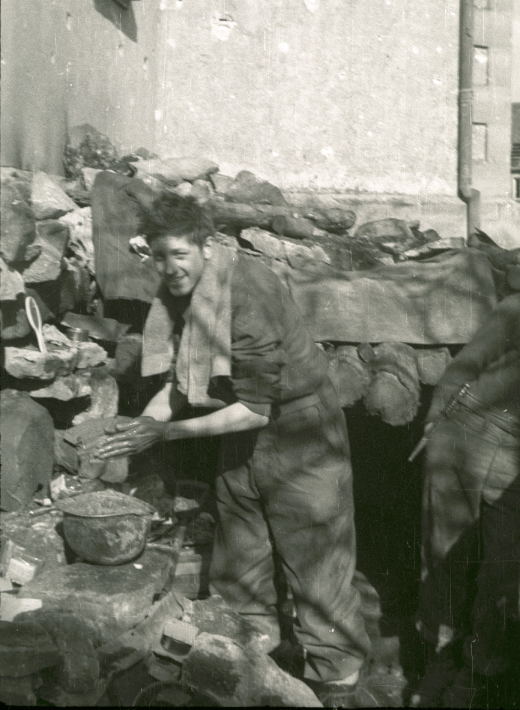
Pfc Eiserloh washing, back of Rimling church
Some books about the resistance of U. S. Seventh Army forces against Operation Nordwind in the Vosges Mountains of Alsace, France:
The Final Crisis-Combat in Northern Alsace, January 1945 by Richard Engler, 1999. The Aberjona Press, Bedford PA.
When the Odds Were Even – The Vosges Mountains Campaign, October 1944-January 1945 by Keith E. Bonn, 1994. Presidio Press, Navato CA
Ordeal in the Vosges by Donald C. Pence and Eugene J. Peterson(Out of print)
Happy New Year Yankee BastardsBy Vincent Priore, MSgt., F Co.,71st Inf. Rgt.,44th Inf.Div. (Out of print).
The information contained has been corrected and redrafted from the original to correct spelling, formatting, grammar and usage from the original whose creator is unknown to me. Therefore any information contained in this account may or may not be factual however it is believed by me to be true and accurate. Dec 20, 2013.
Officially we got our start as an army unit on May 1, 1943, at Camp Bowie, Texas. We, of course, mean the men of the 838th Ordnance Depot Company. By the first of June most of the men had assembled from their various induction stations. We found it rather hot in Texas, but we didn’t realize then just how hot it could get under a Texas sun. During the next thirteen weeks we did more sweating than ever done in our lives. Yes, we had thirteen weeks of Basic Training with all the trimmings.
By the middle of September we were hard at work operating a depot at Camp Bowie and servicing Third Army units. Two months later, November 13, 1943, we left Camp Bowie, Texas for the Louisiana Maneuver Area, now known as Fort Polk. The work that followed, the 838th company endured three months of cold, rain, mud, etc., while participating in maneuver problems. For one month after, training ended the 838th company operated a Base Depot at Camp Polk, Louisiana. By this time we were good overseas material and were placed on alert for movement on March 13, 1944.
On March 30, 1944, eleven months after activation, the organization departed from Camp Polk for Camp Kilmer, N.J. late in the evening of Easter Sunday, 1944, we boarded the ocean liner “Queen Mary” and the following morning we saw the last of the Statue ‘ of Liberty as we sailed out of the harbor into the Atlantic Ocean. The trip overseas was uneventful except for a little rough weather, then April 16 1944 early in the evening we dropped anchor in the Firth of Clyde, Scotland. The next morning we were deployed ashore at Greenock, Scotland, where we boarded a train bound for England.
Late that -night we arrived at Camp Northway, As-church Gloucestershire, England. While in England we were assigned to provide Services of Supply and worked at the U.S. General Depot G-25, Ordnance Supply Section. The work was hard and the hours long but now and then we got a day off and so were able to see some of England’s scenery.
On June 2, 1944, we were relieved from Services of Supply assignment and assigned to the Third United States Army although we did not leave G-25 and Northway behind us until July 19 when we went to Stanton, England. Once in Stanton, England the 838th et al began to prepare for movement to the Continent. Our convoy left Stanton, England on August 2, 1944 en route to the marshalling area two days later on August 4, 1944 all units embarked from Weymouth, England. August 5 1944 part of the organization arrived in France and the rest August 6, 1944.
We landed on Utah Beach and proceeded on to our first bivouac area near Bricquebec, France. We followed the fast movement of the Third Army across France and were on the jump most of the time until we moved into Nancy, France, where we stayed for nearly six weeks, leaving on November 15, 1944.
After several more moves in France, the combined units crossed the border into Belgium and ‘set up at Athus, Belgium Christmas Eve 1944. We all made many friends during our stay in Belgium; we were treated royally by the Belgian people.
However, January 19, 1945 found us on our way again, this time into Luxembourg. We made several moves through this small Duchy, “a village ruled by a Duke or Duchess” and on March 14, 1945, we entered Germany. Our first stop in conquered territory was at the City of Trier, Germany.
The 838th et al, moved on across Germany, crossing the Rhine on March 28, and finally bivouacking near the village of Cham-rôles, on April 29, 1945. It was while there that we received the official news that the European War had ended, and we began to dream wildly of coming home.
On May 24, 1945 we moved into German barracks at deggendorf, Germany, apparently to operate a depot there. Our stay here did not last long, however, because early in June 1945 we were again alerted for movement somewhere-whether home or the Pacific we did not know. Finally we received the great news that we were on our way home for a thirty day furlough.
Finally on June 1945 we left Germany by train, arriving at Camp Twenty Grand in France on June 20, 1945. While we there the 838th company went through the necessary processing for shipment stateside. It was a great feeling to handle good U. S. money instead of the foreign “wallpaper” we had been using for so long.
On June 27, 1945 the 838th et al organization boarded trucks and was transported to Le Havre where the Liberty Ship “Trist ram Dalton” is moored waiting our arrival. We sailed that day from Le Havre and spent many days looking at nothing but water. On July 9, 1945 we saw the good old U. S. A.
So, after fifteen months away from our native land we again set foot on its soil on July 10, 1945, and were taken to Camp Shanks, N. Y. Our processing there included a fine steak dinner with all the trimmings and we all did it justice. Our furlough papers were most welcome but the most welcome news of all was the end of the Pacific War which came while we were on furlough. Twenty-one months after leaving Camp Bowie, Texas, we again assembled there to await further orders.
The 838th Ordnance Depot Company was officially Deactivated at Camp Bowie Texas, October 19, 1945.
Submitted by Ronald J. Regan, Associate, in Memory of George W. Schemanske, 838th Ordnance Depot Co) Deceased 11 Nov 2013 95 YOA.
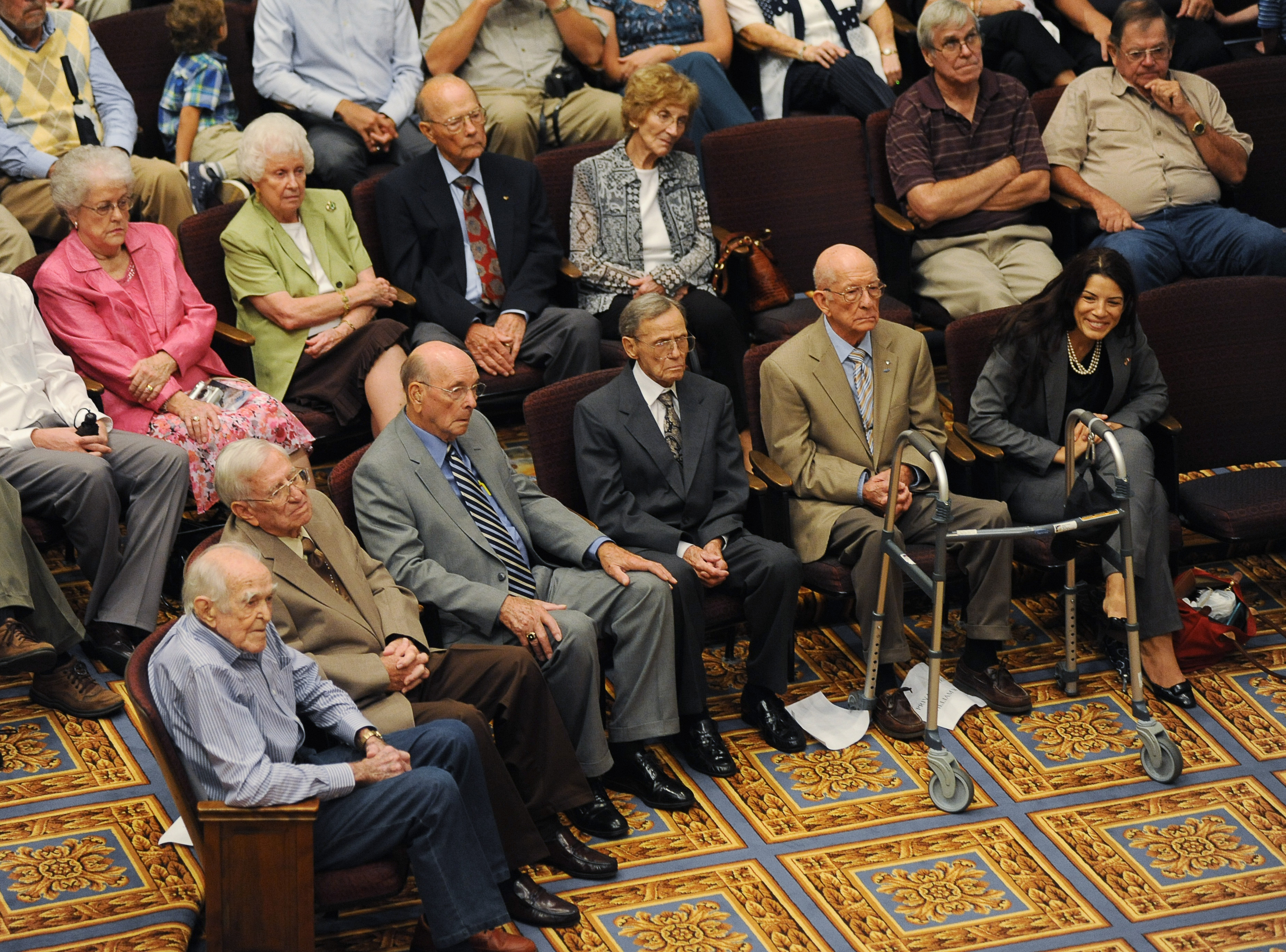
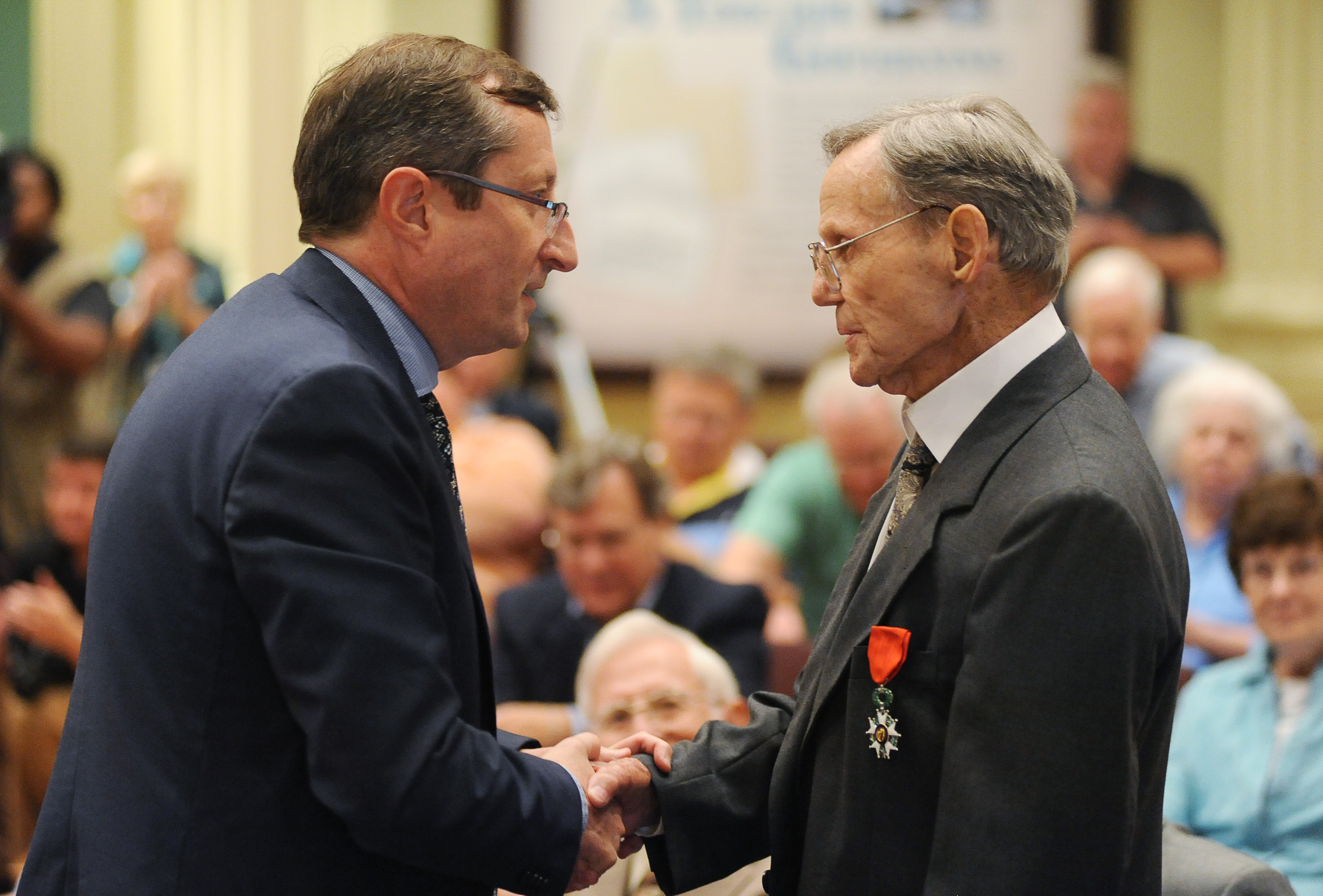
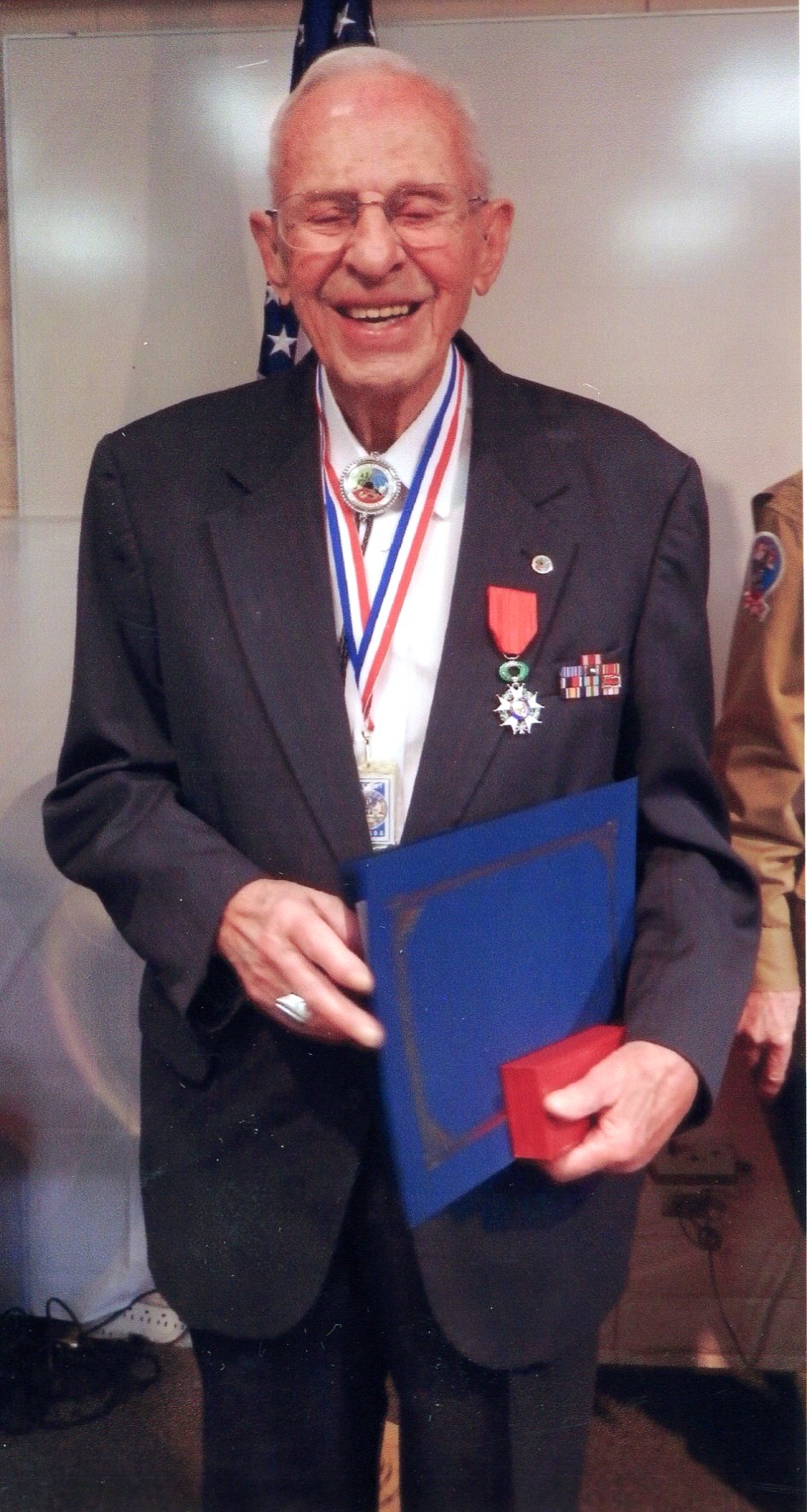
Legion of Honor ceremony, Atlanta, GA September 24, 2013
Thomas Creekmore, front row, fourth from left seated
You entered into active service in September 1943 and you were a part of the C-Company of the 315th Regiment in the 79th Infantry Division.
You were sent on April 7, 1944 to the European Theater Operations. You fought and aided in the liberation of the French towns in Avranches, Cherbourg, Fougeres, Laval, Le Mans, Saint-Armand, Joinville, and Luneville in Lorraine.
For your active participation in these combats, you were awarded the Bronze Star Medal along with the Good Conduct Medal and the World War II Victory Medal.
As a witness to the sacrifice of American combatants during the liberation of Europe, you were, at the end of the war, the only surviving member of C-Company to have landed in Normandy on June 12th, 1944.
Sergeant Thomas H. Creekmore, au nom du President de la Republique francaise, nous vous remettons les insignes de Chevalier de l’Ordre National de la Legion d’Honneur.
Thomas Creekmore presented the Legion of Honor by Denis Barbet, consul general of France in Atlanta, GA
A couple years ago members of the chapter decided to tell their stories, which would appear in a book entitled “The Battle in Common” and be available to the public. A “Book Team” was formed whose purpose was to spearhead the project. Stories were submitted by 19 veterans and four associate members.
Update on the book sales and distribution.
After being published last fall, nearly all “The Battle in Common” copies have been sold. As of this date we have approximately 60 books remaining. ISBN 978-0-9885762-0-9. Books were distributed free to the sponsors and to veterans associated with the project.All other copies of the book were purchased by the public, sold by three Rochester book stores and the book team. The book has generated more than $5000 in sales and donations for VBOB National.
Proposed next steps for the project.
The limited number of books remaining brought the question of a second printing. After much consideration, the Book Team decided to forego a second printing in favor of converting the book to an electronic format (“e-book”) at no cost.
This decision provides two benefits:
There are no production costs, allowing all sales income to go to VBOB National,
The book would be available on all electronic systems ( all computers as well as tablet readers like Kindle, iPad and Nook) for perpetuity.
The conversion of the book content to the new format will be provided pro bono by Michael Riordan, professor of printing at Rochester Institute of Technology who helped with the initial book. Distribution of the electronic books would best be serviced by Amazon, Barnes & Noble and other retailers who sell e-books. To fully enable the book team’s decision, National VBOB has endorsed this plan and will work with the Book Team (specifically RIT Prof. Michael Riordan) to set up distribution agreements with distributors such as Amazon, etc. The agreements would be with each vendor, to provide that revenues go to a VBOB Book Account.
The Rochester Book Team will disband after the program is in place.
Tom Hope (for The Book Team)
XIX Corps, Headquarters
Kudos to the chapter members and others for an outstanding job, one that will help to perpetuate the legacy of all who served in the Battle of the Bulge.
I have been writing to a young Belgian man, Jan Jasper, who lives in Essen, Belgium, up near the coast of Antwerp. He is interested in hearing from veterans of the Bulge. He is an aficionado of the Bulge veterans—very sincere!
He is married with 2 young boys ages 2 and 5. He drove from Antwerp all the way to Liege, Belgium to meet me at the “Remember Museum” 2 years ago.
He would like to hear from veterans who served in the Bulge—He does NOT sell your stories—He is very sincere!
His address is:
Jan Jasper
Hofstraat 7
2910 Essen
Belgium
Many Thanks,
John McAuliffe
87 INFD
Central Mass. Chapter VBOB
There is an incident that I should have brought to your attention before. On March 21, 2011, a memorial service was held here in Buckfield, ME for my husband, Earl F. Turner, who passed away on March 14, 2011. Edward Deverell, as president of VBOB Tri-State (VT-NH-ME) Chapter 17, made the trip all the way across part of NH and ME to attend.
There is not an East-West direct highway, so it is a time-consuming journey! —And I did not realize that another VBOB member had informed Chapter 17 of Earl’s demise. I was grateful for Ed’s presence, and I do believe it was “beyond the call of duty.”
And to make it more interesting, as Ed was about to head homeward, an unexpected snow started falling. —So over two years later, my thanks still go out to Edward Deverell.
Sincerely,
Florence C. Turner, Associate
PS. Believe that Edward Deverell is an associate member and that his father was a BOB vet.
My name is Brittany Polson and I am a Wish Coordinator at Wish of a Lifetime. We are a 501 c3 nonprofit that is dedicated to enriching the lives of deserving senior citizens by granting them their wish of a lifetime. I am currently working on a wish for Robert A. Smith, whom fought in the Battle of the Bulge with the 11th Armored Division, Battery B, 492nd Armored Field Artillery Battalion. Robert has requested that since his fellow comrades are not able to travel and hold a reunion in person, that he would like to commemorate his division and the Battle of the Bulge.
I have arranged for there to be a ceremony held at the Indianapolis War Memorial on December 16, 2013 at 1:00 PM- which will mark the date of when the battle began. Spread the word about this commemoration so we can honor all of the brave men and women who served in this battle.
Best Wishes,
Brittany Polson
Wish Coordinator, Wish of a Lifetime
1821 Blake Street, 200
Denver, CO 80202
[office] 303.954.9144 x14
[fax] 303.648.5626 brittany@seniorwish.org
College Bound, Sept 1943-March 1944
by Sheldon Tauben, 75th ID, 289th IR, 2nd Bn HQ
A precursor to the post war “G.I. Bill/’ that remarkable and exemplary legislation that enabled veterans to obtain low-cost home mortgages and gave thousands the opportunity to secure a free college education, the US Army, in the summer of 1943, began a new educational endeavor, “The Army Specialized Training Program.” With its distinctive shoulder patch, a gold oil lamp of knowledge on a blue background, this special unit directed thousands of soldiers fresh from basic infantry training including air force cadets washed out of flight school and other services, to collection depots for testing and eventual assignment to colleges and universities throughout the United States.
The Citadel, a military school in South Carolina renown for its officer training and tracing a proud heritage back to the early 1800’s, was the major depot in the Eastern United States. All of the soldiers selected for this assignment had one thing in common- an “AGCT” score of 130 or higher. Upon entering the service each person underwent an extensive written examination with the final score prominently entered on his manila service file. The “Army General Classification Test” was an I.Q. exam used to direct personnel into jobs (MOS) or military occupation specialty that would be most appropriate for his on her level of intellectual ability. I had just completed 15 weeks of basic training at Seymour Johnson Field (Air Force) in Goldsboro, NC when I received orders to report to the administration center at the Citadel for further assignment.
After a week or so of inactivity (we did some sight-seeing in Charleston, SC) everyone received new orders directing them to any of the dozens of educational institutions within the program. By luck of the draw I was assigned to the Polytechnic Institute of Brooklyn, a renowned school of engineering located in the heart of downtown Brooklyn. A few days later I arrived in Brooklyn just in time to begin the fall term in September Of 1943. We were housed in the Fort Green housing project, a brand new Federal low cost development and were the first tenants. Bunker beds, desks, chairs and bookcases were provided-two men to a room. If not for the G.I. uniforms, it appeared much like a typical college dormitory. But the comparison ended just there. This was a military unit and run by the book.
6:00 a.m. reveille followed by formation in ranks by battalion in the courtyard, roll call and then dismissal for breakfast. 7:00 a.m. we formed up again by battalion and marched off in a sprightly military manner, each “student” carrying an over-the-shoulder mussette bag-books! Our route took us from the project down Schermerhorn Street and then to 99 Livingston where we lined up in the street in front of Polytechnic some 25 minutes later. Initially, it was a novelty to early morning Brooklynites and we were observed closely. Who doesn’t love a parade?
Formations broke up as we headed to our assigned classrooms for lectures in the usual freshman engineering curriculum plus some liberal arts courses in English, History and Geography. At 12 noon the entire unit again fell into ranks and marched back to the project for lunch. By 2 p.m. we were back at school ending the day with a 5:30 formation and return to our quarters for dinner. All meals were cafeteria-style served and eaten quickly, and no K.P. The basement of one of the buildings was converted into a cafeteria and served about 300 men at a time. After dinner we were expected to study the work assigned. AS I remember there was time for playing cards and craps. As long as we kept reasonably in order we were not bothered by “management.”
School continued for 5 days per week with weekends off on a pass unless some infraction of the rule caused the privilege to be withdrawn. These were pleasant weekends spent mainly with family as we lived in Jamaica about 1 hour away by train. On some weekends we attended local entertainment conducted by the American Red Cross. No hard liquor but lots of Coke and donuts. The girls that joined us were a motley crew from the local neighborhood, which in those days, close to the Brooklyn Navy Yard, was not exactly Park Ave.
One bright spot was the Commish’s Inn on Myrtle Avenue a few blocks away. It was run by my Uncle Irving, the black sheep of my father’s family, who had operated a speakeasy in Broad Channel during prohibition. Family legend had it that he used a black Cadillac hearse to run booze down from Montreal-passing through customs easily-who wants to bother a stiff I Uncle Irving was always good for a beer and pretzels and I saw him often at the time. I was never at a loss for company as 3 or 4 of my buddies also liked free beer. He kept a live monkey in a cage and had one of the first TV sets in NYC-about a 4″ screen in a 6ft high cabinet. Weekly fights and wrestling occupied a few hours at night. Uncle Irving was my father’s youngest brother. He had no children and took a liking to me, buying me my first baseball glove and a “Daisy” air rifle when I was 10 or 11. The odd name of his bar traced back to prohibition days when many of the NYC commissioners were his friends and customers. “Popularly known as “Brooklyn Poly” the name was changed in 1985 to Polytechnic University relocated form 99 Livingston St. to 333 Jay St. and now upgraded to “#6 Metrotech Center.” I still prefer the old names and address-you knew it was not in the Bronx and it favored important persons in American history!
College Bound Part 2
Going to classes 5 days a week for 7-8 hours a day was a difficult regimen|j but it took us through about two years of college “hours” between Sept 43 and March 44. After the war I was able to transfer some of the credits to a BA degree at Adelphi College (class of 49). I really wasn’t interested in engineering but managed to “hang on” while the program lasted. One of my buddies was Ralph Bono. He hailed from the Bronx and introduced us to the pleasures of pizza. Near the Commish’s Inn was a storefront, family-run “pizza parlor,” as they were generally known. Great deep dish, strictly cheese pizza-no fancy toppings but a taste to remember.
George Harris was another Gl from New Harmony, Indiana, deep at the southern end of the state. If it were difficult to locate a spot where the south and the north blended it is likely/ffafc New Harmony would fit the bill. Founded in the early 19th century as an English Utopian Commune, it soon dropped its pretensions and “grew up” as a small southern rural town. George’s family lived in an “honest to goodness” log cabin- outdoor toilets-no central heat and a kitchen pump added only as a recognition of modernity- not 100 yards from the Wabash River.
As fate sometimes dictates, I got to know George’s family well. His mom, Effie, sister, brother-in-law and niece welcomed me months later when I was stationed in Camp Breckenridge, KY with the 75th Inf Div. George had a disability form a poorly set broken elbow which left him on limited duty. He spent the war at desk jobs and while in New York visited my family on the same weekends that I spent in New Harmony with his. That spring and early summer of 1944 hold memories of southern fried chicken, mashed potatoes, iced tea and watermelon served on a wood plank table in the Harris’ front yard. They welcomed me warmly as George’s friend even though they may have wondered privately, what a nice Jewish boy like me was doing in a place like this!
Back to School!
Our Geography professor was a Dr. Fraim who had taught, before the war, at the University of Rangoon in Burma (now “Myannar”). When the troops learned this esoteric fact they recognized Dr. Fraim’s unique background with a monstrous battalion-sized shout of “RAN GOON” each morning as formations in front of Polytechnic broke up for classes. I think we all received “A’s” in Geography. The course work ran through Chemistry, Physics, Mathematics, blueprint drawing etc using text books usually written by the professor. Polytechnic was home to some of the top men in their fields. I never had the nerve to ask but I wondered what they thought of education by the numbers. Eight hours each day-5 days a week!
Through the winter of 1943-1944 we continued the daily grind. However, in mid-March our idyllic military careers came to a screeching halt. While it was all well and good to keep the colleges and universities functioning and give deserving Gl’s a shot at college studies, the manpower needs of the army came first. An infantry troop build-up was in the works and the ASTP was shut down except for some very limited programs in medicine and dentistry. We didn’t know it then but plans for the June 6,1944 D-Day landings in Normandy were well on their way.
Within a few days we were loaded into railroad cars (no Pullmans) and on our way South to Louisiana. Most of our group wound up in 75th Inf Div, then training at Camp Polk where we were assigned to various units. I drew the 2nd Bn HQ Co 289th Inf regiment and remained with them through the extensive training at Camp Polk, then Camp Breckenridge, KY. We departed for Europe in Sept 1944 and wound up in the Battle of the Bulge in Dec 1944. But that’s another story.
One small incident remains in my memory of our days at Brooklyn Polytechnic. During one of our daily “parades” through downtown Brooklyn, on a cold and clear morning we marched in strict military formation passing by a corner drug store. It had 3 steps leading up to the entrance. An older woman, bundled up, stood till, waving her handkerchief to us and called out “hurry back boys/’ She mistakenly thought we were headed to Bush Terminal, a nearby troop embarkation facility. A smart-ass PFC in the front ranks turned to her and replied so all could hear “It’s ok, lady, we’ll be back right after lunch!”
I hope you are doing well and that everything is well over there. I will introduce myself, my name is Patrick from Luxembourg, I am 28 years old and I am very interested in WWII since I was a young boy. My grandfather was also in WWII, he was forced by the Germans into war but he died very early and I had never the chance to hear his war stories, so I started collecting stories of the still living Veterans before it is too late. I have also a small collection of WWII items of US and German soldiers, that I started since I was a young boy. I found an article of you on Internet and I wanted to know more about you, so I decided to write you a letter.
The last few years I had the chance to be in contact with a few Veterans of WWII and I have many stories collected through email or snail mail. I am very interested in your WWII experiences and hope that you will share your story with me. I wanted to know with which Company and Regiment you fought with? I wanted to know where exactly you fought (France, Luxembourg, Bulge, Germany?), what missions did you had, which medals that you earned and what your “job” was during WWII? I am very curious if you have fought here in the Battle of the Bulge in Luxembourg. Did you took part in the crossing of the “Sauer River” in Diekirch in January 1945? I know that it is not easy to speak or write about WWII experiences because there are surely more bad memories than good ones, war is always cruel and I hope that a war like that will not repeat itself again that is why your experiences are so important for the generation like mine and the younger people. We have to preserve the freedom and liberty that you gave us back almost 70 years ago.
I also started since 2 years to collect recent pictures and WWII pictures with a signature of the Veterans in front of them who I met in Normandy, Luxembourg and Bastogne and I would be happy if you could also be a part of my “memory wall” at home. I wanted to know if you could send me some WWII and some recent photos of you through email, I wanted to know if I could print them out with your permission and send them with another letter to you for getting signed in front of them by you with your rank first then name and Unit in order to frame them. Do you think we could manage that, it would mean a lot To me? I will frame the photos and put WWII photos at left and recent photos at right, in the middle I will print the Red Diamond patch with your name and underneath a summary of your WWII story so you will get a place of honor in my home and I would be honored if you could be a part of it. In my next letter I will also include a coupon that you can give to the post office so you haven’t to pay for the shipping costs for sending the photos signed back! I didn’t put one in this letter now because I am not sure if the letter reaches the right person.
Unfortunately I never had the chance to meet you in Europe, have you been back since the end of the war? Do you plan perhaps to come over again in the future? I am also in good contact with Frank Forcinella and Don Hemphill of the 5th Division perhaps you know one of him? Is there any annual Reunion of the 5th Division in the USA?
If you have perhaps written your experiences down somewhere, I would be very interested in them. If you have some other stuff to add, please feel free to do it. If you know other buddies of yours of WWII who want to share their story to with me you can give them my email address and mailing address, I would be happy to get in contact with more Veterans before it is too late to collect their stories. I am looking forward to your returning letter Sir.
♦
Thank you very much your service, your help and time.
Best wishes from Luxembourg
Patrick Dax
11, rue Jules Wilhelm
L-2728 Luxembourg
Luxembourg
Email: golf2_power@yahoo.fr
TECHNICAL SERGEANT EARL R. LISTON- U.S. ARMY CORPORAL GEORGE W. MCGEE. – U.S. ARMY PRIVATE FIRST CLASS MARSHALL W. BAIRD, U.S. ARMY PRIVA TE FIRST CLASS HARPER COLEMAN, U.S. ARMY PRIVATE FIRST CLASS ROBERT KIRBY, U.S. ARMY PRIVATE FIRST CLASS ROBERT WALLING, U.S. ARMY PRIVATE FIRST CLASS MAXWELL WARNER, U.S. ARMY
Program and photos submitted by George McGee, President Southern Arizona Chapter (53)
I tell my kids that WWII veterans saved the world. Your Nov 2013 newsletter shows a new member Robert Pidcoe from the 1st infantry division. Would you publish and/or please forward him this correspondence.
My grandfather was PFC George Tammara 1st division, 26th regimental combat team. He wore the Big Red One. He was a replacement rifleman and went through rifleman training in Florida from July 1944—Oct 1944.
I have done significant research on George Tammara and his unit, The Blue Spaders in WWII. George Tammara was killed in March of 1945 after fighting in the Northern Shoulder of the Battle of the Bulge and crossing at the Remagen bridgehead. I worked hard to get all of his medals awarded posthumously and have compiled much information regarding his WWII service.
I am looking to find anyone who knew George Tammara during WWII. I would very much like to speak with and/or meet anyone who knew my grandfather. More information on George is found at www.WWIIHERO.COM
Thank you to all the WWII veterans for saving the world.