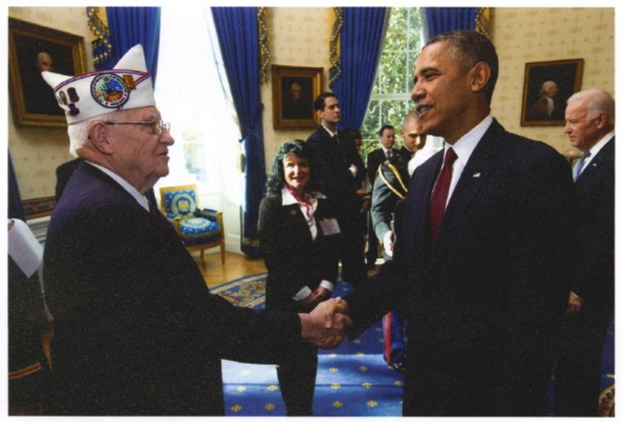
US President meets VBOB President
In 2010, both houses of Congress voted unanimously for a national “Spirit of ’45 Day” to honor the legacy of the men and women of the WWII generation. Spirit of ’45 Day is now being observed each year in hundreds of communities and during Major League Baseball games on the second Sunday in August.
On February 6, 2014 a “Spirit of ’45 Day” event took place in the 30th Street Railroad station in Philadelphia PA. The purpose of the event was to:
Four members of VBOB were present, they were:
During the proceedings Kevin took pictures, interviewed the veterans and video-taped the event. People stopped to talk with the veterans, one young mother brought her three young children over to meet the veterans and had their picture taken. At the conclusion of the proceedings the veterans presented a wreath and saluted while a bugler played taps. The VBOB logo was mounted on an 18”x18” poster board and displayed on an easel. The WWII veterans were impressed and grateful.
[wppa type=”album” album=”$Spirit of 45 Day” size=”680″][/wppa]
People from the following organizations were present;
The logo and easel were given to Warren Hegg, a driving force behind “Spirit of ’45 Day”, to be used at various events across the country. During March the logo will be in San Antonio, TX for an event.

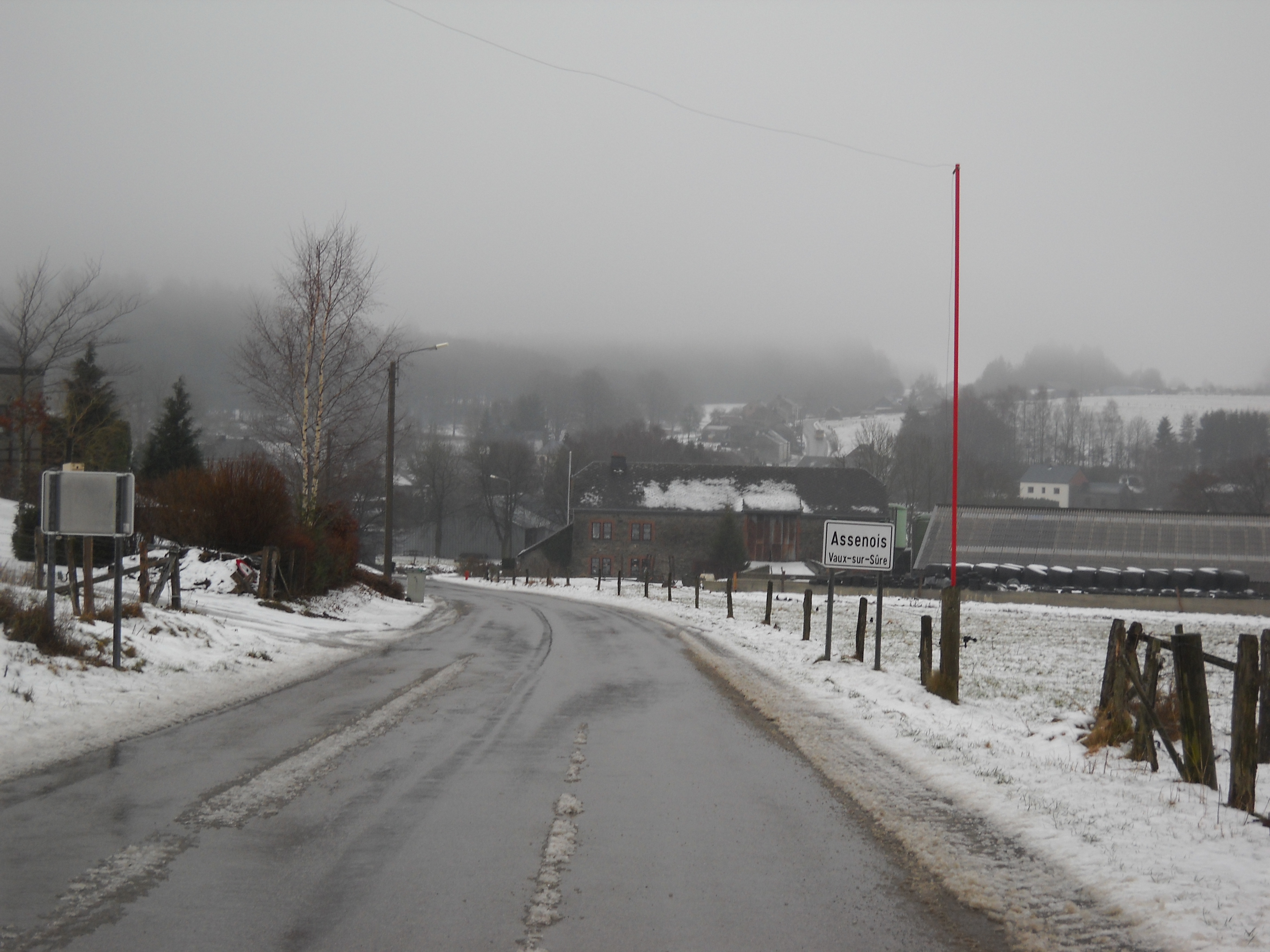
For the citizens of Assenois, the arrival of the German forces was the worst Christmas present imaginable. Assenois had little appreciable military value. It did not sit atop high ground, nor was it a highway hub like its neighbor to the north, the town of Bastogne. Its location was astride a road that linked Bastogne with the town of Remichampagne, which was south of Assenois. Other than that, it was meaningless.
One of the matriarchs of Assenois remembered those dark days. Her name was Madame Denyse de Coune, and she owned a chateau along the northern outskirts of town. With several arched gables and thick stone walls, the great house looked more like a quaint castle. Since it was a large building, it had a several cellars, and as a result, when the fighting drew closer to Assenois, many area families sought refuge under its stone walls. The shelling had started on Wednesday evening, the 20th of December, and for the next twenty-four hours, the battle see-sawed back and forth, but by the morning of the 22nd, the Germans were in control of Assenois and had pushed westward. For all the fighting, the cost was to the town was minor: only one civilian lay dead.
On the 23rd, a German feldwebel (sergeant) from Vienna had approached the matriarch and asked her if they could set up an office within the chateau. Thirty minutes later, he and his staff section were gone, but another unit replaced them. As it turned out, the staff of the 39th Fusilier Regiment also wanted a comfortable locale for their headquarters. With its dense walls and subterranean vaults, the German volksgrenadiers had decided that it was a great spot to command and control their regiment. Oberstleutnant Walter Kaufmann, the commander of the 39th Fusilier Regiment, and a Oberleutnant Specht, the commander of its 1st Battalion, agreed, and they moved in once the phone lines and radio transmitters were active.
Unbeknownst to the Madame de Coune, the 39th Fusiliers were part of a much larger operation. For several days, the 39th, together with the rest of its division, the 26th Volksgrenadier, had been locked in combat with the 101st Airborne Division, trapped inside Bastogne. The Germans needed to capture the town to dissipate the traffic jams, which were clogging up their supply lines. So far, the 101st successfully had resisted every German attempt to seize the vital road net. More important, the Germans were running out of time because Lieutenant General George S. Patton’s Third Army was pushing its way north towards Bastogne. In fact, Assenois was one of the towns that were between Patton and Bastogne.
By the 24th, the Germans were everywhere inside the chateau, as if they had been living there for years. Even worse, the growing presence of German vehicles and troops outside the house made it a tempting target for the American P-47 Thunderbolts, flying above them like birds of prey. As evidence, one group of fighter-bombers strafed the building on Christmas Eve day, but thankfully, the sturdy walls were too much for the bullets, which bounced harmlessly off them like rain drops. Walls, though, would be useless against bombs.
That night, while everyone in the Christian world celebrated Christmas Eve, the German soldiers stole some of the chickens from the de Coune farm for their own Christmas feast. Another landser (German term for soldier), out of kindness, brought American biscuits to feed the hungry children. No doubt, the soldier had found them, since the German soldiers had little food from their own supply chain. To keep up morale, the refugees then sang Christmas carols to each other while the parents regaled their children with stories of the Comtesse de Segur, who was a Russian born, French novelist.
The following Christmas morning started out well. Mrs. Augustus de Coune baked some bread and served it with roasted chicken. As the morning dragged on, more and more refugees arrived, and they were not the only ones seeking shelter. By midday, more German soldiers showed up, demanding sanctuary from the American bombs and artillery. Hearing this, Madame Denyse de Coune shook her head in dismay because she knew the corridors were overcrowded. Someone had to go, and the German soldiers ejected her and the rest of the civilians.
Like Babylonian exiles, they grabbed whatever they could carry. Most only brought a blanket and some bread, and they left for nearby sand dunes, which had been a hideout for the resistance during the long German occupation. When they arrived, they discovered that the shelters were gone. For the next thirty hours, the refugees would be homeless. At least, thought Madame de Coune, the frozen pine trees looked like Christmas trees. That night, they slept under the stars like the shepherds outside of Bethlehem. Nearby, the Germans had set up an artillery battery, and it was firing at the American forces in Bastogne. The paratroopers replied with their own counter battery, and the rounds from the American artillery fell dangerously close to the refugees.
Meanwhile, the tankers and infantrymen of Combat Command Reserve of the 4th Armored Division prepared themselves for combat. They had been fighting almost non-stop since the 22nd of December, and now they were closing in on the prize – the town of Bastogne. While Madame de Coune and the other banished families huddled in the freezing cold, Lieutenant Colonel Creighton W. Abrams, the commander of the 37th Tank Battalion, was leading a combined-arms task force. Several hours earlier, Abrams’ men had captured the town of Remoiville, which was three kilometers south of Assenois.
The following morning, the 26th of December, Abrams began the final drive into Bastogne. First, they overran a German panzergrenadier company in Remichampagne. By noon, Abrams’ forces were just to the south of Clochimont. Only the town of Assenois was between his tankers and the beleaguered paratroopers in Bastogne. Alas, most of the inhabitants of the small village were recent arrivals from the 39th Fusilier Regiment, ensuring that the ride through Assenois would be fraught with danger.
Outside of the town, Madame de Coune watched the beginning of Abrams’ historic assault. In preparation for the final push, P-47 Thunderbolts swept over the town, plastering it with napalm while showering the German defenders with lead from their eight, blazing .50 caliber machine guns. Explosions rocked the forest where the refugees were hiding, causing the trees to tremble and shed their snowy blankets.
After the Thunderbolts, the twenty-six exiles next watched a procession of C-47 transport planes pass over them. Then, like manna from heaven, hundreds of parachutes began to appear, as aircraft crews delivered supplies to the surrounded paratroopers. Luckily for the families, which included seventeen children, many of the para-packs were stuffed with biscuits, cheese, and best of all, chocolate. For the hungry refugees, the food lifted their morale.
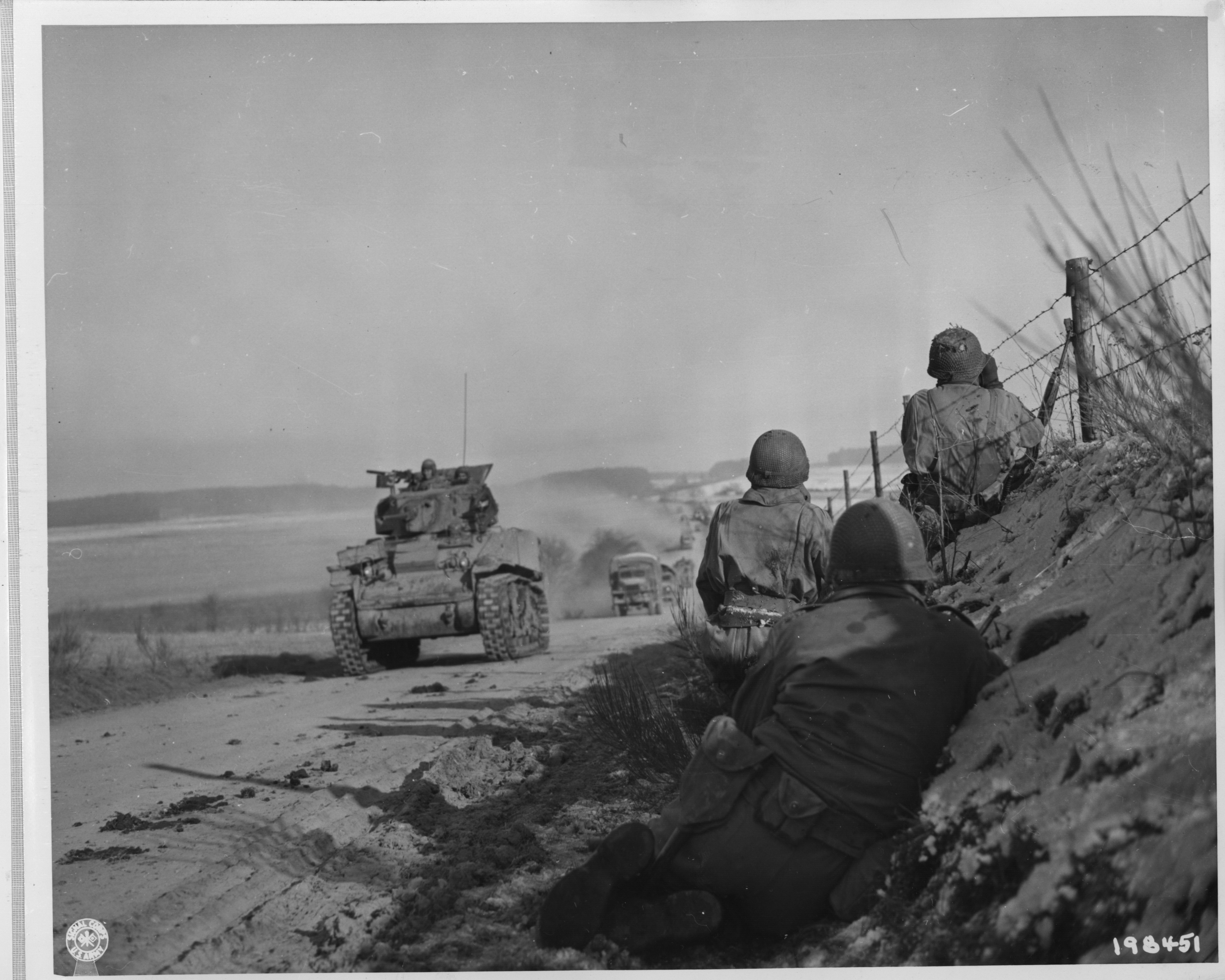
The feast did not last long. Towards the end of the afternoon, Madame de Coune watched as a column of American tanks and halftracks lined up south of Assenois. Then, with guns blazing, the column snaked its way through the narrow village streets and broke through to the other side. She described the vehicles as “spitting fire.” Next, she saw the American forces push the German defenders eastward and into her neighbors’ homes. Now, it was the Americans’ turn to surround the Germans. Some fought, but most of them eventually surrendered.
By early evening, Madame de Coune reckoned the fighting was over, and she led the exiled families back into Assenois where they discovered that her home had not escaped the fighting unscathed. Four artillery shells had penetrated the roof, leaving gaping holes for the rain and snow, and the same shells shattered many of the windows. Despite this hardship, the families of Assenois were once again free. The tankers and infantrymen of the 4th Armored Division had liberated them.
submitted by by Leo Barron, Associate
Please find enclosed an official letter from the Benoît LUTGEN, Mayor of Bastogne, to invite veterans to Bastogne this year.
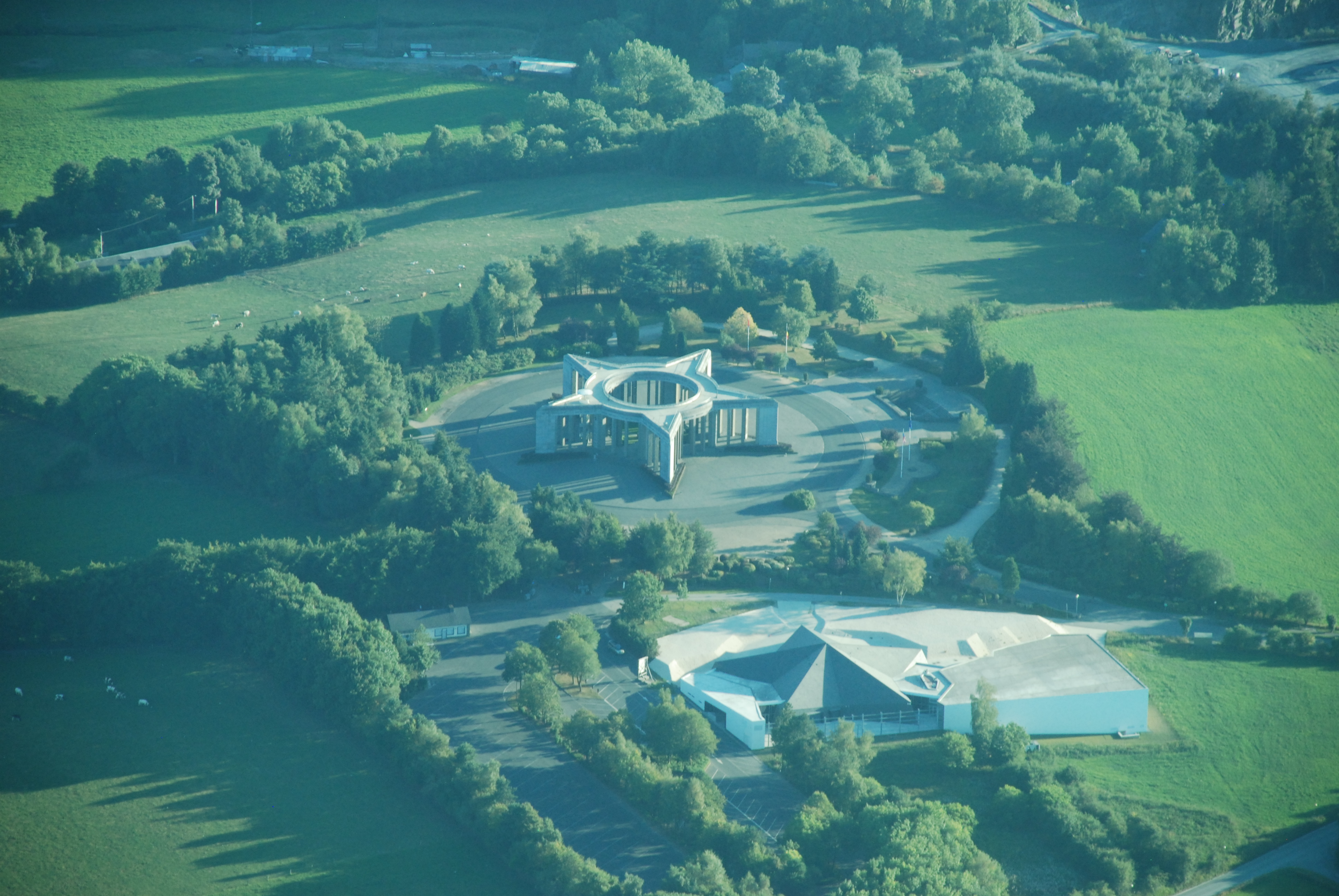
Indeed, as you may know, in March 2014 Bastogne will boast a new memorial site with an international scope dedicated to the Second World War: the Bastogne War Museum. Located on the site of the Mardasson Memorial (see picture), at the heart of a new and innovative architectural structure, the Bastogne War Museum will open to public in Bastogne on March 22 after 4 years of work.
You know perfectly well the story of the American soldiers who spent the terrible winter of 1944-1945 on the front lines in Europe. The Battle of the Bulge, which took place in Bastogne, is an important part of our History. The amount of American soldiers who died or were injured during the battle was higher than ever and the people of Bastogne will always be thankful to the ones who fought for their freedom.
Nowadays, the historical ties that bind the town of Bastogne and the American people are still very strong. People often tell that Bastogne is the most American city in Europe and we are very proud of that reputation. More than 60,000 American people come to visit Bastogne every year, which is a huge amount of people for a 15,000-inhabitant city
If you have any questions please contact:
Coralie BONNET
Chief of Staff
City of Bastogne
Rue du Vivier 58
B-6600 Bastogne
Phone : +32 61 240 913
Cell : +32 498 055 707
e-mail bourgmestre@bastogne.be
I am a young Belgian member of the CRIBA interested in the history of the Battle of the Bulge. My girlfriend and me took part in the annual reunion of the Veterans of the Battle of the Bulge Association in Kansas City last September. I would like to thank the veterans again for their warm reception. It was really a great experience for me to meet so many veterans of the Battle of the Bulge. After that, I reported it to the CRIBA’s members during our November’s reunion. Our trip in the US was wonderful!
We have been back in Belgium since September 10 now. I have found a new job in the new Bastogne War Museum few days ago. I am glad of it because it is a job that is connected to my passion (the history of the Battle of the Bulge). I also wish to remind all veterans and their families are more welcome in Belgium whenever you wish. Please find enclosed the presentation brochure of the new Bastogne War Museum.
I hope it is not too late to wish you a happy new year and all the best for 2014!
Yours sincerely,
Mathieu Billa
Republic of Korea Korean War Service Medal
U.S. veterans of the Korean War are eligible to receive the Republic of Korea Korean War Service Medal. Criteria for award of the Republic of Korea Korean War Service Medal (ROK KWSM) has been established by the ROK government. To qualify for the medal, the veteran must have:
Served between the outbreak of hostilities, June 25, 1950, and the date the armistice was signed, July 27, 1953
Been on permanent assignment or on temporary duty for 30 consecutive days or 60 non-consecutive days
Performed his / her duty within the territorial limits of Korea, in the waters immediately adjacent thereto or in aerial flight over Korea participating in actual combat operations or in support of combat operations
To obtain the medal, those who meet the criteria above must complete the application and provide their respective military branch of service a copy of their discharge paper, commonly known as a “DD-214,” or a corrected version of that document, a “DD-215.”
The addresses of where to send the documents are listed on the application. National Guard members must provide their statement of service equivalent, “NGB Form 22.”
Please only send copies of these documents. Do not send original documents.
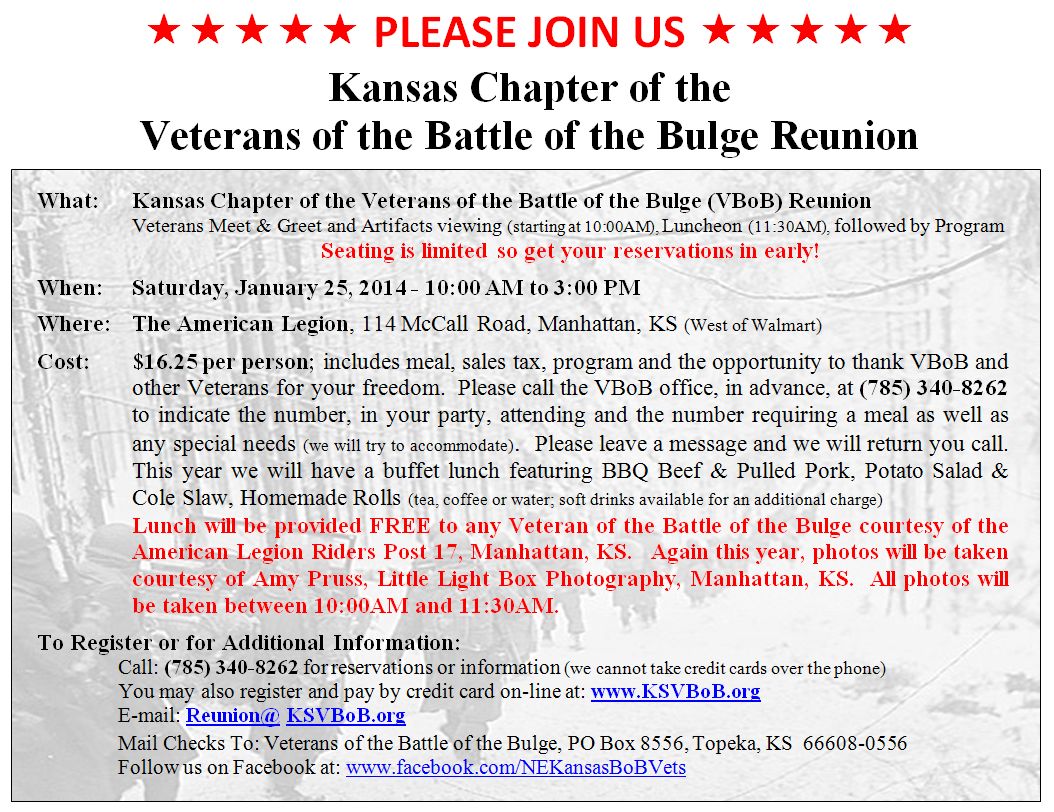
While serving with the 4th InfD, 12th Rgt, 2nd BN, Co F, Wayne Brown had many close calls. Wounded several times, including once with shrapnel, Wayne like many wondered why he survived when others did not, until a fellow Bulge Veteran suggested another path.
A nighttime reconnaissance patrol in the extreme freezing conditions of the Ardennes leads Tom Chambers to a sudden sense of euphoria. He later discovers it was the onset of hypothermia. Tom served with the 9th AmdD Trains Headquarters Co, RECON Platoon
Douglas Harvey Pvt. Antitank Platoon, 1st Battalion, Headquarters Company, 334th Regiment, 84th Infantry Division
December 20, 1944
We had just ended our first month of combat in and around Prummern, Beeck, Leiffarth, and Wurm. These are villages in the Siegfried line North of Aachen, Germany where our casualty numbers nearly exceeded the initial number of men in the Battalion. As we got ready to leave, December 20, 1944, it turned out to the Bulge; we thought our unit was going to a rest area to reorganize the Battalion. Our convoy traveled for two days stopping for at least two night’s rest. I remember spending a night in a large chateau, sleeping in what appeared to be the upper floor under the roof. The windows in the room were of the so-called dormer type. The large room was unfinished with the roof rafters showing. On returning to Belgium many years later I tried to locate the building but failed. We also slept on a concrete floor in what appeared to be a school. Our truck traveled most of the time with the headlights on. This made us feel that we were many miles from any action. It also somewhat supported the rumor of going to a rest area. We had little information at the squad level. The road signs and village names indicated Belgium or perhaps Luxembourg. We did not know that the German Army was charging toward us. At the end of our two-day drive we stopped in the small Belgian village of Bourdon. There were rumors that Germans had been seen along our route. This I doubt as the route we traveled was North and West of the German advances. On the way to Belgium we passed through Pallenberg, Alsdorf, Aachen, Verviers, Durbury, and then stopped in Bourdon. At the time I never heard anything about Germans posing as GIs in rear areas. Most history books cover this to a great extent. There are claims that it caused much trouble. Actually there were almost no Germans in GI uniforms; it was mostly rumor. Even the German paratroop attack was a failure. The closest German troops to our route were those in Hotton, probably 3 miles away. When we arrived in Bourdon we, at least I, had no idea of why we were there or what was happening.
Bourdon in the Belgian Ardennes seemed remote, safe, and distant from all the living hell we had left a few days before. As usual, there were more rumors than facts. We billeted in a barn and collected rumors. Depending on which were true the German Army was in the next town or miles away. I don’t remember hearing gunfire but I was a very sound sleeper and could have been sleeping through any. In fact the German Panzers were approaching Verdenne just over the hill south of Bourdon.
The afternoon of December 24th, Bob Davies and I were ordered to make up a daisy chain. We used eight mines from the stock carried on our Dodge 6 by 6 truck. A commandeered Belgian rope was used to connect the mines together. Our squad leader led us to a position before the first switch back in the road leading up a hill toward woods to the southeast. Later I found the forest up the hill between the villages of Bourdon, Verdenne, and Marenne was the location of the 116 Panzer infiltration. Our roadblock was only a short distance from the comfortable barn hayloft billet where we spent the previous night. Orders were if attacked; let the first two tanks go by and pull the mines in front of the third tank. Our position was in the open with no possibility of cover. The hillside was totally bare, not even a small bush. This was truly a mission impossible. There were no ditches or structures within 150 yards. Any enemy tank coming down the road would see us immediately on turning the upper switch back a short distance away. It was possible they would have been so startled by our pluck or stupidity that they would have backed off thinking it was a trap of some kind.
Approximately a half-hour before dark a Divisional M8 Greyhound armored reconnaissance vehicle appeared from the direction of Bourdon. An officer was waist high out of the turret hatch. The vehicle went around the first switch back and on up the hill. An M8 Greyhound is a six-rubber tired armored vehicle with a 37-mm gun turret. We wondered where it was going and why. Any way we had no information to give the officer had he asked. It did not even slow down as it passed us and disappeared around the switch back. Within a minute the vehicle came back around the upper switchback and down the hill with the throttle wide open. No one was in sight and when it reached our position. The vehicle stopped sliding all six tires. A small part of the officer’s head appeared in the turret hatch shouting, “there are ten German tanks coming down the road, hold at all costs”. Gears clashed and the engine roared as the vehicle disappeared down the road into Bourdon.
I learned later that the Germans were using captured M8 vehicles to lead some attack columns. This possibility never entered our minds when we saw the vehicle coming past us. We only had a vague idea of which way the Germans might come from. At the time I felt Bourdon was south of Verdenne. I had been given no map or compass; as privates our only responsibility was to take orders and follow the leader. After the report and order from the Cavalry Lieutenant there was no doubt about the direction to the Germans. I have determined since then that we were in the exact center of enemy’s main attack. Orders to the 116 Panzers were to cut the Marché-Hotton Road that was to the north of our position. In fact this road could be easily seen from our elevated position. With heavily defended Marché on one end and Hotton on the other Verdenne and Bourdon were the logical points to attempt a breakthrough.
I have attempted to find an origin for the phrase “hold at all costs”. I could not find any authority that traced the history of the statement. It was used in the American Civil War and in the First World War. I feel that almost all Officers that gave this order immediately left the area in the direction away from the enemy. It is positively un-American to accept a suicide mission. Suicide missions generally involve religion. Persons volunteering for these missions feel they will get some reward in an afterlife. Not wanting to disgrace their family or let the Emperor down was the motivation for the Kamikaze pilots in the Pacific. I had already shown that I was not a coward, but none of the factors leading to a voluntary suicide mission applied to me. I was not going to hold at all costs if my life was the currency. Considering our position the only cost to the Germans would be a few machinegun cartridges.
After the M8 armored vehicle passed I quickly scouted the area for some cover. Digging a foxhole in the possibly frozen and hard ground in the time that seemed available was out of the question. The nearest good cover was down the hill in a railroad track siding. There was a railroad car weighing scale pit. Our rope was too short to reach the pit so we just stood by the side of the road and hoped for the best. If we pulled the rope ahead of the first tank I think we would have had at least a 5% chance of one of us making the railroad pit. If we waited for any tanks to pass the first one would have used its machinegun on us. It was so quiet that we felt the reconnaissance officer may have just been seeing things. We stayed on this position until well after dark but heard no tank engines and no tanks appeared. I knew from my experience in Leiffarth, Germany that tanks could not approach undetected as the noise of the engine and the flop-flop of the treads can be heard from some distance. The road on the hillside had two switchbacks after it came out of the woods. We easily heard the recon-vehicle as it approached the switchback up the hill above us.
The tanks were there, as I discovered many years later, in the area now known as the Verdenne Pocket. It is also reported in Heinz Gunther Guderian’s book, “From Normandy to the Ruhr With the 116th Panzer Division World War II” that their orders were to cut the Hotton-Marché road, which was down the hill and across the railroad track from our position. Our two-man roadblock was the only defensive position in the way of this objective. Since that time I have pondered reasons why an attack was not made down the hill. The most probable is the German Commander Johannes Bayer did not want to sacrifice his men to a lost cause. Fuel and other supplies were also a problem for the somewhat cutoff group. I learned later that they had broken through our thinly manned foxhole line between Marché and Hotton to occupy the woods. Also the 116 Panzer Division had driven our troops out of Verdenne. A rifleman from one of our units described this attack to me. Our heavy 30 caliber water-cooled machine guns were able to each fire only one round. Water in the cooling jackets had frozen so the mechanism could not function. The rifleman escaped down the back yards of a street in Verdenne with a enemy tank following him. He vaulted over the back yard fences, which the tank was easily knocking down behind him.
We reported the incident of the recon-vehicle to our squad leader and as usual, he did nothing. I will probably never know if whoever was directing our movements in this area received a report from the officer in reconnaissance vehicle. However, the action of Company K 333 indicated they didn’t know. As usual, the so-called fog of war was very thick. I also do not know whether any one was on our position when Company K 333 took this road up the hill thinking it was the way to Verdenne. A platoon from company K was assigned the task of recapturing Verdenne. I feel sure that our antitank squad members would have told them about the reported enemy tanks up the road. When the Platoon from Company K came on the German tanks in the woods they thought they were their support tanks to aid them in retaking Verdenne. When one of them rapped on the side of a tank to let them know that they were ready to advance on Verdenne the answer was “Vas ist los”. The excursion of K 333 past our position is covered in the Leinbaugh/Campbell Book. “The Men Of Company K”. See pages134-144
In the fight with the German tanks and their supporting infantry several of the men from K 333 were wounded. However, most of them got back down the hill. Of course the tanks that the reconnaissance officer told us about at least six hours before were the ones found by K 333. Why there was not better transfer of information was probably due to military protocol. The reconnaissance officer was from some attached cavalry unit. He would have reported to his unit commander who would report of someone in division headquarters who might possibly pass it down. Davies and I reported it to our squad leader; we had no other possibility or responsibility.
We left the position when relieved by two others from our platoon around ten. We told them about the reported tanks. I feel they must have left the position, as they would have reported the possibility of German tanks up the hill. We were relieved around two hours before K 333 men passed. The first time I learned of the Company K 333 venture up the hill was when reading Leinbaugh’s book over 50 years after the event.
After a little sleep that night, we were awakened around midnight to prepare for the recapture of Verdenne. We did find the correct road and entered around 0200 December 25 1944. This road went up the hill with the woods on the left that was the location of the pocket (referred to in Guderian’s book as the hedgehog).
Guderian also reported that General Hasso Eccard von Manteuffel, head of the Fifth Panzer Army, was in Grimbiemont two miles to the southeast on December 24, 1944. He was there to order an attack on the Marche Hotton Road. This attack if made would have of course gone through our roadblock.
Draper reported in his book “The 84 Infantry Division in the Battle of Germany”, that the retaking of Verdenne started at 0100 25 December 1944.
“As soon as the German position was sized up a second attack was launched at 0100 25 December.” (Draper wrongly considered the aborted excursion up the hill by K 333 as the first attack on Verdenne. They were more than a mile away.) Draper goes on: “This time by the 333rd’s Company L and the 334th’s Company K, the later down to approximately 40 men. It was now, Christmas morning. Our attack began with a heavy artillery and mortar barrage.
While shelling was still going strong, Company L entered. The first two platoons to go in were temporarily outnumbered and were engaged from three sides. One enemy tank began to move in close. A rifleman S/Sgt. Edward T Reineke, took careful aim, chose the tank commander as his target, and killed him. The tank stopped, Reineke ran toward it, jumped, dropped a grenade into the turret, and finished the job himself. This one-man victory turned the tide. The two platoons swept through the town and dug in on the opposite side while the rest moved to mop up. It was dark and many Germans were left. Another tank showed up and terrorized the town until daylight.”
When we arrived in Verdenne less than an hour after the start of the attack we saw the tank that Reineke had attacked. From the location of the dead Commander we felt he was probably standing on top when hit. It may have been getting ready to move or just standing there waiting for something to happen. Reineke single-handed killed the crew and put this tank out of action. Many have gotten a Congressional Medal of Honor for less. Reineke did get a Silver Star for his aggressive action. At least two Germans were dead inside the tank. One was in the turret and the other in the machine gunners seat. The engine was off. I feel they were getting into the tank and were surprised by the attack. This tank was later started and driven down toward the pocket by a GI with the intention of firing the turret gun at the German positions in the woods (the Verdenne pocket). This never happened and later the tank was disabled by blowing off the end of the turret gun with an explosive. Chuck Car of our platoon climbed in the tank and removed the radio and used it for listing to radio broadcasts from the US armed services network. Later when listening to this liberated radio he was the first in our unit to hear of President Roosevelt’s death. This same tank is pictured in publications covering the 1944 battle in and around Verdenne. the Book was published as part of the 50-year commemoration held in and around Verdenne.
I still don’t know what our mission was during the attack on Verdenne. We were an antitank unit, but were not called on to fight the tank that Draper’s book indicated was terrorizing the town that early a.m. of Christmas day. As usual the rifle platoon leader was not told of our presence. I felt at the time that the German Troops did not expect any action on Christmas and were possibly partying. A lot of prisoners were taken during the 25th and we helped in searching and guarding them. By midday our trucks brought up our 57-mm antitank guns and the trucks were used to transport prisoners to Bourdon. The road from Verdenne to Bourdon passed near the woods occupied by the Germans, the so-called Verdenne pocket. Each time we drove the road we were fired on by automatic weapons. The trips were made after dark and no one was hit.
During the 25 and 26 December most of the Antitank Platoon were in Verdenne on the North side of town. Unknown to us at the time, we were only yards from the Verdenne Castle and the battles around it. Sometime in the afternoon of the 26 a German tank was reported as crossing the field southeast of Verdenne. The time agrees with the German Task Force Bayer’s breakout from the pocket at 1800 hours.
One of the tanks turning right (southwest) was most likely the one reported to us. Our support tanks (Shermans) refused to go southeast down the street to engage the German tank, a Mark IV. Several from the antitank platoon, myself included, volunteered to push our 57mm gun down the street and fire on the tank. We moved our gun around 100 yards to a point where the tank was in sight in the open field to the south. For some reason it had stopped, perhaps it was out of fuel or had mechanical problems. We set the gun trails on the hard surface street and aimed the gun. Several looked through the telescopic sight. I found a stick to fire the shell as without the trails dug in the gun jumps back several feet from the recoil. A 57mm antitank gun is usually fired from a kneeling position. Elevation is by a crank screw and direction from a shoulder frame. Sergeant Cable was about to fire the gun kneeling as I approached with the stick shouting to get back, don’t fire it that way it will back over you. I think then he realized what would happen and moved clear. I hit the firing pad with the stick and the gun jumped at least six feet back from the recoil. Immediately, the view of the tank was obscured by a dust cloud from the muzzle blast. One of the riflemen watching from across the street shouted, “You hit it, you hit it”. Several more shots were registered on the tank from our gun. Then one of our Shermans came roaring down the street fired a round as it came to a stop and then backed rapidly up the street. It was the tank that refused to engage the German tank earlier. I’m sure it reported that it knocked out the tank.
The crew of our gun all received Bronze Star awards for hitting the tank. The citation read as follows:
“For meritorious service in connection with military operations against the enemy in Belgium, December 26, 1944. As a member of a gun crew occupying a position from which effective fire could not be placed on an enemy tank which was firing on friendly forces, Private First Class Harvey, completely disregarding his own safety, in full view of the enemy and under direct fire, together with four other soldiers, moved an anti-tank gun by hand a distance of approximately 50 yards and from this new position delivered fire which destroyed the enemy tank. The dauntless, daring action, disdain for danger and exemplary conduct displayed by Private First Class Harvey enabled his unit to continue its advance and reflect the highest credit upon himself and the service of the United States.”
We were not fired on and I felt other actions that I was in were more worthy of the award. The German tanks that retreated that day had to pass through our defense, which was essentially an ambush. In our sector Hitler’s “Wacht Am Rhein” was stopped and had had gone on the defense.
References:
Draper “The 84th Infantry Division in The Battle of Germany”, The Viking Press, New York, 1946.
Leinbaugh/Campbell “The Men Of Company K” William Morrow and Company, New York, 1985.
Guderian “From Normandy to the Ruhr With the 116th Panzer Division World War II” English Translation, The Aberjona Press, Bedford, Pennsylvania, 2001.
Mr. Ambassador,
I would like to thank you and say that it is indeed an honor to be here in the presence of many distinguished guests and survivors of the Battle of the Bulge. I also want to thank Colonel (Ret) Douglas Dillard, 82nd Airborne and President of our National Veterans of the Battle of the Bulge organization, along with Ralph Bozorth and John Bowen, without whose help I would not have had this opportunity to fulfill one of my final wishes and that is to present you with this map and for this I am truly grateful.
First let me say something about our family military history. My father was born in Italy in 1892 and came to America by himself at the age of seventeen, seeking a better life. When World War I broke out he volunteered to serve our country, whose language he could hardly speak. Yet, like many of his time, he was willing to put his life in harms’ way for the opportunity of becoming an American citizen. He joined the Army and served with the 53rd Field Artillery Brigade. He soon found himself in France, fighting in the Battle of Meuse Argonne and the Battle of St. Mihiel, at which time he found himself in hand-to-hand combat with a German soldier; he received a minor bayonet wound to his thigh and was too proud to report it. He told us that he killed the enemy but regretted doing so because he “was so young” and “he had no choice.” My father was awarded the French Legion of Honor Medal. His unit also served in Belgium, and there is a monument in Oudennard, Belgium honoring the 53rd Field Artillery Brigade.
Let me add that I started this Battle of the Bulge signature index map to honor my brother Joe and all of the brave men and women who served during the largest land battle ever fought and won by the United States Army. It is my contribution towards keeping the memories of all who served alive, especially those who were left behind, so that future generations are reminded of the sacrifices that were made by all who served during the Battle of the Bulge.
Mr. Ambassador, I am honored to present to you and the people of Luxembourg this Signature Index Map, signed by 105 Battle of the Bulge survivors who signed their names in the exact location where they fought.
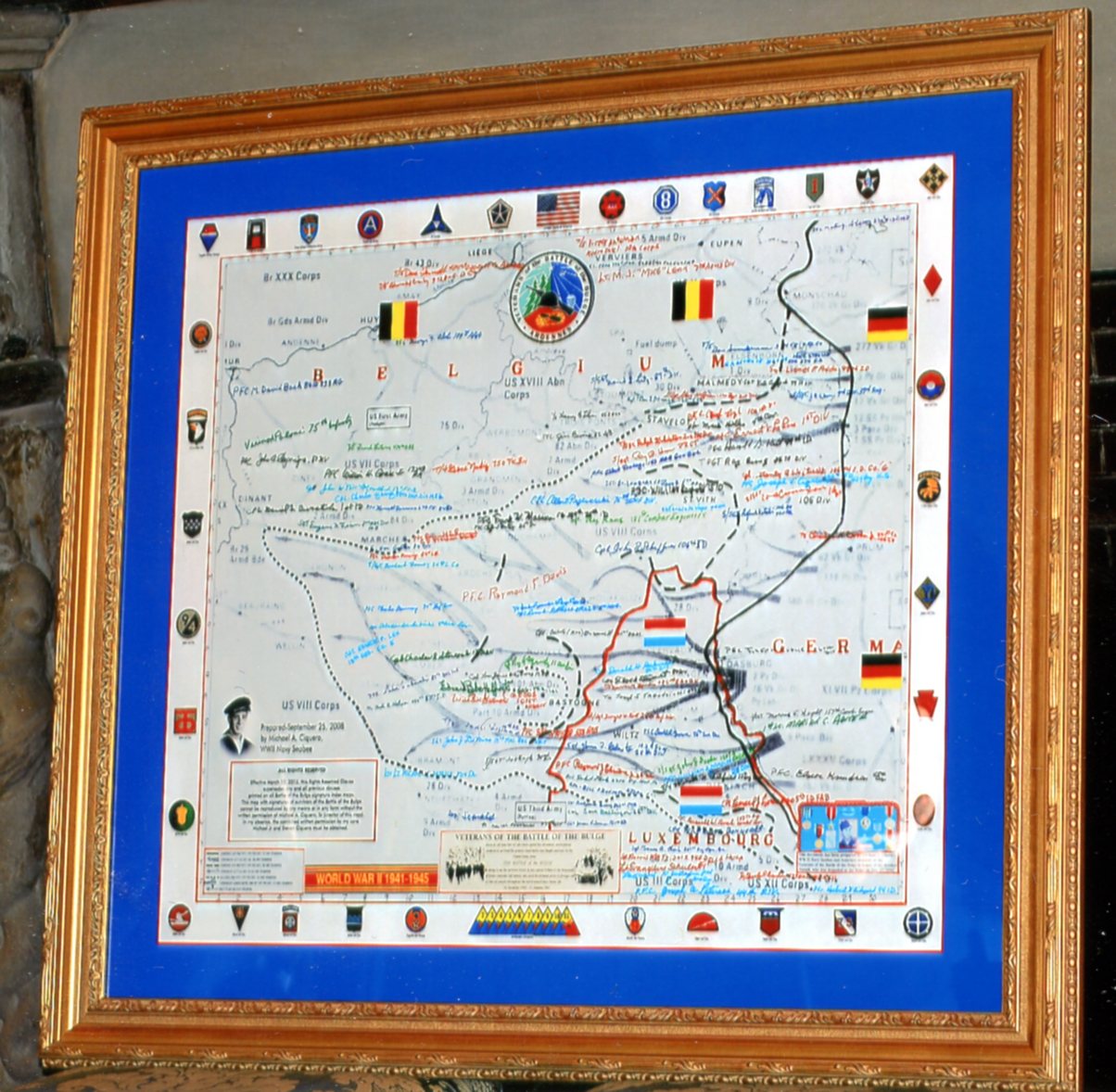
Twenty-five of these names were signed in Luxembourg. I humbly ask that you extend our best wishes to the people of your country and I remind everyone that there are a little over one million WWII veterans alive today who are dying at the rate of one every 90 seconds. The day will soon come when there will be one survivor standing and it is possible that that person could be a Battle of the Bulge survivor and could be in this room today.

Respectfully,
Mike Ciquero, WWII Navy Seabee and VBOB Associate
December 15, 2013
VBOB member Dan Santagata volunteered for the U.S. Army while a senior in High School. He describes his encounters with Gen. George Patton, a battle in Metz, and onto Remagen where Dan discusses the loss of a very good friend and comrade in arms. Dan served with the 5th InfD Engr Cmbt Bn.
Carl Shell recounts his tour of duty with the 9th AmdD 14th Tank Bn. His unit advanced from Paris to Luxembourg, Belgium, Germany, Holland and finally to Czechoslovakia.

On Christmas 1944, Gus Epple was at the wheel of an Army Jeep, stuck in a traffic jam many miles long leading to the German lines. Dysentery forced the 19-year-old to abandon his Jeep every 15 minutes to relieve himself along the side of the road. Each time, he trudged through the snow and wrestled with an overcoat, field jacket, two layers of uniform pants and longjohns worn against the bitter cold. That night, his unit started a fire in their stove, a more compact version of a Coleman, to keep warm. Their folly quickly became apparent.
“You couldn’t believe how brilliant that little gas stove was,” said Epple, now an 88-year-old living in Cape May Court House. “We left it on for five or 10 seconds and shut it down again. It could’ve given away the position of the entire convoy.” Epple was one of an estimated 610,000 Americans who served during the Battle of the Bulge, Adolph Hitler’s last major offensive of World War II. By the end of fighting, which began Dec. 16 and ended Jan. 25, 1945, about 81,000 would die. Germany would surrender just more than four months later. And that year became the “winter without a Christmas” for the soldiers who returned home.
Decades later, however, Epple and a group of local vets have banded together due to their shared experience. Their numbers have dwindled and some are now confined to nursing homes, but a hearty few still unite throughout the year, most poignantly at Christmastime. They are the brothers of the Bulge.
It all started in 1999, when a couple of veterans — both deceased now — organized a luncheon for a local chapter of the national Veterans of the Battle of the Bulge. At the time, the quarterly meetings attracted a group of about 50 said the 88-year-old Army rifleman. “There’s a common bond there that means something to us.” The Cape May Court House resident, who lives near Epple, spent Christmas 1944 south of Bastogne in Belgium. The days run together in memory, but he was probably in a foxhole, hoping German soldiers didn’t stumble upon his position.
When possible, Umbenhauer would try to dig a trench to lie in, but one night it wasn’t possible. Instead, three soldiers huddled together in a snow bank, their warmth and body weight creating a depression in the snow. “I was just lying there in the snow. Several miles away I could hear German Panzer tanks driving back and forth,” he said. “If they decided to come after us, I wouldn’t be here — we were totally unprotected.”
Umbenhauer joined the local group several years after it formed, after reading about it in the newspaper. One of the members mentioned the 8th Armored Division. “Hey—that’s my division,” he said. Many of the members’ experiences intersect. For instance, Ewing Roddy, another survivor, was a machine gunner who flew six missions over the course of the battle. “I like to say they were fighting the Germans on the ground while I was fighting above ground,” Roddy said. The 89-year-old now lives in a Linwood nursing home with his wife, but he tries to make the group’s annual Christmas luncheon — on Wednesday this year — and stays in touch with other veterans, sharing news and remembrances.
Like most groups, Epple said, the Bulge veterans’ numbers have dwindled with time. Today, about five of them still meet regularly, with several more attending when their health or transportation allows.And Umbenhauer said the remaining active members are always on the lookout for new blood. “If they find a veteran from the Battle of the Bulge, they practically drag you to the meeting,” he said, with a laugh. He knows from personal experience, of course.
But a funny thing happened in recent years. Although the ranks of actual veterans have diminished, the group has welcomed relatives of deceased Bulge vets and soldiers from other battles and conflicts. The group’s current president, 70-year-old Ed Steinberg, was a New Jersey Army National Guard reservist — he responded to the Newark riots of 1967 — and the son of a Bulge vet who died in 1992. His own father, Albert, was close-lipped about his experiences, but Steinberg enjoys hearing the experiences of other World War II vets. “I would rather connect and sit down with these guys than people of my own generation,” he said.
Steinberg, who lives in the Rio Grande section of Middle Township, took over when Epple needed a break from the constant scheduling duties. “I was sort of hoping it would just fold and we’d quit,” Epple said. “I didn’t think it would last this long.” But Epple added that there’s real value in continuing the legacy of the Battle of the Bulge, and remembering the Christmas that never was.
During the battle, Epple and the rest of the soldiers were eventually ordered to abandon their overcoats because they could be too cumbersome if they had to run. Most of the Germans kept their coats. Epple remembers one fled as his crew fired mortars around him. “I’d never seen such a sight,” he said. “Trailing out the back of him was the overcoat. He must’ve gone at a pretty good speed.”
Umbenhauer said he likes to tell people that he spent that Christmas in a foxhole singing “I’m Dreaming of a White Christmas.” Of course, that quip doesn’t reflect the reality he and many of his friends lived that day. They already had more than enough snow. “For us, it was another night,” he said. “We couldn’t help but think about Christmas, but for us it was another unpleasant night.”
by Wallace McKelvey, Staff Writer
Atlantic City Press, NJ