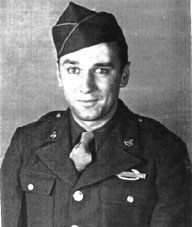
Frank Chambers, 75th Infantry Division, 291st Infantry Regiment, Cannon Company
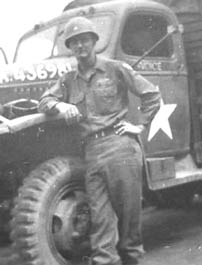
He had grown up on a farm and knew how to drive, so the Army gave Frank Chambers a truck. So many other recruits, city kids without licenses, had to carry rifles. “I was really fortunate,” he said this week from his kitchen table near Holmes Lake in Lincoln. “In any infantry, the best place to be is in a truck.”
His was an older GM deuce-and-a-half, and it had already seen action in North Africa by the time he climbed behind its wheel. But that truck kept him warm and it kept him dry and, when he cooked his canned beans and soup with the warmth of the engine’s manifold, it kept him fed.
He drove it into World War II, all over Europe, 10,000 miles through snow and mud and night. He hauled supplies and men, but mostly he towed the howitzer cannon that helped push the Germans out of France, twice.
And then he drove that six-by-six, safely, out of the war. He returned to the States to a long career and a longer marriage. He went decades without talking about his service — or even thinking about it much — until about 18 years ago, when a grandson asked about it.
Since then, the 90-year-old former Farm Bureau and Gallup employee has documented his experiences — both the big picture and the bracing details, like shaving in zero-degree weather — for his family.
He’s spoken to students and assembled a home library of World War II books. He’s attended reunions of the 75th Division and tracked down old friends, or their widows.
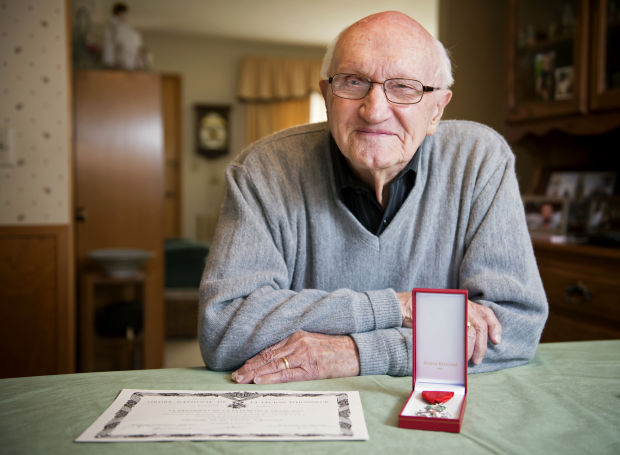
And late last month, wearing a gray suit coat and striped tie in the sixth-floor library of the French embassy in Houston, and with Doris and their daughter and grandchildren watching, Chambers was named a knight in the French Legion of Honor for his service to that country 69 years ago.
The consul general, Surijo Seam, spoke of the long friendship between France and the U.S. He spoke of the award, his country’s highest decoration. He spoke of the U.S. service members who fought in France during World War II.
“Frank Chambers,” he said, pinning the Legion of Honor on the Nebraskan, “you are one of these valiant and brave American heroes.”
He unwraps the rubber band from the red box, revealing the award that dates to 1802, when it was instituted by Napoleon Bonaparte.
This one came by FedEx.
Chambers applied for it in 2012, sending to the embassy in Chicago the proof of his service in France nearly 70 years ago.
The son of farmers from western Illinois was drafted in 1943. He’d had howitzer training in the ROTC, so the Army sent him to artillery training in Oklahoma. But then it selected him for specialized training.
“They needed civil engineers for the rebuilding of Germany and the world after the war. They thought that would be the purpose of these fellows.”
Six months into the program in Wisconsin, the Army shut it down. So he joined the Air Corps program and was sent to West Virginia. He wanted to be a pilot or, at least, part of the flight crew.
The Army shut that down, too, four months later. It needed fresh troops as it readied ground forces for the upcoming battles in Europe. Nearly 35,000 aviation cadets found themselves out of that program, he said.
“The generals in charge there, they were really upset about all of these guys over here in cushy jobs.” So he was sent to the 75th Infantry Division and, because of his artillery training and farm background, assigned a truck. He sometimes had an assistant driver, and always a crew of six assigned to the 105mm cannon attached to his hitch.
They landed in France in December 1944, relief for the troops fighting since D-Day six months earlier. In Belgium, they fired their first round on Christmas Eve, their introduction to the Battle of the Bulge.
It was cold in the Ardennes forest; men were losing their hands and feet to the chill. And it was deadly; an estimated 20,000 Americans lost their lives.
When it was over on Jan. 25, 1945, when the Allied Forces had finally pushed the Germans out, Chambers and his division thought they would get some rest.
But Germans were crossing the Rhine into France to the south and east. The 75th got new orders.
He was part of the caravan two days later, more than 1,400 vehicles carrying 7,000 soldiers, crawling through the mountains. They traveled in blackout conditions at night, Chambers focusing only on the dim, 2-inch “blackout light” attached to the truck in front of his, a sheer drop to one side of the road, a solid wall on the other.
“It’s just like a bunch of elephants following each other,” he said.
The trip to the Alsace Province took two days. The snow in the mountains to the north was replaced by mud that mired the truck and the men.
“We had a difficult time getting the cannon in position. Every day or two, we’d move to a new location.”
Partnered with the First French Army, they were pushing forward, driving the Germans back. They were lucky, he said. All of the men attached to his truck’s cannon — the forward spotter, the soldier who got the ammo ready, the soldiers who loaded it, the soldiers who fired it — stayed safe.
But there were scares. German bombs exploded nearby the first day they were there. And they saw their first German jet, saw it before they heard it.
“Boy, that scattered us when it came in and strafed us.”
Frank Chambers
Decades later, from his home in Lincoln, he would describe to French officials what he helped do for their country. “Our Company cannons destroyed a church steeple that harbored German snipers,” he wrote. “The Company also destroyed several German self-propelled weapons.”
(No matter how one looks at it, these are incredible. Aside from the figures on aircraft, consider this statement: On average 6600 American service men died per MONTH, during WWII (about 220 a day). Most Americans who were not adults during WWII have no understanding of the magnitude of it. This listing of some of the aircraft facts gives us a bit of insight.)
276,000 aircraft manufactured in the US
43,000 planes lost overseas, including 23,000 in combat
14,000 lost in the continental U.S.
The US civilian population maintained a dedicated effort for four years, many working long hours seven days per week and often also volunteering for other work. WWII was the largest human effort in history. From Germany ‘s invasion of Poland Sept.. 1, 1939 and ending with Japan’s surrender Sept. 2, 1945 — 2,433 days. From 1942 onward, America averaged 170 planes lost a day.
How many is a 1,000 planes? B-17 production (12,731) wingtip to wingtip would extend 250 miles. 1,000 B-17s carried 2.5 million gallons of high octane fuel and required 10,000 airmen to fly and fight them. According to the AAF Statistical Digest, in less than four years (December 1941-August 1945), the US Army Air Forces lost 14,903 pilots, aircrew and assorted personnel plus 13,873 airplanes — inside the continental United States . They were the result of 52,651 aircraft accidents (6,039 involving fatalities) in 45 months.
Think about those numbers. They average 1,170 aircraft accidents per month— nearly 40 a day. (However, less than one accident in four resulted in total loss of the aircraft) Almost 1,000 Army planes disappeared en route from the US to foreign locations. But an eye-watering 43,581 aircraft were lost overseas including 22,948 on combat missions (18,418 against the Western Axis) and 20,633 attributed to non-combat causes overseas. In a single 376-plane raid in August 1943, 60 B-17s were shot down. That was a 16 percent loss rate and meant 600 empty bunks in England. In 1942-43 it was statistically impossible for bomber crews to complete a 25-mission tour in Europe.
Pacific theatre losses were far less (4,530 in combat) owing to smaller forces committed. The worst B-29 mission, against Tokyo on May 25, 1945, cost 26 Superfortresses, 5.6 percent of the 464 dispatched from the Marianas.
On average, 6,600 American servicemen died per month during WWII, about 220 a day. By the end of the war, over 40,000 airmen were killed in combat theatres and another 18,000 wounded. Some 12,000 missing men were declared dead, including a number “liberated” by the Soviets but never returned. More than 41,000 were captured, half of the 5,400 held by the Japanese died in captivity, compared with one-tenth in German hands. Total combat casualties were pegged at 121,867. US manpower made up the deficit. The AAF’s peak strength was reached in 1944 with 2,372,000 personnel, nearly twice the previous year’s figure.
The losses were huge—but so were production totals. From 1941 through 1945, American industry delivered more than 276,000 military aircraft. That number was enough not only for US Army, Navy and Marine Corps, but for allies as diverse as Britain, Australia, China and Russia. In fact from 4943 onward, America produced more planes than-Britain and Russia combined and more than Germany and Japan together 1941-45. However, our enemies took massive losses. Through much of 1944, the Luftwaffe sustained uncontrolled hemorrhaging, reaching 25 percent of aircrews and 40 planes a month. And in late 1944 into 1945, nearly half the pilots in Japanese squadrons had flown fewer than 200 hours. The disparity of two years before had been completely reversed.
These numbers kind of make you want to think. Remember how we used to crack about the flyers having it so good, returning to their bases where they would be able to shower, to put on clean clothes, to eat a decent meal and sleep under warm dry blankets on a clean cot, under cover and protected from the snow and rain? Looks like their lives weren’t all tea and crumpets.
The last two years, 1942 and 1943, had caused real anxiety in all of us. Choices are very difficult. Many of my friends had left school to join the service–their seats are draped with the service flag. Graduation from Powhatan Point, Ohio, High School was on a very warm day in May 1943. The empty seats made each of us realize the uncertainty for what our future may hold. I graduated with a scholarship to Ohio State University in music. My first love was music, and I played the trumpet in our band. We also had a small dance band which played music throughout the Ohio Valley. What a night of celebration we all had! It was the first time I ever became drunk. When my Dad finally found me, much to my surprise, he never scolded me. I guess he was aware of the danger that laid ahead. The war was escalating, and the Germans were in control of most of Europe. Like so many young, I was ready to serve and save our country and freedom. We went to the nearest recruiting office in Bellaire, Ohio. Upon arriving there, the line was very long with high school graduates all longing for action, to fight the enemy. When my turn came, the recruiter said, “Well, son, what is your preference?” I requested Air Force but he replied “Sorry, this is infantry week, next week is Air Corp”. So I enlisted in the Infantry. Although my parents were very sad, they tried so hard to be brave and proud.
We were sent to Fort Hayes in Columbus, Ohio where we were given physical examinations. On June 18, 1943 I was shipped to Fort Benjamin Harrison in Indianapolis, Indiana, where I was assigned to the reception center. I remember a newspaper took our picture. We all looked like kids on our way to Boy Scout Camp. From there we went by train west to Camp Haan, located outside of Riverside, California, for basic training. Our training was in the desert center (Fort Irvine was gunnery range for anti-aircraft and Death Valley for maneuvers). It was hell in the heat. Some days the temperature was 120 degrees and at night it was cold. There was always a possibility of a rattlesnake curling up beside you in your sleeping bag to keep warm. For a boy from the cool hills of Ohio to 120 degrees, it was an experience beyond belief. Several of us were bitten by a rattlesnake, but we managed to survive. We became very close, and as fate would have it, we stayed together and became part of the 125th Artillery Battalion.
Occasionally we would have a pass to riverside or L.A. They would have a USO dance, which helped make the weekends more enjoyable. One weekend I even went to Phoenix, AZ with a buddy, as his home was there. Phoenix was a cow town in 1943. It had a theater, a store or two and some place to buy beer. Those days at Camp Haan weren’t all that bad. I was assigned to the Headquarters Division of the 125th AAA gun Bn. The men all became family, and many in the 125th were from the Ohio Valley area. My 1st Sergeant was George W. Barber, who was a WWI Vet. He seemed like an old man, but was probably only 43-45 years old. But we were only 17 or 18. My Captain was Dale Nix, a graduate of Texas AM and in the S2 (Intelligence). He was a rancher from Texas, and a good friend and mentor to me. Operations Officer was Captain Mark Lightfoot (S3).
When we left Camp Haan, we went to Camp Livingston at Lake Charles, LA. I knew it wouldn’t take long before we were shipped out. After several weeks there, we went to Camp Edwards outside Boston, MA. It was there that I ran into a friend from home, Henry Bindle, who had joined the Navy. We were able to spend some time together before I was shipped to England. We didn’t see each other again until 1947.
In September, 943 at the port of embarkation, I boarded the SS Mt. Vernon, a large passenger ship made into a troop ship. The voyage across the North Atlantic was rough, and most of us became seasick. We had a submarine warning, while the convoy was forming. One of the ships got hit–we saw the smoke, but never heard what happened. After about seven days, we landed in South Hampton, England. I was put on a train to the Dover area on the English Channel. The English people were very good to us. My unit was stationed at Dover in Liverpool and Folkestone. We soon learned the horrors of war.
The English had been fighting since 1939. The USA had been sending them help with equipment, etc. In 1941, when Japan bombed Pearl Harbor, the US became involved on both the Western and Eastern Fronts. The Germans were bombing London and had set up a strong defense on the Normandy coast. The English had strong Royal Artillery on the Channel area but they were glad to have help from America. Our Field Artillery had the big guns: 105mm and 90mm.
At first it was planes with bombs and then the Germans were sending VI Rockets, propelled rockets without any control called Buzz Bombs. It was our job to shoot them out of the sky before they reached London. The sound of the VI was like no other. As long as you could hear them it was ok. It was the deadly silence when fear would strike. Just before they hit their target, the motor would go out and then a loud crash and the sound of destruction. The 125th AAA Gun Bn. was set up at Folkestone on the Dover coastline. The GIs were well trained and successfully destroyed 97.8% of the VI bombs. We were credited with destroying 269 VIs.
We had to spot the bomb by radar or visualization information for a direct hit by the gun. We didn’t have calculators in those days. It all had to be done by eye and mind, calculating on a crude rangefinder. The air war went on 24 hour a day and gun crews were at their post continuously. The time in England was not all work and fighting. Most of us were 18 or 19 years old and some recreation was guaranteed. The good old American GIs ingenious nature was to make things happen. One day we improvised cowboy rodeo, with the help of Texas born Captain Nix. This was something the English had never seen. I truly treasure the pictures of Nix riding a bull at the Rodeo.
I also had taken my trumpet with me and was invited to play with a dance band organized with seven American Artillery and seven English Royal Artillery guys. We had a great band called The Ameroanglos. The band played for dances in the ballroom at Lea’s Cliff Hall in Dover. The ballroom was carved out of the chalk cliffs of Dover. The band also played for the BBC (British Broadcast network), which broadcast to the Armed Forces. Glen Miller’s band also played there when on a USO tour. In England I was very fortunate to meet Eddie and Pat Wedgwood. They became very dear friends to this day, and we keep in touch. Eddie was a member of the English Royal Artillery. At this time, even with the destruction in London, the people were great and we still had no idea of the Hell that was to come.
On June 6, 1944, General Eisenhower and the High Command decided there would be a landing on Normandy Beaches. The allies had no idea how heavily guarded the Germans had made the beachhead. They had underground bunkers with their best artillery guarding the beaches. Our stay in England ended on D-Day. The invasion of France was to begin. As we boarded the boats to take us across the English Channel, we had no idea what was to come, but each of us was very scared, as well as anxious, to fight the Germans. There was a storm that day and the water was very rough, and many became ill on the crossing. We thought the beach landing would be a piece of cake. Intelligence was not informed on how heavily enforced the beaches were by the Germans.
Rommel had done everything possible to prevent the landing: barbed wire, and mines going off in every direction. The first wave on the beach was mowed down like animals. I remember going off the front area of the boat into water up to my armpits. I had to hold my rifle above the water. Our boat couldn’t get any closer to the beach because the Germans had put tanks in the water to prevent heavy equipment getting to the beach. I remember seeing a soldier in the water. I thought he was alive, so I held on to him until we got to the shore, only to find he had been shot and most of his face was gone. As we beached under fire by the Germans, the beach water was red with blood, and dead bodies of the men who went before us were strewn all around. It was necessary to keep down and crawl over them. Finally, after many hours and cover fire from the ships that took out some German guns, and thousands of dead GIs, the beachhead was made and we were able to move forward. Many of the officers were killed. The GIs didn’t wait for orders–they did what needed to be done for the situation. It took six days to secure the beach. The Allies had a line from Utah to Juno and Omaha. Nine thousand three hundred sixty GIs were killed and five thousand bodies were never recovered at Omaha Beach.
From the beach area we fought our way to St. Lo. The Air Force had been bombing St. Lo and when we arrived, the town was destroyed, the people and Germans gone. The hedgerows were to come. The hedgerows were mounds of dirt the farmers had built as fences surrounding orchards, farms and houses. Many American died here, as the hedgerows made perfect places for the Germans to take arm. They had tunneled in the mounds and set up machine guns emplacements. The Germans had better armor then we had. The Americans had very few tanks that would navigate the hedgerows. Our tanks were like toys compared to the German tanks. It often took 4 or 5 Sherman tanks to take out a German tank. Our tanks were called “moving graves”. Finally the GIs made an adapter to the front of the tanks from junk steel welded together that acted like a snowplow. We were able to uproot the hedgerows.
The way forward was difficult, for there was a problem getting gas and needed supplies from England when the supply ships ran into trouble. On June 16th, a severe storm came to the Channel and many ships with supplies were unable to land, and some even sank. Not all went well, even with the best plans. Unfortunately, General Montgomery made his first big mistake at Caen, France in the Falaise Gap battle. Many casualties occurred when he didn’t head out of Caen. The battle through the hedgerows would not have been necessary. Montgomery took credit for the Cobra breakout, but truly it was General Bradley who was the one to make the difference on the total breakout from the beaches. General Patton was under Montgomery at this time and had to follow his command. Because of this, the German army was able to escape and retreat. They reorganized to fight later. From here we are on our way to Paris. General Patton took command. The Air Force was welcomed and did their job as expected. The Americans moved more in one day than they had in six. Now organization was put into the battles by combining air, tanks and infantry.
1944 Summer/Fall
Upon reaching the outskirts of Paris, the Americans were stopped. The Free French by General de Gaulle were to be the first to enter Paris. The Germans had left Paris without any organized resistance. They left very little damage to the city. However, there were some snipers still present August 25, 1944.
The British went forward to liberate Brussels, Belgium; we went east to Nylan, Belgium and to Antwerp, Belgium. Getting supplies to the troops became more difficult. Trucks were bringing supplies over land. The truck convoys were called “The Red Ball Express”. The roads were not good in Europe, and rain often made the roads very muddy. Also, the distance became so long, we needed another port to receive supplies. Antwerp became a very important supply route. The British fought to secure the port and we were to set up Artillery (the 125th) outside Antwerp to defend it from the VI Buzz bombs that the Germans sent. The operation was known as “Antwerp X”. It was a highly secret mission. The US Government did not allow any information out about this mission until 50 years ago, after WWII was over. During this time (September 1944) a Buzz Bomb Rocket hit a recreation theater in Antwerp. The children were watching a western movie that afternoon, and 500 died. Russ Elliot and I helped carry many of the children out. The success rate for destroying the VI rockets was 90%. But the V2 Rockets were so fast that radar couldn’t pick them up, and there was no defense.
Battle of the Bulge, December 16 1944 through January 25,1945
World War II continued in 1944 and for a rest after Antwerp X, we were sent to the Bulge area located in Ardennes, Belgium. Winter was on the way. It was said that this was the coldest winter on record for many years. The snow was so deep we could hardly walk. Many of the men had frozen feet and needed amputations. My left foot was frozen, and I was told gangrene would set in if not removed. I kept asking for one more day. By the morning of the next day, circulation began to reappear. We were to have winter clothing and boots, but for some reason the boots were for summer and not waterproof, and no winter clothing was given. ‘
Our unit was started at St. Vith. We were assigned to keep the Germans from coming to the crossroads from Houffalize and prevent the Germans from going further west. Thankfully, we had raincoats. We would sleep in our wet clothes, and most of the time in an army blanket. During this time we could not put up a tent, as there wasn’t time. We were always moving and most nights we spent in foxholes in the snow. When we had a chance, we would get into an old building.
The Ardennes forest was so dense they had to have tanks to knock down the trees to get the large artillery through. The large artillery was set up behind the line and would shoot over the line to the Germans. A B-17 crashed near us while on a bombing run. We picked up several men. All were deceased. One was a general, but at the time we didn’t know that. In combat no stars or badges were worn. If taken prisoner, you didn’t want the Germans to know your rank. Later the story was written up in The Stars and Stripes.
The weather stayed bad for days or weeks–I don’t remember which. But I do remember all the frozen feet and sleeping in the snow. Christmas Day 1944, a German jet was strafing us. It was a brand new model (ME262) jet. The attack caused multiple injuries and fatalities to our men. In the Battle of the Bulge, there were 600,000 Americans and 650,000 Germans. It was the largest land battle of WWII. Three American armies and six Corps, 81,000 GI wounded, 19,000 killed. When the weather finally permitted planes to fly, the 101st in Bastogne had supplies dropped by air.
Winter of 1944 – Spring 1945
General Patton’s 3rd Army and tanks were received with much joy, and the battle began in our favor. General Patton was held up from arriving sooner because of the weather and no gas for his tanks. My unit, the 83rd Infantry Div. 329th Infantry, was sent toward the East (Rhine River), crossing it into Czechoslovakia. The Germans knew the Americans were coming and near the town of Pilsen, the Concentration Camp of Nordhausen was liberated. The Germans guards left or wore civilian clothes so as not to be known as guards. The prisoners in the camp were not able to move, because most were too weak or too sick. Approximately 1/3 of them survived. Near the end of the war was the discovery of the Dachau Concentration Camp. Pilsen was the capital of Czechoslovakia and the prisoners were used by the Germans as slave labor. Where the underground VI Missile flying bomb assembly plant was located, the underground factory had multiple miles of tunnels. When the camps were freed, the Occupational Army took the refuges to another camp to be clothed and fed until they were healthy and able to make decisions for themselves. It was found if they were left alone they would eat and eat. Not mentally able to make a decision until the body became healthy.
After leaving this area, we went on to the Elbe River, going through the Hurtgen Forest. The combat lasted about a week to 10 days. Upon reaching the Elbe River (March 13 or 14, 1945) the crossing was made on a pontoon bridge and small boats brought by the engineers. The engineers were great craftsmen. The area was about 35 miles from Berlin. We waited for the Russians, who came on April 13, 1945. The wait was necessary, for President Roosevelt and Winston Churchill had promised Stalin (the Russian Ruler) that the Russians could take Berlin. The Germans surrendered May 8, 1945.
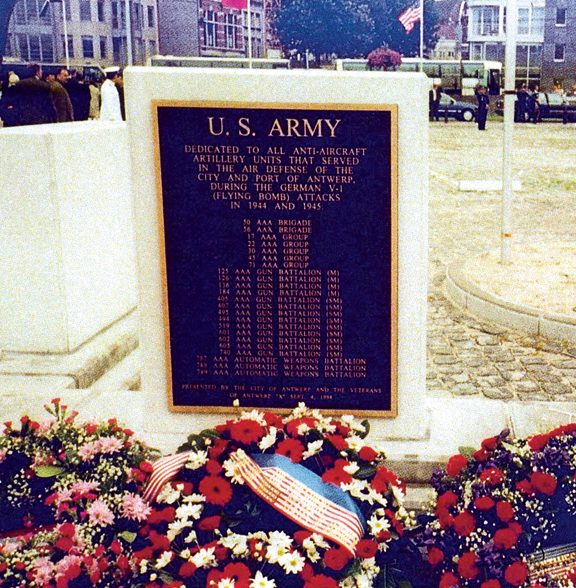
Antwerp, BE monument honoring the American AAA gun battalions
On September 4, 1994, on the 50th University of Antwerp X and the liberation of Antwerp, Belgium, the Belgium Government celebrated. In 1994 Col. Barkie and I, along with the help of the Veterans from the 125th Gun Bn, dedicated a monument honoring the American Artillery, which shot down 481 VI Buzz Bombs in the defense of Antwerp. The Mayor of Antwerp, Mayor Cools, and the King of Belgium did us a great honor and held a ceremony for the group of Veterans attending. I was honored to lay the wreath on the monument and received the Belgium Flag that covered our monument. It was presented to me by Mayor Cools of Antwerp. The wreath from the USA was laid by Hazel O’Leary, Secretary of Energy, who was sent by President Clinton. The third wreath was sent by the Mayor of Antwerp.
World War II Veterans who participated in the Normandy Invasion will be honored at the Memorial Day Concert on the Mall, May 25, 2014. There will also be a select number of seats reserved as “Seating of Honor” for all World War II Veterans who would like to attend.
Every US veteran, soldier or relative who has ever visited Bastogne, has surely gone to the Mardasson monument. Neighboring the Mardasson monument, a WW2 museum was also to be found. The City of Bastogne, supported by local, regional and EU funding, has taken the task to renew the museum. It was closed for almost two years. Work included a general overhaul and extending the existing building and a complete new scenography, dedicated to the entire cyclus of WW2.
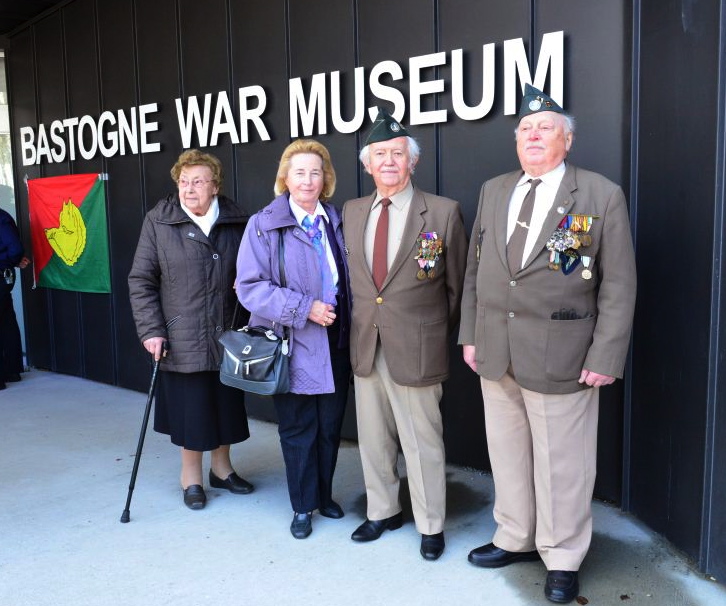
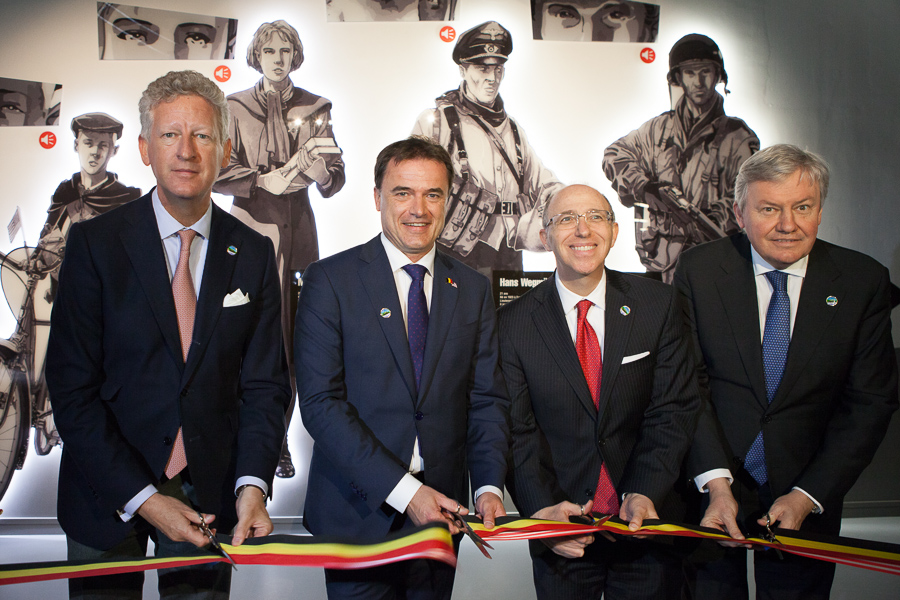
(l-r) Mrs Frans Marique; Christiane D’Haese; Marcel D’Haese Pres VBOB chapter; Frans Marique, VP VBOB chapter
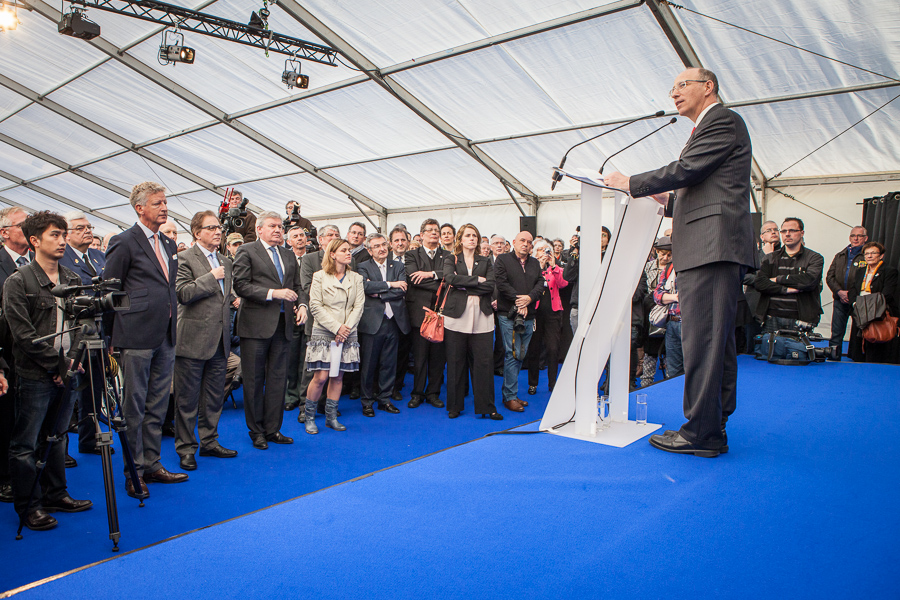
Over 800 people were invited to the inauguration of the new “War Museum” in Bastogne on Friday, March 21st. The “Greatest Generation” was also present, as three WW2 US Veterans and the Belgian VBOB Chapter, led by Marcel D’Haese were special guests.
Everyone was welcomed by the mayor of Bastogne, Benoit Lutgen, followed by a short but powerful speech of Mark C. Storella, Deputy Chief of Mission U.S. Embassy Brussels. After the speeches, Mayor Lutgen, Mr. Storella and other VIP’s officially opened the Bastogne War Museum, a new museum dedicated to the Remembrance of the Second World War.
The bold architectural concept of the museum, which flanks the famous Mardasson Memorial, will welcome visitors for a unique journey to the past. The “Bastogne War Museum” experience will allow the visitor to step back in time and understand the reality of the Battle of the Bulge. From the causes of the battle to its dramatic consequences, the visitor will be immersed in an interactive experience. The personal testimonies, the many authentic artifacts, the innovative scenography, and the experience-orientated approach (three scenovisions, 3D Multi-sensorial devices) make the Bastogne War Museum a must see.
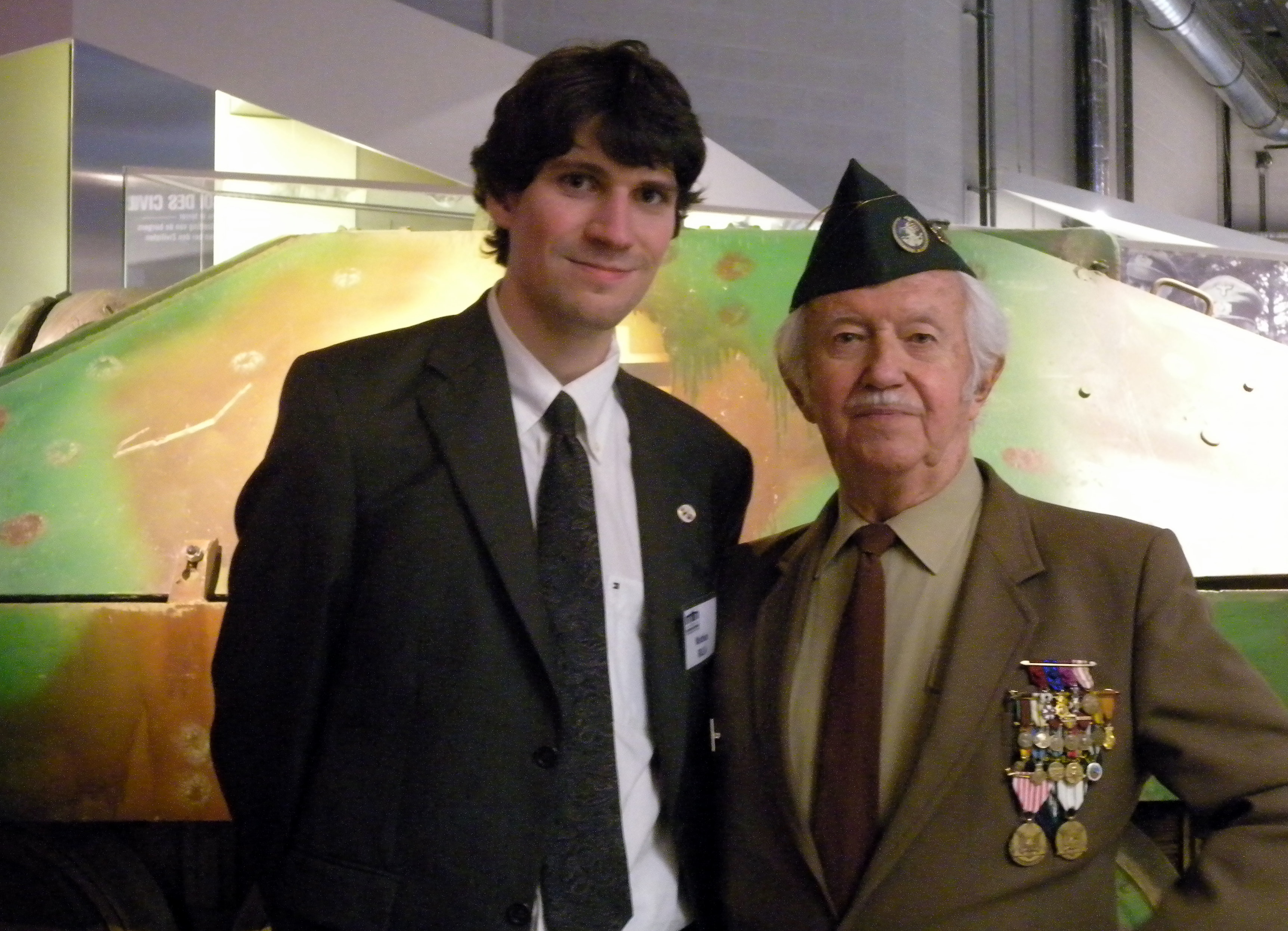
(l-r) Mathieu Billa, Museum curator; Marcel D’Haese BE Fusiliers
The Mardasson Memorial and the “Bastogne War Museum” share the same ambition: maintain the memory alive of those who fought for our freedom and defend values such as peace and freedom. With the upcoming 70th Anniversary of the “Battle of the Bulge”, the museum will be an interesting place to visit.
The Museum is open from March 22nd, 2014. All information can be found at www.bastognewarmuseum.be.
Story and photos submitted by Patrick Brion & Malek Azoug
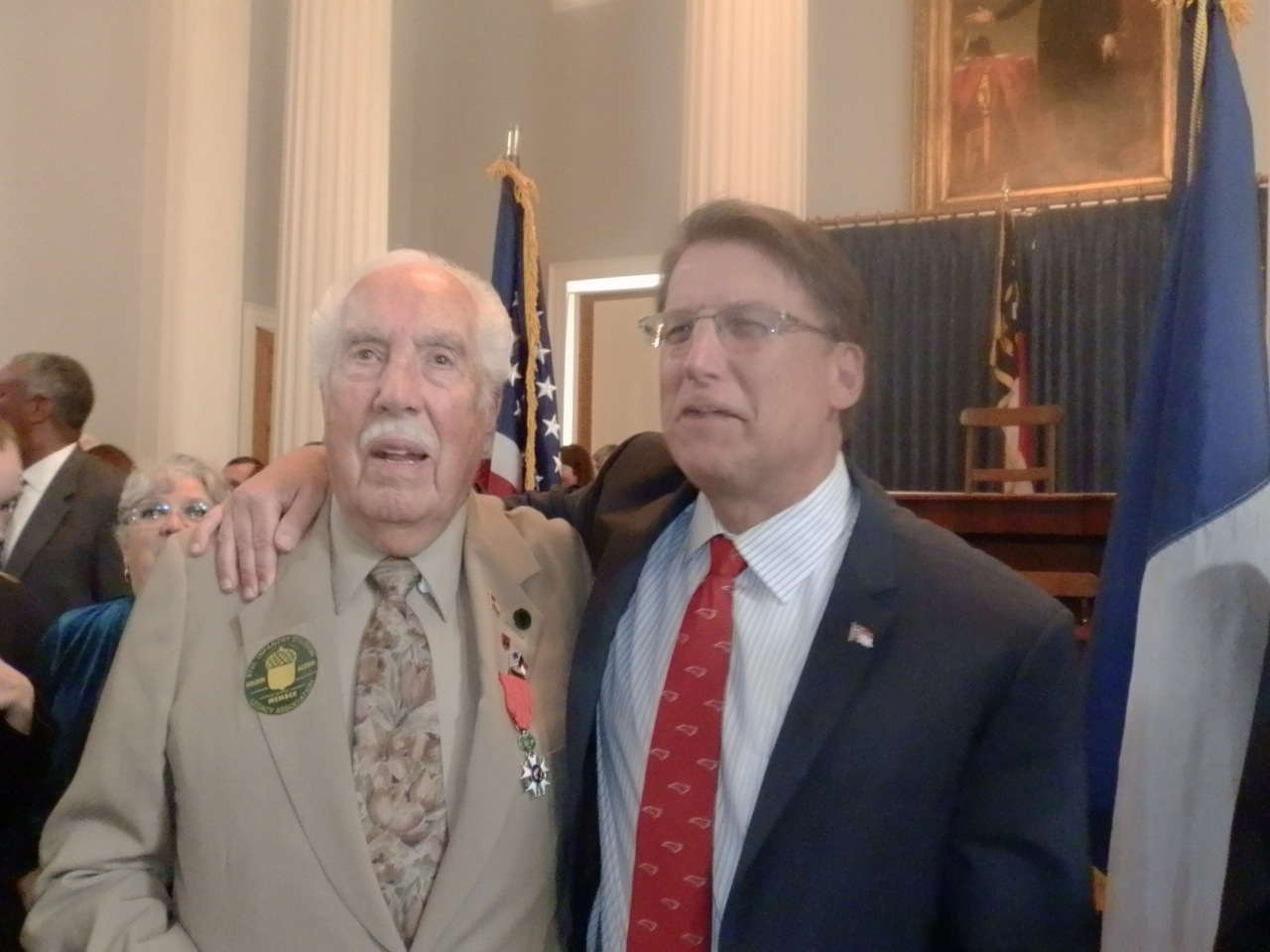
Jessie O. Bowman from Granite Falls, NC (Sergeant, 345th Regiment, 87th Infantry Division) along with 13 other American WWII Veterans from the U.S. Southeast was awarded the French Legion of Honor during a ceremony on February 20, 2014 at 1:30 pm at the State Capitol in Raleigh, North Carolina.
Jessie will be quick to tell you that “I did not win the war; you did not win the war. We all won this war together!” Jessie Bowman was trained as a gunner operator of an 80mm mortar with company D, 345th infantry of the 87th division. Jesse fought in the battle of Morcy and then on to the Ardennes Forest and the Black Forest. Jessie also fought in the Battle of the Bulge, St. Vith and then crossed the Moselle River into Koblentz on the Rhine River and finished up fighting in Plauen in Northern Germany, which is near the Czech border.
Chapter 30 President Barry Veden takes the story of the Bulge on the road
From the time Veden was elected president of the northern Indiana chapter of the Veterans of the Battle of the Bulge, he has been speaking to numerous groups about the battle that occurred in the Ardennes during that coldest of winters seventy years ago.
“I began making presentations to organizations such as the Lions Club, local Rotary Clubs, Church groups, retiree associations and AMVETS conventions,” Veden said. “The presentations have been received nicely. It’s amazing to me how little is known about the battle, or even about World War II for that matter. As president of our local chapter, I feel that is my responsibility to educate as many people as possible about the Battle of the Bulge so that there is a better understanding of what my dad and the thousands of others like him accomplished during the largest land battle ever fought by the United States Army.”
After sending out letters to Assisted Living facilities in the tri-county area of LaPorte, Porter and Lake Counties last year, and receiving a good response, he began speaking to residents in those facilities. “The residents living in those facilities are basically from the World War II generation, and they enjoy hearing about that time in their lives when the world was at war, and how we were victorious,” Veden said. “I’ve been invited back to speak to some of them two and three times.”
In November of last year, Veden was the keynote speaker at the first meeting of a veteran’s organization at the company from where he had retired ten years earlier. “There were about forty veterans in attendance at that inaugural meeting. Most of them had fought in either Iraq or Afghanistan; some of them in both wars, and they were very receptive to my talk about the battle.” “I’m going to continue my mission of speaking to as many groups about the Battle of the Bulge as I can. I owe that to the men in our chapter,” he said.
Barry Veden is the son of Edward Veden, a staff sergeant with the 112th Infantry Regiment of the 28th Infantry Division. Edward was on the Siegfried Line on the morning of December 16, 1944, and faced the initial assault by the German Wehrmacht that day. During the ensuing 41-day battle, he was seriously wounded and spent the rest of the war in a hospital in England recovering from his wounds.
AFTER 50 YEARS, A FEARFUL INCIDENT TURNED HUMOROUS
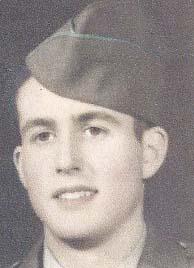
by Sam Ballinger, 3rd Army, 26th ID, 328th IR, Co E
Sam Ballinger
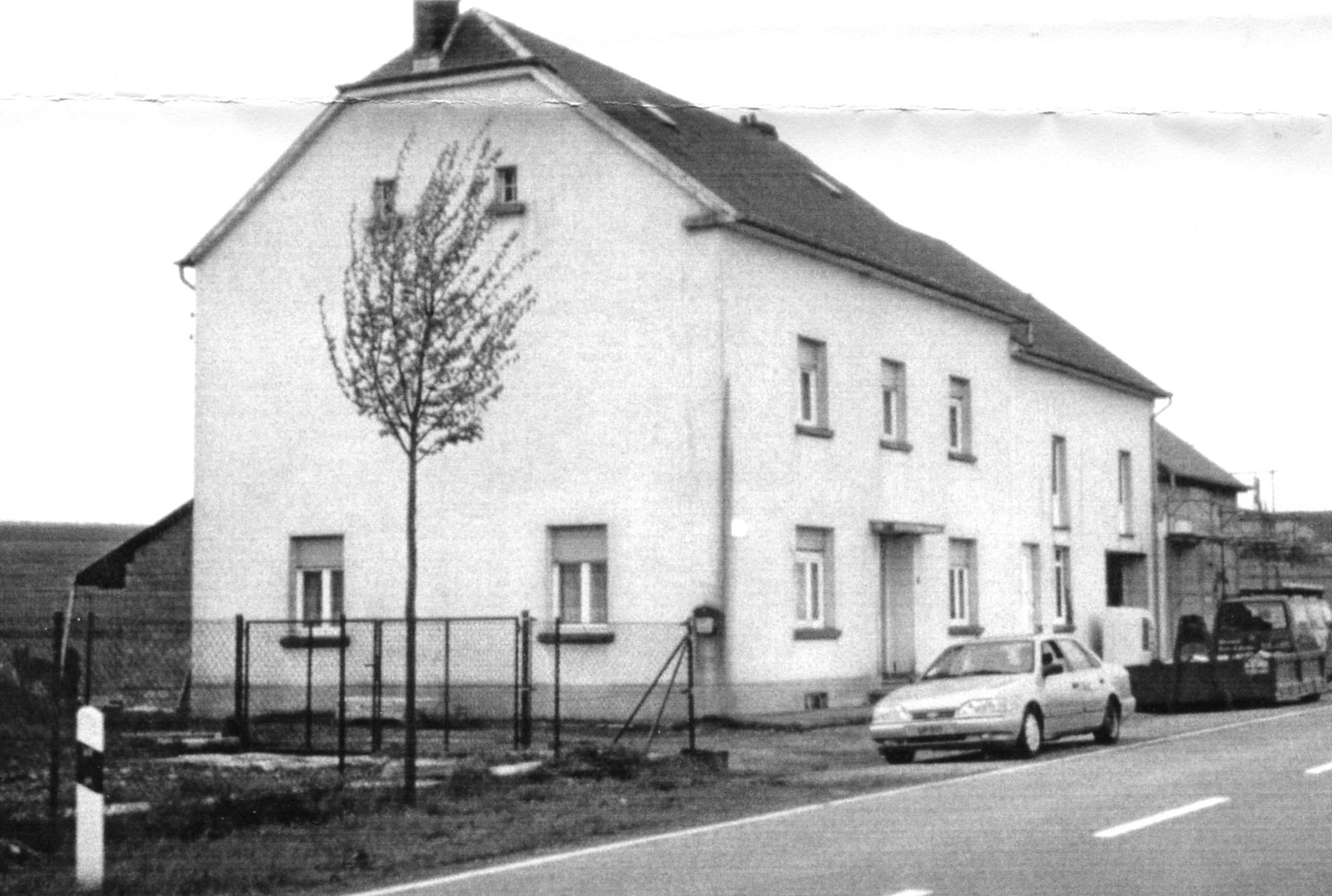
It was Christmas Eve at midnight, 1944, when we started out across a snow covered field to take the town of Eschdorf to relieve the pressure on Bastogne. Our squad walked up a road on the right side of town when all hell broke loose. Heavy and light German tanks painted white started running among us like fire engines looking for a fire. Three of us ducked into a barn filled with cows. The rest of my squad went to the left and took cover behind an old wooden barn. A tank’s machine gun fired right through the barn killing all nine men of my squad.
We were unnoticed in the barn until the afternoon when the three of us were moving in the barn past a large open doorway. Two white clad Germans were approaching to enter the barn. We saw them first and brought them down and dragged their bodies inside where they couldn’t be seen. From then on, all we thought of was an attack on our barn. Surely they would miss those two soldiers, but it was deathly quiet the rest of the day and through the night We survived by drinking milk from the cows and moving around to keep from freezing.
Today this house was that barn
The next morning, my buddy came running to me saying, “Hurry Ballinger, they’re coming!” We all ran to that side of the barn and peered out through the cracks. There was a hedge just beyond the barn, and there they were, white forms moving down along the other side of the hedge towards the barn. They seemed to be coming after us in full force. Fear struck me, but I didn’t panic. My body was numb and my mind was frozen with the thought of being among the casualties, because they weren’t taking any prisoners. The field outside was littered with dead GI’s. I kept peering through the cracks when I saw red parts moving also. After a few seconds, I gave a sigh of relief. Being a farm boy, I realized those white forms weren’t the white clad Germans, they were white leghorn chickens scratching for food. I could have shot my buddy, Gonzales, for scaring the hell out of us.
Soon after this, a battle broke loose at the other end of town. The sky cleared and the P-47’s of the 9th Air Force were bombing and strafing anything that was a target I decided we’d better make a run for it while the enemy was busy and before they bombed our barn. We ran about 1,000 yards across a cow pasture with barb wire fences to distant woods and safety.
Of course there is more to this story about the Battle of Eschdorf, but after reading many books, I still don’t know what really happened to the rest of my Company that Christmas Day. I left the line with trench foot and spent 2 1/2 months in a hospital, and was then assigned to limited service.
The highlight of every World War II weekend is our roster of Special Guest WWII Veterans. As they do each year, many of these veterans will speak at our various show speaker venues, relating their first hand experiences during the war. This is real “living history”, told by the men and women who lived it. We have thirty-one guests, including several who fought in the Battle of the Bulge, currently scheduled to attend.
Remembering World War II and the Battle of the Bulge by Philip Walsh, 2nd AD, 66th AR, Co C
I was 18 years old when I got my draft notice from President Franklin Roosevelt. It was 1943. The notice read “greetings from President Roosevelt” and went on to say I was drafted to the US Army. I had never been away from home before and I wondered if I would return home to Maine.
I was sent to Fort Devon’s, Massachusetts, for a few weeks where I received my army uniform and medical shots. I recall walking down a narrow hallway and got shots in both of my arms. The fellow in front of me passed out after receiving his. I can still hear the guys who had already got their shots saying “you will be sorry.” They were right. They also warned me to watch out for the square needle that’s left in overnight. I found out to my relief they were just kidding because I was a new recruit.
From there I was sent to Fort Knox, Kentucky, for 21 weeks of tank training. I remember being homesick, went to see the doctor, a major, who gave me some pink pills and said I would be fine. I wasn’t. I was still homesick. When our training ended we were sent to Fort George Meade, Maryland, for advanced training. Then I was sent to Camp Shanks, New York, to board the Aquitania for Europe.
I recall when we landed in Greenock, Scotland some Scottish girls greeted us and gave us muffins filled with meat. I took one bite and threw it out. It tasted awful to me. We left Scotland by train to England. By the time I arrived in England I was no longer homesick. It was more than 6 months since I left Maine. The war was underway, and by this time I figured I’d never get home alive.
When I was sent to France I was assigned to Company C 66 Armored Regimen, 2nd Armored Division. Afterward I was deployed to Omaha Beach in June – six days after D-Day. When I landed I asked the Beach Master if many men were killed. He said if anymore were killed no one would have gotten ashore. I remember one solider, in particular who landed on the beach with me. He was from the southern part of the States and was assigned to another tank because tank commander, Lt. Johnson, also from the south, picked him for his crew because of the connection to the south.
This was the first day in battle for us. Lt. Johnson’s tank was heading down a road between a row of hedges rows and ran over a mine. The explosion blew a track off the tank. The crew climbed out of the tank, started to crawl on the ground and a mortar shell landed on the back of the soldier from the south. All that was left of him was a piece of his fly and belt buckle. It was terrifying. Later I was told that Lt. Johnson was planning to get married in Paris after the war and arranged to have his bride’s wedding dress made from a parachute. Unfortunately he was killed outside of Berlin at close range by one of Hitler’s Youth with a Panzer Faust bazooka after he stepped outside of his tank.
We were never told where we would be deployed or given any details. That was one thing I didn’t like about the Army. After Omaha Beach we were sent to another location in France. We were on the front line for 21 days with the Germans firing at us from a train with artillery guns. I remember it sounded like a freight train coming at us. Three crew members and I barely left tank for the entire 21 days. It was too dangerous to stay outside for any length of time due to the constant shelling from the Germans. We had to be extremely careful.
The ground around the tank was all torn up from shelling and the mud was a foot thick. Every time someone left the tank they would get about two inches of mud on their boots. I remember getting mud dropped on my shoulders whenever the tank commander, a schoolteacher, climbed back into the tank after checking our surroundings. I was seated at the machine gunner’s seat and there wasn’t any room to move. It was very tight quarters inside the tank. I also recall when the lieutenant was injured after a shell struck the side of the tank when he was underneath trying to cook a meal with a Coleman Burner. He was taken to the aid station.
We had an opportunity to take prisoners. Seven Germans waving a white flag tried to surrender to us. One of our crew members fired at them and they took off.
After 21 days in France we were on the move again, this time to Germany. We arrived to a location that looked like a park and were able to sleep outside on the ground. One morning when I awoke, I noticed the tank was leaking. I looked inside and saw about three inches of gasoline on the bottom of the tank. A new replacement had changed the fuel filters incorrectly on both Cadillac engines.
Our next deployment was to Bastogne for combat at the Battle of the Bulge where I remained for the duration of the conflict. It was winter, freezing cold, and I drove an open top half track 100 miles in the pouring rain to Bastogne. Somewhere along the way I drove off the road. I was very tired, soaking wet and it was difficult to see because there were no headlights. I accidentally backed into Captain A.Z. Owen’s tank. He hollered “get that man’s name.” I was afraid he would send me to jail. He didn’t do anything.
When we arrived at our destination near Bastogne we were exhausted and cold. We pitched our pup tents in the freezing temperatures and went to sleep shivering. What amazes me now as I think back about sleeping in soaking wet, heavy Army clothes with my shoes frozen to the ground is that I never caught a cold.
Our tank was parked next to a farmhouse. The family living in the home felt sorry for us staying outside in the cold and they invited us in to dry our clothes and get warm. We stayed with them for several nights. Unfortunately one of the soldiers flirted constantly with the homeowner’s wife. The husband got fed up and told us all to leave.
One time we liberated a couple of chickens and some vegetables from a Belgium farmhouse and I cooked it in a 5-gallon can. You cannot imagine how good this tasted on a cold day especially after living on K and K rations. It was the best chicken soup I had ever eaten. A captain from Georgia said to me, “Walsh where did you get the chickens from?” Another soldier spoke up and said he got a package from the states. This seemed to satisfy the captain who helped himself to the soup without asking any more questions.
Later during the battle I was asked to drive this same captain in a jeep to a command post set up in a house near Bastogne. When we arrived we saw the T/5 Sergeant who had flooded our tank with gas when he was assigned to our crew in France. He was on duty at the command post and did not salute the captain in my jeep. The captained yelled to the T/5 sergeant “Salute me.” He obeyed.
When the Battle of the Bulge ended, I was deployed to Berlin. We were the first troops to arrive in Berlin after World War II ended. I was transferred to the 12th Armored Division and sent to Marseilles, France where I prepared to go home. It was 1946. I am proud to have served my country, but I wouldn’t want to go through this again.
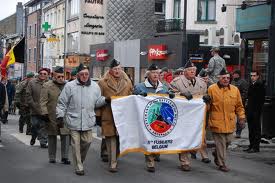
A few days after the liberation of Belgium in the Tresignies Barracks of Charleroi on 7 October 1944, it was learned that all the men in the barracks were war volunteers. The enlistment had taken place in Mons on 23 September 1944 after the call of the Belgian government arrived from London. The 5th Belgian Fusiliers Battalion was the first unit of the Belgian Army formed on the national territory since 1940. The Tresignies Barracks had been occupied by the German Army from May 1940 until the liberation in the earliest days of September 1944. Most of the officers, NCOs and men were ex-Resistance fighters originating from the province of Hainaut. Some Belgian instructors landing in Normandy with the Allies completed the number of officers.
Rapid but intensive training was conducted in the Tresignies Barracks and on the fields around the coal mines around the town of Charleroi until 13 December 1944, date of the transfer of the battalion to the 1st US Army. On same day the battalion was sent to the Ardennes in Spa, Verviers, Malmédy, areas, which became the theatre of the Battle of the Bulge (North sector) three days later. From the 16 December 1944 the 5th Belgian Battalion of Fusiliers became mixed in the Allied operations against the Germans in the Battle of the Bulge.
The unit operated in the areas of Verviers, Remouchamps, Stavelot and Malmédy and was included in the patrols along the front line, protecting the American anti-tank posts rapidly deployed. While passing Malmédy (Baugnez) on 17 December, a few minutes before the 285th Field Artillery Observation Battalion convoy, a platoon of the 5th Belgian Fusiliers escaped the massacre of the American convoy by Kampfgruppe Peiper. The Belgian platoon was in charge of the protection of the installation and convoys of the 200th US Quartermaster Company supplying gas for the tanks on the front line. The same platoon escaped again from the Germans around 0300 hours on 22 December in the forest east of Saint-Hubert, and a section of this platoon reached Bastogne with a small gasoline convoy for the 101st Airborne Division.
This section then succeeded in avoiding the German encircling through the road to Neufchâteau in the dark of the night. A Company of the 5th Belgian Fusiliers patrolling along the Vesdre railway captured German paratroops. Germans wearing American uniforms are also captured by the 5th Belgian Fusiliers between Remouchamps and Stoumont when the Kampfgruppe Peiper arrived in this area. On several occasions during the first days of the Battle of the Bulge the 5th Belgian Fusiliers operated on the first line before being relieved by American units. This happened namely between Stavelot and Malmédy during the evacuation of the gasoline dumps under enemy fire, also between Remouchamps and Stoumont when Peiper broke through, and in Cour and Andrimont where two sections of Fusiliers set up a defensive post when the enemy entered La Gleize. In Stavelot late in the morning of 18 December a platoon of 5th Fusiliers set fire to the first gasoline dumps along with soldiers of the 526th Armored Infantry Battalion and 825th Tank Destroyer Battalion on the old road to Francorchamps when Kampfgruppe Peiper penetrated Stavelot.
There are then lengthy periods of guard duty and patrols in the cold and snow; these are hard times for the unit unti1 25 January 1945. There will be dead, wounded and sick. After a short rest period and reorganization in the Verviers, Pepinste and Aubel areas, the 5th Belgian Battalion of Fusiliers penetrate into Germany in the first days of March 1945, cross the Rhine on a pontoon bridge at Königswinter between Bonn and Remagen at the end of March. The unit was in charge of protecting the communications lines of the 1st US Army in its rush to the East.
The Belgian Fusiliers are primarily used for security along a portion of the south flank of the Ruhr pocket where a German army is trapped. The 5th Fusiliers maintain their progression with the 1st US Army taking many German prisoners. When the war in Europe ended 8 May 1945, the Belgians were spread along the Fulda and Werra rivers southeast of Kassel where the Russians have arrived on the east bank of the Werra river. The 5th Belgian Battalion of Fusiliers returned to Belgium at the end of June 1945, and the unit demobilized on 30 November 1945. Most of the members return to civilian life.
Title: From Generation to Generation, the Legacy Continues…an Event Honoring Holocaust Survivors, Rescuers, Liberators, and their Descendants
Date: Sunday, June 8, 2014 Time 10:00am – 4:00pm
Location: Hofstra University, Hempstead, NY
This event will celebrate the legacies of Holocaust Survivors, Holocaust Rescuers, and WWII Liberators. Participants will include members of these three groups, their children and grandchildren as well as the general public. The program will provide networking and assistance opportunities for Holocaust Survivors from agencies such as SelfHelp and Blue Card.
This event will celebrate living witnesses to the Holocaust and, according to Generations of the Shoah International (GSI, the world’s largest Survivor association), is unprecedented for the east coast. Numerous organizations are helping to promote this program, including United States Holocaust Memorial Museum, Association of Holocaust Organizations, Claims Conference, GSI, American Jewish Committee, Hadassah, Museum of Jewish Heritage, Association of Holocaust Survivors from the Former Soviet Union, American Gathering of Jewish Holocaust Survivors and their Descendants, Jewish Community Relations Council, and 3GNY.
Keynote speakers will address the conference audience followed by break-out sessions which will consist of educational presentations, historical films, author and book discussions, eyewitness testimony, special exhibit displays, and pedagogical resources.
In addition to educating the public about the history of the Holocaust, one of the primary goals of this conference is to provide opportunities, services, and friendship to Survivors that are without relatives or resources. Thus, special efforts will be made to bring isolated and indigent Survivors to the event and help them connect with our Holocaust Memorial and Tolerance Center to cultivate relationships and community.
For additional information, please contact:
Beth E. Lilach, Senior Director of Education and Community Affairs
Holocaust Memorial and Tolerance Center
Welwyn Preserve
100 Crescent Beach Road
Glen Cove, NY 11542
Ph. 516.571.8040 x 105 bethlilach@holocaust-nassau.org