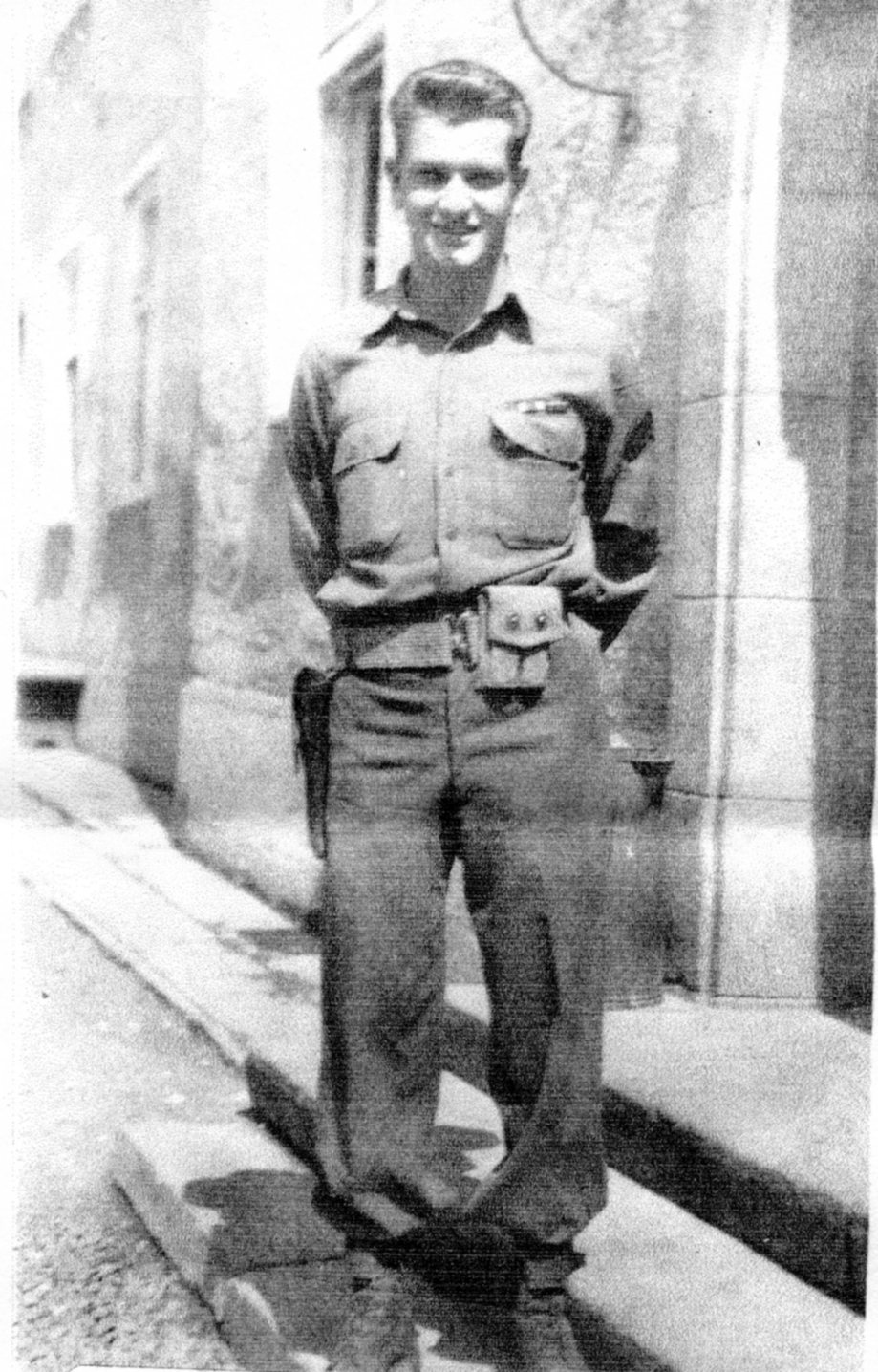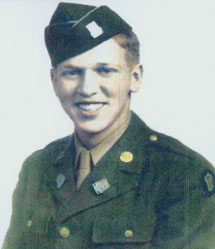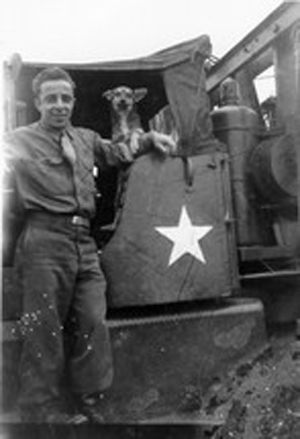
The Bulge, Warren M. Jensen, 793rd FAB

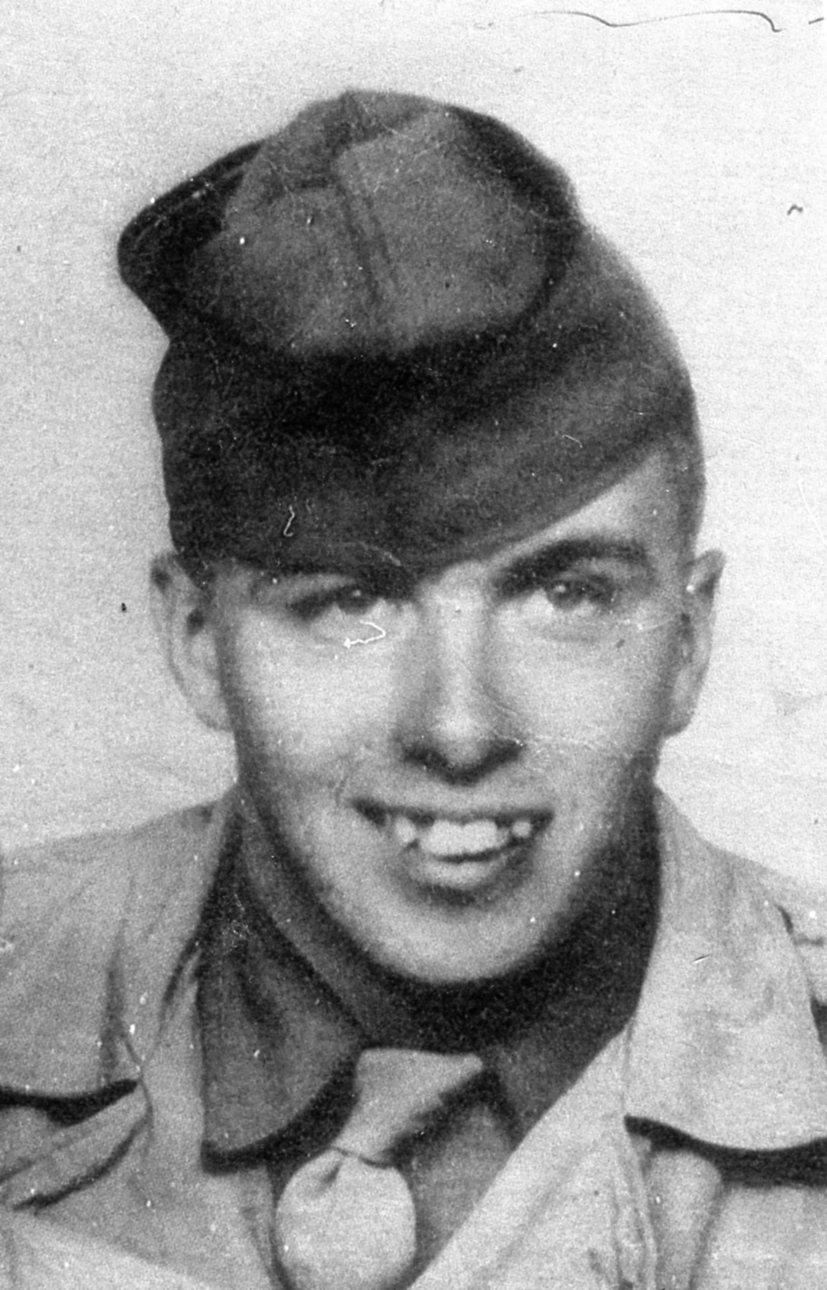
The Ardennes Offensive began on December 16,1944. The weather was bitter cold, foggy and dreary. All was quiet until Dec. 16 when the Krauts attacked. There was chaos that slowly resolved itself into grim determination, desperation and numbness…you got it. “The Bulge” refers to the progress of the German offensive and to how far they pushed our lines back. Winston Churchill is quoted as saying, “This is undoubtedly the greatest American battle of the war and will, I believe, be regarded as an ever famous American victory.”   Two million men were involved in this the largest land battle the US Army has ever fought.

We were brought down to the St.Vith area. Our missions depended on the targets spotted. We wouldn’t fire non-stop unless necessary. We were limited to the ammunition available to us. Sometimes we’d get a FIRE MISSION at various times day or night. At chow time half of the gun crew would go to the rear to get fed so the rest of us had to carry out the mission. Then, sometimes, by the time we had a chance to be fed, all the food was gone so our dinner was sometimes just a piece of bread and coffee. Or we ate combat rations.

As far as getting any hot food from December 1944 to February 1945 our cooks were able, once in a while, to bring hot food up in insulated Mermite cans. The US Army has a tradition of always trying to get a turkey dinner to the troops on Thanksgiving and Xmas with all the trimmings. Kinda hard to serve it up properly in that cold weather with everything served onto one’s cold mess kit all together with dessert slopped on top. That was special. Night time could be beautiful. The searchlights would go on to create artificial moonlight for our Infantry lads. There would be flares fired and the magnesium flares would light up an area as they came down on little parachutes.. Machine gun tracers from our anti-aircraft guns would make pretty patterns in the sky because every 5th round had the rear hollowed out and packed with a chemical that glowed when fired. All this was to help the gunner zero in on his target. And the sounds that filled the night: Of weapons firing by the Infantry machine guns, mortars going off and other artillery pieces firing. And then the krauts would send over “Checkpoint Charlie” at night. He’d come over, drop a few flares and take, we think, photos, drop a bomb or two, and with his distinctive engine sound disappear back to his own lines. Sounded like the engine needed a tune-up.

One memory I’ve had of this Xmas time was firing a mission and the FDC guys (Fire Direction Center) said, “You guys know that tonight’s Xmas Eve?” That’s how we found out during the winter of ‘44. Since our gun positions were generally in the open or at the edge of trees we were pretty well exposed to the chilling wind. Frostbite casualties were common due to a lack of proper clothing and boots. I wouldn’t know how cold it got without having a thermometer but it was the coldest winter in Europe in 40 years. Records show that temperatures plummeted from 40 degrees down to minus 10 to minus 20 F at night. Brrrr.

Bradley and even Ike felt the war would be over by Dec. 1944 so they had the manufacturing and shipment of winter clothing stopped. Some supplies were in warehouses in France but the rear echelon guys got into those. All we had were leather boots and were supposed to massage each other’s feet to prevent frostbite. The medical Dx was “frozen feet” but in WWI it was called “trench foot”. Not much more than commiseration with my buddies held me together mentally during times of hardship as we were all in it together. Our bedding was just a wool Army blanket each. Yes, just one blanket. In December they issued us a mummy style sleeping bag, which was a blanket with an outer shell and a zipper. Eventually they got wool gloves, a wool scarf, a sweater and galoshes or overshoes to us at the front. It was joked that it was so cold that it would freeze the balls off a brass monkey. Don’t know where that expression came from but it always got a laugh.

After we would get our howitzer into firing position, next we would did a hole for the projectiles and powder charges, and then dig our personal fox holes, then dig a small slit trench, the width of a shovel blade, and thus we could squat and straddle the trench, cover it with some dirt we had dug. TP was slid onto the handle of the shovel, which was jammed into the dirt we had dug out. It was quite an experience to squat in icy cold weather and expose your butt to the cold.

The Belgians generally cleared out as they were fearful of the reprisals from the Germans. Those few who stayed opened their homes to the troops. If we stayed for a few days it would give us a chance to contact a farmer in France, N. Belgium, or Holland for cider, wine, or females. We tried to lure them to our area with promises of food, cigarettes. Not much success. We could not talk with any German for fear of a fine of $65 (a months’ pay for privates). On December 23 the skies finally cleared and all we heard were aircraft engines and saw contrails and there was cheering at the event. Our guys parachuted in ammo, food and medicine to the encircled troops at Bastogne but unfortunately, the Krauts got some of the chutes. After the war a German soldier reported that that he found a canned Hormel ham hanging from a parachute and had dined with a Belgium family that Christmas.

We pushed the Germans back into Germany and the Ardennes Offensive ended the beginning of February 1945. When December weather comes in with its cold and fog, even after 68 years, my thoughts drift to the Bulge experience and I shiver as I remember those Bulge weather days of suffering. We moved eastward quickly and eventually found ourselves below Magdeburg, Germany in support of the 2nd Armored Division and the 83rd ID which both had bridges across and troops on the east side of the Elbe river until we were ordered to hold our positions. This is now April 1945.

We went “scrounging” in Germany but couldn’t go far. Some guys found weapons or other souvenirs. If we found food we feared it might be poisoned. Krauts knew we scrounged for wine and schnapps and would urinate into those bottles. Once in a small town in Germany I went scrounging for a door to put over my foxhole to prevent shrapnel from coming in. The house was untouched with even a beautiful crucifix on the wall and I spotted this grand piano. I was angry at the Germans so, in a fit of adolescent stupidity, I destroyed a good part of the piano with my carbine,so the residents would have something to suffer with. We prepared to move for occupation duties in Giessen, Germany.

We liberated several German concentration camps and witnessed the results of the atrocities. Unfortunately we gave the starving inmates our high calorie rations which caused them distress and even death. This liberating of POW and concentration camps came in our drive to the Elbe River. VE Day came May 8 and the Russians on the east bank of the Elbe River were celebrating. We could hear them yelling and firing into the air with their weapons. Flares were going off and an accordion was playing. I decided to take a lone journey across the pontoon bridge one day and got a ride in a jeep. On the east bank of the Elbe I saw a column of rough looking Mongolian troops, female traffic cops, and their kitchens pulled by horses. I thought, “I sure hope we never have to fight them.”  Ourselves, on the west bank of the Elbe River did no celebrating as we were due to ship out to battle in the Pacific.

In Giessen we guarded first the Polish and then the Russian DPs (Displaced Persons) or manned the checkpoints on the Autobahn. One time we took a trainload of Russian DPs packed into boxcars into the Russian Zone. The four of us had a boxcar to ourselves, which was loaded up with Ten-in-One rations. Our journey was overnight to the edge of Czechoslovakia. We’d distribute the ration boxes to each car at mealtime stops. Our unit was broken up based on an individual’s point system and we were sent to one of the “cigarette camps” near La Havre for weeks of idleness while we waited for transportation home by ship.

Warren M. Jensen
Warren M. Jensen

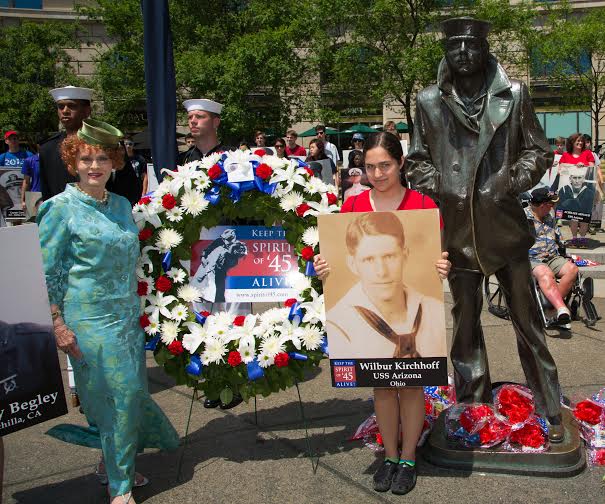
Mary Waller, Associate lays wreath at the Lone Sailor Statue

Greater Austin Council National Director Lays Wreath at the United States Navy Memorial, Keeping Alive the Spirit of ’45


Mary Virginia Pittman Waller on left

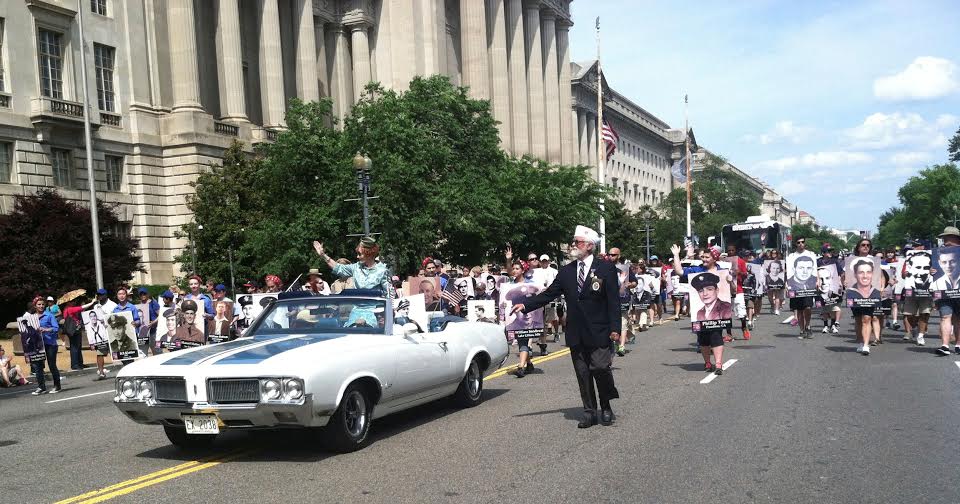
 Greater Austin Council member, Mary Virginia McCormick Pittman-Waller, a National Director of the Navy League of the United States, represented that organization in the National Memorial Day Parade and wreath laying ceremonies at the United States Navy Memorial in Washington, DC on Monday, May 26.  She was part of a special parade unit honoring the fallen of World War II organized by “Keep the Spirit of ’45 Alive”, a national grassroots coalition that is raising public awareness about Spirit of ’45 Day, the annual day that honors the men and women of America’s “Greatest Generation.”   Ms. Pittman-Waller was accompanied by Dr. Richard Small, Western States Commander of the Military Order of the Purple Heart and Captain Jerry Yellin, US Army Air Corps, national spokesman for “Keep the Spirit of ’45 Alive” and the pilot who flew the final combat mission of WWII in a P-51 Mustang.  They were joined by more than 300 youth volunteers who carried photos of individuals who were posthumously awarded the Medal of Honor in WWII and those who were killed in action during the attack on Pearl Harbor. The Spirit of ’45 Day entry also included a 34 foot motor home that has traveled more than 20,000 miles throughout the country as part of a national campaign to publicize events planned for 2015 to commemorate the 70th anniversary of the end of WWII.


Washington DC parade

The Spirit of ’45 Day Express visited the Alamo in San Antonio in February, and will be returning to Texas in the fall to visit several WWII memorials and museums.  The wreath laying ceremony took place at the iconic statue of “The Lone Sailor” at the United States Navy Memorial.  The United States Navy Memorial honors the men and women of the Sea Services past and present; Navy, Marine Corps, Coast Guard and US Flag Merchant Marine.  For Ms. Pittman-Waller personally, it was a day to was remember and honor her own late father, Dr.  James Edward McCormick Pittman of Utopia, Texas who was a member of the greatest generation and served as a US Army (Col.) medical officer during the Normandy Invasion and the Battle of the Bulge. He received the Bronze Star for service for gallantry during the Battle of the Bulge.  Ms. Pittman-Waller is an Associate Member of the Battle of the Bulge Association.

Article and photos submitted by R. Glenn Looney, Chairman of the Board, Greater Austin Council, Navy League of the United States

Days Not Forgotten, Wilbur Halvorsen, 6th AD

Days Not Forgotten December, 1944
Wilbur (Web) Halvorsen
6th Armored Division
50th Armored Infantry Battalion
Company A

[The story in the February’ issue by Benjamin A. Goodin, “Time on Target, ” Les Bois Jacques, Bastogne was of great interest to me.] I had tied in with the l0lst Airborne Division. At that time we were spread out mighty thin. We lost more than half the men in our company, including all of our officers. First Sergeant Remmer was acting company commander. All the men in the outfit were being pushed to the limit. We were cold, tired and hungry. For eight days, our half-track with our sleeping bags couldn’t reach us forcing us to take shelter at night in a snowdrift. If we were lucky, we could find a deep dug German foxhole with logs over the top.

While we held this line I could hear German activity in the wooded area 400 yards out in front. The sound of tank engines turning over increased as the day wore on. We sent the word back and hoped for some TD help, but nothing happened. I made the rounds of the men as they huddled in their slit trenches, encouraging them to move to induce some circulation, or at least to work their feet against the side of the trench to keep them from freezing. Many developed frozen feet. I kept a pair of socks in my helmet liner, and changed whenever I had the opportunity. I saw men with frozen feet. It was terrible. We were told to hold the line at all costs, so we waited it out. Night came. We were exhausted, and tension kept building up, knowing that we could be hit at any moment, surely at daybreak.

At night the Germans sent up flares that turned the darkness to day. Artillery fire was heard off and on. Each time we knew the attack was on, but nothing happened. I was one of the few left of those who disembarked from the LST’s at Utah Beach, so I had some battle experience. Some of the new replacements were only there a few days. I can remember to this moment the look of fear and anxiety in their eyes. A young replacement that I put on guard duty could stand it no longer. Thinking he would be sent to the rear, he shot at the tip of his finger. The rifle blast and velocity took most of three fingers. So it was as we waited it out.

Sergeant Remmer came by with orders for everybody to stay put in their holes. He had heard that something was afoot, and would let me know. It wasn’t long in coming. The sound of artillery firing behind us was something I never will forget. The shells from the 105’s and 155’s kept coming and coming, whistling over our heads. I thought it would never stop and it was like music to our ears. All were on target to the wooded area in front of us. No one could survive the intensity of the blasts. That TOT that Benjamin Goodin wrote about saved the day for us. We were lucky.

Shortly after, a patrol was sent to view the damage. 1 am happy to this day I wasn’t on that patrol. The slaughter was indescribable. It was a massacre, littered with broken bodies and random wreckage. Many bodies were hanging from tree branches. It was utter and absolute devastation. Those still living would have minds shattered beyond repair. Men returning from the patrol were speechless. They were sick; I felt sorry for them.

The following incident happened a few days later. The Germans were still probing for an opening along the entire front. We found ourselves again on line at the edge of a wooded area. The Germans had their tanks lined up opposite us. We could see them, through the trees in the woods across from us. I saw one of our own tanks lined up with them. Sergeant Remmer sent back for firing power but it wasn’t promising, so we just waited. Then something very strange happened. A G1 came running out of the woods from the German side, waving his arms in desperation, telling us that we should get out of there as we didn’t have a chance. He said that he was released by the Germans to warn us to move out or we would be annihilated.

His uniform was a mess. He wore no helmet, and his hair was down in front of his face. He spoke good English, and loud enough for every one to hear. Some of our new men did make steps to the rear before they were halted. It didn’t take long for me to figure it out. After calming him down, I backed him against a tree and started asking him questions for him to admit he was German. I sent him to the rear, but not before a couple of our men ordered him to exchange uniforms with a dead German. He was correct in saying that we were about to be attacked.

It wasn’t long before a Tiger tank came moving slowly across the frozen ground in our direction. We had only our Ml rifles. It was strange that only one tank came forward. But, one or ten were at its mercy. However, the good Lord was with us. From the rear we heard a tank destroyer, crashing through the pine trees, dashing in front of us. It stopped, whirled, and fired at the Tiger. He then pulled back after one shot and repeated the operation down the line. The tank with its heavy armor wasn’t knocked out. It went into reverse and made it back to where it started. The attack was called off. After dark we pulled back to a better defensive position. It didn’t allow us any rest or ease the tension.

The next day we were again on the attack.

American Legion Magazine reps to attend VBOB reunion

Representatives of American Legion Magazine will be accompanying Battle of the Bulge veterans during their reunion in Columbia SC for a story for the magazine and website.

Henry Howard, the deputy director of the Legion’s Media and Communication Division, will conduct the interviews. Brett Flashnick, a Columbia, SC area photographer and videographer, will be handling the photo and video duties.

Howard and Flashnick are willing to work around the reunion schedule. They will be available Saturday and Sunday morning, and other times convenient to the veterans. Battle of the Bulge veterans are welcome to contact Howard in advance to set up a time, or meet up at the hotel. Howard can be reached at 317-630-1289 or hhoward@legion.org.

The American Legion, which is the nation’s largest veterans service organization, is dedicated to honoring America’s past and present war heroes by sharing their stories in print and online. In the past, Howard has interviewed and written about the Doolittle Raiders, Medal of Honor recipients and survivors of the USS Indianapolis.

The 87th ID at Biddulph Moor, England-Oct-Nov 1944

The 87th Infantry Division was a relative newcomer to the US Army. Most of the
Officers, commissioned and Non-commisioned, were new to the Army and the soldiers were primarily of young college age as the result of a change in approach on the part of the army in which the participants in a program designed to train engineers for the Engineering Corps were transferred to the Infantry when demand for the latter skill intensified as the result of the German Invasion of France.

The Engineering Training Program was known as the US Army ASTP with many
of the participants underage (less than 18 years of age] for the regular army and
were carried in a reserve category known as the ASTRP. The end result was a
division with a preponderance of very young soldiers with most 18 years of age. The
87th and probably the 106th Divisions were probably the youngest soldiers in the US Army.

Members of the ASTP completed their Basic Training at Fort Benning GA and
then were assigned to the 87t [and the 106th] when the ASTP was discontinued. The
87th left Fort Jackson in mid October 1944 and were received on the Queen
Elizabeth and the H.H. T Pasteur for the trip to England. We arrived at Gourock
Scotland on the Firth of Clyde on 22 act 1944 and were transported via train to the
Biddulph Moor area to regroup and reequip. During the 23-27 November period
the 87th departed for France and eventually combat with the German Invaders. We
had a great month with the people of Biddulph.

During our sojourn in England prior to being shipped to France, D Company-
345 Infantry [my company] was billeted in an old stone velvet mill on the moors
outside of Biddulph. There were no sanitary facilities except for an outside latrine.
At night, everyone kept a #10 can underneath one’s bunk to use for middle of the
night nature calls and it would be emptied in the morning when you went to the
latrine for the AM activities. Some unfeeling scoundrels would use their neighbors
can and occasionally would fill it to the point where the rightful owner would find
it full when the need arose at 100 or 200 AM. Needless to say, the language that ensued could not be described in polite terms as the latrine was a good 100 yards outside and it was overcoat weather.

The velvet mill also lacked shower or bathing arrangements and we were transported to a nearby coal mine to use the shower facilities. About 20 or so of us soldiers would position ourselves under the shower heads and the water would be turned on and off from a central spigot. There were no individual controls. It was strictly a case of wetting down, soaping up and then showering off after a quick washup. It worked!! Any alternative was not in the cards and we managed to keep clean especially for the Saturday Night Dance back in Biddulph that the residents arranged for this young group of soldiers. We appreciated the effort and we hoped that the young ladies also received some gratification.

The bus route from town terminated at a crossroads pub (The Rose & Crown] about a mile cross country from the mill and most of us would get a cone of chips in town prior to boarding and have them with a pint or so of good English beer before commencing the trek on foot back to the mill. We had ample opportunity to restock our bladders with this arrangement. The people were very friendly in the Town of Biddulph and I keep fond memories of my sojourn there. I was especially intrigued by the narrow canal boats that hauled coal to the nearby potteries and pottery back. The canal’s were very narrow. I understand that most of these boats have been converted to tourist use.

We were sorry to leave in late November as the people of Biddulph has been so kind to we young soldiers. A number of us returned following the war for a visit and especially a ride on the converted Canal Boats that became so very popular during the post war period. My Wife Carol and myself took advantage of the opportunity later in the 1970’s when we undertook a driving tour of England and Ireland. Biddulph was just as I had remembered it and the Canal Boat ride was wonderful.

Girard Calehuff, 87th ID, 345th IR, Co D


I will always have a fine memory of Happy Days in Biddulph.


Remembering my father Tech. Sgt. Vincent A. Rella

It is hard to believe that 10 years have passed since the World War II Memorial Dedication my now-late mother and I attended with the Veterans of the Battle of the Bulge.   I recalled this experience from that wonderful tribute to the Greatest Generation, and I’d like to share it with you:

Tech. Sgt. Vincent A. Rella, 1st Army, 7th Corps, 507th Engineer Company, Light Pontoon, Combat Engineers

The letter written nearly 60 years ago from Belgium after the Battle of the Bulge remained yellowed and faded among my father’s Army mementos until his death in 1996. At one time, I had it translated for him, and tucked it away in an album to preserve it.

And there it stayed until I decided to bring a copy of it with me to display in the Memorabilia Room at the 2004 VBOB Convention with its simple, but caring message, addressed to my father and the three other soldiers who stayed at the Closset Family’s farm for one week before returning to the front:

“We often speak about you and the time we spent together. We are well and hope you are too…If you have a couple of days’ leave in Belgium, we’d be happy to welcome you (again).”

After visiting Normandy and Belgium with my mother in 2001, and then meeting the Belgian students and veterans at the VBOB convention in May 2004, it haunted me. Was this wonderful family still alive?

I found the answer through the May 2004 issue of the The Bulge Bugle – when I spotted the blurb about the U.S. Army Descendents Association (USAD). I then sent a copy of the letter and its translation to the group’s headquarters in St. Simeon, Belgium.

Less than a week later, I received an e-mail from Marlyse Larock, secretary of the three-year-old organization she and her husband Jacques founded after he searched for his American father – a U.S. soldier named J.F. Chadwick — and wanted to help others do the same.

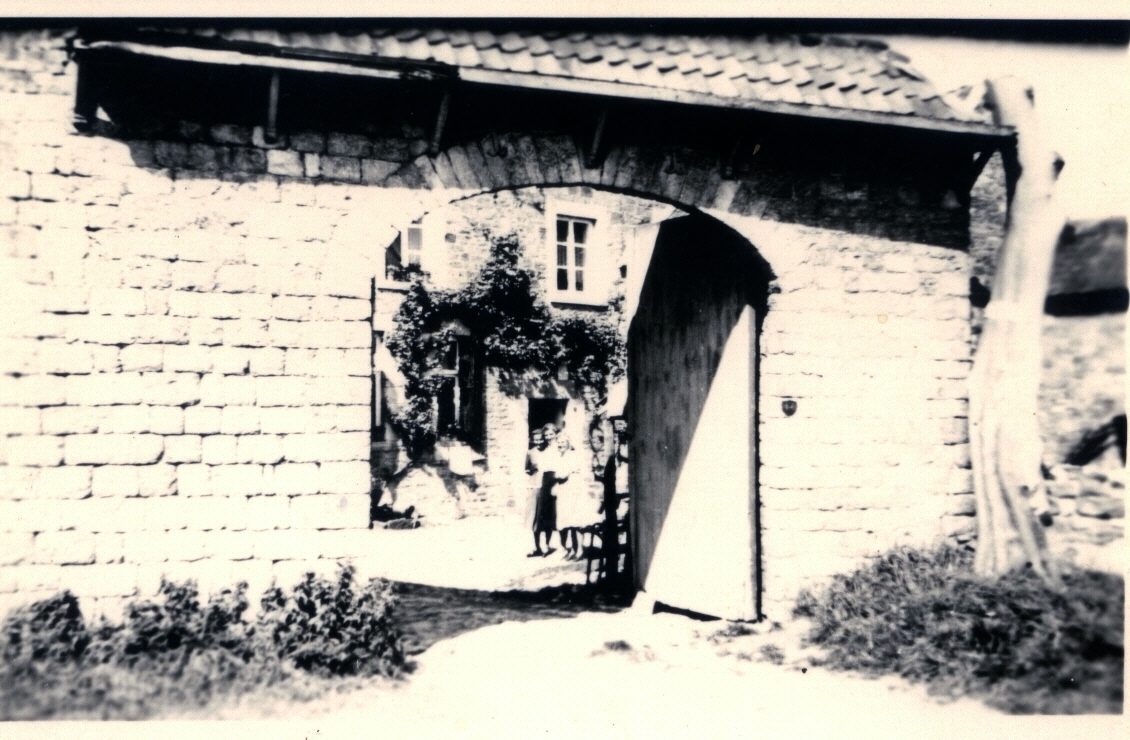
The Closset Family’s farm near Liege, Belgium (1945)

It was good news. Marlyse found Marie Therese Closset, who was a teenager when she wrote the letter on behalf of her family (five aunts, an uncle, and a sister). Marie Therese, who was 79 and living with her husband an hour from the USAD headquarters, was delighted to hear from me. She said the family worried about the four soldiers and always wondered what had happened to them. She was glad to hear my father made it home.

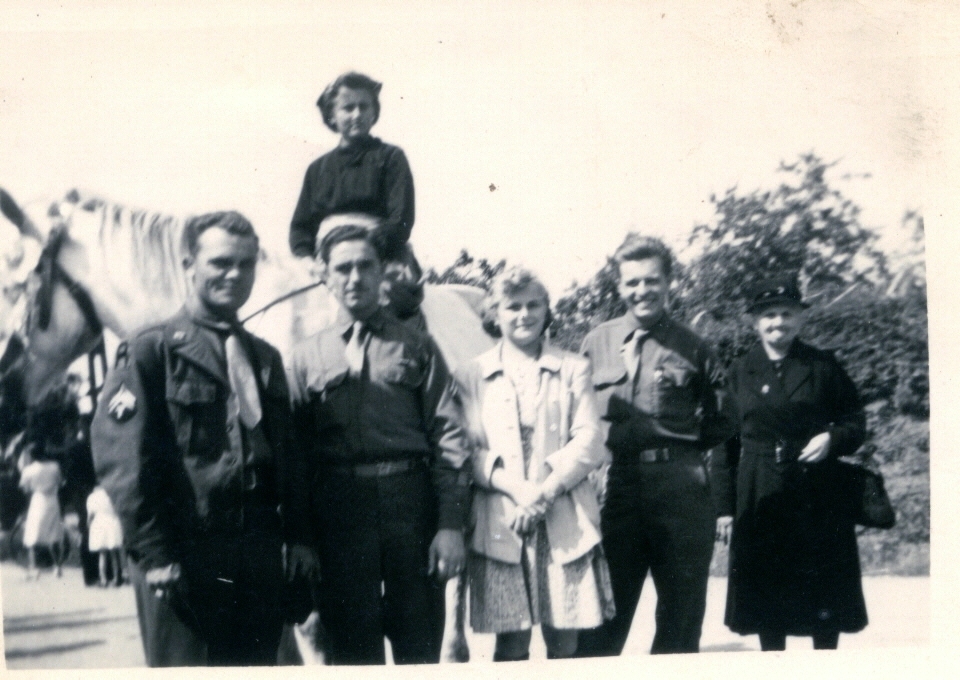
Marie Therese Closset (on horse) with her sister, her aunt, and three other soldiers from the 507th Engineer Company

With Marlyse as our go-between (aka translator), Marie Therese sent me a photograph of three of the soldiers (my father apparently took the picture) and photographs of the Closset Family’s farm near Liege, Belgium. The truck in which the soldiers arrived was hidden behind the farm under a camouflage cover, she said. Seeing these old photographs brought it all to life for me

In turn, I sent her photographs of my father, a newspaper column I wrote about him and his fellow veterans, and copies of his two entries in the World War II Memorial Registry.

Thank you, The Bulge Bugle, for helping me learn more about my father’s war experiences and honoring his memory.

Best regards,
Nancyann Rella, Associate

Daughter of Tech. Sgt. Vincent A. Rella, U.S.Army, 1st Army, 7th Corps, 507th Engineer Company, Light Pontoon, Combat Engineers

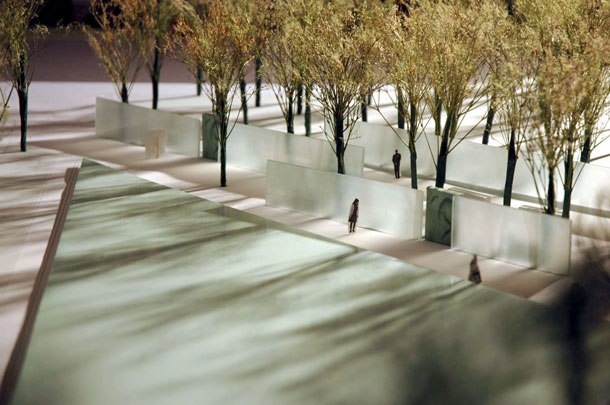
The American Disabled Veterans for Life Memorial

dav-design-conceptThroughout our nation’s history, service men and women have gone bravely into battle, risking their lives and livelihoods, sacrificing their safety to defend America. When their duty is done, many return home to life as it was. Sadly, for over 4 million veterans seriously injured in the line of duty, leaving the battlefield does not mark the end of conflict. These permanently disabled heroes often carry home life-altering disabilities – stern reminders of the price of freedom.

America’s disabled veterans have honored us with their service and selfless duty. It is now our turn to honor them.

For the first time, America will pay tribute to some of our most courageous heroes – our disabled veterans. The American Veterans Disabled for Life Memorial will celebrate those men and women who may be broken in body – but never in spirit.

Click http://www.avdlm.org to learn more about the Memorial

The Bulge-Donald Schoo, 633rd AAA

Donald Schoo, 633rd AAA

December 16, all hell broke loose: the start of the Battle of the Bulge. The Germans were everywhere. They hit us with 1900 heavy artillery, 250,000 soldiers, 100 large tanks, and other assault weapons. On an eighty-mile front we had 75,000 men in this area: the Ardennes. The weather was very cold, 10 to 20 below zero, heavy wind and snow. The sky was overcast so our Air Force could not come to help. Everyone had frozen feet, hands or faces. We were low on food, ammo, gas, and our heavy winter clothing had not arrived. Most of our communications were knocked out. “We were all on our own fighting as single units. We found other units and organized into a unified fighting force as best we could. The Germans at this point were desperate. They were using every combat unit they had left to try to stop the Allied drive into mother Germany.

The SS were inhuman at this point, they killed everyone; old men, women and children. They burned everything and shot POWs. This was the only time I saw American troops kill German soldiers that tried to surrender. If they wore black uniforms of the SS, they were shot. At Baugnez, Belgium, the SS shot over 100 American POWs. This was called the Malmedy Massacre because there was a sign at Baugnez pointing to Malmedy, which was two or three miles down the road.

I cannot describe the cold, hunger and atrocities that the Allied troops were subjected to in the Battle of the Bulge from December 16, 1944, until January 25, 1945. We fired and ran, bled and ran, until we were out of ammo and gas, then we looked for American tanks and trucks that were disabled and took what we could use from them. One day we got lucky, several boxes of K rations were on a truck. With very little food we would heat water (from snow) and drink that.

Our last fire mission in the Battle of the Bulge was to support the 4th Armored Division and the 318th Infantry of the 80th Division, break through, and relieve the 101st Airborne at Bastogne, Belgium. When the Battle of the Bulge ended, 81,000 allied and 125,000 Germans were dead. This battle broke the back of Hider’s army. We met only pockets of resistance after this battle. Christmas 1944 we were still in the Battle of the Bulge just outside of Bastogne, Belgium with snow knee-deep and cold as hell. We had cold K rations for dinner. I would have given anything for a hot cup of coffee and a pair of dry socks. We were hit by mortars and heavy artillery all day. I was sure it would be my last Christmas, but thank God I lived to see the New Year come in. Between Christmas 1944 and New Year’s Day 1945, we were under fire, in fact, we were being shelled continually, until the middle of February 1945, by German tanks and infantry mortars.

After February 1945, the war changed and we went on the offensive. One day when I was on guard duty, I went out to my half-track to relieve the man on guard. He couldn’t get out of the gun turret. His overcoat was wet when he got in and it froze so he couldn’t get out. The day I froze my feet, hands, and face, our half-track hit a land mine and blew the right front wheel off-—it was below zero, windy and snowing. We went into a woods looking for shelter. We didn’t find any so we cut some branches off the evergreen trees to make a windbreak. I went to sleep and when I woke up I didn’t have any feeling in my feet or hands, and my face was gray. It was daylight so we started a fire. Most of the crew had frozen parts. The fire saved us. I know several soldiers froze to death that night.

The next day we destroyed our machine guns, set fire to the half-track, then we walked until we located our outfit 633 AAA in a town. There, we got another half-track that had bad luck also, but that crew was all killed. We fixed two flat tires and we were back in action. Two days later, we helped liberate the 101st Airborne at Bastogne, Belgium, near Pont-a-Mousson, France, on the Moselle River. We heard a very odd sound. This was the first time I saw one of Hitler’s buzz bombs. It went directly over us at about three hundred feet. It was noisy but not as bad as the German screaming meemies. They sounded like a thousand teenagers at a rock concert in a small room.

War is hell—hot and cold. Normandy was hot hell—the Battle of the Bulge was cold hell. You are always cold or hot, it is raining or snowing, you are thirsty, tired, have diarrhea, your feet are sore, you are dirty, itchy and you stink. You hurt all over and chafe, afraid because a few miles away, an enemy artilleryman is about to kill you, or just over the next hill an enemy infantryman is going to try to kill you before you kill him. Before the firefight starts you can step on a mine and blow your legs off. Your buddies are always getting injured, your hands are sore and bleeding, Ups chapped; there is no privacy. Everyday happenings are twisting an ankle, smashing a thumb in the bolt of a weapon, cutting a hand on a ration can, chipping a tooth, tearing off a fingernail trying to shore up the ceiling of your underground hold. You get rheumatism from living in wet foxholes and sleeping in cold water and mud. No one said anything about how you smelled because everyone smelled bad. These are some of the joys of combat living. Get careless and you die. Combat soldiers are very close, they will risk death to save another soldier and think nothing of it.

VBOB BOOK OF YOUR STORIES IS AVAILABLE


THERE ARE TWO PLACES TO PURCHASE THE BOOK

1.    Barnes & Noble
2.    Online:
    Amazon – http://www.amazon.com
    Barnes & Noble – http://www.barnesandnoble.com

There are no doubt other online companies available; but we recommend you deal with Amazon or Barnes & Noble.

The best way to order a book, whether you do it online or in the bookstore is provide the ISBN and the title of the book:
    ISBN: 978-0-9910962-3-7
    Title: The Battle of the Bulge, True Stories From the Men and Women who Survived

The price of the book is $34.99

YOU CANNOT ORDER THE BOOK THROUGH VBOB

Legion of Honor-Frank Chambers, 75th ID

Frank Chaber, 75th Infantry Division, 291st Infantry Regiment, Cannon Company
Frank Chambers, 75th Infantry Division, 291st Infantry Regiment, Cannon Company

He had grown up on a farm and knew how to drive, so the Army gave Frank Chambers a truck. So many other recruits, city kids without licenses, had to carry rifles. “I was really fortunate,” he said this week from his kitchen table near Holmes Lake in Lincoln. “In any infantry, the best place to be is in a truck.”

His was an older GM deuce-and-a-half, and it had already seen action in North Africa by the time he climbed behind its wheel. But that truck kept him warm and it kept him dry and, when he cooked his canned beans and soup with the warmth of the engine’s manifold, it kept him fed.

He drove it into World War II, all over Europe, 10,000 miles through snow and mud and night. He hauled supplies and men, but mostly he towed the howitzer cannon that helped push the Germans out of France, twice.

And then he drove that six-by-six, safely, out of the war. He returned to the States to a long career and a longer marriage. He went decades without talking about his service — or even thinking about it much — until about 18 years ago, when a grandson asked about it.

Since then, the 90-year-old former Farm Bureau and Gallup employee has documented his experiences — both the big picture and the bracing details, like shaving in zero-degree weather — for his family.

He’s spoken to students and assembled a home library of World War II books. He’s attended reunions of the 75th Division and tracked down old friends, or their widows.

And late last month, wearing a gray suit coat and striped tie in the sixth-floor library of the French embassy in Houston, and with Doris and their daughter and grandchildren watching, Chambers was named a knight in the French Legion of Honor for his service to that country 69 years ago.

The consul general, Surijo Seam, spoke of the long friendship between France and the U.S. He spoke of the award, his country’s highest decoration. He spoke of the U.S. service members who fought in France during World War II.

“Frank Chambers,” he said, pinning the Legion of Honor on the Nebraskan, “you are one of these valiant and brave American heroes.”

He unwraps the rubber band from the red box, revealing the award that dates to 1802, when it was instituted by Napoleon Bonaparte.

This one came by FedEx.

Chambers applied for it in 2012, sending to the embassy in Chicago the proof of his service in France nearly 70 years ago.

The son of farmers from western Illinois was drafted in 1943. He’d had howitzer training in the ROTC, so the Army sent him to artillery training in Oklahoma. But then it selected him for specialized training.

“They needed civil engineers for the rebuilding of Germany and the world after the war. They thought that would be the purpose of these fellows.”

Six months into the program in Wisconsin, the Army shut it down. So he joined the Air Corps program and was sent to West Virginia. He wanted to be a pilot or, at least, part of the flight crew.

The Army shut that down, too, four months later. It needed fresh troops as it readied ground forces for the upcoming battles in Europe. Nearly 35,000 aviation cadets found themselves out of that program, he said.

“The generals in charge there, they were really upset about all of these guys over here in cushy jobs.” So he was sent to the 75th Infantry Division and, because of his artillery training and farm background, assigned a truck. He sometimes had an assistant driver, and always a crew of six assigned to the 105mm cannon attached to his hitch.

They landed in France in December 1944, relief for the troops fighting since D-Day six months earlier. In Belgium, they fired their first round on Christmas Eve, their introduction to the Battle of the Bulge.

It was cold in the Ardennes forest; men were losing their hands and feet to the chill. And it was deadly; an estimated 20,000 Americans lost their lives.

When it was over on Jan. 25, 1945, when the Allied Forces had finally pushed the Germans out, Chambers and his division thought they would get some rest.

But Germans were crossing the Rhine into France to the south and east. The 75th got new orders.

He was part of the caravan two days later, more than 1,400 vehicles carrying 7,000 soldiers, crawling through the mountains. They traveled in blackout conditions at night, Chambers focusing only on the dim, 2-inch “blackout light” attached to the truck in front of his, a sheer drop to one side of the road, a solid wall on the other.

“It’s just like a bunch of elephants following each other,” he said.

The trip to the Alsace Province took two days. The snow in the mountains to the north was replaced by mud that mired the truck and the men.

“We had a difficult time getting the cannon in position. Every day or two, we’d move to a new location.”

Partnered with the First French Army, they were pushing forward, driving the Germans back. They were lucky, he said. All of the men attached to his truck’s cannon — the forward spotter, the soldier who got the ammo ready, the soldiers who loaded it, the soldiers who fired it — stayed safe.

But there were scares. German bombs exploded nearby the first day they were there. And they saw their first German jet, saw it before they heard it.

“Boy, that scattered us when it came in and strafed us.”

Frank Chambers
Frank Chambers

Decades later, from his home in Lincoln, he would describe to French officials what he helped do for their country. “Our Company cannons destroyed a church steeple that harbored German snipers,” he wrote. “The Company also destroyed several German self-propelled weapons.”

By Peter Salter / Lincoln Journal Star
January 30, 2014

WWII Statistics – Duncan Trueman Chapter (57)

(No matter how one looks at it, these are incredible. Aside from the figures on aircraft, consider this statement: On average 6600 American service men died per MONTH, during WWII (about 220 a day). Most Americans who were not adults during WWII have no understanding of the magnitude of it. This listing of some of the aircraft facts gives us a bit of insight.)
276,000 aircraft manufactured in the US
43,000 planes lost overseas, including 23,000 in combat
14,000 lost in the continental U.S.

The US civilian population maintained a dedicated effort for four years, many working long hours seven days per week and often also volunteering for other work. WWII was the largest human effort in history. From Germany ‘s invasion of Poland Sept.. 1, 1939 and ending with Japan’s surrender Sept. 2, 1945 — 2,433 days. From 1942 onward, America averaged 170 planes lost a day.

How many is a 1,000 planes? B-17 production (12,731) wingtip to wingtip would extend 250 miles. 1,000 B-17s carried 2.5 million gallons of high octane fuel and required 10,000 airmen to fly and fight them. According to the AAF Statistical Digest, in less than four years (December 1941-August 1945), the US Army Air Forces lost 14,903 pilots, aircrew and assorted personnel plus 13,873 airplanes — inside the continental United States . They were the result of 52,651 aircraft accidents (6,039 involving fatalities) in 45 months.

Think about those numbers. They average 1,170 aircraft accidents per month— nearly 40 a day. (However, less than one accident in four resulted in total loss of the aircraft) Almost 1,000 Army planes disappeared en route from the US to foreign locations. But an eye-watering 43,581 aircraft were lost overseas including 22,948 on combat missions (18,418 against the Western Axis) and 20,633 attributed to non-combat causes overseas. In a single 376-plane raid in August 1943, 60 B-17s were shot down. That was a 16 percent loss rate and meant 600 empty bunks in England. In 1942-43 it was statistically impossible for bomber crews to complete a 25-mission tour in Europe.

Pacific theatre losses were far less (4,530 in combat) owing to smaller forces committed. The worst B-29 mission, against Tokyo on May 25, 1945, cost 26 Superfortresses, 5.6 percent of the 464 dispatched from the Marianas.

On average, 6,600 American servicemen died per month during WWII, about 220 a day. By the end of the war, over 40,000 airmen were killed in combat theatres and another 18,000 wounded. Some 12,000 missing men were declared dead, including a number “liberated” by the Soviets but never returned. More than 41,000 were captured, half of the 5,400 held by the Japanese died in captivity, compared with one-tenth in German hands. Total combat casualties were pegged at 121,867. US manpower made up the deficit. The AAF’s peak strength was reached in 1944 with 2,372,000 personnel, nearly twice the previous year’s figure.

The losses were huge—but so were production totals. From 1941 through 1945, American industry delivered more than 276,000 military aircraft. That number was enough not only for US Army, Navy and Marine Corps, but for allies as diverse as Britain, Australia, China and Russia. In fact from 4943 onward, America produced more planes than-Britain and Russia combined and more than Germany and Japan together 1941-45. However, our enemies took massive losses. Through much of 1944, the Luftwaffe sustained uncontrolled hemorrhaging, reaching 25 percent of aircrews and 40 planes a month. And in late 1944 into 1945, nearly half the pilots in Japanese squadrons had flown fewer than 200 hours. The disparity of two years before had been completely reversed.

These numbers kind of make you want to think. Remember how we used to crack about the flyers having it so good, returning to their bases where they would be able to shower, to put on clean clothes, to eat a decent meal and sleep under warm dry blankets on a clean cot, under cover and protected from the snow and rain? Looks like their lives weren’t all tea and crumpets.