Best Western Hotel in Gettysburg has agreed to give people attending the Bulge conference a special room rate of $85 a night. The Best Western is a new hotel and very nice, right on Gettysburg’s glittering “Strip,” Steinwehr Ave.
As of Sunday, January 14, seven rooms were still available and the hotel will honor the rate as long as the rooms last. Guests should call the hotel at (717) 334-1188 and say “Battle of the Bulge conference”
The official conference will take place at the World War II American Experience, which is located a few miles northwest of town. A pre-conference activity is being planned at the hotel the night before. Stay tuned for more details.
In his memoirs, Ike reflected on what we owe the American GIs who fought in the Battle of the Bulge:
“More than the constant threat of imminent death, our men had overcome all that the unbridled elements could inflict on them in the way of snow and ice and sleet, clammy fog and freezing rain; all the pain of arduous marches and sleepless watches. They had given up their wives and children, or set aside their hope of wives and children, overcome luxuries or poverty, fought down their own inclinations to rest their tired bodies, to play it safe, to search out a hiding place.
“I believe we can always rely, even as I had to in the Battle of the Bulge and the concurrent winter fighting from the North Sea to the Italian Alps, on the willingness and readiness of Americans, including young ones, to endure greatly in their country’s cause.”
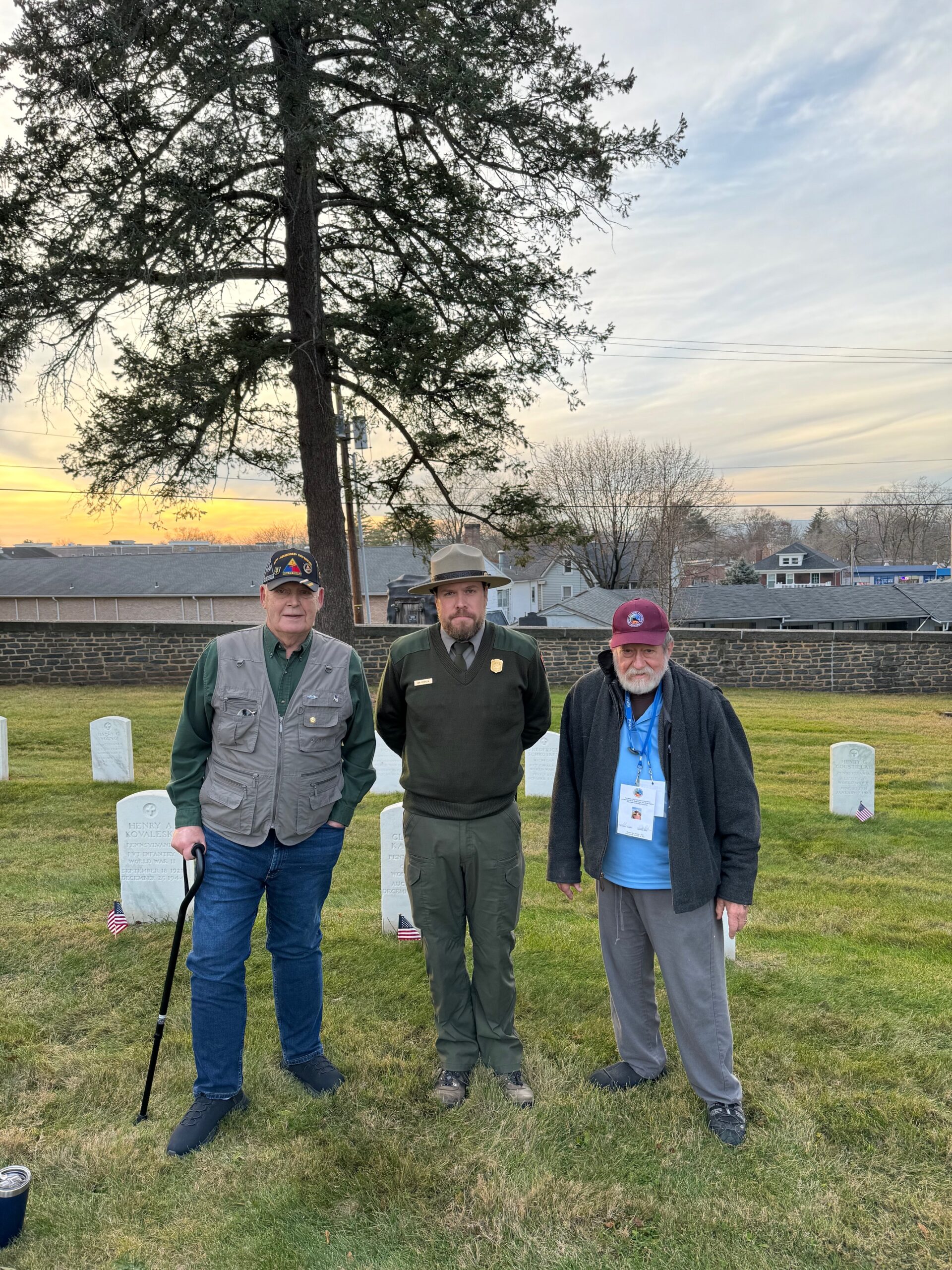
Nice program in the national cemetery in observance of the 79th anniversary of the start of the Battle of the Bulge. Eisenhower National Historic Site ranger Dan Vermilya led the program. He observed that Gettysburg “is hallowed ground not just for what happened here in July 1863, or in November 1863.” He noted that Gettysburg is one of few places “where you can see in a small area the grass of people who died defending freedom in 1944 and in the Pacific and in World War I through Vietnam.”
Dan will be on of the speakers at our Gettysburg conference on January 27. Two other speakers, BOBA member Tom Vossler and Bugle editor Leon Reed, also attended.
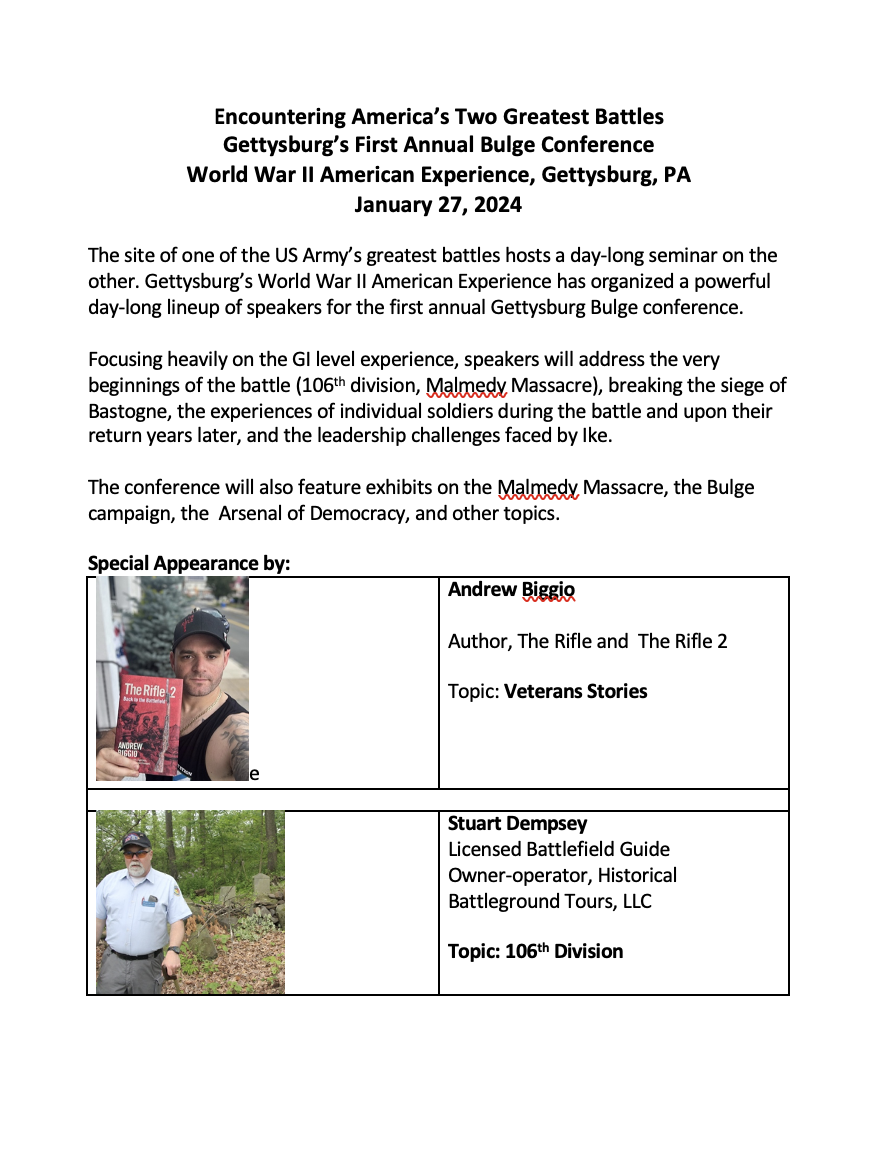
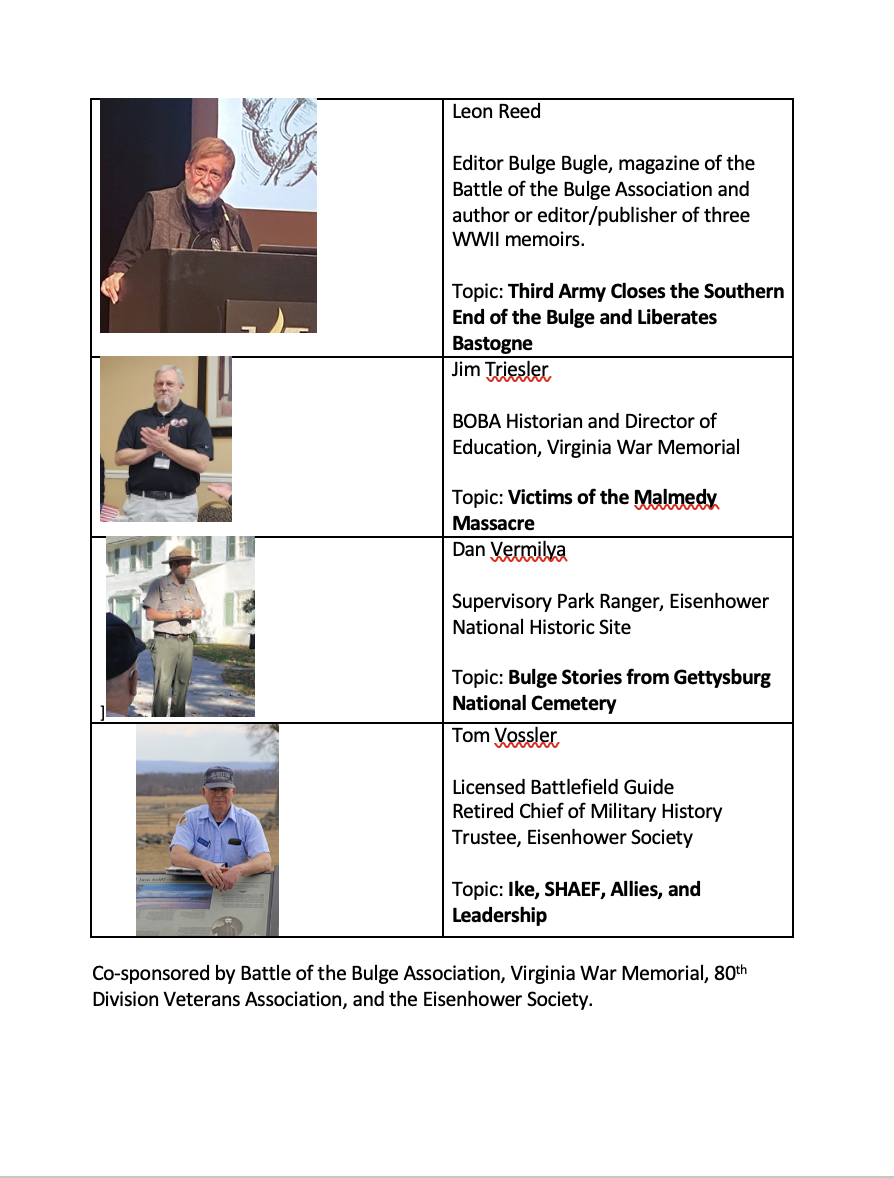
January 27, 2024. Extend your trip for the Commemoration. Come to Gettysburg for a power-packed speaker’s lineup. Single-day conference. Speakers include:
Stuart Dempsey, licensed battlefield guide and owner-operator of historic tours company., speaks on the106th Division.
Leon Reed, BOBA editor and author, gives a GI-level presentation on the 80th Division’s role in breaking the siege of Bastogne;
Jim Triesler, BOBA historian and Education Director of the Virginia War Memorial, speaks on the Victims of Malmedy;
Dan Vermilya, supervisory park ranger at Eisenhower Historic site, speaks on the WWII dead of Gettysburg National Cemetery.
Tom Vossler, licensed guide, former chief of military history, and Eisenhower Society trust, speaks on Ike and leadership
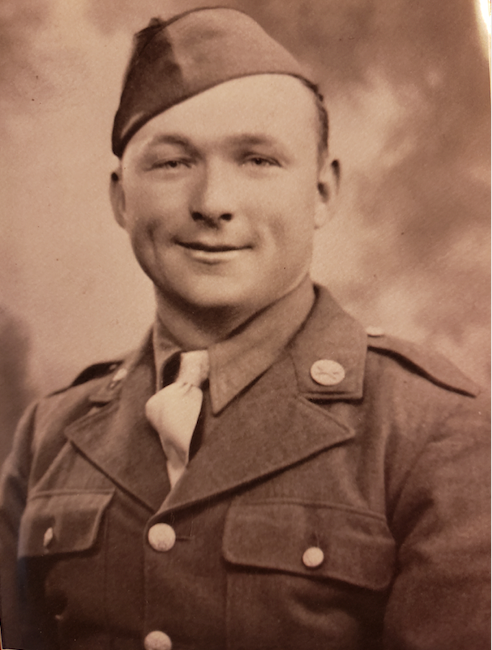
Today, October 17th, PVT James Hampton Coates would have been 101 years old. Instead, James sadly was one of 86 servicemen who was killed in the Malmédy Massacre in Belgium during the Battle of the Bulge. He served in the 13 FAOB HQ from 1942-44. During that time he landed on Utah Beach D-Day+1 and was injured in July by a mine or dud, but stayed with the battalion under field medical care. In October 1944, he joined 285 FAOB BTRY B, and two months later he was killed in the massacre.
James left behind a wife and two children: a 2-year-old daughter and 7-month-old son. He was buried in Henri Chapelle Cemetery, Belgium and later reinterred in his hometown of Kilmarnock, Virginia. His daugther, Mary Ann Coates Smith, is currently the President of BOBA’s Virginia Crater Chapter.
People attending the annual commemoration in the Nation’s Capitol will have the opportunity to extend their trip a little for more Bulge programming. BOBA is co-sponsoring what we hope is the First Annual Battle of the Bulge conference at the site of the US Army’s other greatest battle, Gettysburg, PA.
Gettysburg is only about 100 miles north of the Commemoration HQ hotel and we can work on transportation for people whose S-4 (logistics staff) didn’t arrange transportation. The conference will be held at the World War II American Experience museum on the outskirts of town on January 27.
Two key BOBA officials, historian Jim Triesler and editor Leon Reed, will be presenting at the conference, along with another BOBA member, Tom Vossler.
We hope to get best selling author Jeff Shaara to give a keynote address (and sign some books).
Other speakers and their topics:
Andrew Biggio, author of The Rifle and the brand-new The Rifle 2, will speak about GI experiences in the battle and upon their return many years later.
Stuart Dempsey, licensed Gettysburg guide and owner/operator of Battleground History Tours LLC, will talk about the underdog 106th division
Leon Reed, Bugle editor and by then the author or editor-publisher of three WWII memoirs, will speak about the role of the 80th division in stabilizing the southern flank of the Bulge and the liberation of Bastogne.(He gave an early version of this talk at the 2023 commemoration but it is far advanced since that time.)
Jim Triesler, who works as Education Director for the Virginia War Memorial when he’s not doing his more vital work for BOBA, will speak about 10 victims of the Malmedy Massacre.
Tom Vossler, licensed guide and retired chief of military history at Carlisle, will speak about Ike, SHAEF, coalition warfare, and the incredible leadership skills Ike summoned to keep the entire alliance (mostly) moving in the same direction.
We think this is a powerful lineup and BOBA is proud to be a co-sponsor.
The following story was found in the records of BOBA’s Ohio Buckeye chapter. The chapter recently closed but the son of the last president thought to contact us to see if we want to have the records sent to us. We are making an arrangement with Jim Triesler to have the Virginia War Memorial serve as the archive of VBOB/BOBA records.
*******
Christmas Peace
A True Story by Fritz Vincken,
Found in the papers of the Ohio Buckeye Chapter, VBOB
More than half a century ago, on Christmas Eve 1944, in the middle of the battle about the Ardennes, mother and I had unexpected guests.
On that Holy Eve the infantry division No. 256, having received replacements from Bohemia was fighting left on the Rhine bank. Its six battalions had been regrouped. In the New Year Night they once more attacked the Maginot Line from the area around Pirmasens under the code name ‘Nordwind.’ The casualties of that final German advance in the west are buried on the soldier cemetery at Bad Niederbronn (Alsace) and at Dahn (Palatinate).
At that time I was twelve years old and we were living in a small cottage in the Ardennes, near the Belgian border. Father had used this little house before the war when he had gone hunting on weekends. And when our hometown Aachen suffered more and more under the air raids, he sent us there. He himself was ordered to the 6 km distant border town Monschau for air raid protection. “In the forest you will be safe,” he said to me. “Take care of Mother. You are a man now.”
But one week ago Generalfeldmarschall von Rundstedt had started the last desperate German offensive and whenever I went to the door I heard the battle raging.
When there was a knock at the door on Christmas Eve, Mother quickly blew out the candle. Then she went to the door, I behind her. Outside, before the ghostly background of snow-covered trees stood two men with white steel helmets. The one addressed Mother in a language we didn’t understand and pointed to a third one who was lying on the snow. She conceived quicker than I that they were Americans.
Mother stood – her hands on my shoulders – unable to move. The men were armed and would have been able to force their way in. but they didn’t move and were begging only with their eyes. The wounded man in the snow was more dead than alive. “Come in,” Mother said finally. The soldiers carried in their comrade and put him on my bed. None of them spoke German. Mother tried with French and in this language one of the men was able to communicate to some extent
Before Mother took care of the wounded man, she said to me, “The fingers of both are totally stiff. Have them take off their jackets and the boots and go and get a bucket of snow.” Shortly after, she rubbed off their blue frozen feet with snow. The stocky, dark haired man, we heard, was Jim. His friend, tall and slender, was Robin. Harry was the wounded man who slept in my bed now. His face was as white as the snow outside. They had lost their unit and got lost in the forest trying to find the Americans, always anxiously watching out for the Germans. They were unshaved, but without their heavy coats they looked like tall boys. And Mother treated them accordingly.
“Go and bring Herman,” Mother said to me, “and also bring some potatoes.” This was a deep cutting change in our Christmas program. Herman was a fat cock (named after Hermann Goering, for whom Mother hadn’t any sympathy). He had been fed in the past few weeks in the hope that father would be home at Christmas.
While Jim and I helped in the kitchen, Robin took care of Harry, who had got a shot in his upper leg and was almost bleeding to death. Mother tore a sheet in stripes to bandage the wound.
Soon the smell of the baking cock filled the room. I was just about to lay the table when there was another knock. In the expectation of seing even more Americans, I opened without hesitation. Outside were four men in a uniform well known to me. German soldiers – Ours! I was paralyzed by the shock. Despite my youth, I knew the law. Whoever is hosting the enemy is committing treason. We all could be executed. Mother also showed fear. Her face was white, but she went out and said calmly: “Merry Christmas!” “We have lost our unit and want to wait until day comes,” explained the leader, a sergeant. “Can we stay with you? “Naturally,” mother said with the calmness of desperation. “You can also have a good warm meal and eat as long as something is available.”
The soldiers smiled while sniffing the good smell coming through the half open door. “But,” Mother continued energetically, “we have three more guests here, whom you are not likely to consider as friends.” Her voice was suddenly so strict. I had never hard her speaking in this manner. “Today is Holy Eve and there is no shooting.”
“Who is inside?” the sergeant asked brusquely. “Americans?” mother looked each one in the frost stiffened face. “Listen,” she said slowly, “you could be my sons and they in there too. One of them is wounded and is fighting for his life and his two fellows are lost and hungry like you. In this night,” she spoke to the sergeant and lifted her voice, “in this Holy Night we do not think of killing.”
The sergeant looked at her. For two, three endless seconds there was silence. Then Mother ended the uncertainty. “Enough talk,” she said and clapped her hands, “put your weapons there on the wood pile – and hurry before the others eat everything up.”
Dazed, the four soldiers put their weapons in the box of firewood in the aisle. Two pistols, three carbines, one light machine gun, and two bazookas. Meanwhile, Mother talked hastily with Jim in French. He said something in English and I saw with astonishment that the Americans also handed over their weapons to Mother.
As now the Germans and the Americans were standing shoulder to shoulder with embarrassment. Mother was in her element, smiling, looking for a place for each one to sit. We had only three chairs but Mother’s bed was large. There she placed two of the later arrivals next to Jim and Robin. Then she continued cooking without taking notice of the tense atmosphere. But Hermann didn’t get bigger and we had four eaters more.
“Quick,” she whispered to me, “go and et a few potatoes and some oat meal. The boys are hungry, and when the stomach rumbles one is easily irritable.” While I was plundering the store room, I heard Harry groaning. When I returned, one of the Germans had put on his glasses and was bending over the wounded soldier. “Are you an ambulance man?” Mother asked. “No,” he said, “but I studied medicine in Heidelberg until a few months ago.” Then he explained, as it appeared to me in fluent English, that Harry’s wound was not infected, thanks to the low temperatures. “He has only lost a lot of blood,” he said to Mother. “He simply needs rest and nourishing meals.”
The pressure was fading. Even I had the impression, when all the soldiers were sitting side by side, that they were all still very young. Heinz and Willi, both from Cologne, were sixteen. The sergeant was the oldest with his twenty-three years. He took out a bottle of red wine from his haversack and Heinz found a loaf of rye bread, which Mother cut into slices. They were all asked to come to table. The rest of the wine was set aside for the wounded man.
Mother spoke the prayer. I saw that she had tears in her eyes when she recited, “Komm, Herr Jesu, sei unser Gast . . .” and when I looked in the round, the eyes of the soldiers were wet too. They were boys again, the ones from America and the others from Germany. All distant from home.
Towards midnight Mother went to the door and requested all to follow her to see the star of Bethlehem. With the exception of Harry, who slept quietly, all stood next to her. And while viewing the Sirius, the brightest star in the sky, the war was far away and almost forgotten. Our private ceasefire endured also the next morning. Harry awoke in the last night hours, groaning, and Mother poured some broth in his mouth. When the day dawned, he was visibly stronger. Mother stirred him one egg, we took some sugar in the rest of the red wine for a powerful drink. We others ate oat meal. Then a stretcher was fabricated for Harry with two sticks and Mother’s best table cloth.
Bent over Jim’s map, the sergeant showed the Americans how they could find back to their troops. In this mobile war the Germans seemed amazingly well informed. He put the finger on a brook. “Go along here,” he said, “on the upper leg you will meet the First Army, which is reorganizing.” The medical student translated everything in English. Mother gave back all the weapons. “Be careful, boys,” she said. “I hope that one day you will get back to where you belong, back home. God Bless you all.”
The Germans and the Americans shook hands and we saw them disappear in opposite directions. When I returned in the house, Mother got the old family Bible. I looked over her shoulder. The book was opened to the Christmas story, at the report of the birth of Christ and the manger and the three men who came from far away to bring gifts. Her finger slid over the line, “… And they traveled back to their land along a different route.”
Postscript from Washington Post article “US and German Soldiers Shared Christmas eve dinner at height of WWII, by Dave Kindy, 12/24/2022
Not long afterward, the war ended, and the Vinckens were reunited. Fritz immigrated to the United States in 1959 and later opened a bakery in Honolulu. Hubert died in 1963, and Elisabeth followed in 1966.
Fritz always hoped to meet the soldiers again, though he knew his chances of seeing the Germans were not good, given their staggering casualty rate at the end of the war. He thought publicity might help, starting with his 1973 Reader’s Digest article, which President Ronald Reagan mentioned in a 1986 speech. In 1995, Fritz appeared on national television, telling his story on “Unsolved Mysteries” to host Robert Stack.
A nursing home chaplain in Frederick, Md., saw the episode and remembered a resident telling a similar story. He contacted the TV producers about Ralph Blank, a World War II veteran who had been a sergeant with the 8th Infantry Division in 1944.
In 1996, Fritz flew to Maryland to meet with Blank, who was 76 and in poor health. They recognized each other immediately and reminisced about their shared evening of peace during a hellish war.
The reunion was filmed and shown on “Unsolved Mysteries” later that year. At one point during the episode, Ralph turned to Fritz and said, “Your mother saved my life.” For the former German boy who was now an American citizen, that moment was the high point of his life.
“Now I can die in peace,” he told the Honolulu Star-Bulletin. “My mother’s courage won’t be forgotten and it shows what goodwill will do.”
Neither man lived to see the 2002 TV premiere of “Silent Night,” a retelling of their 1944 encounter. Ralph died in 1999 at age 79, and Fritz died in 2001 at 69. (The families of both men could not be reached for comment.)
In a 1997 interview, Fritz spoke of the lessons he learned from the Christmas miracle.
“The inner strength of a single woman, who, by her wits and intuition, prevented potential bloodshed, taught me the practical meaning of the words ‘good will toward mankind,’ ” he said, adding, “I remember mother and those seven young soldiers, who met as enemies and parted as friends, right in the middle of the Battle of the Bulge.”
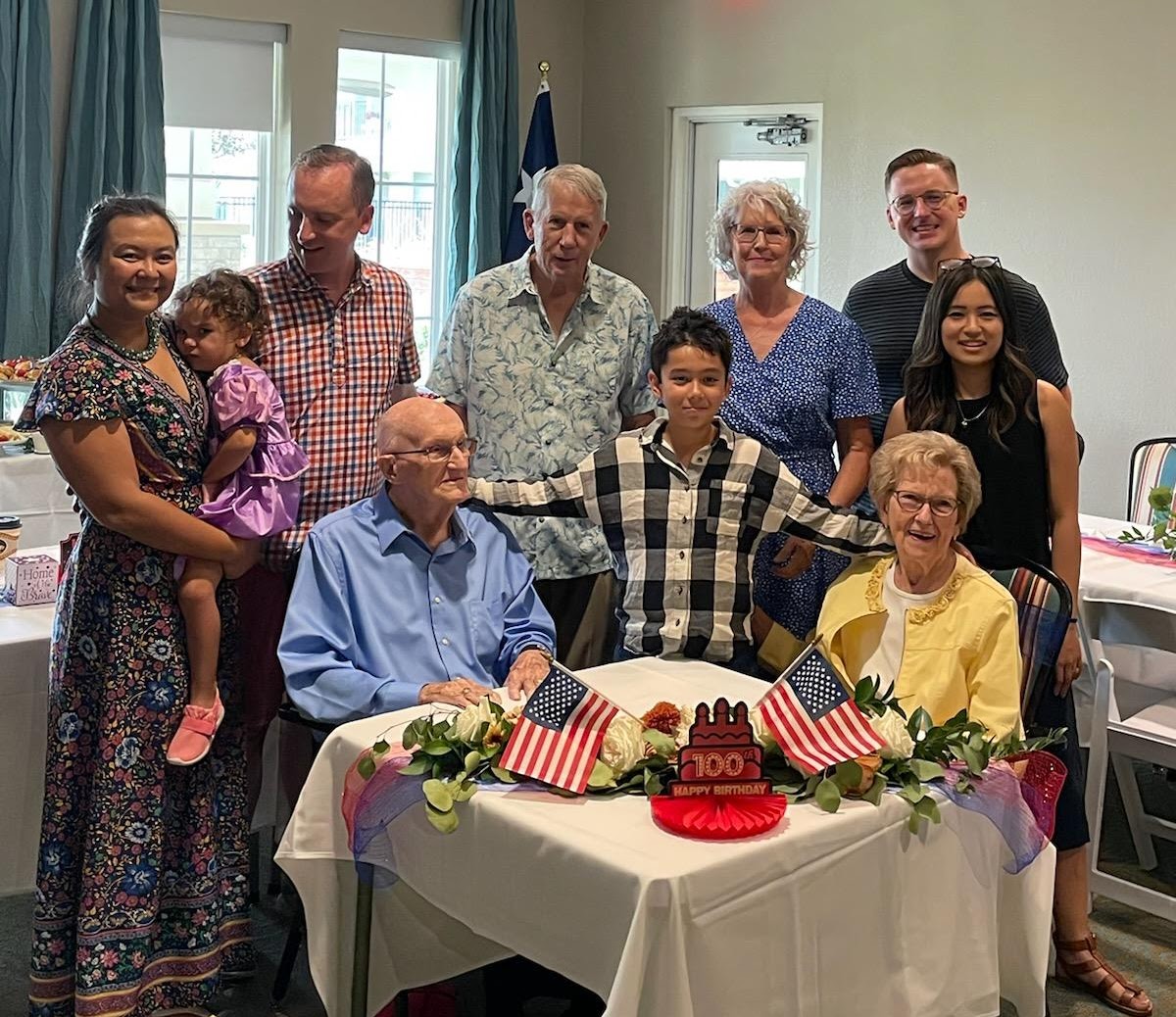
Frank Chambers celebrated his 100th birthday on August 9, 2023. Chambers served in the 75th Infantry Division, 291st regiment during the Battle of the Bulge. He pulled a 105 mm canon behind his 6×6 Jimmy truck. He earned the Combat Infantryman Badge and Bronze Star. Dad was awarded the French Legion of Honor in 2010.
After the service he married Doris Albers, and they had two children, Marjorie Duffield and John Chambers (1956-1984). Frank has 2 grandsons and their wives, and 2 great grandchildren. .
Much of Frank’s career was with the Farm Bureau organizations in Illinois and Nebraska. He also had a 19 year career with the Gallup Organization, retiring at age 80.
He is a life member of The American Legion, and has been active in his church, Scouts, and speaking to public school students about WW2. He resides with his wife in League City, TX.
Four generation photo at Frank Chambers’s 100th birthday celebration.
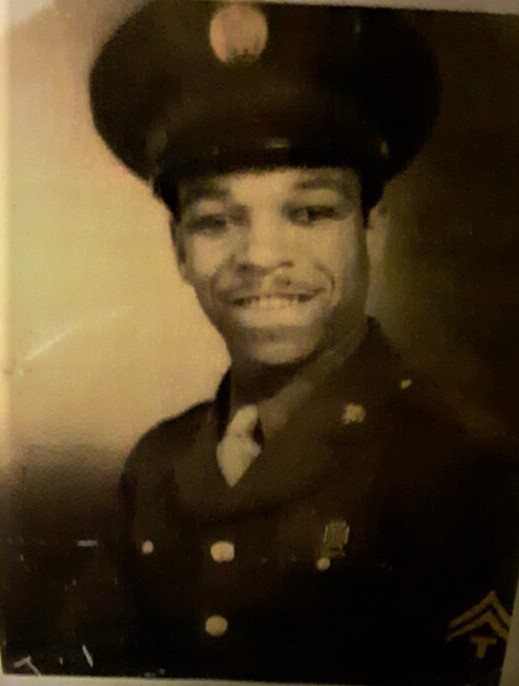
Benjamin Melvin Berry was born to parents Hester and James Wallace Berry Sr. on September 21, 1923. He is celebrating this milestone with a party at Philadelphia’s Mission BBQ.
He was one of four children. He can proudly trace his ancestry back to great-great grandparents Paul and Ameilia Edmonson, whose children Emily and Mary were friends of Booker T. Washington and Frederick Douglass and were active abolitionists in the Washington DC. area in the 1840’s. Their story is told in the book Fugitives of the Pearl.
Ben was drafted into the segregated US army in WWII in 1943. He served in Germany, Luxembourg, France, England, and Belgium and was in The Battle of the Bulge, the largest battle fought by Americans in WWII. His title was Technical Corporal, with duties of providing equipment and supplies to his company, even water for drinking, washing, and cooking. Blacks were not allowed to fire weapons, but he and his buddies sometimes sneaked and practiced by shooting rats at the dump. Ben prayed if God let him survive this war, he would serve him the rest of his life, and he has kept that promise. He’s been a faithful member of First Baptist Church of Crestmont for nearly 90 years. Ben was honorably discharged in 1945 after serving 27 months.
Ben went to Bok Vocational School on the GI Bill to learn paperhanging. Although blacks were not allowed in the paperhangers’ union at that time, he became a successful entrepreneur, managing his own business for more than 60 years. He provided apprenticeship opportunities to young people, some of whom opened their own businesses, and did charity paperhanging from time-to-time, for example papering walls at the Ronald McDonald House.
Ben has four children, 9 grandchildren, a host of great-grandchildren, one great-great grandchild, and lots of other family that he loves.
Two of the many honors he’s received in his life include recognition for 50 years of service as a deacon at his church and election as president of the Philadelphia Paperhangers Guild.
Ben has many interests, including genealogy, antiques, and veteran’s organizations. He is on the Board of Aces, a veteran’s museum in Germantown, and is often interviewed about his experiences in the army.
Three things Ben would want you to remember are (1) Serve God and others (2) Save a lot; give some; spend a little (3) Put family first.
One thing I would like you to remember is that everyone has a story that others can benefit from hearing. It’s important to tell your story.
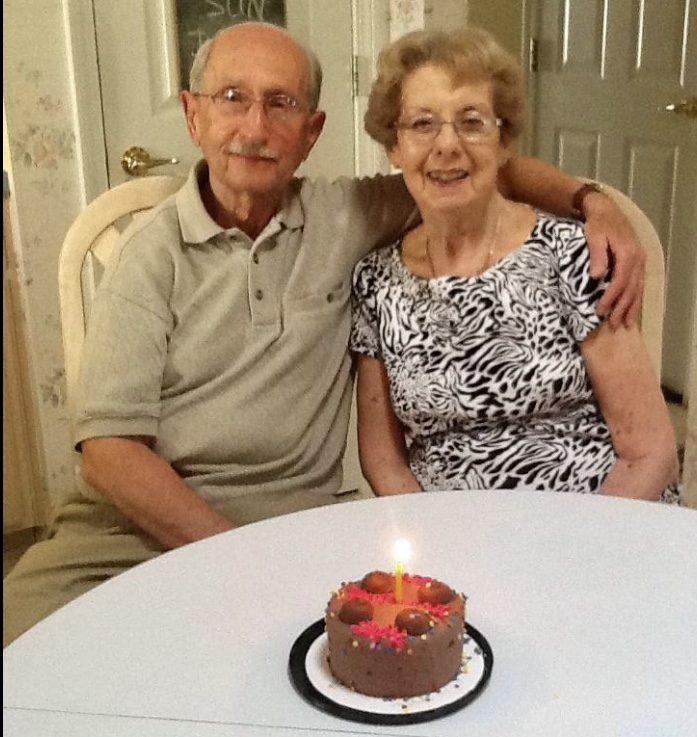
WWII and Battle of the Bulge Veteran Dr. Ralph I Dinin is celebrating his 100th Birthday on September 12, 2023.
Ralph was born September 12,1923 and was raised in Brooklyn/Bronx, New York. He graduated from Stuyvesant High School and continued his studies at Brooklyn College until 1943 when he entered the Army. Ralph served from February 1943 – January 1946 with the 701st and 740th Tank Battalions 82nd Airborne during WWII and the Battle of the Bulge. He received The Good Conduct Medal, three campaign stars for the European, African Middle Eastern Campaign Medal, the American Campaign Medal, and the WWII Victory Medal, The French Legion of Honor, the Sharpshooter (for marksmanship) Badge with Machine Gun clasp and was recognized for Meritorious Service by the State of New Jersey. His nickname was “Bulldog” and he was discharged in 1946 with the rank of Technical Sergeant.
We all thank Ralph for his service and wish him a very happy birthday as we celebrate this momentous milestone!
Two members of our Delaware Valley chapter, Jake Ruser and Benjamin Berry, will appear at the Eisenhower Farm in Gettysburg on September 17 to discuss their experiences during the Battle of the Bulge. They will be speaking at the Eisenhower Farm WWII weekend, a major living history and educational event that will take place from Friday, September 15 through Sunday the 17th.
Ruser and Berry will talk at noon on Sunday. Ruser was featured in the Spring 2023 issue of the Bugle; he recently returned to Hurtgen Forest to relive memories of being a stretcher bearer during that battle.
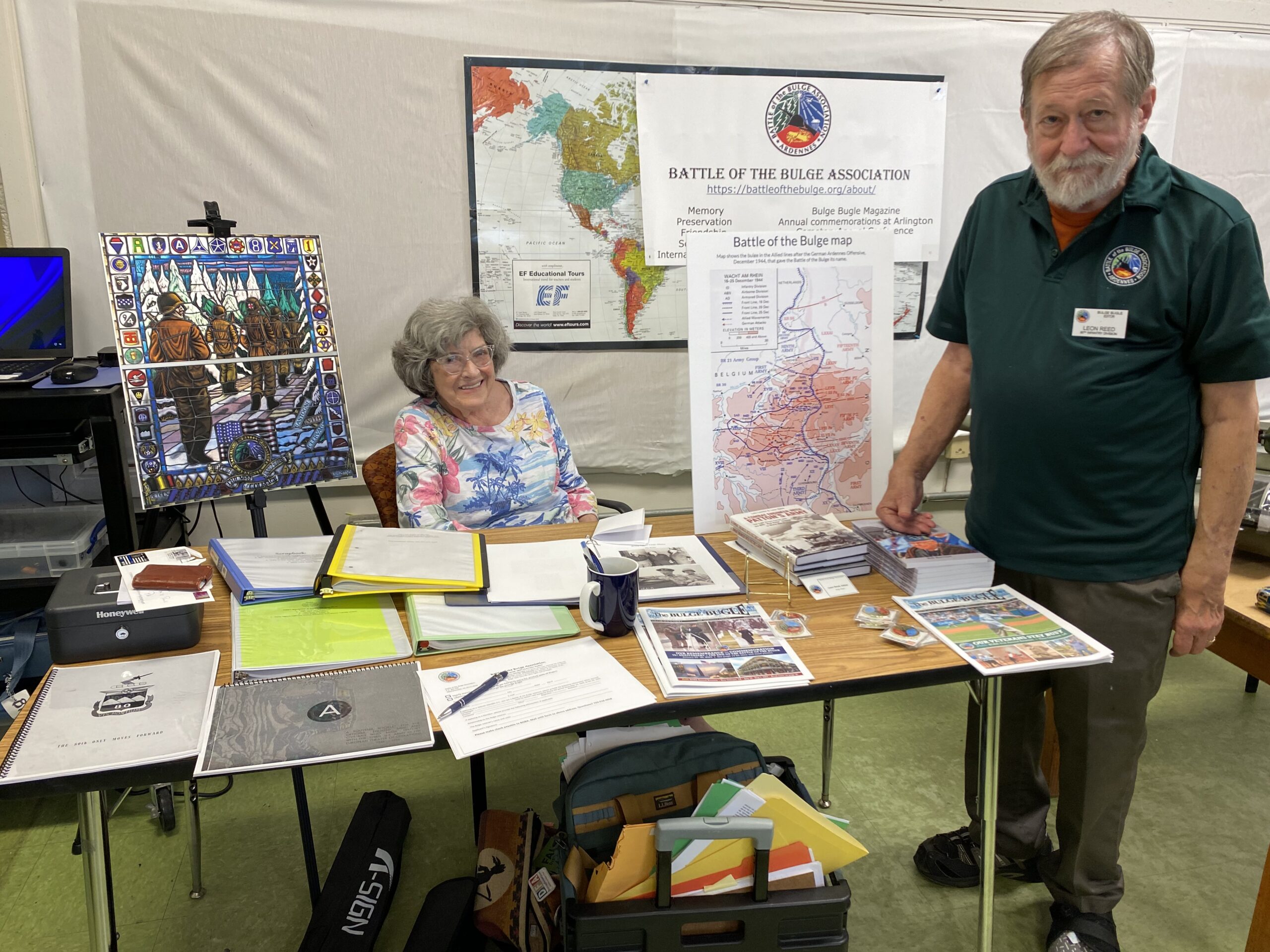
BOBA will also have an information table at this event. Other attractions will include presentations and book signings, vehicles, living history, and hands-on events. Admission is open to everyone and there is no charge. Drop by if you’re in the neighborhood.
Join us at the Eisenhower Farm in Gettysburg. BOBA will be exhibiting there Saturday, September 16 and Sunday, September 17. Come by and say hello. This is a big World War II event and gives BOBA good exposure to a crowd of World War II enthusiasts.
The theme of the Eisenhower Farm event is “1943,” which is outside our main area of interest, obviously. Besides information and exhibits about BOBA and the Battle of the Bulge, we’ll have exhibits on two activities that were underway in 1943 that were vital in creating the mobile, lethal strike force that blunted Hitler’s legions: the Arsenal of Democracy, which produced the weaponry, and the 1943 Tennessee Maneuvers, which allowed the army to incorporate the lessons of mobile warfare.
My association with the 8th Air Force is through the 361st Fighter Group where I was assigned as a P-51 pilot from October 1944 to July 1945. The 361st Fighter Group was credited with participation in the Battle of the Bulge. When I was young and picking strawberries on our Delaware farm, I once saw planes flying in formation, and knew they were having more fun than I was. Since then, I always wanted to fly.
On the 4th of June 1942 my sister Theresa and I graduated from Laurel High school in a class of 31. Of the fifteen boys that were in the class I can think of only three who did not enter one of the military services.
My older brother Nathan had requested two letters of recommendation so that he could volunteer for aviation cadet training. So I asked my parents to get two letters for me. With my two letters, I went to Wilmington and put in my application. In a few days I got a letter telling me to report to Fort Dix, New Jersey.
Having passed my physical, I got a letter telling me to report to the Post Office in Camden, New Jersey. There, on November 30th 1942, I was sworn in as an enlisted Private in the Reserve Corp.
After completing our six weeks of college classes we were again loaded on a train; this time with Pullman cars, which I guess does prove that a college education pays off. At the San Antonio Aviation Cadet Center, we were to go through classification and, if qualified, on to preflight training. Our classification consisted of many written tests, motor skill tests, and a visit with a psychologist or psychiatrist (I don’t know which.) All of this testing and evaluation was to determine whether you should enter pilot training, bombardier training, or navigator training. I had to go see the psychologist a second time, and he asked me why I was so nervous. I told him it was because I was afraid that he wouldn’t let me go to pilot training, and he said, “Well, if you don’t, you know it’s for your own good!” I told him, “Well, it might be, but that isn’t what I enlisted to be. I want to be a pilot.” I guess he believed me, because he passed me for pilot training, which took place at Corsicana, Texas, where we were assigned for primary flying school.
Near the end of the basic flying course you were asked to make a choice as to where you wanted to go for advanced training, and I chose pilot training. For advanced training I was sent to Aloe Field at Victoria, Texas, where I flew the AT-6. I also flew the P-40. After completing the 15-20 hours of flying time in the P-40, I finished my 200 hours of flying time, and on the 15th of April 1944, I graduated as a pilot and was promoted to Second Lieutenant. We were again loaded up on the train and took a long ride to Camp Kilmer, New Jersey, which was a staging area for the port of New York.
Meanwhile my brother, Nathan, had been eliminated from the flight training in the cadet program and had gone to gunnery school, training for the B24 prior to going to Europe. Nathan and I were later to fly several missions together for the 8th Air Force.
After 5 days of crossing the Atlantic, we arrived in Liverpool. Due to the speed at which the Mauritania could travel, we did not have an escort going across the Atlantic until we were close to the English shore. We then had some escort ships pick us up with some aircraft overhead. From Liverpool we boarded one of the quaint little trains for a trip to Goxhill, which was located on the northeast coast of England, a few miles south of a port city of Hull, where shipyards and dry docks were located.
After completing our training at Goxhill, it was time for the pilots to be reassigned to the fighter units. We were told that if a group of us wanted to go together, we could match up our number of pilots with the number that is required for a Fighter Group, and then we could get assigned together to that unit. Some of my buddies and I were sent to the 361st fighter group.
On November the 25th 1944, I flew my first regular combat mission. It was escort to Lutzkendorf. I don’t remember exactly where that is, but it was a deep penetration mission, because we logged 5 hours 35 minutes flying time. It was our commander’s practice (Major Rew) to take the first mission for new pilots and fly them as his wing-man. I doubt there were many other squadron commanders who would trust their protection to a first mission pilot. I flew again the next day, and again the mission was escorting a radio relay ship. While we were escorting the relay ship, the fighter escort for the bombers encountered a large number of German fighters: ME 109s and FW 190s. The Group had their best day of the war destroying 23 German airplanes, probably destroying 2 others and damaging 9. We had no losses during this encounter—however, one pilot had to crash land in Holland on his way back home. Thankfully, he survived. Among those claiming victories in this encounter was my flight commander John Wilkinson and my good buddy Richard Chandler. Also claiming victories among the fellows who came from Waycross, Georgia were Robert Farney and Delmar Ford. Ford was killed later in the war, while strafing an aerodrome.
The next mission I flew was on November 30th. We were escorting B-17s that were bombing an oil refinery area north of Munich. The weather was clear, not a cloud in the sky, when the first bombers came to the target area. They were all making contrails, and before the middle of the bomb stream had passed, the clouds had completely covered the area with nothing but contrails. There was more than 1,000 B-17s on the one target. The target area was covered with a cloud of black smoke from the anti-aircraft fire. It looked like a thunderhead that was totally black. The B-17s would fly into this cloud and then they would be streaming out from the bottom or the sides, some planes on fire and some upside-down. I believe there were 49 B-17s lost on this mission. We also had about the same number of fighter plane escorts, and did not see a German airplane in the area. We did see one P-47 that came towards our formation and appeared that he wanted to join up. However, we turned towards him and he turned away. After he had gone, I realized that he did not have an external tank on the airplane, so I don’t know how he could have made it back to friendly territory with no external fuel. There was some speculation that it might have been a German flying the P-47, to pass information back to the defense units there.
My next mission was an escort of B-17s to Berlin on the 5th of December. As we approached the target area, we followed the usual practice of not being close to the bombers when they entered the flak barrage. We were well to the south of the bomber track and flying east, which gave us a good tail wind. Suddenly, three rounds of German anti-aircraft fire burst between me and the lead ship, and three more burst between the lead ship and the plane flying in the number three position. The second volley of six rounds scored hits on two of our aircraft, but not enough to cause them to discontinue the mission. When the first rounds went off, we all broke in different directions like a covey of quail. I broke to what appeared to be the thin area of the barrage, that later turned out to be further eastward. My other flight members had broken to the other direction. When the shooting stopped and I looked around, I was on the east side of Berlin and my other flight members were on the west side, and were heading westward to escort the bombers home. I had two choices. I could go to the south and go around the area where the flack was coming from, but I figured this would put me so far behind the other planes that I’d not be able to see them. The other choice was to go straight across the area and then catch up with them. I opted to do the latter. I revved up the airplane to nearly full speed, and dove down toward the cloud cover, and started across the southern part of Berlin. As soon as I reached the city limits, they started shooting at me. They were using radar-directed flak and they were firing behind me and on the right, so I started a turn to the left. They were now chasing me around in a circle. I soon figured I couldn’t keep doing this, so the next time I came out on a westerly heading, I dove down to the top of the clouds. As I pulled out on the cloud deck, the engine quit. I had run an external tank dry. Without even pulling back the throttle, I reached down and switched the fuel selector valve to an internal tank. The engine started and I went full speed after my friends and did not look back any more.
We returned to the base. After the debriefing, I approached Major Rew, who was also flying that day and leading the squadron. I said,“Major Rew, I don’t have much experience in this, but it seems to me that was pretty good shooting the Germans were doing today.” He replied, “You’re damn right it was! I think we got into instructor school on demonstration day.”
I again flew on target escort to Minden on December 6th, another escort mission to Bingen on December 10th, and again on December 12th to Hannau. The next day, the very bad winter weather, for which the Battle of the Bulge was to become famous, began. My next combat mission was on the 18th of December, when I flew a fighter sweep at the Laacher Lake Bonn-Aachen area. The weather was so bad over Germany that I don’t think the bombers flew their scheduled bombing mission. There was no activity in the vicinity, so near the end of our mission, someplace in the south of Aachen, we let down through the clouds and broke out below at 6,000 to 8,000 feet. We could see the ground from there and when a group of flashes appeared, one of our pilots, I believe it was Herbert Dixon, said, “Hey, guys, look! See the flashes—they’re bombing through the clouds.” The rest of us knew what the flashes were, and we started our evasive maneuvers, but Dixon was on the radio talking, and nobody could tell him that is was not bombs but 88 millimeter anti-aircraft guns that were shooting at us. Dixon got a piece of shrapnel through his canopy, and we quickly went back into the clouds and departed the area. That was only the third day of the Battle of the Bulge. Normally the 88 millimeter anti-aircraft would not have shot at us at that altitude, because the fighters, with a dispersed formation and frequently changing directions and altitude, were not a good target. However, with the Battle of the Bulge just starting, I could think they probably wanted to shoot and chase us away, which they did.
During the last half of December, 1944, and most of January, the weather was terrible. We had a large snowstorm, large for English standards, and several days of ice and fog. Whenever the weather was suitable, we flew only to check out new pilots or fly some test flights that needed to be flown after major engine work. We had Lyle L. Jewel from Michigan join our flight in December. The squadron got three new replacements in the first week of January, and two of those were killed on the first flight. Both deaths were attributed somewhat to weather conditions.
About the first of February, we all moved from Little Walden over to our new base in Belgium at Chièvres. On the 6th of February I flew my first combat mission from Belgium, and during the month flew a total of seven missions. The mission I remember the most was on February the 22nd, when the group went out in two sections. One section was escorting B-26s that were attacking communications centers and rail yards. The other section was strafing the same targets. I was in the section escorting the B-26s. However, I was also on the same radio channel with the fellows doing the strafing. I heard—midway through the mission—my friend Chandler call his flight leader as he came off a target, and he was said, “Hey, Latimer, I’m having trouble keeping up. Slow up a little.” The flight leader replied, “Okay, I’ll throttle back.” A few seconds later, Chandler said, “I still can’t catch up with you. There’s something desperately wrong here!” That made me chuckle, because I had seldom heard Chandler use a three syllable word—however, I knew he was in trouble. One of the other members said, “Hey Chandler, I think you’d better check. I think you’re on fire.” He checked his gauges and said, “Yeah, I believe so.” The flight leader exclaimed, “You’d better bail out, Chandler!” He replied, “Well I don’t know how I’m going to get out, but I’m going to try!” From about 12,000 feet, he rolled the plane over on its back, jettisoned his canopy, fell out, and delayed opening his parachute. When the chute opened, he made one swing and hit the ground. He picked up the parachute in his arms and ran into the woods nearby. Chandler later told me that by hiding in the woods during the daytime, and walking at nighttime, he evaded capture for three days. However, he spent the rest of the war in prison camp.
Sometime in February, our flight leader John Wilkinson, who had now been promoted to Captain, finished his tour and rotated home. Since I was now the senior pilot in the flight that did not have an assigned airplane, I was assigned to fly his plane, “Pretty One the III.” I don’t know how that name came to be, but I didn’t want to change the name, because it was sometimes considered unlucky if you changed the name of an airplane. The crew chief on the plane was Ross Benson from Idaho. He not only kept the plane performing perfectly, but it was also spotlessly clean. Having confidence in the airplane, and having a clean canopy and windshield ,made flying combat missions much easier.
When we went to a briefing for a mission, we were given a 3” x 4” preprinted form, on which we entered much of the data we would need to complete the mission. After the flight, starting about the first of March, I wrote notes on the back of the form as to what went on during the mission. I still have eight to ten of those forms.
I had learned that my brother Nathan was also in the 2nd Air Division, and was a gunner in the 392nd Bomb Group at Wendling. As it turned out, Nathan had finished his tour of 30 missions on the lead crew, and had rotated back to the states before we knew that we had flown some missions together. I have an account of his last mission on March 3rd, when we were flying escort for his group. For that mission, we had a briefing at 7:00 for a 7:41 takeoff. It was snowing a little, with some low cumulus clouds. On takeoff, Young’s engine quit, but he was able to stop on the runway and he was not hurt. After takeoff, Rizzio joined the flight to replace someone who had aborted. After a late takeoff, we went north like the “hammers of hell” and overshot the rendezvous with the bombers. When there was a break in the under cast, we were over the Baltic Sea, in sight of the mountains of Sweden. Finally, we caught the bombers, Silvertail B-24s, a few minutes before target time. There were German jet aircraft in the area that Mac and I chased but couldn’t catch, even while going 400 MPH! I fired on two from well out of range and didn’t observe any results. During the mission, I saw two bombers collide and one spinning down over the target. This was the first time I saw parachutes from bombers going down. The flak was described as better than yesterday, meaning that it was better from the German point of view.
Several days later, I received a letter from my brother Nathan saying that the March 3rd mission to Magnaburg was his 30th and final mission of his tour. The public information people made a newspaper story of it, in which they described it as Nathan having his big brother flying escort. They missed the point: that Nathan was nine years older than I. Magnaburg was considered about the second most difficult target, with only Berlin being a more difficult one. I have recently talked with Willis Miller, who was the pilot of Nathan’s crew, and from his description of the Magnaburg mission and other missions, I’m convinced that my decision to become a fighter pilot was one of the smartest decisions that I have ever made.
During March, I flew 17 missions. Among those was on the 14th of March when Dixon, Waldusky, and I were scheduled to fly combat air patrol over the Remagen Bridge. We briefed at 5:40 in the morning expecting to have a sunrise takeoff. However, the fog was so thick that we could not take off until 10:20. We took off with about 800 yards of visibility ,and climbed through the fog to 3000 feet, where we were in the clear. We were under Nuthouse Control, which was the radar controller for the area, and he directed us to the Bridgehead area. Whenever they detected an unidentified aircraft, we would be directed to intercept them. In all cases, it was one of our own aircraft, usually a P-47. We flew at 10,000 feet, while below us were P-38s, which were in close because of their unusual configuration, so they would not be mistaken for German aircraft. Part of our mission was to protect the P-38s, which the Germans would attack—whereas they would not provoke a fight with the P-51s. The Germans were also trying to sneak aircraft in, to bomb the bridge that had been captured, and also the pontoon bridges that, by this time, had been placed across the Rhine River.
On the 22nd of March, we had a mission to escort about 200 British Lancaster Bombers on a daylight raid, to bomb marshalling yards in the town of Hildershime. It was a perfectly clear day, and they were flying in their typical British gaggle of individual planes, following a pathfinder at about 8,000 feet. The British theory of bombing was: if you wanted to destroy the marshalling yard that was in a town, if you destroy the town, you’d probably destroy the marshalling yard—which they proceeded to do. There was such widespread destruction from 10,000-pound bombs and a mixture of small incendiaries, that by the time the last 30-40 bombers came, there were no military targets left. The fires were so widespread that when we dropped escort in the vicinity of Brussels, which was about 200 miles away, we could still see the smoke rising from Hildershime, and the next day, the place was still burning.
Whenever we flew escort for our bombers, we would have one squadron flying on each side of the assigned box of bombers, and one squadron flying top cover. The B-17s usually flew an altitude of 27,000 feet, and the squadron on either side would be about 27,000-28,000 feet. The top cover would fly from about 30,000 feet on up.
Whenever the Group Assistant Operations Officer flew, he did so with our flight. The more experienced pilots in our flight considered his decision-making and leadership skills somewhat questionable, and they did not like to fly with him. So I usually got the job to fly wing-man for him. One day when he was leading the squadron and we came to the target area, where we usually circle wide and pick up the bombers after they bombed, he flew right through the flak barrage. After we returned home, and at the debriefing, one of the pilots said, “Major, why did you lead us through that flak barrage?” He replied, “Oh, I thought it might raise the morale of the bomber boys if they saw us in there with them.”
While stationed in Belgium, our escort missions were usually about one hour shorter than they were from England. So we would have plenty of time, after dropping escort, to go back into Germany and look for targets of opportunity on the ground. One day when our good Major was leading us, we did this, and going across the countryside, we spotted six or eight box cars on a railroad track. He flew across the train, made a right turn, and set up a traffic pattern like we would have done at Waycross when we were doing ground gunnery, and then proceeded to come around and make a strafing run from across the open field. I was #4 in this formation, and I figured if there were anything around to stir up, they would have it stirred up good by the time I got there. So when I made my turn for the target, I sprayed the wooded area behind the train from well out of range ,and when I got into gunnery range of about 300 yards, I concentrated on the box cars. As luck would have it, it was not a flak trap as the Germans were famous for setting up.
Sometime in March, Col. Rew was replaced by Major Charles Bergman, whom I believe came from Texas. In March, I was promoted to First Lieutenant, but there were no silver bars available anyplace. So I peeled the foil off chewing gum wrappers, and wrapped it around my gold bars. That served very well, unless you scraped against something— then you would have to replace it. During March, I was very busy, as I flew 17 missions in the month. By the beginning of April, spring was arriving in Belgium. The weather was good, and the war showed signs that it would soon be over. There were very few targets available other than airfields, which were crowded with airplanes. Apparently the Germans had to retreat from airfields on both fronts, and brought their airplanes back into Germany. But they did not have fuel or pilots to fly them.
On the 9th of April, we flew an escort mission for bombers bombing the Lechfeld Airfield and recovered back at Little Walden. We went back to the poor visibility and bad weather in England, just when things were getting good in Belgium.
On the 11th of April, I flew my last mission, which was a target support in the Regensburg area. This mission made my 7th in April and made a total of 40 for the war.
NOTE: This recollection was excerpted from a much longer story of Col. Hedges’ life. He is a member of BOBA, South Carolina Chapter 7.
The afternoon of December 24th, Bob Davies and I were ordered to make up a daisy chain. We used eight mines from the stock carried on our Dodge 6 x 6 truck and a commandeered Belgian rope. Our squad leader led us to a position, before the first switchback on the road leading up a hill toward woods to the northeast, to the forest and the villages of Verdenne and Marenne. The hillside was too steep a road to go straight up. The rather small dirt road angled up to a switchback that further angled up to a woods. Later, I found the forest up the hill was between villages of Bourdon, Verdenne, and Marenne was the location of the 116 Panzer infiltration on the east side of Verdenne. It should have been known by our Platoon leader that, at that time, the Germans of the 116 Panzer Division had breached our front line, taken Verdenne, and occupied some of the area around the village. A correct response would have been a more extensive defense involving the entire platoon. More mines and a deployment of our antitank guns would have been appropriate. I have no way of knowing what knowledge the squad leader had of the Verdenne attack. However, someone in Battalion or Regiment must have know something, as Davies and I were suddenly put on the defensive position. Our roadblock was only a short distance from the comfortable barn hayloft billet where we spent the previous night. I think the rest of the platoon was still in the barn, with a single guard posted. Davies and I had orders: if attacked, let the first two tanks go by, and pull the mines in front of the third tank. The position was in the open, with no possibility of any cover. The hillside was totally bare, not even a small bush. This was truly a mission impossible. There were no ditches or structures within 150 yards. Any enemy tank coming down the road would see us immediately, on turning the upper switch back 300 yards away. It was possible they would have been so startled by our pluck or stupidity that they would have backed off, thinking it was a trap of some kind. All we could do is stay there and wait for something to happen.
In reality, the two of us were the only defensive position between the 116th Panzers and their assigned objective of the Marche Hotton road. The Division Headquarters of the 116 Panzer Division was in Grimbiemont, a few miles to the southeast. Heinz Guderian gives a reasonably accurate description in his book “From Normandy to the Ruhr” of actions from December 23 to 28. The attack on Verdenne began at noon of the 24th. Verdenne and the forest, 1500 feet up the hill and to the southeast of Bourdon, were captured and occupied by German tanks and troops. The forest uphill from our position was occupied by Bayer’s combat group. Guderian p. 331 indicates there were 13 Panzer fives and 2 Panzer fours in the forest. Guderian also relates that a patrol crossed the Marche Hotton Road. A false report must have been made, as we were on the only route from the woods to the road, and saw no Germans.
Approximately a half-hour before dark, a M8 “Greyhound” armored reconnaissance vehicle appeared from the direction of Bourdon. Markings on the vehicle indicated that they were a cavalry unit. Our division history indicates that we had no attached cavalry units at the time. However, the 771 Tank Battalion, part of the 4th Cavalry Group, was attached December 20, just before we arrived in Bourdon. An officer was waist-high out of the turret hatch, as if he might be going to a parade. The vehicle passed us, and disappeared around the first switchback and up the hill. An M8 Greyhound is a six rubber-tired armored vehicle with a 37-mm gun turret. They are no match for a fight with a tank. Our 37 mm antitank guns were replaced by 57s during training in Louisiana. A 37mm would not be much better than an M1 rifle against a tank of any kind. We wondered where the M8 was going, and why. Anyway, we had no information to give the officer, had he asked. The vehicle did not even slow down as it passed us and disappeared around the switchback. Within a minute, the vehicle came back down the hill with the throttle wide open. No one was in sight, and when it reached our position, the vehicle stopped, sliding all six tires. A small part of the officer’s head appeared in the turret hatch, shouting, “There are ten German tanks coming down the road—hold at all costs!” Gears clashed, and the engine roared, as the vehicle disappeared down the road into Bourdon. We never saw it again. If the M8 was from the tank unit, perhaps they were the tanks that were to support K 333, to attack Verdenne later that night. They may have been lost, or at best it was a reconnaissance mission. It is an interesting irony that the M8 Greyhound vehicle met tanks of the German 116 Panzer Division, which was known as the “Greyhound” Division. How they were able to count ten tanks on the road in the woods is a mystery. The officer was so shook that perhaps 10 was the first number that came to mind.
I learned later that the Germans were using captured M8 vehicles to lead some attack columns. This possibility never entered our minds when we saw the vehicle going past us. We only had a vague idea of which way the Germans might come from. At the time, I felt Bourdon was south of Verdenne, when it is really north. I had been given no map or compass, as a private’s only responsibility is to take orders and follow your leader. After the report and order from the Cavalry Lieutenant, there was no doubt as to the direction of the Germans. I have determined since then that we were in the exact center of enemy’s main attack. Orders to the 116 Panzers were to cut the Marche Hotton Road that was to the north of our position (Guderian, p. 332). In fact, this road, less than 200 yards away, could be easily seen from our elevated position on the side of the hill. With heavily defended Marche on one end, and Hotton on the other ,Verdenne and Bourdon were the logical points to attempt a breakthrough. Hotton had been attacked repeatedly for several days, but the brave Engineers, with little help from anyone else, held out. The resistance at Hotton directed the 116 Panzers toward Verdenne and Bourdon. Hotton was 3 miles to the east. We probably should have reported the officer’s information to our squad leader, but we could not leave the position until relieved. Also, I don’t think we really believed the Cavalry Lieutenant. We were not terrified by the possibility of 10 German tanks coming down the road, although we should have been. Sometimes it is better not to know.
I have attempted to find an origin for the phrase “hold at all costs.” I could not find any authority that traced the history of the statement. It was used in the American Civil War and in the First World War. It has probably been used in every war. The order or its equivalent was probably used in many combat situations during a retreat, when faced with overwhelming forces. I feel that virtually all Officers that gave this order immediately left the area, away from the enemy’s direction.
It is positively un-American to accept a suicide mission. Suicide missions generally involve religion. Persons volunteering for these missions feel they will get some reward in an afterlife. Not wanting to disgrace their family or let the Emperor down was the motivation for the Jap Kamikaze pilots in the Pacific. I had already shown during the previous month of combat that I was not a coward, but none of the factors leading to a voluntary suicide mission applied. I was not going to hold at all costs if my life was the currency.
After the M8 armored vehicle passed, I quickly scouted the area for some cover. Digging a foxhole in the possibly frozen and hard ground, in the time that seemed available, was out of the question. The soil in the area was hard clay, not like the sandy soil we had just left in Germany. In Germany, we could dig a good hole in less than an hour. I never made a complete foxhole in Belgium, but it reportedly took at least 5 hours. The nearest good cover was down the hill, in a railroad track siding 100 yards away. There was a railroad car weighing scale pit. One could enter the covered pit by opening a hatch. The pit was around 3 feet deep, and filled partially with the beams, levers, and other parts of the mechanical weighing scale. Not really good cover, but the best within running distance. Our rope was too short to reach the pit, so we just stood by the side of the road and hoped for the best. If we pulled the rope ahead of the first tank, I think we would have had at least a 5% chance of one of us making the railroad pit. If we waited for any tanks to pass, the first one would have used its machine gun on us. We were just standing by the side of the road, like onlookers at a bicycle race.
It was so quiet that we felt the reconnaissance officer may have just been seeing things. We stayed on this position until well after dark, but heard no tank engines, and no tanks appeared. I knew from my experience in Leiffarth, Germany, that tanks could not sneak up, as the noise of the engine and the flop-flop of the treads could be heard from some distance. We easily heard the recon-vehicle as it approached from up the hill above us. The road may have been too small, and with the switchbacks, too difficult for the large German tanks. The tanks may have been trapped by a road that was inadequate for their size and weight. I believe the hill was too steep for a tank to leave the road and go straight down.
The tanks were there all right, in the area now known as the “Verdenne Pocket.” It is also reported in Guderian’s book, “From Normandy to the Ruhr With the 116th Panzer Division World War II,” that their orders were to cut the Hotton Marche road, which was down the hill and across the railroad track from our position. Our two-man roadblock was the only defensive position in the way of this objective. Since that time, I have pondered reasons why an attack was not made down the hill. The most probable is Commander Johannes Bayer did not want to sacrifice his men for what he knew (although unspoken) to be a lost cause. Fuel and other supplies were also a problem for the advanced and somewhat isolated group. The Germans in the pocket were short of food and fuel. I learned later that they had broken through our thinly manned foxhole line between Marche and Hotton to occupy the woods. Also, the 116 Panzer Division had driven our troops out of Verdenne.
A rifleman from one of our units described this attack on Verdenne to me a few days later. Our heavy 30-caliber water-cooled machine guns were able to each fire only one shot. Water in the cooling jackets had frozen, so the mechanism could not function. The rifleman escaped down the back yards of a street in Verdenne, with a enemy tank following him. He vaulted over the back yard fences, which the tank was easily knocking down behind him. It was not dark, but he felt that the occupants of the tank did not see him. If he had been seen, the tank would have fired the forward-pointing machine gun.
The foxholes on the line defending Verdenne, containing men of our 3rd Battalion, were 50 to 100 yards apart. There was no way that the riflemen could stop the tank attack. Why the Germans holed up in the woods is a mystery. The most probable explanation is they wanted to hide from our aircraft, which were operational that day. Previously, the weather had kept them on the ground. Trees also seem to give a feeling of security. Of course, trees cause artillery shells to explode above, sending shrapnel down. Tree bursts are effective against men in foxholes. The December 23rd directive to the 116th Panzer Division quoted from p.329 of Guderian’s book: “It is important for the Division to achieve a quick breakthrough toward the north, between Hotton and Marche, to prevent reinforcement of the opponent in his position.” Our two-man roadblock, up the road from Bourdon, was the only obstacle in their way on the night of the 24th. Guderian reported that after the capture of Verdenne, “reconnaissance elements were deployed across the Hotton-Bourdon-Marche road.” This cannot be true, since the only road available was past our position. The German unit must have made a phony claim. I think the Germans, for the most part, had no stomach for coming down the hill toward Bourdon. They must have known our Division was there and heavily supported by artillery. The 116 Panzers had already suffered heavy losses during the 7 days of almost continuous enemy contact. When the weather cleared on the 23rd, daylight travel in the open was difficult, if not impossible.
Chapter 25 Company K 333 Attacks the Pocket
After being replaced on the roadblock, we reported the incident of the recon-vehicle to our squad leader. As usual, he did nothing. I will probably never know if whoever was directing our movements in this area received a report from the officer in the reconnaissance vehicle. However, the action of Company K 333 described below indicates they didn’t know. As usual, the so-called fog of war was very thick. I also do not know whether anyone was on our position when Company K, 333 took this road up the hill, thinking it was the way to Verdenne. I feel sure that our antitank squad members would have told them about the reported enemy tanks up the road. Communication between lower level units are not encouraged or even allowed. Communications are required to go way up, then back down, if at all. Of course one may talk to a GI from another unit if he is next to you. If I had been on the road when K 333 started up the hill, I would have passed on the tank sighting report the officer in the M6 armored vehicle had given us.
The excursion of K 333 past our position is covered in the Leinbaugh/Campbell Book, Men Of Company K, pp 134-137. I have excerpted these pages below.
From Leinbaugh’s book:
“When we unloaded from our two and a halfs, the battalion operations officer was waiting. He told us we were in Bourdon, a couple of miles east of Marche.
The platoons formed up along the village’s main road while the officers and platoon sergeants crowded into the battalion CP in a school building for orders. The meeting was short, lasting less than five minutes. The only available map of the area was a badly printed, smudged black and white copy with roads and trails barely distinguishable. The sky was clear, but the feel of snow was in the air, the ground lightly frozen and covered with frost. To us, the night was ominously quiet, the only sound the distant mutterings of heavy artillery. The sergeants were briefing their squads when the colonel hurried out of the CP and told us to get moving – the attack was already behind schedule. Seeking some means of identifying each other in the dark, we tried tying handkerchiefs around our right arms, but their olive drab color blended too closely with the dark brown overcoats to be of help.
We‘d learned this much in the briefing. The 334th’s Third Battalion had been defending a series of villages and strongpoints to the east of Marche, and some hours earlier German tanks had overrun the lightly held village of Verdenne. Heavily outnumbered, the Gls pulled back in good order, setting up new defensive positions along a woods line between Verdenne and Bourdon.
A sergeant from the 334th came down to lead K Company up the hill and point us toward the objective. According to the last radio message, four or five tanks were with the riflemen in the woods. They were to follow behind us in the attack, but details would have to be coordinated on the spot with the tank commander. Our battalion staff lacked precise information, but they thought at least a company of German infantry and several tanks were defending. The tanks were our big concern. The colonel told Leinbaugh our regiment’s attached artillery battllion would lay down a barrage on Verdenne just before the final assault which was to begin at midnight. L Company, in reserve, was to follow behind K and help consolidate.
As the company moved out, Brewer was setting up a CP in the village. He called a quiet greeting to Phelps. “Merry Christmas, Don. Take care of yourself.”
“Don’t worry,” Phelps replied, but he had a feeling that it was his turn, that he was going to get hit that night.
The company column crossed twin railroad tracks to begin a gradual ascent toward the ridgeline then stopped as the road forked. Which road? The main road to the left, or the secondary road, a half right? Our guide from the 334th hesitated, then pointed to the left. Pulling the map from his field Jacket, Leinbaugh, shielded by a raincoat, struck several matches but he was unable to pinpoint the road junction in the brief flares of light.
“What’s the name of that goddam town?” “Verdenne,” Campbell answered. “I’m pretty sure that’s it, about a mile I’d guess.”
“Yeah……Well, as long as we’re going up we’re okay.”
Heading left and uphill, the company moved on, traversed a horseshoe curve the direction seemed right and after a hundred yards entered a dense forest.
(The horseshoe curve was the position of Davies and myself with our daisy chain of antitank mines.)
Just ahead a tank loomed out of the darkness, its huge bulk nearly filling, the narrow road, branches pressing in on either side brushing its steel plates. The men at the front of the column stopped several feet away and passed back word to hold up.
The ground mist had thickened after entering the woods, so it was impossible to see more than a few yards. The time was exactly midnight. As the column halted, Leinbaugh turned to Phelps. Tell the tankers to follow the tail end of the company through the woods. We’ll work out details for the attack on the far side.”
Phelps felt his way slowly along the side of the tank and called out, but there was no answer. Pounding on the side of the hull with the butt of his M l, he yelled louder: “Hey, you guys open up!” He pounded again.
The hatch opened slowly, a creak of metal, and the head and shoulders of a man appeared. “Was ist los?” the man demanded. Again, peering over the side of the turret, “Was ist los? It took awhile, more seconds than necessary but suddenly as we hit the ditches, we realized K Company’s first full-fledged night attack was getting off to a bad start. Compiled shortly after the war, the 84th Division’s history noted that the enemy’s salient beyond Verdenne was discovered in a curious way.”
The first man in the company to grasp what was happening, Phelps stepped back two steps and fired a single shot at the dark form in the turret. The man screamed and collapsed from view. Seconds latter the hatch clanged shut.”
In the fight with the German tanks and infantry, several of the men from K 333 were wounded. However, most of them got back down the hill alive.
Of course, the tanks that the reconnaissance officer told us about at least six hours before, were the ones found by K 333. Why there was not better transfer of information was probably due to military protocol. The reconnaissance officer was from some attached cavalry unit (probably the 771 Tank Battalion). He would have reported to his unit commander, who would report to someone in division headquarters, who might possibly pass it down. Davies and I reported it to our squad leader—we had no other possibility, or responsibility. According to our Division History, we had no Cavalry attached between December 20 and January 2nd, but the 771, which was attached at the time, was part of the 4th Cavalry Group. I will possibly never know positively why or who were the men in the armored vehicle that passed our position Christmas Eve 1944.
We left the position when relieved by two others from our platoon around ten. We told them about the reported tanks. I feel they must have left the position, as they would have reported the possibility of German tanks up the hill. We were relieved around two hours before K 333 men passed. The first time I learned of the Company K 333 venture up the hill was when reading Leinbaugh’s book more than 50 years later.
After a little sleep that night, we were awakened around midnight to prepare for the recapture of Verdenne. We did find the correct road, and entered around 0200 December 25 1944. This road went up the hill, with the woods on the left that were the location of the pocket (referred to in Guderian’s book as “the hedgehog.”) The road (trail) we took into Verdenne is no longer in use, and was smaller than the one taken by K 333.
Guderian also reported that General Hasso Eccard von Manteuffel, head of the Fifth Panzer Army, was in Grimbiemont a few miles to the southeast on December 24, 1944. He was there to order an attack on the Marche Hotton Road. This attack, if made, would have of course gone through our roadblock. This was the only road of any size between Hotton and Marche. Again, I’m sure we were saved by the Germans lack of supplies and their probably hidden, at least unspoken, feeling that Hitler’s big offensive into Belgium was totally futile. They may at the start had some enthusiasm, but now out of food, gasoline, and artillery support, they were ready to go defensive. Also the weather had cleared, and any daytime movement was open to air attack. New Allied forces had moved into defensive positions, and were well supported by artillery. The Germans had underestimated our motorized mobility. Hitler and his generals overestimated the time required for our response, with troops to set up defenses in the path of the advancing German units. Hitler also counted on a much faster advance of his units.
Guderian complained about their lack of air support. It was promised but never came. I am completely sure that the ten tanks (at that time there were at least 20) with attached foot troops could have gone through a 2-man roadblock. We did have mines, a bazooka, and side arms, but they are not much against Panther tanks. If they had been supplied, they could have easily made their objective, the Muse River. However, on that narrow road, down from the woods, a single disabled tank might have stopped them all, for at least a while. Roads in the Belgian Ardennes are at best narrow and winding, and may not be paved. Yes, the attack in that area was unexpected, but probably a bad idea. The roads were easily jammed with traffic, especially when two-way movement was attempted. One can only speculate on what might have happened if the Germans had tried to move down the hill toward the Marche Hotton road.