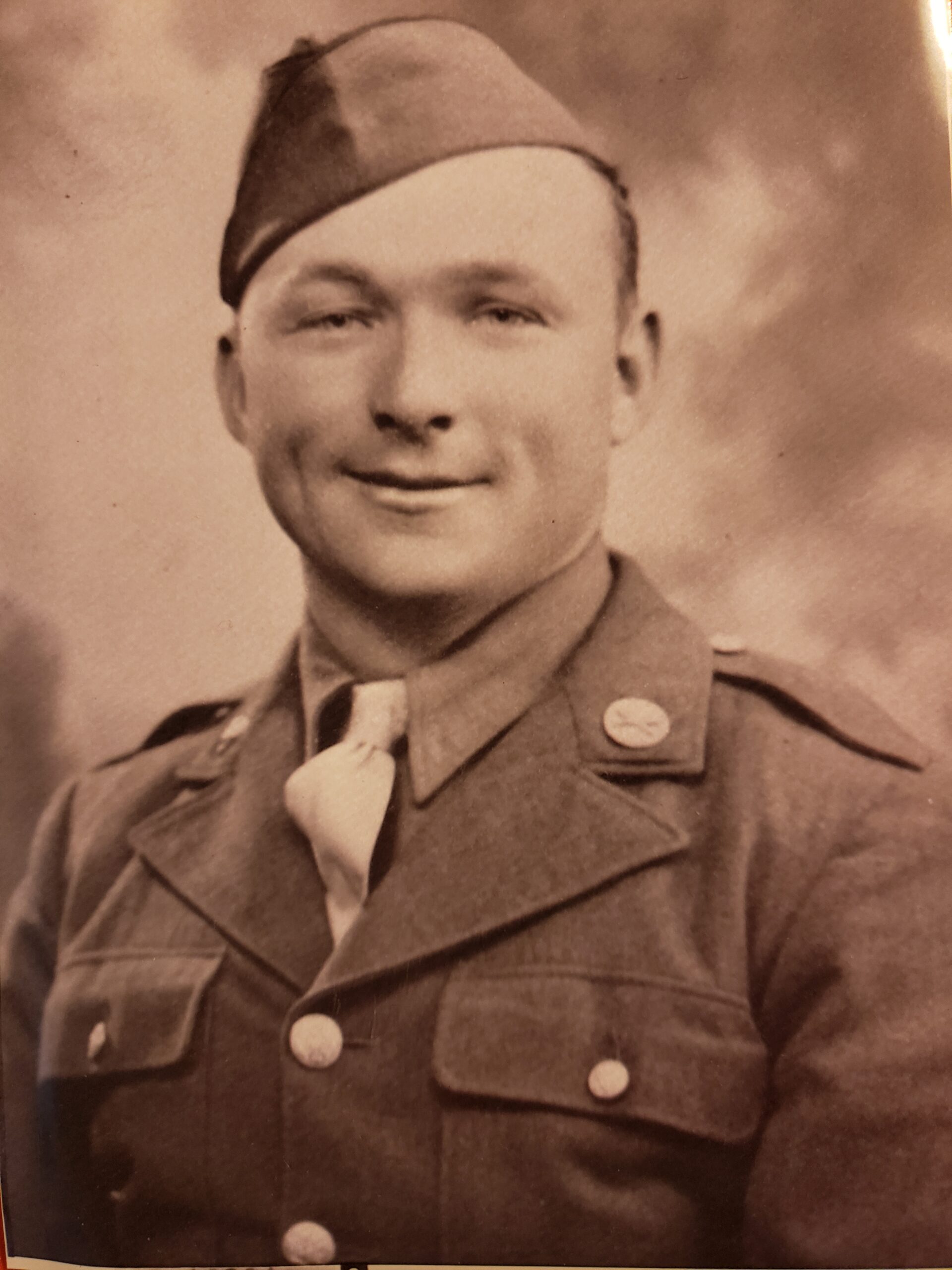
PVT James Hampton Coates – 285 FAOB BTRY B, US Army POW/KIA Malmédy Massacre 12/17/44
James was one of 86 servicemen who was killed in the Malmédy Massacre in Belgium during the Battle of the Bulge. He served in the 13 FAOB HQ from 1942-44. During that time he landed on Utah Beach D-Day+1 and was injured in July by a mine or dud, but stayed with the battalion under field medical care. In October 1944, he joined 285 FAOB BTRY B, and two months later he was killed in the massacre.
James left behind a wife and two children: a 2-year-old daughter and 7-month-old son. He was buried in Henri Chapelle Cemetery, Belgium and later reinterred in his hometown of Kilmarnock, Virginia.
Submitted by his daughter, Mary Ann Smith, Virginia Crater BOBA Chapter President
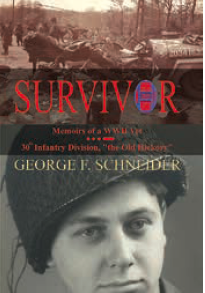
BOBA veteran member George Schneider passed last year, and his daughter Barbara-Ann shared his book, SURVIVOR: Memoirs of a WWII Vet, 30th Infantry “The Old Hickory.” The following is an excerpt regarding his unit’s involvement in the Battle of the Bulge and what they discovered in Malmédy:
By now, the weather was horrible even though the sky was clear. Snow was ankle to knee deep, and temperatures were well below freezing. We were now getting many casualties from frozen feet. We were poorly equipped with only our leather combat boots and thin socks. One of our generals rounded up all of the GI blankets he could find and sent them back to the Netherlands or Belgium where he had local women make booties from the blankets. We wore them inside a pair of overshoes and managed to keep our feet from freezing as we plodded on to the south.
Sometime around December 19th or 20th, we began to hear rumors of a massacre of Americans near Malmédy. Information was sketchy, but the word was spreading that the number of those slaughtered was significant, and most alarmingly, the Germans were not taking prisoners.
On the outskirts of Malmédy, we reached a small community called Géromont. There were only a few houses along the main road, and in these houses, our company established our headquarters for a couple of days.
One more mile south of Géromont, a distance of approximately 2 miles from Malmédy, we came to the intersection of five country roads which we named Five Points. Not more than two or three houses were in this area. There were no signs to indicate that the community had a name, and our maps didn’t identify the village, but today it is called Baugnez, and this small piece of geography is now well known to military historians as the site of the Malmédy Massacre.
The frigid winter air shrouded this site. We were now witnessing the site of the worst massacre of American troops by the Germans in WWII. In the snow-covered field adjacent to Five Points lay 86 frozen bodies, the only evidence of the atrocity manifested by humps in the snow and occasional exposed body parts and clothing. Each mound was a soldier. A man. Although I knew none of these men from the 285th, I felt a bonding with these fallen comrades, and we all felt a renewed hatred for the SS and elevated our resolve to pay back the perpetrators. The massacre had taken place during the initial German attack on December 16, 1944 when elements of the 285th Field Artillery Observation Battalion were captured on December 17th. More than one hundred men were herded into the open field near the intersection of five points and machine gunned in cold blood. It was not until our drive south of Malmédy on this day, January 14, 1945, that the massacre was confirmed when units of my 120th Regiment discovered the frozen, snow-shrouded bodies. Some survivors of the massacre had reported the tragic encounter with the advancing SS troops, but the reality was confirmed by us twenty-eight days after the massacre.
While I viewed this tragic scene, just a few yards away, a jeep load of media correspondents drove up and parked in the intersection of Five Points to document the massacre. We knew the Germans had an 88 zeroed in on the intersection, so we stayed clear of this target. I was close enough to observe a shoulder patch on one of the neatly dressed reporters that identified him as being from Brazil. Reporting of the massacre had apparently made news throughout the world. Shortly after the reporters dismounted the jeep, an 88 narrowly missed the jeep and exploded a few yards away. The artillery piece was probably along the road to Ligneville, our next objective. One round was all the reporters needed to hasten a retreat to Malmédy without any photographs for their archives.
I, along with my 30th Division, left the bodies as found, and the Graves Registration Battalion later identified the bodies and removed them from the field. Baugnez, a.k.a. Five Points, will always be remembered as the site of the infamous “Malmédy Massacre”.
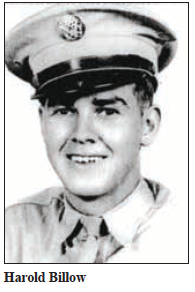
Although it was initially reported that as many as 135 men had been executed, the final count now stands at 86. Most of the 86 were members of the 285th Field Artillery Observation Battalion. Many Americans living today claim to be survivors, but few truly are. I can vouch for two survivors, Robert “Sketch” Mearig and Harold Billow. Into the new millennium, both were still active members of our local chapter of the Veterans of the Battle of the Bulge, the South Central, PA Chapter. The following depicts the events of the massacre as told to me by my friends Harold and Sketch:
It is late afternoon and quickly getting dark. The Germans herd the Americans into an open field where an SS officer surveys his catch with pride. Suddenly he shoots the guy standing next to Harold in the head.
Then he shoots the guy on the other side. He shouts a command to the machine-gunners, and they open up. Sketch & Harold, although not yet hit, drop to the ground and play dead amongst the corpses of their buddies. After all the men have fallen, the officer calls a halt to the firing and inspects his trophies. Sketch & Harold stifle their breaths as they listen to the officer walking amidst the bodies, checking for signs of life. The SS officer, speaking perfect English, would ask if anyone was wounded, and if he gets a positive response, he has a target. He asks one soldier if he is wounded, and getting a moan in response, he shoots the soldier in the head. The officer continues his walk among the pile of bodies, and any movement or groan is terminated with a shot to the head. He kicks them in hopes of getting a reflexive response. When he comes across Harold, he kicks his boot. Harold doesn’t flinch. The officer moves on, arbitrarily choosing bodies to kick. A few flinch or moan. He shoots them. Now satisfied that they are all dead, he orders his men to move out. By this time, it is fairly dark, and with just a handful of Germans now still at the site, Sketch decides to make a break for it. He is near the far end of the field and believes he has a shot at it. He flees toward the woods and, while under fire, disappears. Harold and another guy decide to make their break. They dash towards a house on the corner and make their way inside. Realizing the Germans had probably seen them go in and would probably come after them, they race out the back door and high tail it toward Malmédy. Sketch spent three days wandering in the woods between Baugnez and Malmédy before finally being rescued by our regiment. Regimental Commander Col. Purdue took him back to his quarters and gave him his bed for the night.
In Summer 2020, the 30th Division was awarded the Presidential Unit Citation for their critical victory during the initial months of the Normandy invasion and extraordinary heroism at the Battle of Mortain, France, in 1944. George’s daughter wrote, “My dad passed having only one unresolved issue in his life—to see the Old Hickory finally awarded this citation. He contacted several people close to the president, but he did not live long enough to see it actually happen… I know this award means the world to all Old Hickory survivors.
If you’d like a copy of George’s book, his daughter Barbara-Ann is offering it “at cost” to BOBA members ($19 total with shipping for US only) which is less than the Amazon rate. To order, contact her at vbobgeorge@gmail.com.
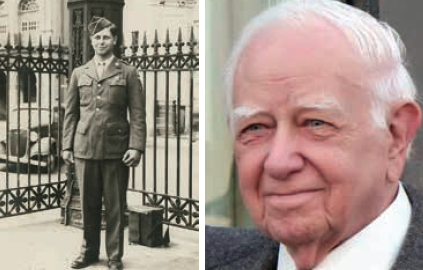
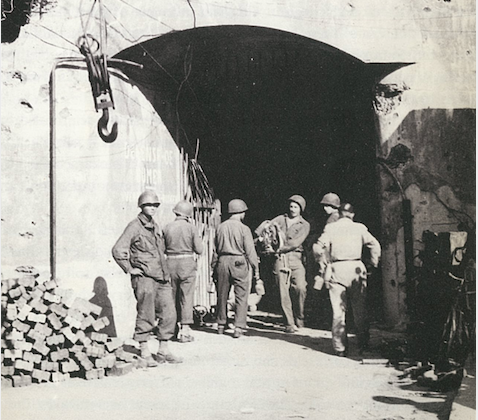
Fort Eben-Emael, Belgium, captured by the 30 INFD. George Schneider is exiting the fort with a Nazi flag. 75 years later, the 30 INFD was awarded the Presidential Citation in 2020.
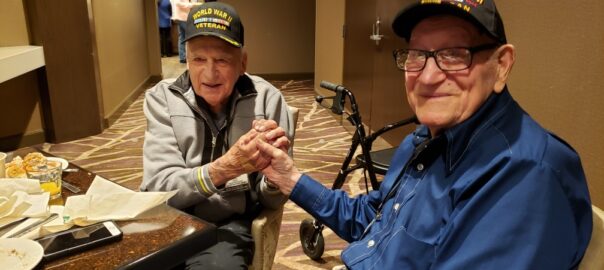
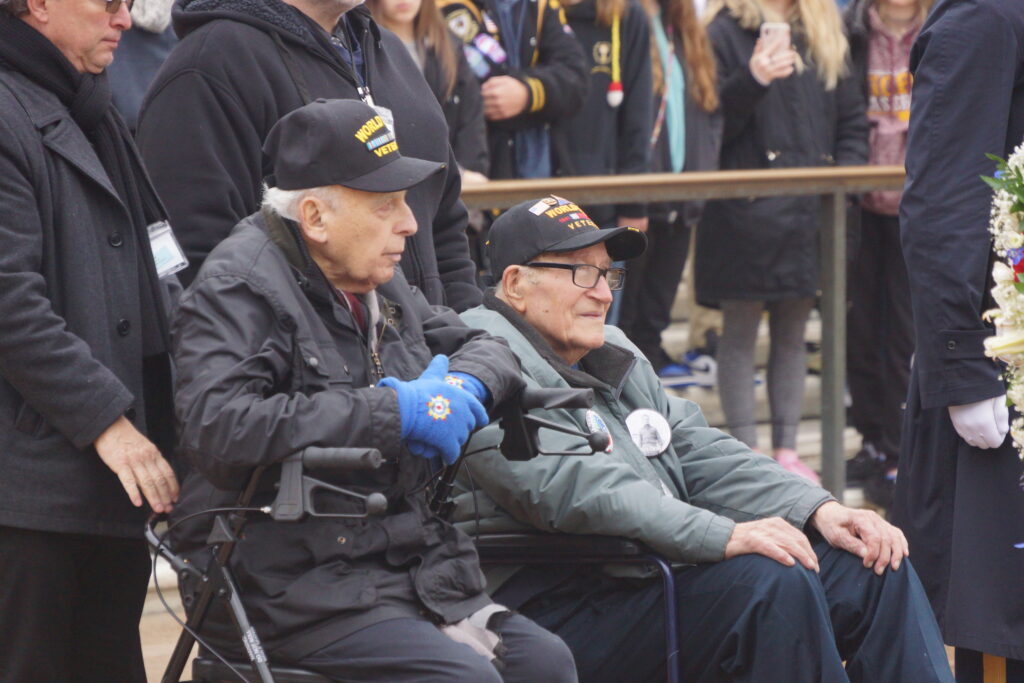
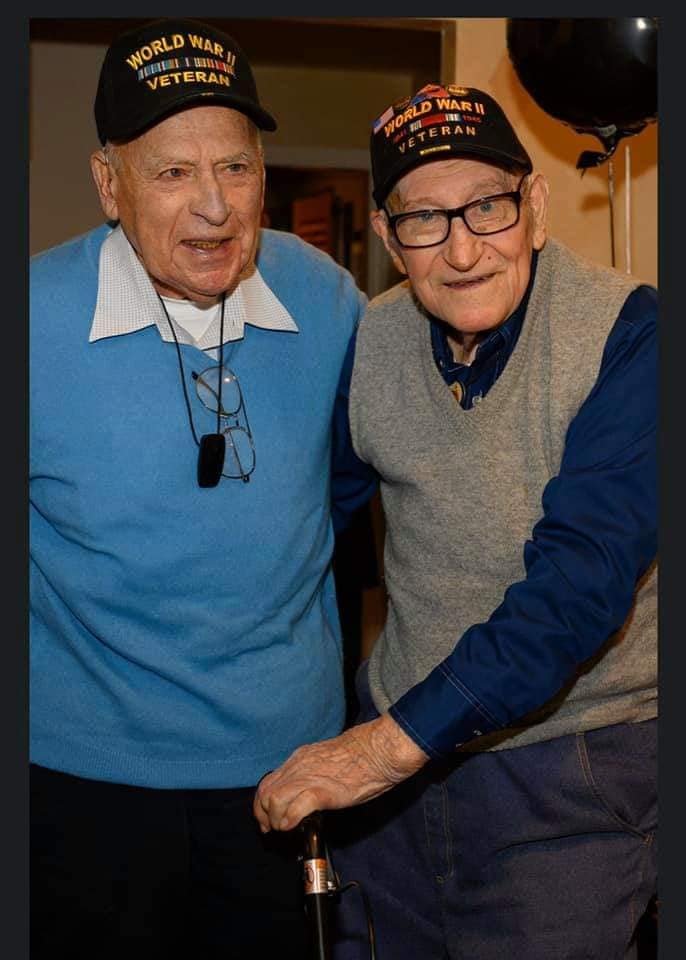
They became fast friends and were chosen to lay the wreath at the Tomb of the Unknown Soldier together (pictured below). The next month, Francis, who lived in Mahanoy City, PA, travelled to New Jersey to attend Lester’s 95th birthday party. They and their families kept in touch and looked forward to the next reunion.
Sadly, we lost them both within a few days of each other. Francis passed on November 24, 2020 at the age of 96 and Lester at the age of 95 on December 5, 2020.
Francis and Lester, two amazing men, who sacrificed their youth to preserve our freedom and our liberties. Their BOBA family is privileged to have known them and sends condolences to their families. We miss them so much!
December has always been a special time of year. And, like most other events in this unforgettable year of 2020, our observances may be unique. No doubt, we each have unusually long lists of losses and heart aches. Some people may even prefer holidays to pass unnoticed.
But celebrate we shall, we must!
In a time when darkness, real and metaphorical, settles heavily on us, we can find joy in celebrations of light, indeed of miracles: Hanukkah and Christmas. Light those candles for Hanukkah, Christmas, Kwanzaa – creatively honor your faith/family tradition(s).
The image of our soldiers doing their best to celebrate in the midst of battle always touches my heart. Gain strength from them. Whatever their internal dialog at the moment, no matter how far from loved ones, despite the danger, they touched each other’s lives as best able with warmth, caring, and faith – and they endured.
We celebrate them, even as we mourn those so dear to us who have recently died. Take a moment to reflect on their lives and their impact on us. Although we cannot gather formally this December 16 to commemorate the 76th anniversary of the beginning of the Battle of the Bulge, please pay tribute in your heart to these brave service men and women who fought to preserve our freedom and our liberties. Honor their families, too – and all who supported them.
And now in this blessed season, permit yourself a little perspective shift. Don’t focus on what you’re missing! Focus, with joy and gratitude, on what you have – “hold fast what is good.” Invite the peace of the Lord to reside in your heart. Joyfully, believe that God has a plan far greater than anything of which we can conceive. Humbly, acknowledge that God uses difficult times to strengthen, to teach, to guide. Continue your faith journey, even when you stumble. “Do not quench the Spirit” (in yourself or in anyone else)! Let your light shine – you will feel better and so will those around you.
Prayer: Lord, keep us mindful of how blessed we are – and joyfully share those blessings. Open us, especially in challenging times, to an awareness of, and gratitude for, the many silver linings. Grant us contentment. Give us strength to live out our faith, to constantly reach out to you and rejoice in you, knowing you are always with us and you keep your promises. AMEN.
A blessing for today and for the coming year:
“May the Lord bless you and protect you. May the Lord smile on you and be gracious to you. May the Lord show you His favor and give you His peace.” (Numbers 6:24-25)
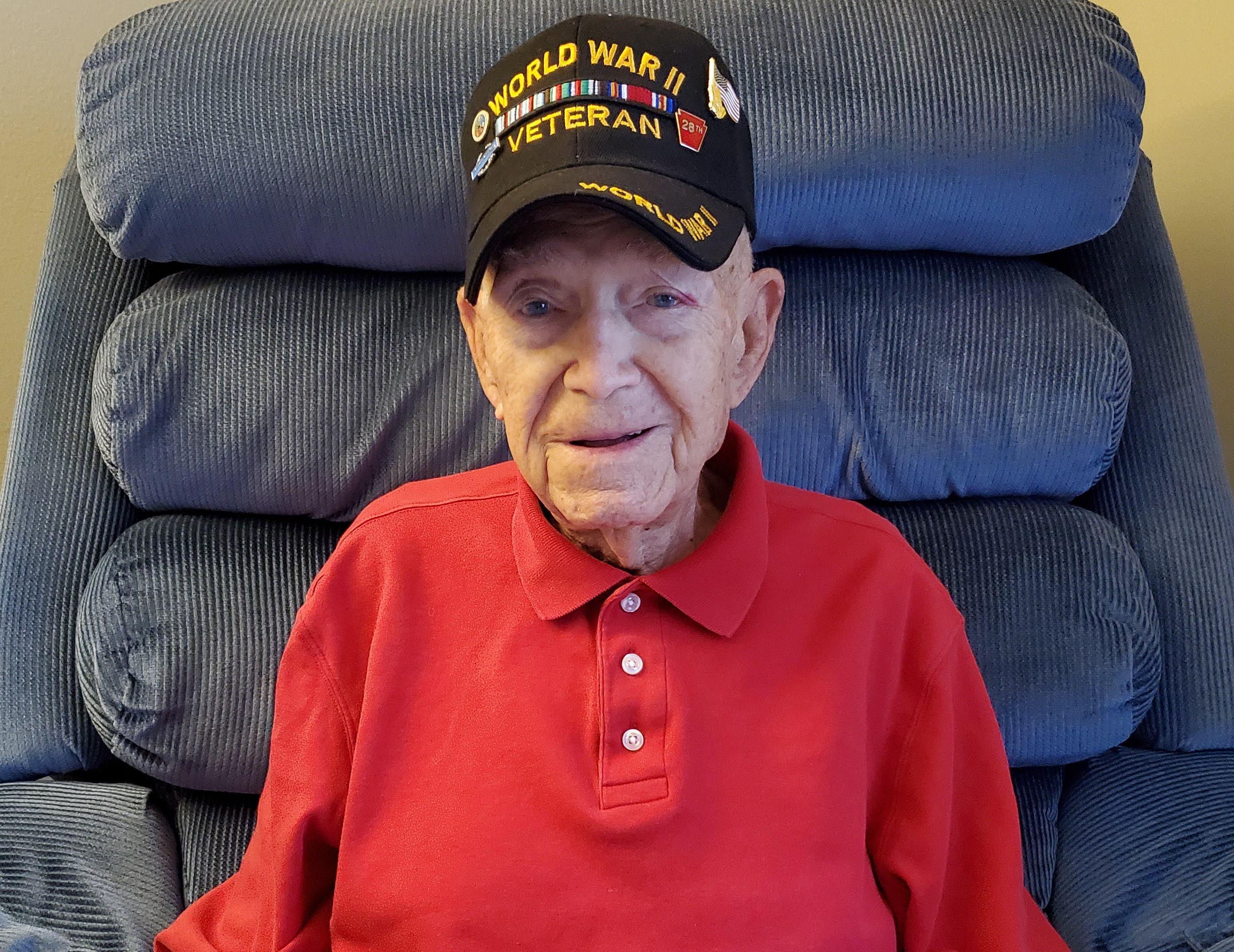
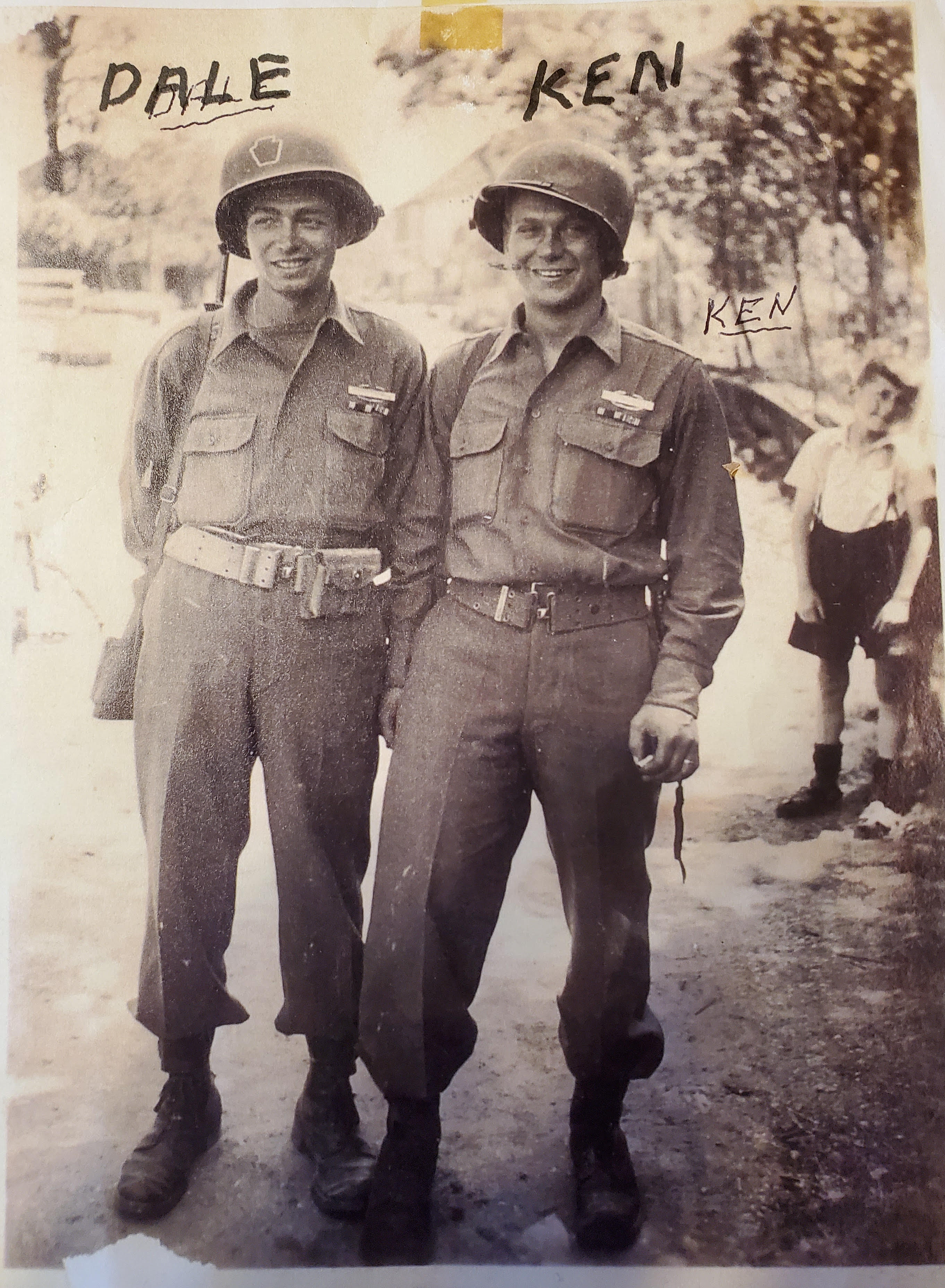
Dale Cooksey (28th Division, 110th Inf Rgt, Co A) turned 100 on December 3rd and the local police and fire department helped him celebrate! He is a proud American – he raises his American flag on his flagpole every morning and retires it in the evening – rain or shine.
Dale was born in Trenton, MO in 1920 and lived in the midwest all his life. His first job (at age 16) was to sell shoes and he became store manager at age 18. He was drafted into the US Army at the age of 23. He trained at Camp Roberts, CA. When he left for Europe on the Queen Mary, he left behind his young bride who was carrying their first child. Dale recalls his experiences as well as some of the places he fought in – St. Vith, Clervaux, Wiltz and Cologne.
He was lucky to return home in January 1946 without injuries and he met his daughter for the first time. He worked in Chicago as a manufacturing representative selling brushes (for artists, hair stylists and painters) and eventually became a sales manager at a Sherwin Williams store for over 20 years.
After retiring, he worked as a volunteer at a Thrift Shop. He loves to tinker with clocks and he can fix anything that is broken. He has always been a generous man who believes in working hard and living honestly. He lives close to family and still manages his household – including doing his own housecleaning, laundry and even mowing his lawn!
He’s never met a stranger – he loves people. He was married to his sweetheart for 74 years and has 3 daughters, 4 grandchildren and 6 great grandchildren who adore him. I’m one of them – his grandson – who is extremely proud of him. He taught me more than he’ll ever know.
Submitted by BOBA member Jason Ryan, grandson of Dale Cooksey
Bulge Memory – Originally published in The Bulge Bugle® Winter 2020.
We were sent to Belgium after fighting many battles in France. We ended up in St. Vith which was supposed to be a “Rest Area” for our troops.
On the night of December 16 or 17th, we heard the huge buildup of armor across the valley. The following night, about three Sherman tanks attacked one or two tigers which were visible from our vantage point. The Sherman’s were running circles around them but were eventually knocked out by superior Tigers. It was like the 4th of July and we had a good seat. Little did we know what was about to come.
All of a sudden the barrage started and never seemed to let up, as their 88s poured into us. Many of our men were hit and were calling “Dick, I’m hit!” (not “Medic!”). I had trained with all of these men and was assigned to the 1st Platoon so they all knew me.
A man from New Bedford, MA was hit in the chest and was bleeding badly, so I crawled over to him and bandaged him up as best I could and they evacuated him. I didn’t give him much hope to make it. (Several years later after the war, I was walking down the streets of Boston with my sister when a man and a friend stopped us and introduced me to his friend as the guy that saved his life. I was speechless, I thought he was dead). Several others were KIA or WIA and I treated them to the best I could under the circumstances.
We were told to evacuate on the 21st of December, and we congregated on a hill about 20 miles behind the German lines with Col. Riggs. Riggs gave us three options: 1) fight out enforce, 2) break up into squads and try to work our way through the lines, or 3) retreat in the deep woods and wait for a counter attack. The vote was taken, and much to the dismay of Col. Riggs, #2 was elected. (Note: Most of the GIs had already destroyed their firearms so #1 would have been useless).
I was in the first squad to leave and eventually we were surrounded by Germans. My days as a POW began.
Many years later at the 168th reunion, our Battalion was awarded the Distinguished Unit Citation and the Belgian Croix de Guerre (war cross). Both awards recognize the 168th for their stubborn defense of St. Vith Belgium during the Battle of the Bulge. The 168th held the pivotal communication center against a larger German force for seven days before being ordered to retreat.
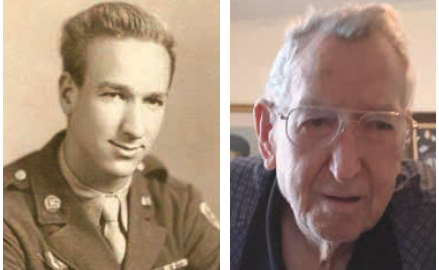
Richard Lewis survived 4 months of German POW camps and suffered from frozen feet which were saved with penicillin after liberation April 6, 1944. Later on he graduated from business college and was named Business Administrator for a private high school for girls. He later owned and operated a retail variety store for 15 years until his retirement. His first wife Virginia died in 1995, and he has since married Mary, with whom he lives in Florida.
Battle of the Bulge Association, Veterans of the Battle of the Bulge and The Bulge Bugle are registered trademarks.