Veterans honored by Belgian American Association

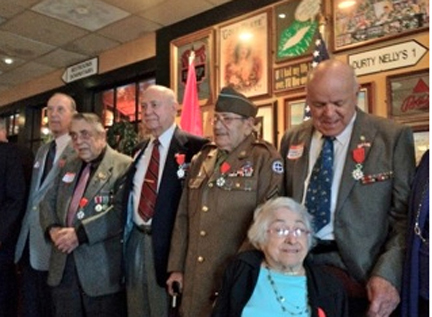
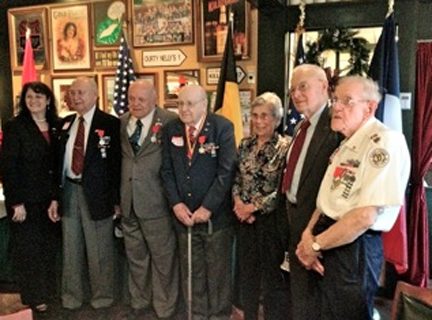
Commemoration of the 67th Anniversary of the Battle of the Bulge at Arlington, Virginia December 16, 2011

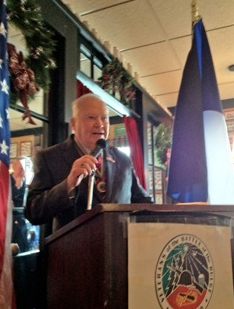
Address to the Veterans of the Battle of the Bulge by Paul Goffin, former Vice President of the Belgian American Association and trustee of BOBHF

Veterans of the Battle of the Bulge, families, and friends of the Veterans, I am grateful for the honor of participating in this important commemoration. It’s a privilege to be with you. This week, in the Ardennes and Luxemburg, there are commemoration events celebrating the Battle of the Bulge and the liberation of both countries. These include concerts, parades and wreath lying’s in the military cemeteries of Hamm, Luxemburg and Neupre and HenriChapelle, Belgium. Some 18,000 marble headstones stand in perfect military order, worthy of the dignity of those who rest there. Each headstone is a testament to the price paid for freedom.

In September 1944 I , with my family, my neighbors, my whole village and my whole country, Belgium, were thrilled with joy and admiration for those who liberated us from the Nazi tyranny. But the joy was of short duration, three months later, in December 1944, the news spread like fire that “the Germans are coming back and shooting even civilians”. It took three to four weeks before the good news reassured us that not only were the Germans contained but that they were crushed. The response brought by 45 units assembling more than 600,000 men of the United States Forces was swift and decisive and became known in history as the Battle of the Bulge.

But that victory came at a tremendous cost. About 19,000 U.S. soldiers died, and 47,000 were wounded. The British suffered 1,400 casualties with 200 killed. The Germans themselves experienced 100,000 killed, wounded or captured. To this list let’s not forget the 2,500 civilian casualties of which hundreds were massacred by the German troops. So one can question was this bloodshed worthwhile? The positive answer lies in the word “liberation”.

Its meaning is something very beautiful and literal. It’s the triumph of freedom over tyranny. That’s what it meant in 1944 and what it still means today.

The story of the Battle of the Bulge, both in combat and in decisiveness, is recounted today to our troops in Iraq and Afghanistan by our military and political leaders. They characterize it as part of a struggle that brought freedom to a huge part of Europe and helped make this country more safe and secure. The discipline, courage and motivation displayed in the Battle of the Bulge prevails today in the Armed Forces of the United States.

Sixty seven years ago you fought valiantly in the Ardennes and we were liberated. We owe you the life of freedom we know today. We are lucky to be together here this evening and thank the good Lord. We might be a bit balder and bit rounder around the waste but our feelings have not changed we have the same gratitude and affection for you as in 1944. You are the best, God bless you and God bless America. Click here to read the address to the veterans

Poem – A Brief History of the Bulge – by Jacob G. Zimmerer

On September 16th, 1944, Hitler had five confederates swear to his last offensive plan through the Ardennes to split the Allied powers.
He promised fifteen hundred tanks, one hundred trains of ammo and a force of 275,000 men to strike in November’s waning hours.
Everyone available from cooks, to U-boat sailors, to band members were to be retrained for this unholy crusade Without its’ success to sue for peace, the Nazi movement of “Gott Dammerrung” would fade.
All new equipment from Albert Speer’s factories build with slave labor would come into
play Finally, these troops were posed to strike on a sixty mile front on December’s 16th day.
With overcast skies the 106th and 28th Infantry Divisions received the starting thrust at the German border.
Allied engineers slowed the German advance by blowing many bridges to stem the initial slaughter.
At a conference in Verdun, General Patton stepped forward with a plan to disrupt their
infantry and tanks,
The 4th Armored, 80th and 26th Infantry Divisions would attack their vulnerable southern
flank.
The German plan was to move on the main highway through Bastogne toward the
Meuse River, splitting General Bradley’s command in the west,
The 101st Airborne stood in its’ way at Bastogne and this held up any chance for
success.
This surrounded town, the key to the German salient, was relieved by the 4th Armored
on Christmas day,
The skies cleared and 3,700 planes, bombers from England and pursuits from France
came into play.
The infantry and artillery followed the tanks while the quartermaster delivered the
needed supplies for an endless fire power display.
The German supply train of depots beyond the Rhine were bombed and the front line
strafing took many lives,
Artillery batteries fired nonstop with a tremendous pounding from 155s and 105s.
On the northern sector Stavelot and St. Vith’s, stubborn resistance hurt their panzers
thrust, plus a critical shortage of gas.
Colonel Peiper’s brutal killing at Malmedy is as an example of frustration after the initial
clash.

The 82nd Airborne having motored to Marche led a steadfast defense causing a German
offensive halt,
Their efforts were hampered by superior power, air attacks and leadership faults.
By mid-January the Bulge was a narrow salient through Hauffalize with the Germans in the jaws of the U.S. Army’s vice,
The remnants of General Von Mantueffel’s panzers were in desperate straits to save their lives.
There is one phase of the battle that U.S. leadership regrets, a stain for life,
For the first time ever American troops were under the orders of Britain’s General
Montgomery for the northern sector’s fight.
The former German colossus was badly beaten and should have surrendered to the
Allies.

Instead the following three months only increased the devastation and agony for
everyone who survived.

This dictatorship was stomped on the aurora of arrogance and superiority acquired
since the time of Fredrick the Great and it did not last.
Finally at the Bulge its’ invincibility on the battlefield came to pass.

Jacob G. Zimmerer 39th Signal Corp. 26th Infantry Division

Read the poem

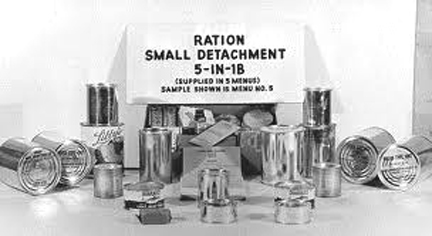
Ration Small Detachment, aka 10-IN-1

The conversation around the table of the Duncan T. Trueman Chapter 59 at the November meeting turned to those delicious meals we were served on Thanksgiving day in ’45, and so I include here a brief listing of what the Army supposedly fed us. According to the Stars and Stripes, every man, woman, and even that Sergeant they had to keep muzzled and on a leash, was fed a full Thanksgiving dinner, complete with turkey and all the fixings. It was supposed to be true, but I’ve run into a couple of guys who said that was just some Rear Echelon Commando’s pipe dream! I know that I had mine with everything piled up together on a steel tray, which I ate standing at a mess table welded to the deck on the USS Monicello, a Navy transport, on my way to England.

When it could, the Army really did try to do well by us, an effort which unfortunately some Mess Sergeants and Army cooks managed to mess up. First was the “A” ration, which included all fresh food. Then came the “B” ration, which included canned or otherwise preserved food items. No need to describe the C-Ration – Dog food in two small cans! The D-Ration was that high energy bar of chocolate and cereal, which could be melted to produce a pretty good beverage if your canteen cup could stand the heat from the wood fire,or that little stove-in-a-can (if you were lucky enough to have one) or cooked up with those crackers to make something resembling chocolate pudding. The K-ration was more dog food, in a GI Cracker Jack box. Finally there was what I personally consider the best of the field rations offered to us in combat, the 10-in-l Small Detachment Ration, commonly referred to as the 10-in-l.

The 10-in-l Small Detachment Ration consisted of one 5-in-lA and one 5-in-lB unit, and was composed of 5 menus, varying between 8500 and 4050 calories and supplying between 91 and 121 grams of protein. The vitamin and mineral content was slightly below requirements, and the ration weighed 5 more pounds than specifications called for.
The full day’s rations were divided into two sets of two cartons, each set with food for five men so it could feed ten men for a day or five men for two days (or even one man for ten days). The four cartons were placed into a larger packing carton. Each separate carton contained one of five different menus containing a wide variety of canned food and accessory items such as cigarettes, matches, P38 can openers, toilet tissue, soap, and paper towels.

A typical menu follows:

Breakfast: Cereal, Sliced Pineapple, Pork Sausage, Crackers with Jam, Coffee, Milk, and Sugar.
Dinner: Luncheon Meat (AKA Spam), Cheese, Crackers, Fig Pudding or Fruit Cake, Cocoa, Chocolate Bar ID Ration).
Supper: Spaghetti and Meat Balls, Peas, Crackers with Army Spread (Canned Butter), Coffee, Milk and Sugar, Caramel Nougat Bar, Peanuts.

Water purification tablets were included to purify drinking water.
Veterans of MA Chapter (22) receive French Legion of Honor

Eleven (11) Veterans of the Central Massachusetts Veterans of the Battle of the Bulge, Chapter XXII received the prestigious French decoration, which is called  :”Chevalier de la Legion d’ Honneur.” on November 29, 2011.   The French “Consul General de France” came from Boston, MA. to pin these medals on the chest of our Veterans; all of them fought on the French soil from Omaha Beach, Normandy  or Southern France all the way to the Northeastern border of France and Germany.  This very special ceremony has been organized by Dr. John E. McAuliffe, a retired Worcester dentist, who created Chapter XXII VBOB nineteen years ago and has been its President for all these years.

John E. McAuliffe, Chapter President

The veterans:
Dorothy Taft-Barre – 16th General Hospital
William Ford – 107th Evacuation Hospital
Francis J. Gaudere – 30th Infantry Division
Arthur J. Hubbard – 110th AAA Gun Battalion
John F. Judge – 26th Infantry Division
Charles Kady – 128th AAA Gun Battalion
John F. Kreckler – 110th AAA Gun Battalion
Athanace Joe Landry – 776th AAA AW Battalion
Helen Najarian-Rusz – 59th Evacuation Hospital
Chester C Wenc – 106th Infantry Division
Richard Woolson – 110th AAA Gun Battalion


Information by Christian W. de Marcken, Secretary of Chapter XXII
Photos by Robert Rhodes, Associate member
Worcester Telegram & Gazette

Looking for information about PFC Willie L. Elam

My name is Gerard Roggen and I am Belgian and a historian of the Battle of the Bulge.
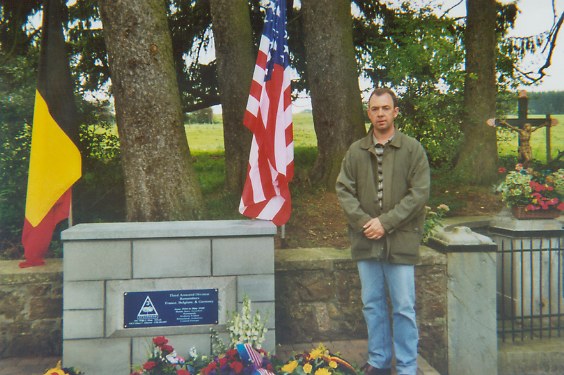
I am looking for information about Willie L. Elam, serial number 38043752, who was killed in action near Amonines, Belgian on December 28, 1944. He served in the 3rd Armored Division, 36th Armored Infantry Regiment with his best friend Elmer C. Sherrer who serial number is 3800851.
Both of these men were killed in their jeep at the same place and were buried in a temporary American Cemetery at Fosses-la-Ville near Namur from 1944 in 1947. They now rest in peace in the American Cemetery of Henri-Chapelle.
Since 2002 I have been in contact with the Sherrer’s family. If you knew Willie L. Elam, who was from Mesquite Dallas, Texas please contact me.

Gerard Roggen
#66 Rue Haut-Vent
5070 Fosses La Ville, Belgium

Gerard Roggen at the 3rd Armored Division Memorial – Amonines, BE

Read Gerard’s “The Heroic Defense of the Aisne Valley”

Thank you card from Belgian school girl

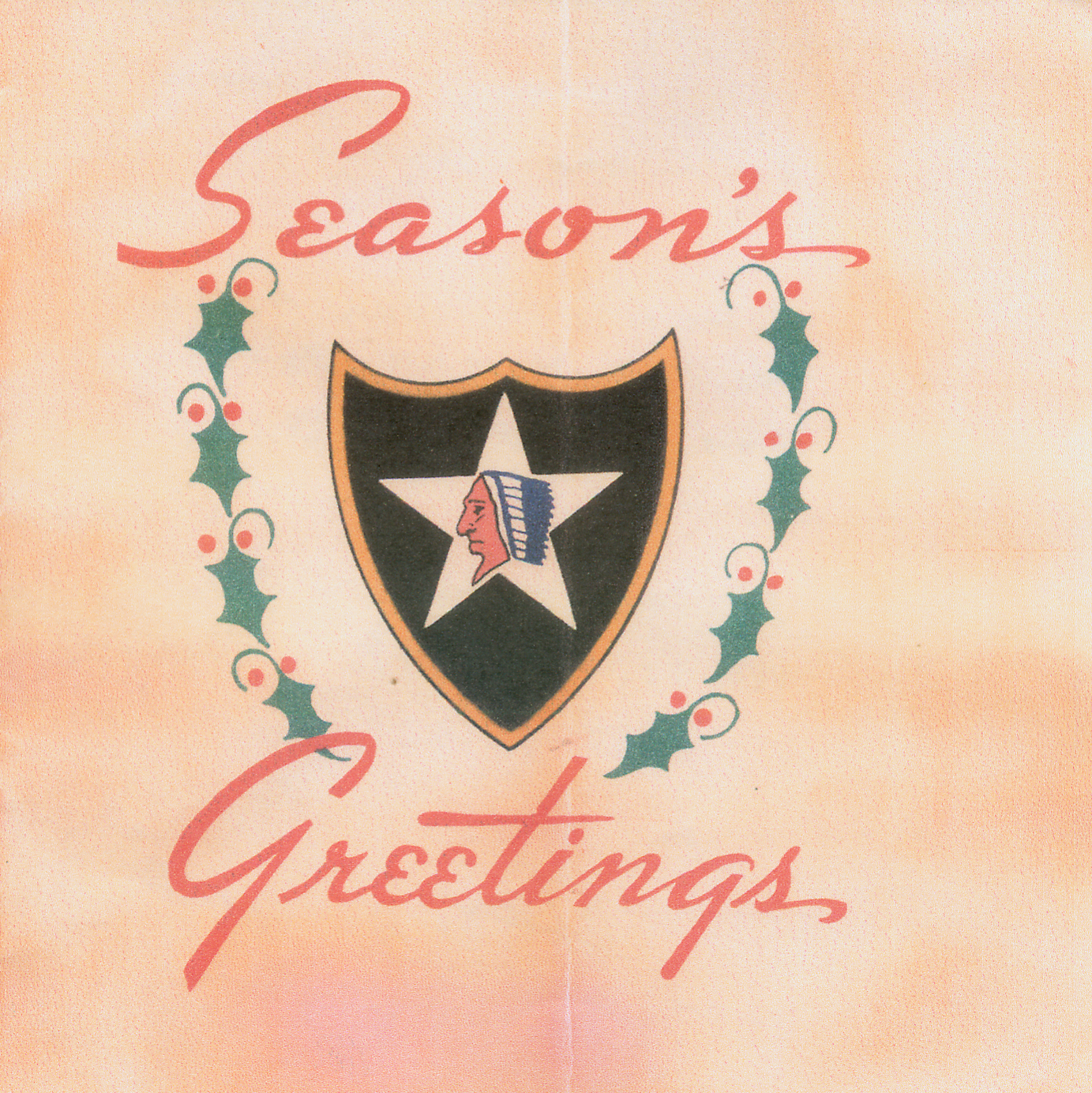
The solemn bond between Belgian citizens and the US soldiers, who fought to preserve their freedom, continues today long after the Battle of the Bulge ended. The graves of thousands of those who gave their lives have been adopted, honored and maintained by citizens of Belgium. This thank you card was sent to Beverly Pangborn, an associate member, whose uncle was killed in the battle.


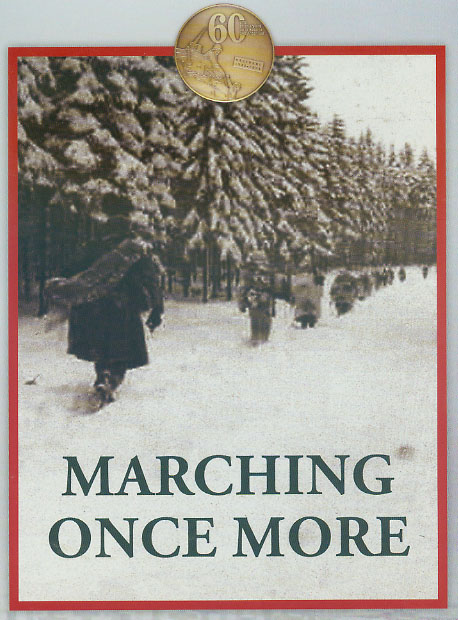
“MARCHING ONCE MORE” to be on TV

Sixty years after the Battle of the Bulge, veterans make an emotional return to the battlefield. The movie, produced by Brenda Hughes of Wetbird Productions  is now being distributed nationally to PBS stations by American Public Television.   From November 1st, 2011 to October 31, 2015, MARCHING ONCE MORE will be available to PBS stations for broadcast.

2011 APT TV BROADCASTS – MARCHING ONCE MORE
KVIE               Sacramento, CA            December 7                8:00pm
SC ETV            South Carolina              December 4                6:00am
KENW              Portales, NM                December 12              9:00pm
IPTV                Iowa Public TV            December 16              8:00pm
WPTD              Dayton, Ohio                 December 16              10:00pm
WPTD              Dayton, Ohio                 December 27              9:00pm
KLVX               Las Vegas, NV              December 17              9:00pm

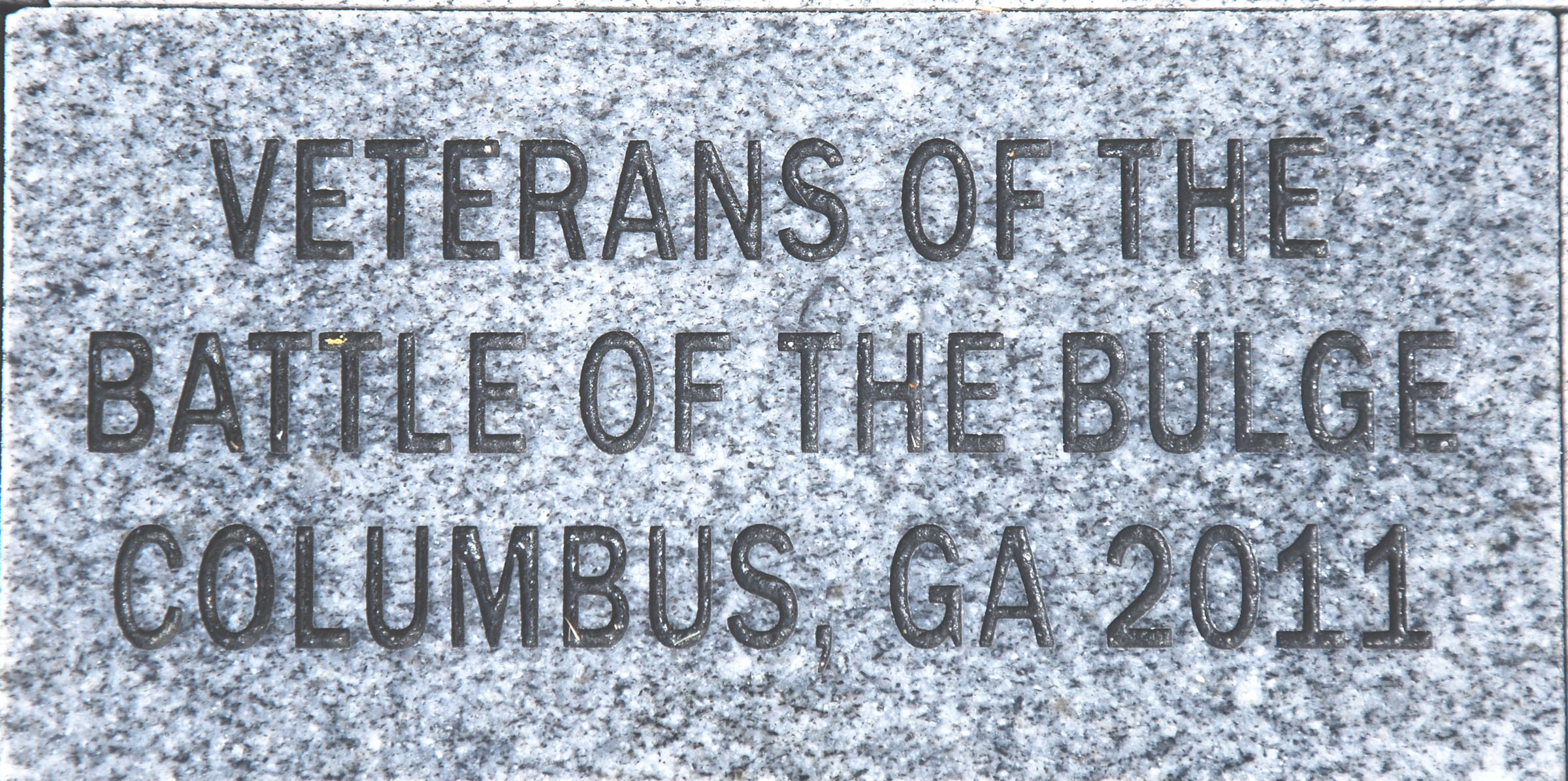
Columbus, GA CVB Honors VBOB

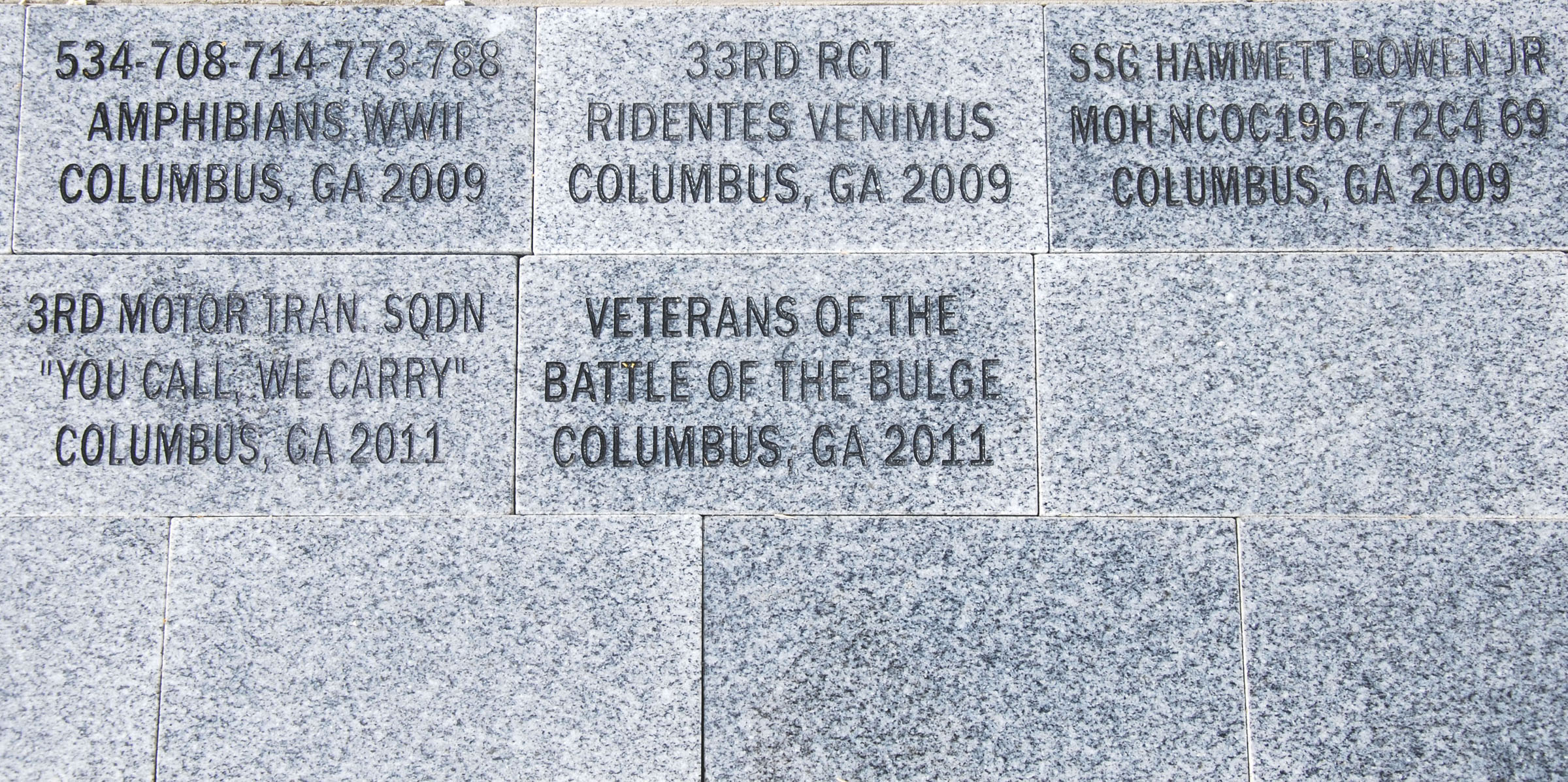
The Columbus, GA Visitor and Convention Bureau donated a “paver” to honor the Veterans of the Battle of the Bulge who held their reunion in Columbus from September 20-25, 2011. The “paver” was dedicated at the National Infantry Museum adjacent to Fort Benning on November 11, 2011

Harry Kirby – Golden Triangle Chapter Florida

Battle of the Bulge veterans meet, thanks to DAR
by Susan Smiley-Height

Veteran Harry Kirby salutes as the color guard from the Francis Marion Military Academy ROTC retires the colors during the Veterans Day Observance 2011 held at the College of Central Florida in Ocala, Fla., on Tuesday, Nov. 8, 2011. The event was held to honor veterans who participated in the Veterans Project of Marion County, a joint program by the Ocala Star-Banner and the College of Central Florida.
by Jacqui Janetzko/Special to the Star-Banner

Veterans Day National Ceremony – VBOB President

J. David Bailey, 106th Infantry Division and president of the Veterans of the Battle of the Bulge will be attending the Veterans Day National Ceremony to be held on November 11th at Arlington National Cemetery. The ceremony commences precisely at 11:00 a.m. with a wreath laying at the Tomb of the Unknowns and continues inside the Memorial Amphitheater with a parade of colors by veterans’ organizations and remarks from dignitaries. The ceremony is intended to honor and thank all who served in the United States Armed Forces.
Click here for additional details from the U.S. Department of Veterans’ Affairs

VETERANS DAY, 2011
BY THE PRESIDENT OF THE UNITED STATES OF AMERICA
A PROCLAMATION
Today, our Nation comes together to honor our veterans and commemorate the legacy of profound service and sacrifice they have upheld in pursuit of a more perfect Union. Through their steadfast defense of America’s ideals, our service members have ensured our country still stands strong, our founding principles still shine, and nations around the world know the blessings of freedom. As we offer our sincere appreciation and respect to our veterans, to their families, to those who are still in harm’s way, and to those we have laid to rest, let us rededicate ourselves to serving them as well as they have served the United States of America.
Click here to read the full Presidential Proclamation


Courage and Sacrifice – a power point presentation

The PowerPoint presentation consists of 96 slides that include battlefield scenes, military cemeteries, insignias of the armies, corps, infantry divisions, airborne divisions, armored divisions and the two US Army air forces. In order to view the presentation your computer must have Power Point software.

Click here to download the PowerPoint presentation
If you do not have power point software you can download free power point readers from the web.