Easton, PA Area Community Center is hosting “Eyewitnesses to History” during its first Monday event at noon on May 7 …
Easton, PA Area Community Center is hosting “Eyewitnesses to History” during its first Monday event at noon on May 7 …

The Year 1945: More War? World Peace?
Time: January 1st, 1945
Place: Ardennes Forests of Belgium and Luxembourg
New Year’s Day, 1945 dawned crystal clear and bitterly cold. Boughs of the Ardennes fir trees were strained under the weight of the recent snowfall. More snow had descended on the Allied troops during the night, adding to the misery of the intense cold. Lack of warm clothing and adequate footwear plagued the troops in their quest to shove the German army back to their homeland. Many soldiers, especially frontline infantry troops, suffered frozen feet.
The unexpected breakthrough by the German troops occurred two weeks ago. Hundreds of thousands of Allied soldiers were rushed into the Ardennes to blunt the German move. This included 15,000 men of the 75th Infantry Division, 291st Infantry Regiment, Cannon Company. The truck driver of Cannon 14 was counted in those thousands that had rushed north into the Ardennes from a camp near Paris, France. He had witnessed the blinding shell bursts as his motor convoy approached the front lines on that memorable night journey ten days ago.
The truck driver and his buddies welcomed hot coffee from the company’s mess tent. Those cooks worked long hours to serve hot food under primitive conditions. While sipping the steamy liquid, they had several laughs about last night’s spectacular bombardment. Every artillery piece in the Allied armies fired three rounds into the German lines at the stroke of midnight. The three 105 mm cannons of the Company joined in the New Year serenade to Hitler.
January 4, 1945 was a signal date for the truck driver. It was his father’s 47th birthday—a veteran who had served in France in the first War. His father was a truck driver with a balloon observation company. His outfit would launch a gas filled balloon tethered to a ground-based winch. Two observers in the basket of the balloon would peer across the enemy lines, checking on their activity. The crew would quickly winch the balloon to the safety of the ground. Those balloons were prime targets for German aviators. The truck driver recalled conversations with his father regarding the outcome of the first War. His father had strong feelings that problems with Germany had not been resolved and that another war was inevitable. He felt that his son would likely be caught up in another conflict. These conversations took place in the 1930’s as Hitler was rebuilding Germany into a military power. All this went through the truck driver’s mind as he and his buddy transported men and supplies in the campaign to drive the German army from the Ardennes salient.
Sound sleep became a problem for the Allied troops. Each night the German buzz bombs sputtered overhead. None had crashed near the Cannon Company site, but the soldiers were always alert to that possibility. On trips to army depots near Liege and Spa, Belgium, the truck driver had seen collapsed buildings and giant craters as the result of buzz bomb strikes. “Bed Check Charlie”, that lone German aviator, continued to annoy Allied troops by his late night sorties. In mid January, the truck driver found himself in an army field hospital in Spa. He could not remember the details, but his buddies brought him up to date. He had been in the bitter cold for several hours. He entered a warm building and stood before a hot fire. As the warmth of the fire soaked into the truck driver, he suddenly collapsed. His buddies caught him and he was transported to the Spa army hospital. After several hours of sleep and some hot food, the truck driver insisted that he be returned to his outfit. He was fearful that his Company would move on without him. His outfit had moved to a new location but his buddy had cared for the truck driver’s belongings.
A venison feast was celebrated by the Cannon Company soldiers. One of the guys shot a deer. It was illegal to kill a deer in the Ardennes, but the shooter explained that the deer “just got in front of the bullet”. The truck driver and his buddies with farm backgrounds properly “dressed” the deer and the cooks prepared the feast with all the trimmings. By late January the German army had been driven back to mid December positions near the Rhine River. The Ardennes campaign was now history. Thousands of Allied troops were killed. Thousands more were wounded, missing in action or taken prisoner. Many of the casualties resulted from the lack of proper clothing and footwear. The German army also suffered tremendous losses. The superiority of the Allied forces in equipment, manpower and planes seriously depleted Hitler’s ability to wage war on two fronts. The tide had turned in favor of the Allies.
But that was not the end of heavy lifting for the 75th Infantry Division. Hitler created another breakthrough in southeast France near Strasburg. His strategy was to divert the Allies’ attention from a possible Rhine River crossing by pushing into the Alsace-Lorraine city of Colmar near the Swiss border. Late January found the truck driver in a long convoy of military trucks and equipment departing Belgium and heading south through France. The convoy drove day and night, passing through the city of Nancy and over the treacherous Vosges Mountains. Extreme driving skill—and lots of luck—was required to navigate the narrow mountainous roads while traveling under complete black out conditions. The driver’s only guide was to follow the tiny slit of blackout light from the vehicle ahead. Deep snow-filled ravines reflected in the cold moonlight.
More than 72 hours of continuous driving brought the 75th Division convoy to another battlefront. The German army was deeply entrenched around Colmar. The snow and cold of the Ardennes was replaced by deep mud. It was now the task of the 75th and other American units to assist the French Army in driving the Germans back across the Rhine. The Allies and French forces waged intensive, but successful, warfare for three weeks. The invading German forces were pushed back to their homeland. The honor of the French Army had been restored. During the Colmar campaign, the truck driver observed his gun crew buddies firing several rounds and then celebrating. Their guns were directed to fire at a church steeple being used as an enemy observation point. After firing five rounds, a big cheer went up. Five direct hits! The church steeple was obliterated. No more snipers from that place. The next day the Company’s cannons knocked out two enemy self propelled guns. Being several miles from the target, the crews relied upon the reports from their “forward observer”. The “F.O.” was positioned with the front line infantrymen to direct the fire of the cannons—at great personal risk.
Now that the Colmar Pocket in southeast France was eliminated, the 75th Division was ordered to “load up” and hit the road. The convoy retraced its route back through the Vosges Mountains, back through the city of Nancy to a rest area for rehabilitation of men and equipment. While passing through Nancy for the second time, the truck driver recalled his father being stationed there in the first War. Ironically, they had traveled the same highways. This stop for rehab was fondly remembered by the truck driver. A 291st Regimental Officer located a Quartermasters bath unit near Luneville, France. A schedule arranged for the maximum number to take advantage of the showers in a short time period. For most men, it was the first shower in many weeks. Upon leaving the showers, the men were greeted by another amazing sight—clean clothes—the first clean clothes since mid December. The troop’s morale was very high after this welcomed pause in the journey. It was amazing what a shower and clean clothes could do.
Resuming their journey, the refreshed troops of the 75th Division proceeded north through Belgium into the Netherlands. The 291st Regiment relieved the 3rd British Parachute Brigade of their positions along the Maas River. The Cannon Company was now in the level river valley near Horn, Holland in Limburg province. The Maas River must be crossed before reaching the Rhine River and the German border. A few hours after arriving in the area, the truck driver was visited by several teen age Dutch boys. One of the boys, Manny, spoke fairly good English and proudly served as interpreter. The boys visited almost daily. The Cannon Company troops would share food items, especially chocolate, with the teenagers. The boys claimed to be practicing their English, in exchange for treats from the soldiers.
Several days after arriving at the location near Horn, Manny invited the truck driver to be a guest for a meal in his Dutch home. The truck driver received permission from his Company Officer to accept the invitation. The Company’s head cook heard of the invitation and provided sugar, coffee and other staples to present to the Dutch hosts. The meal with Manny’s family was centered on their delicacy: buttermilk pie. It was an enlightening evening for the truck driver. Manny did the translating for his parents and sister. It was revealed that Manny’s oldest brother was conscripted into the German army in 1940. His family had no knowledge of their son’s whereabouts or safety. The family proudly showed a picture of their 1939 Chevrolet. That vehicle was taken from them immediately upon the 1940 German occupation of Holland. Their only mode of transportation now was bicycle or walking. As he thanked his hosts for a pleasant evening, Manny gave the truck driver a note with this address: E Knopps, Ryksweg C.38, Horn, Limburg, Holland.
The balmy, spring-like weather of Holland was appreciated by the Cannon Company troops. Just a few weeks ago, the soldiers had been shivering in the bitter cold in neighboring Belgium. Last week they had departed the mud and mire of Colmar in southeast France. In a few days the 291st Regiment crossed the Maas River and took up a position near the west bank of the Rhine River. The Cannon Company was assigned to occupy a farmstead in the river plain. The farmstead consisted of a substantial barn and home, each being connected to the other. This building arrangement was very common. A low wall surrounded the farm compound. At least twenty cows were housed in the barn. A huge hay loft above the barn provided an inviting space for the troops to deposit their sleeping bags. Some of the “city” soldiers did not appreciate the smell of the cows or their gentle mooing at night. They all agreed that sleeping above the cows was many times better than the Ardennes snow or the Colmar mud.
News began to circulate regarding the anticipated Rhine crossing. In preparation for possible enemy action, the farm family was ordered to vacate their premises and move to a safe area further behind the lines. Upon being told to move, the farmer protested loudly. He refused to leave his cows. They must be milked twice daily. No provision had been made to evacuate the cows with the family. His protestations rang loud and clear. Sensing a solution to the milking problem, the truck driver approached his officer with a plan. Being raised on an Illinois farm, he volunteered to milk the cows in the farmer’s absence. The farmer reluctantly agreed to this arrangement. Actually, he had no options. The truck driver selected other farm guys to assist in the milking. He drafted the city guys to operate the manual beet chopper. This machine required considerable manpower to spin the crank to crush the beets that were the staple source of cow’s food, along with the hay. The milking endeavor was successful. The soldiers milked morning and evening. They were not permitted to drink the raw milk. However the Company cooks provided tasteful meals using heated milk.
Several days passed. The Rhine crossing was completed and the German army was pushed further east. As Cannon Company prepared to depart the farmstead, the farm family was permitted to return. The farmer rushed into the barn, saw that his cows were in good health and had been milked properly. With tears streaming down his face, he grabbed the truck driver, gave him a heartfelt hug and kissed him on both cheeks. The farmer’s gratitude was beyond description. He attempted to thank the troops in broken English and with more hugs and kisses. The truck driver knew he would always remember milking cows while in the Army. Incidentally, several city guys tried their hand milking—but without much success.
Devastated German cities met the eyes of Cannon Company soldiers. No citizens were seen. The Allies encountered pockets of German resistance in the drive to the Ruhr industrial complex. The factories and steel mills of Essen and Dusseldorf produced critical material for the German war machine. Hundreds of German soldiers were captured daily. Many appeared to be teenagers. Others were much older—in their sixties or more. Conscripted soldiers of many occupied nations were glad to be captured. They were aware a prisoner of war of the Allies was assured of food and shelter—much better than being a weary and starving German soldier.
By mid April, 1945, the Ruhr factories were silenced. Thousands of German prisoners filled the Allies’ compounds. Elements of the German army were retreating further east. Concentration camps were discovered and liberated. The indescribable conditions at these camps shocked the world. Another April event shocked the Allies: the death of President Franklin D. Roosevelt! Vice President Harry Truman was now Commander in Chief. The truck driver of Cannon 14 was busy transporting food and supplies to the liberated conscripted labor camps. Those forced laborers were taken to rail stations to be returned to their homelands. Most did not know if their homes and families had survived the war years. The truck driver heard more earth shaking news: Hitler committed suicide!
May 8th, 1945–the truck driver was working on a warehouse dock. The loud speakers suddenly blared: “Germany has surrendered! The war in Europe is over!”
The surrender took place near Rheims, France, in the same building as the 1918 German surrender and the Armistice of the first war. The Nazi regime in Europe was history. Now all eyes were directed to the Pacific. When would that war end? At what cost?
Truck driver and narrator: PFC Frank Chambers, Cannon Company, 291st Infantry Regiment, 75th Infantry Division
Narrator’s Notes:
The dates, places and events were derived from several sources: “75th Infantry Division, 291st Regiment After-Action Reports”–(Official secret military reports now declassified), “The 75th Infantry Division in Combat” and personal material. Writings and books from veterans and war historians were helpful in the creation of this and previous narratives.
Brothers in combat, the Oswego County “Battle of the Bulge” Veterans have remained a force over decades of service to their communities …
Back in 1943, Warren Forrest was an 18-year-old boy from Algiers who had helped support his widowed mother with a paper route …
The 82nd Airborne Division Association of El Paso paid homage to its surviving members of the war at a commemoration and recognition ceremony held at the company building in central El Paso December 16, 2011 …
22nd Annual
World War II Weekend
June 1-2-3, 2012
“A GATHERING OF WARBIRDS”
Don’t miss the opportunity to meet and listen to the men and women of the “Greatest Generation”
Click on maam.org for complete details
World War II has become a milepost in the growth and maturation of our great nation. John Malloy in Making John A Soldier has succeeded in giving us a complete and fascinating panorama of World War II through the device of his own experiences. For starters we are given a glimpse of how the United States, struggling in a depression, coped with total war.
Malloy sets his scenes accurately with just enough detail to make the reader seek the author’s reaction as an AST Program volunteer who becomes an infantry wire-crew member, and eventually a veteran. His experience in the AST Program, a temporary haven, then unexpectedly in the frozen hell of the Bulge is a compelling story of re-arranged military priorities. It shows how casualties in one instance result in even more in others. Unexpected casualties sustained after D-Day and through the hedgerow fighting in France caused a demand for even more men to counter the German Ardennes offensive and then fight on into Germany.
As Malloy moves through the strategy and, in some cases, the tactics employed in the war, the reader is treated to concise chronological explanations of what is happening on all fronts in the fight against the Axis powers. On a more personal level, the exploits of Audie Murphy and the author’s fellow Nebraskans, who were awarded the Medal of Honor, are asides that spice-up the narrative. Not as well known is the story of the development of technology for the two bombs that ended the war. Finally, a tale of pathos and confusion experienced by the author after the German surrender is sure to make the reader blink in disbelief. It is all here under one cover!
The marvel of this book is that this Nebraskan, who went to war, was able to pack so much of interest, in such a fascinating manner, into a single volume. I consider it a keeper!
Hoyt S. Vandenberg, Jr. Major General, USAF (Ret)
Source: http://www.amazon.com/Making-John-Soldier-Nebraskan-ebook/dp/B006IEX5ZE
In 1943, the Swett family was living at 301 So. Spring Ave., La Grange, Illinois. I was 17 and graduated from LTHS in June. While a senior I had taken the A-12/V-12 “IQ” tests and passed, so was accepted into the ASTRP program to study engineering. I and friend classmate Ralph Leavitt were sent in August to the U of Wis, Madison. We were not yet 18, so were in the reserves, wearing the ROTC uniforms with blue collars. Until the next term started in Sept. we did physical exercises and marched in close order drill. Ralph and I were room mates in Kronsage Hall, along with a tall thin fellow from Centralia, 111., Bill Williams.
We marched to our first class in the morning, but were mostly on our own after arriving in the academic area. Saturdays were workdays but Sunday we were free until supper time when we were expected to show at the dining room for cold cuts, cheese, crackers and bread. After supper it was back to the books. At least once, Ralph and I went to a Congregational Church which was just south of campus. We may have made Sunday services more than once, but we were not regular attenders.
There were several other 1943 LTHS graduates in the Navy V-12 program. They were billeted not far from us and we bumped into them infrequently. Several of our high school buddies visited us one weekend, but other than these intermissions, we were very busy studying. We were told that we were taking almost twice the course load of a normal student in normal times. On weekends the student union showed foreign films. When I could I would attend these. Thinking back on these days, we did work hard but we had moments of fun and relaxation. After a few days of classes we started to sing as we marched to our first class – nothing fancy – “I’ve been working on the railroad”, “You are my Sunshine”, etc. We were in a beautiful spot next to Lake Mendota, and the campus with its hill(s) offered interesting and beneficial hiking. Madison was a good place to be with so much of the world on fire.
At the end of this first quarter, Ralph and I had both become 18, but as Bill was still 17, we had to say good-bye to him. We all went home for Christmas. After Christmas Ralph and I went to Ft. Sheridan where we took additional aptitude tests and both were assigned to the Infantry school in Ft. Benning, GA. We were told that because we were so swift, we would be taking a 13 week basic course in 10 weeks. Looking back on the history of these times, I wonder if they put us through basic in a hurry as they were planning for an invasion back up.
Ralph and I were assigned to different training companies so I didn’t see him again until our next move. On one of my first mornings at Ft. Benning I was detailed to start a morning fire in our barracks. They must have known that this city boy wouldn’t know anything about starting a wood fire in a furnace so they sent Walter A. Petersen, “Bud”, with me to show me how it was done. Bud, I was to find out later, grew up mostly in the North Woods of Wisconsin and Minnesota, with a brief period during high school years in San Francisco. His mother died when he was quite young (before San Francisco). He was the younger of two brothers with a father that was a prison guard. The San Francisco experience occurred when his father was transferred to Alcatraz. Without a mother, but an older brother. Bud was left many of the household duties, such as cooking and cleaning. His two most active hobbies were guns and cameras, about which he was very knowledgeable. Of course, he showed me how to make a furnace fire, but I was never called upon to do the task again.
Bud had been accepted by the ASTP program and had finished his basic in the group before us, but had been held back as cadre to help train our group. History indicates that the decision to terminate the ASTP program had already been made and therefore no one was being sent to colleges to study engineering. My experience in basic was good – training was hard but what we needed. I became an expert marksman with the M-l, and the machine gun, but with the slight chance we were given with the 45 cal. hand gun, I was not able to hit the broad side of a barn. With the constant exercise and good plentiful food (the breaded fried egg plant was great) I went from a 150 Ib. weakling to a 180 Ib. man of muscle. My speed and strength were tested on the obstacle coarse and along with push-ups and chin-ups of the required number (I think it was 30 each) I won the coveted Expert Infantry Man’s Badge, which increased my monthly pay from $21 to $26. We had a very little snack shop near our parade grounds in the Harmony Church area. It was here I was introduced to the Krispy-Kream donut, which I believe were $.10 for a package of two. I would go to the snack shop on our morning breaks.
In March our training was over and most of us were assigned to the 106th Div. which was still on Tennessee maneuvers. Bud and I were assigned to H Co., 423rd Reg., 3rd Platoon. Ralph was assigned to a rifle Co. in a different Battalion so I was not to see him again but only once or twice in our training with the 106th at Camp Atterbury, Ind. A few days after we landed at the Camp, the regulars came in from weeks on maneuvers, worn out, dirty – most, utterly exhausted. Their ranks had been depleted by many being sent overseas as replacements. They knew most of us were wet behind the ears, but they seemed to tolerate us fairly well.
Bud was assigned as part of a mortar crew (the 3rd Platoon of a Heavy Weapons Co. consists of 81mm mortar squads – the other two fighting platoons consist of30cal. water cooled machine gun squads). Because of my experience as a car owner and shade tree mechanic, I was assigned to the motor pool, driving the 3rd Platoon leaders Jeep. I was to see less of Lt. Thomas than the walking members of our Platoon as he always preferred to march with the troops rather than ride in his Jeep. And I was noted to be a careful driver.
Bud and I would go to Indianapolis on weekend passes, mostly to look at photographic equipment in the camera stores and to enjoy the freedom found outside the camp. Over time I became friendly with the acting company clerk, and found that he could write me a weekend pass that would allow me to go home to La Grange. While the pass was fake with a fictitious officer’s signature, I had no problems with using it until one weekend I was delayed getting back to camp because of a freight train wreck on our track. On this trip I was “lucky” to find a seat (many times on these trips to Chicago, we had to stand – once I went to sleep on the platform between cars) but it was next to a high ranking officer. He could sense that I was disturbed by our delay, so he quieted my fears by saying that we could get off at a special station where a staff car would be waiting to take us to camp. It worked out just as he had said. The entire Company was standing at reveille when the camp adjutant delivered me in his staff car. No one ever questioned my tardiness or my whereabouts. What good fortune.
We trained together as a unit from early April until early October. One 35 mile overnight march was the only physical exertion I was subjected to. We did go down to a state park south of the camp where a high pier had been constructed. We jumped off as if we were abandoning ship. For this exercise we wore full field pack and helmet but no boots. That was good as the boots would have been ruined in the water. I believe no one drowned – at least not in our Company. Another group of replacements was sent out of our units, to be replaced by people from the Air Corps and some fresh from basic training. This occurred in late August or early September. We left for Camp Miles Standish, Mass. in early October so we didn’t have time to fully integrate these new troops.
We left Miles Standish as a Regiment, and on Oct. 17, 1944, we left New York Harbor on the Queen Elizabeth, advertised as the largest and fastest ship afloat. Our trip to Scotland was zigzaggy and took five days. The food was so bad and the chow lines so long that many of us elected not to eat. We had nine soldiers and their gear in each stateroom which would be used for two people in civil peacetime.
The people of Scotland greeted us with open arms. Unfortunately we spent very little time with them as we disembarked from the Queen Elizabeth directly onto trains that took us overnight to Toddington in England. After several days there (my notable remembrance of that place was from my first view of the “Honey Dippers” in action) Bud and I were transferred to the stables behind the country estate of Batsford Park, owned by an official of the Imperial Tobacco Company. Bud was chosen because of his vast knowledge of small arms. He chose me to help him run the armory to which all the Division officers had to turn in their weapons. We had a cozy room on the second floor and slept with the guns. Bud taught me haw to play Parcheesi and I taught him Chess. After a few weeks they opened a small USO type room across the hall from us – even brought in a piano. This gave me the opportunity to play some of the pieces I had memorized over the many years of music lessons. I remember no one else taking the opportunity to use this instrument.
Bud and I were issued permanent passes with the idea we could use them as we wanted to as long as one of us was in residence at the Armory. We honored this concept for a while, each spending much time in Oxford, but as we realized we were getting close to our departure to the continent, we traveled together several times to Oxford. During our several months in England, Bud and I would go to the village dances which occurred almost every evening in the nearby town of Moreton-in-Marsh. Neither of us danced but we were entranced by several beautiful English lasses – my heart flutterer was Dorothy Church, who lived only a block away from the dance hall which stood in the middle of the main street. There was one middle aged English couple that everyone watched as they went through their tango routine. Most of the dance floor was cleared when they came out to dance.
One small incident that occurred at one of these village dances. There was a teenage English male that seemed to be at least slightly drunk. He had the idea it would be good to get Bud or me out in the dark individually. Bud and I suspected that he had some accomplices out there that thought it might be proper to do in an American soldier. Among the English “4-Fs” there was a considerable amount of hostility toward American GIs mainly due to the competition for the limited number of females. Bud and I asked him if he needed assistance and that we would both be glad to help. We went out into the air-raid proof darkness, one on each side of him. We ended up down the street and into a back ally, each of us standing on either side of him at the public urinal. Nothing more happened.
From the huge military vehicle depot, all the drivers in our company were issued new Jeeps, with a new weapons carrier for our motor pool sergeant. Bud and I had returned to Toddington by way of Cheltenham S.P.A. on November 20. After all our equipment was cleaned and organized we left in a convoy for Southhampton on Nov. 30, Bud with the other troups on trucks while I drove my new Jeep solo. When we arrived at the docks on Dec. 1, we loaded the second battalion’s vehicles on LST #344, with the drivers staying with their vehicles. The foot soldiers loaded onto troop carrier ships. For the next nine days the most unusual saga of my military carrier took place. For all intents and purposes I was in the U.S. Navy for those nine days, eating Navy chow which was the best in my two years of Army duty. As a PFC I did have some duties to perform, the only significant one that I remember at this point (2005) was guard duty on deck.
LST 344 arrived outside the harbor of Le Havre sometime early the next morning but the harbor was so crowded the we had to take a position outside, dropping anchor to await our turn at the beach or dockside. Several days later we received instructions to move up into a new position. I was on guard duty with my carbine, standing on the port side watching the weighing of the anchor. As the top of the anchor broke the surface, the last link in the chain broke, and the anchor dropped to the bottom of the English Channel. We changed our position and dropped our stem anchor in order to keep this position. This anchor held for at least a day, maybe more, but the cable gave out with a bang. I was in the fantail mess room when this happened, but I’m sure the sound reverberated so that everyone in the ship heard the report. We held our position in the area of the harbor for several days by running the engines.
The word came down to us that there was a problem with one of the engines so we were returning to Southampton. We did, and transferred all of our vehicles to another LST which had two good engines and two anchors. We left Southampton for the second time and arrived at the beach in La Havre with almost no delay. Our disembarkation and start through France was on Dec. 9, 1944.
The trip to Division location was uneventful. We stayed overnight in a French forest. There was snow on the ground. Rather than try to clear a space for my sleeping bag on the ground, I elected to sleep sitting up in the Jeep – passenger side, I recall. Waking up fairly stiff, we were back in convoy on our way to the environs of St. Vith, which is where 106th Division headquarters was located. Breakfast had been a “K” ration — cold. We arrived in Bom either late morning or early afternoon, Dec. 10.
Because the 2nd Battalion, 423rd vehicles had been delayed crossing the Channel, they had put the entire Battalion in reserve, stationed mostly in Bom. I was assigned to a two story house which seemed to be fairly new. We had a number of “H” Co. troops on the second floor, none of which I can now remember so they couldn’t have been from our 3rd Platoon – no close buddies. Bud Petersen had arrived with the foot soldiers eight or nine days before us with the troop transport 2-1/2 ton trucks. He was well settled in a farm house that was closer in toward the center of town. He had already made friends with the family that owned the house, attached barn, and livestock. He was able to get some fresh eggs and was living quite well with only minimal reliance on our Company kitchen. The “old” man of the farm had a short wave radio which was also at Bud’s service. Obviously I spent most of my free time at Bud’s place, only retiming to my billet way after dark. We were located in what was called a non-strategic area, with not much chance of combat action this close to the end of the war. We were warned that there had been encountered some German patrols in the area and that we should be careful of crossing them. I remember trudging through the snow on my way home from Bud’s place, with only a dim light and my carbine held by both hands at the ready. I don’t believe any of the civilians living on the first floor of my house were awake on my return. There were one or two of the fellows in our second floor dorm who had not yet drifted off, so lights were still on.
All went smoothly back in the reserve area. I don’t remember the field kitchen meals. They were regular but evidently not spectacular. Two facts kept us alert. Nightly the V-l rockets would go overhead on their way to England. Early on we would shoot at them with small arms fire as they seemed to be traveling at a low altitude. This was officially stopped as we were needlessly using up ammunition with no apparent affect on the V-ls. The other thing that concerned everyone (we were to learn much later, even our top officers were worried) there was noise from the movement of heavy equipment on the German side of the Ardennes. This was noticeable in the daytime but was particularly worrisome at night when it continued and was almost the only sound that could be heard. We learned later that our Division officers were told that being new to the war we were just unnecessarily jumpy. It would soon be reveled to all what had been going on in Germany.
At 5:30 on Dec. 16,1944, we were awakened by a distant rumbling and the word that we must be on our way at once as the enemy was shelling our lines with the possibility of a ground attack coming soon. I remember thinking that I would dress warmly but leave the remainder of my equipment in my duffle bag in the sleeping room on the second floor of our billeting home as we would probably be back by evening. What a mistake. I never saw any of my personal items or clothing again. The greatest loss was my Waltham watch given to me as a graduation present from High School and the silver dollar with my mother’s birth date, 1890, given to me by Dad just before I left for the service.
Our convoy stopped in St. Vith before proceeding to the front – possibly to receive detailed (?) orders. After much starting and stopping going basically east, we ended up well east of Schonberg and near Bleiauf pulling in between an artillery battalion and the Germans at a very late time in the night. Our mission was to hold off the enemy until the artillery people could extract their pieces and move them toward the rear. Research would probably give me this units name but at that time all we knew was that it’s personnel was black (negro) and that we had a job to do. It was after midnight before all but one 155mm were removed. The one piece not removed was too mired in the mud to get out.
The remainder of that night and much of the next two and one half days and two nights is a blur in my memory, with some notable events standing out but I am unable to place them in a firm order. The problem of retaining precise memories is at least partly due to the weather – it was constantly raining, sleeting or snowing with always low visibility — probably less than a quarter of a mile. There was no sun to guide us and we lowly privates had no compasses. We were instructed who to follow in a convoy, or given instructions for short one or two road trips. Some of the events I do remember were: The road from “Purple Heart Comers” to Auw was along a ridge and open on the side facing the enemy. It was down hill and open on the German side and open fields. On our side (still in Germany) also went down hill but there was the cover of a forest only a few hundred feet below the ridge. Our motor pool sergeant Jacob Antonovich thought we should be down near the trees in what turned out to be a very soft muddy field. All of our vehicles had to be winched out of the mud. Sarg’s weapons carrier may have been the only one that moved out on its own power. It was a good thing that we didn’t have an emergency evacuation.
Another exciting event took place on what road I don’t remember, but we were in convoy, stop and go, when a plane flew over strafing the vehicles. I was right behind a truck carrying ammunition which must have been hit as it started to smoke. Both vehicles in front and back of me were very close, leaving no room to turn around or turn onto the shoulder. My thought was to remove myself from the scene of a gigantic explosion. I jumped out of my Jeep and hopped on a six wheeled armored truck going in the opposite direction. It took me back to our Company H. The truck never exploded and I still feel it was Lloyd Diehl who retrieved my Jeep for me.
When we were together as a platoon in the forest and near the Engineer’s Cutoff, several German prisoners were brought to our area. They had been separated and one was being interrogated, so we had a good chance to observe the one we were guarding. He appeared to be very young, perhaps 14 or 15 years old. He had a deep vertical slice in his back, perhaps 12 inches long and down to his rib cage. He had been given a cigarette and seemed to be unconcerned about his condition. Probably he was in a state of shock. He had evidently been treated by a medic as the wound seemed clean and free of fresh blood. These were events that I saw first hand, I heard many other stories from buddies that were very interesting, but I do not intend to include in this bio. any events that I can not verify by my own observations.
The sharpest memory still with me after all these years (I am now almost 82, and this all took place over 60 years ago) are the events that took place on the evening of December 18, and the day of the 19th, the day we were surrendered. As it was getting dark, we received orders to form up our vehicles on the Engineer Cutoff to attempt a run down the Bleiauf/Schonberg road in order to make a breakthrough to the 3rd Battalion, giving us a better chance to fight our way through the encirclement and work our way back through Schonberg and hopefully, back to St. Vim. All 2nd Battalion vehicles were lined up ready to go as darkness fell. As it was almost pitch black we shoved off to drive as fast as we could down the enemy held road. At comers many of our captured field pieces were pointing down the road directly at us. I must have been near the front of the line, as nearly as I made out my jeep wasn’t hit by enemy or friendly fire. Ken Smith claimed to be riding on my ammunition trailer, but was thrown off on a comer before we reached 3rd Battalion on a hill just outside Schonberg. I was stopped by 3rd Battalion personnel and told to dump my jeep in the river as the Germans were on the low side of the road and occupied Schonberg. After detaching my trailer which had some 81mm mortar ammunition in it, I drove to the right and down to the river, and as best I could determine in the dark, dropped off the bank and buried the radiator in the river bank. After doing this I was told that the Germans held the river also.
Going back up the hill I fell into a large hole. I went down so suddenly that I fell out from underneath my helmet. For what seemed like many minuets, I felt around for it. I could not locate it, so climbed out of the hole and went up the hill and laid down. It was drizzling, cold and damp. I hadn’t slept in three nights so didn’t much care where I slept or under what conditions. This was a deeply forested area. The shells from the German 88’s were exploding in the trees above us. I got some sleep this night but several stray pieces of shrapnel from the 88’s hit my face and hands (wrist), caused some bleeding of surface wounds, but didn’t cause me to lose much sleep. I was bone tiered and didn’t much care at that point if the enemy got a direct hit on me.
The next morning, December 19, we had no meal (most of us hadn’t eaten since dinner on Dec. 15) but went to work defending our hill. I soon discovered that only two of our Battalion vehicles made it through the intense fire on the German held Bleiaulf 7Schonberg road on the previous evening. The other vehicle was an “H” company headquarters jeep driven by Ramey Boetcher. Days, months and years later I learned many of the stories of the demise of the other unfortunate vehicles, how they were shot up, went off the road, missed turns and some were captured. God must have had future plans for me as he guided me safely down that road.
I spent the morning hauling 81mm mortar rounds up the hill from my trailer to the one 3rd Battalion mortar which had been set up in a clearing over the crest of the hill. During the day, someone noticed my lack of helmet and gave me one that had a bullet hole right through the side. I was told its previous owner had no further use for it. As I was carrying mortar shells up and over the hill, there was a tall lean fellow digging himself a foxhole just to the right of my path and near the forward side of the hill. When he finished his hole he got into it and nothing could pry him loose. As I passed him for more than an hour as he was digging. (Years later at a Division reunion I was telling this story to other members of”H” Co, 423rd, and Ramey admitted he had been the one who had dug his hole and wouldn’t be moved out. He said, “I was going to stay out of the way of those 88’s”)
At approximately 3:30PM, we were out of ammunition, had been for some time. A loud speaker came up from the base of the hill, and a voice with no trace of German accent said, “Your officers have surrendered you. Come down off the hill and form up on the road.” This was repeated a number of times and the lack of firing of any kind (very quiet) indicated this was probably the end of the war for the 3rd Battalion. (Later we were to learn that it wasn’t only the 3rd Battalion, 423rd, that had been surrendered, but our commanding officers Col. George L Descheneaux of the 422nd, and Col. Charles C. Cavender of the 423rd, had indeed surrendered our two regiments.) When the truth of the situation sunk in, I had the immediate job of taking my hand weapons apart and throwing their parts as far as I could into the forest. I could see troops already forming up on the road as I came down the hill.
As I came onto the Bleialf/Schonberg Road, I noticed a headless GI lying in the ditch. His body was the shape and size of one of our husky privates. Later I learned our husky private had survived and was in fine shape. Ramey’s jeep was still sitting in the middle of the road and Sgt. Webb was sitting upright in the back seat, dead. The motor was still running. Soldiers I didn’t know, brought a badly wounded fellow dragging between them. They set him on the far side of the ditch, gave him a cigarette, he took several puffs and died. We were surrendered to an SS troop, and while nothing was said, many of us recently free soldiers may have had some worries as to how they would treat us. Evidently, the German officer in charge knew or felt the war was almost over, or perhaps he was one of the few SS officers who was more humane than what we had been led to believe, we will never know which, but we were not treated badly. His troops lined us up on the road and after a half hour or so, we were marched the six or eight miles to Bleialf. It was just getting dark when we arrived in Bleialf. We slept in the church yard that night (Dec. 19). I still had my heavy GI overcoat, but it was cold and damp and as we had no food for several days and little or no sleep since Dec. 16,1 was all set up for one of my winter colds.
On the morning of Dec. 20, we were lined up on the road opposite to the one on which we had arrived the previous evening, ready for the 25-30 mile march to Gerolstein. Still no food. By this time Bud Petersen and I had been reunited and we marched together on our way to the rail junction at Gerolstein. Four or five miles from the start of our march we entered to city of Prum. Other than the central church, every other building had been reduced to rubble. For me it was a very depressing sight. This was really the first physical affects of war that most of us had witnessed – bricks and stones piled haphazardly and flowing into the street.
We had yet many miles to go, marching until dark, arriving in Gerolstein an hour or so after sunset. I remember little of the details of this march as I had awakened that morning with a raging fever. I kept throwing my coat off, Bud kept picking it up and putting it back on me or carried it himself. This probably was a life saver for me. I will always feel I owe Bud more than I can ever repay. We slept on the soiled ground at the bottom of a sheep shed that night. We did have a roof over our heads, however. Still no food.
The next morning (Dec 21) they say we had some thing to eat, maybe so but I have no memory of what it might have been. Sometime during the morning we boarded a string of 40/8 boxcars. These are small cars and it was very possible we had more than forty prisoners on each car. We had a can to use as a latrine and an open window (very small covered with barbed wire) to facilitate the release of deposits. The can was used very little – nothing going in so nothing coming out. We had received no food or liquids for days.
Our train’s progress was very intermittent – stop and go. We never knew where we were at any time but learned much later (mostly after we returned home) some of the high points of this trip. We were in the same boxcar from the morning of Dec. 21, until the morning of Dec.25, never being let out or offered food or drink. We tried to sleep but there wasn’t enough room for all of us to sit down, much less all lie down at once. The biggest excitement to occur on this short-distance-long-time trip happened in the Koblenz rail yard the night of Dec. 23/24. British Mosquito light bombers bombed the rail yard extensively. One soldier in a nearby car was shouting at the top of his lungs to God for deliverance. I shouted back that God could hear us without shouting. Several cars were hit with some injuries and deaths, but our car wasn’t touched. The rail yard just to the east of us in Limberg must have been the British main target that night as their casualty rate was much higher and the tracks were so disrupted we never saw the prison camp there to which the Germans originally intended for our train load.
Sometime early in the morning of Dec. 25, Christmas Day, before daylight, our train stopped. We had arrived in Bad Orb. As soon as their was any light from the dawn, we could see a few scattered German officers standing and walking on the platform. They were dressed in natty uniforms all in light pastel colors. At this time we didn’t know where we were. As soon as it was fully light, we were let out of our boxcars and lined up in a nearby street in columns of four. The Germans soon had us organized and we were marched up the town’s main street, up the hill, approximately one and one half miles, to our new home, Stamlager IX-B, or for short, Stalag IX-B. We were the first Americans to arrive at this camp.
INTERNMENT: Much has been written about These German POW camps so I will only include the high points as I was impressed. This memoir was started in another century, and it is now (2010 AD) 65 years since these events took place.
The camp was not too full upon our arrival. It had been used to house combatants that were not fully covered by the rules of the Geneva Convention. There were Russians and other Eastern Europeans soldiers as well as French underground fighters. The French seemed to be in charge of the kitchens which turned out to be not a great benefit to us Americans. After a few weeks this was changed and we took over our own kitchen. Our daily diet consisted of a cup of ersatz coffee in the morning, a piece of bread along with some margarine (sometimes) with a ladle of very weak soup for lunch, and some kind of tea for supper. I weighed 180 Ibs. going into the camp. Three and one/half months later I was down to 105 Ibs. In our last month and one/half, we received four Red Cross boxes. Each box was distributed to so many inmates (the first went to 11, the second to 13, the last two to 5 and 6) that they were not noticeable in staving off starvation. These individual boxes were sized for one person, or two at the most.
Our (Bud Petersen and I) first barracks was quite large with two large rooms on either end for sleeping in triple bunks, and a wash room with a cold water tap in the buildings center. Each large sleeping room had a hole in the floor for nighttime toilet use. During the day we were to use a large pit outdoors which had an A frame built over it with horizontal poles running down each side. If you had to defecate you would back up to one of these poles so you were sitting over the pit. This was all open air, no sides, no floor, no roof. Fortunately with not much in the way of solids going in, this pit got little else but urine.
After three or four weeks, with more prisoners coming in (Americans, British, South Africans, Australians) our squad, including Bud and I, were moved to a smaller barracks which had no bunks, so we slept on the floor. We shared blankets so that we could have one under us and one over. The blankets were never cleaned and as we never received a clean change of clothes or had no shower for at least three months, we lived in a total condition of filth and stink. I found that my personal biggest problem was the growing colony of lice in my pants and underwear. When this problem became unbearable we would take off our clothes and search out the little critters, ending our misery by popping the guts out of them. That must have ended their misery also.
The division of the bread each day was a special ritual. We had eight or nine in our squad and either Walter A. (Bud) Petersen volunteered to be the bread cutter (squad leader) or we elected him. Every day he cut the bread into equal(?) portions and he was the last to have a choice, – he took what was left. No one ever questioned his work as he did such a fine job. On his grave stone in northern Wisconsin is engraved, “He cut the bread fair and square”. There was not much to occupy our time, and as bread was the only solid food we received each day. Bud had the most important job in the squad.
I had a piece of sheet steel about seven inches long that I had sharpened on a stone. This was my knife and after I received my bread I would spend at least an hour, generally more time than this, to cut my bread into minute pieces. Then I would spend almost as much time eating the pieces one by one. Other time occupiers for me was reading. I must have read the New Testament at least twice and a history of the de Medici family by some English author. This book was loaned to us by some English suppliers to the Red Cross. The book was informative but very poorly written and boring. As our energy levels continued to fail, there was less that we wanted to do and less that we could. The Germans early on tried to give us small tasks but even they became undoable as our abilities ebbed.
There were three or four substantial stone buildings just down the slope from our main gate. Bud and I were given the job of carrying arm loads of wood down to these units which were being used to house wounded German soldiers being rehabilitated. Between loads, Bud and I stood side by side between two of these buildings, looking down into the woods below us. We had no guards with us. We discussed the possibility of escaping into the forest. Our tracks in the snow would have been a great path for our captures. We decided it would be a worthless endeavor, – a bad idea.
Later in our stay, we were told that there was a real chance that we would be bombed by our own air force, and that we should help in digging bomb shelters. By this time I was so weak that I couldn’t lift the shovel from the bottom of the hole to its top edge. Our guards soon gave up on this project. The only brutality that I witnessed happened soon after we arrived at Bad Orb. I think it happened the day after our arrival. Dec. 26, 1944. Upon being interrogated those of us who refused to give anything other than our name, rank and serial number (all that we should have been required according to the Geneva Convention) a group of 40 to50 of us were stood at attention outside in the snow without coats or hats. One of our group who had been injured in his hand, put the bandaged hand inside his shirt front in an effort to suspend it and keep it warm. A guard saw that this wounded soldier was strictly not at attention, so in walking past he grabbed the soldier’s hand ,• pulled it out and hit it with the handle of his pistol. Some in that group of Americans said we stood out there in the cold three hours. I think it may have been more like one hour. There were penalties meted out for infractions of the rules but nothing that seemed unfair.
Conversations revolved about food. When you are starving you don’t think of anything other than eating. I was able to save a small address book in which I recorded important events as they happened, and FOOD. I have a list of every candy bar that anyone could think of, some that I had never heard of. It also included favorite recopies. The southerners in our group, and we had many, invariably included peanuts in their favorites.
Some couldn’t give up smoking. It was more important to some than food. These folks would trade food, money, anything for smokes. Of course most of these people died of malnutrition a month or two after arriving in the camp. Cigarettes eventually became the camps monetary medium of exchange, each cigarette being valued as $5.00, and $5.00 was worth then what is worth $20.00 or more today (2010 AD).
Easter came on April 1, 1945, April fools day. Early on April 2, a light armored contingent from Patton’s Third Army, “broke down the front gate”, representing our liberation. I was too weak to go out and welcome them. Our liberators brought us plenty of food, but the wrong kind – too rich. Those of us who could eat the new rations developed diarrhea, and were soon back on our old prison diet. The Red Cross brought in one of their donut trailers. One of our number who thought he had a cast iron stomach went over to the trailer and reportedly ate a dozen. He died shortly thereafter. Why would the RC allow him to eat all those donuts? I was too weak to make it over to the RC trailer.
Before liberation, George Thompson was enjoying the spring weather and laid down on a slope to contemplate his world. George developed a grand case of pneumonia and Bud and I placed him between us on the barracks floor so we could keep him covered during the night. This worked out (not very well) for only two or three nights and then George was taken to our dispensary, which was staffed by several medics, Don Candy, a neighbor from LaGrange being one, and perhaps an American doctor. Anyway, George died on April 1, 1945. We had his funeral on April 4, with Bud and I leading the honor guard. A movie of this funeral procession and the grave side burial was taken by some officer and I have a grainy copy of it. I still can’t reason how I had enough energy to walk the quarter mile out to the cemetery and back. By this time reporters from the “Stars & Stripes” and other publications were swarming over the camp so Bud and I had numerous photos all over the world.
After almost a week after liberation, it seemed that transportation would soon be organized to get us out of Stalag IX-B. One morning, about this time, they set up sick call and several members of our squad thought! should go and find out the source of my constant cough. So I did – walking pneumonia. That same morning I was taken to a nearby air field and transported by C-47 to a field near Camp Lucky Strike in northern coastal France. I was at once placed in the camp hospital for “rest and rehabilitation”. The food was wonderful. Soon my stomach had adapted to steaks and other great American treats. After a month in this hospital, during which time FDR died, I was offered a pass to Paris, but was told I might miss the first ship home if I took it. No sir, I wasn’t going to chance missing that first ship.
The hospital ship was a converted Liberty ship, the SS Marine Devil. We had only approximately half the maximum number of patients the ship had been designed for, so the kitchen was not overworked. I can remember having as many as six custom fried eggs for breakfast, many of the candy bars we had talked about in Bad Orb, and of course, many steaks. It took us two weeks to get from Southhampton to Boston, during which time the war in Europe was officially over. I took a train to Chicago and another one to LaGrange and home to 301 So Spring.
After a very eventful 90 days at home on R&R, I went to Miami Beach for reassignment. That was a pleasant week with not much to do but visit relatives and swim in the hotel (White House) pool. I didn’t yet have enough points to allow me to be discharged (the war with Japan was over by this time) but the reassignment clerk said he would send me anywhere I might want to go, except the Air Force, as there was already way too many people in the AF and they couldn’t let them out fast enough. I chose to go to the Engineers as that profession was what I had decided on and that is what the Army had staifed me on in the ASTP at the U of Wis. They sent me to Ft. Belvoir, the Army Engineers school, which is just outside Washington, DC. I had a varied experience here on the cadre under the direction of a tech sergeant that was old enough to be my father. At this time I had received my second stripe so I expected all the privileges of a noncommissioned officer. However they were short of privates on base, so corporals had to pull KP. But in the two months there, my name never came up for KP duty. I worked with a survey crew laying out the lines for a new drill field, became a projectionist, was taught to instruct in laying booby traps and demolition explosives, as well as making signs advertising my bosses girlfriend who was singing in a Washington club.
I left for home and discharge in late November. My boss took me to the Non-Com club on base and bought me my first drink. I was just 20.
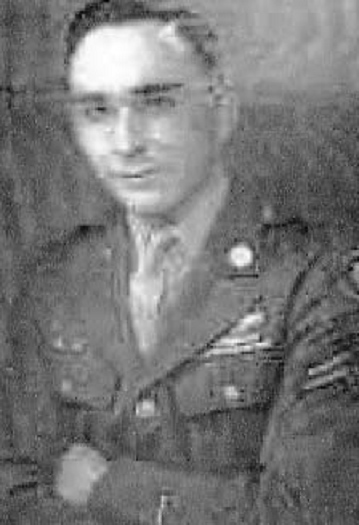
I was a replacement the day after Christmas. I was made a machine gunner, 30 caliber liquid cooled. Four days later, on New Year’s Eve, the Germans attacked. They were all dressed in white. This was my first introduction to combat, and it was the Battle of the Bulge. We did not lose one inch of territory, but the Germans lost plenty. We recaptured the Maginot Line, crossed the Iller River, the Danube and the Rhine.
We were crossing the Iller River when the Germans sent in an armor piercing shell that landed about 20 feet from our assault boat. Our boat capsized and I had to swim in the icy water to the German side. It was so cold that if I took off my pants they would have stood up by themselves. Later that night, the engineers, with the help of a tank, put a tree across a blown out bridge two miles down from where we were. Some riflemen came and got us. Then we had to inch across the tree using our arms and legs, holding on for dear life until we reached our side again. I was immediately taken to a field hospital for about ten days. While in the hospital, our battalion was caught in the Fern Pass in the Alps, and we lost half our men.
When I got out of the hospital, I rejoined my company in the Brenner Pass. We went into Italy and linked up with the 10th Mountain Division, which ended the war for us. We were then told to go to Otz, Austria, until we were sent home. We were scheduled to go to Japan for the invasion there, but the atomic bomb was dropped, thus ending the war. The 44th Division was de-activated and I was discharged.
Joe’s citation for his Bronze Star
OFFICE OF THE COMMANDING GENERAL
44th INFANTRY DIVISION
CAMP CHAFFE, ARKANSAS
17 NOVEMBER 1945
GENERAL ORDER
NUMBER 65
SUBJECT: AWARD OF BRONZE STAR MEDAL
CITATION: PFC JOSEPH A. MINTO 31469604
On the 15th of February 1945 in the vicinity of Remeling, France the 71st Inf. of the 44th division attacked the strongly fortified town of Remeling. M Co. was to be the leading Co in the attack. During the first hour of the attack M Co was held up by four German Royal Tiger tanks. It was at this time that Pfc. Jos. Minto, a machine gunner of M Co abandoned his machine gun temporarily and picked up the bazooka of a fallen comrade. Crawling forward under the intense fire from the 88’s and machine guns of four German tanks Pfc. Jos. Minto at great personal risk worked himself into a favorable position and open up on the four Tiger tanks with his bazooka. After 10 minutes of concentrated bazooka fire three of the German tanks were knocked out and the fourth was forced to withdraw. It was then that M Co could resume its advance and Pfc. Jos. Minto could return to his beloved machine gun which he had sentimentally named “Hun Killer”
But his gallantry was not to end, for three hours later that morning after half of Remeling had been taken by the 71st Inf. the Germans launched a strong counterattack. It was during this counterattack that Pfc. Jos. Minto disregarding all personal safety mounted his gun on the roof of the city hall where he was exposed to all enemy fire but where are all the enemy was exposed to his fire. It was here that Pfc. Jos. Minto broke up the enemy counterattack by killing 78 Germans and wounding almost 100 more. It is men like Pfc. Jos. A. Minto who stand out in the annals of the United States Army and who are a tribute to their army and country.
By Order of Lt. General Reese
Commanding Gen. 44th Inf. Div.
CR/JD
My father enlisted in the U.S. Army at 17 and lied about his age so that he’d be accepted. Like many sons and daughters of military personnel, I rarely had the opportunity to discuss my father’s World War II duties, experiences or exploits with him, and when he passed away in late November 2001, there were many unanswered questions about the wound he suffered to his knee, the photos of concentration camps he tucked away in a shoebox in his closet and the medals he received while serving our country for a brief time in 1944 and 1945.
Click here to read the article written by Carl Danbury, which appeared in the June 2010 issue of the Points North Magazine, Atlanta, GA
A Side Bar. I note in my photo album that on Dec. 15 a USO troupe headed by comedian Frank McHugh put on a performance for the 2nd Armored Div. troops. The next day things would change rapidly.
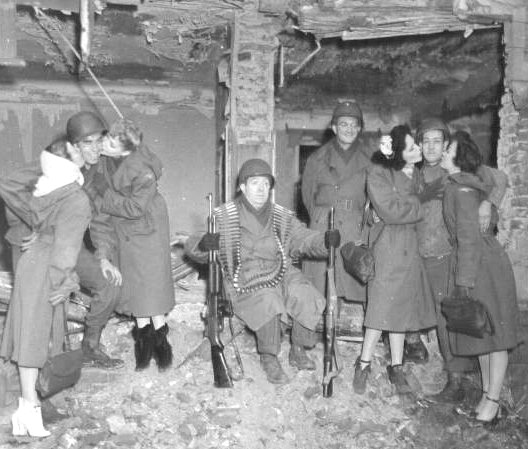
Dec. 16 – Morning Staff Meeting. The Corps G2 opened the meeting and quickly reported that a major German attack had begun during the night. Gen McLain probed the G3 and G2 officers as to the status of our three divisions and locations. Our line was quite thin, covering many miles of front…. The G2 officer said that he had just gotten a report that a German plane with American markings had just been shot down. The German soldiers in it were wearing American uniforms…. I remember, I think it was the G3 officer, telling us that the day’s password would be changed every two hours. Everyone had better know who won the World Series last year, etc.
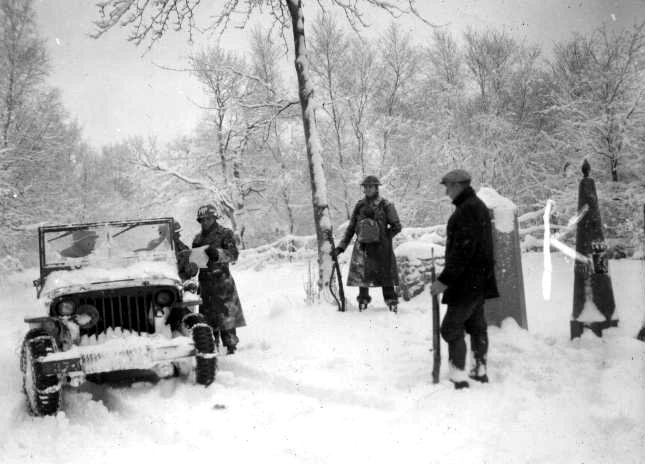
As the meeting was ending, I remember Gen. McLain saying something to the effect that he would never be taken alive. That was something to have your general make such a startling pronouncement. It was to be a fight to the death. That really hit me as to how serious the situation was. As the meeting closed, Gen. McLain said he wanted to see me. He ordered me to get a photographer and go immediately to the downed plane and get pictures that might be needed at some future time.
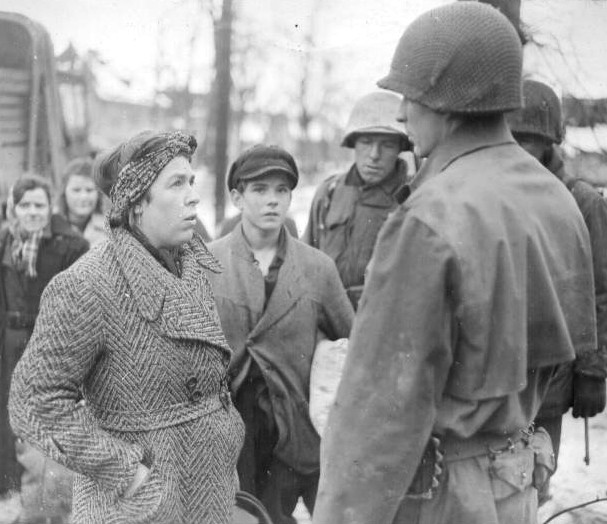
Skipping breakfast, I took a still and a movie man. In less than half an hour we were at the downed plane with American markings. Dead Germans lay in and around the plane. I went up to one dressed in American uniform. His jacket was partly unbuttoned. I saw something in his shirt pocket, a picture of a girl. On the back was her name and Heerlen, Holland. The Germans expected to be in Heerlen that day. The Germans had done a masterful job in disguising their troops.We had trouble with our cameras being so cold the oil in them stiffened and slowed the shutter speed on both movie and still cameras. Many of our troops were not equipped for 10 below zero.
Another picture in the album is of my weapons carrier (like a Ford pickuptruck only built sturdier) that I had named Sweet Sue. What a coincidence. Four years later I married Mabeth Sue Stewart, whom I lovingly call Sweet Sue. There’s more of a story behind that from my 1937 trip to Holland to attend Fifth International Boy Scout Jamboree. When we were enroute and stayed a couple of days in Brussels, Belgium, one Sunday afternoon in our hotel where the orchestra was playing dinner music, an American tourist girl requested that the orchestra play Sweet Sue. It broke up the dining room of staid Belgium diners. Also it made an impact on me, a 17-year-old Boy Scout. Hence Sweet Sue has had a special place in my memory.
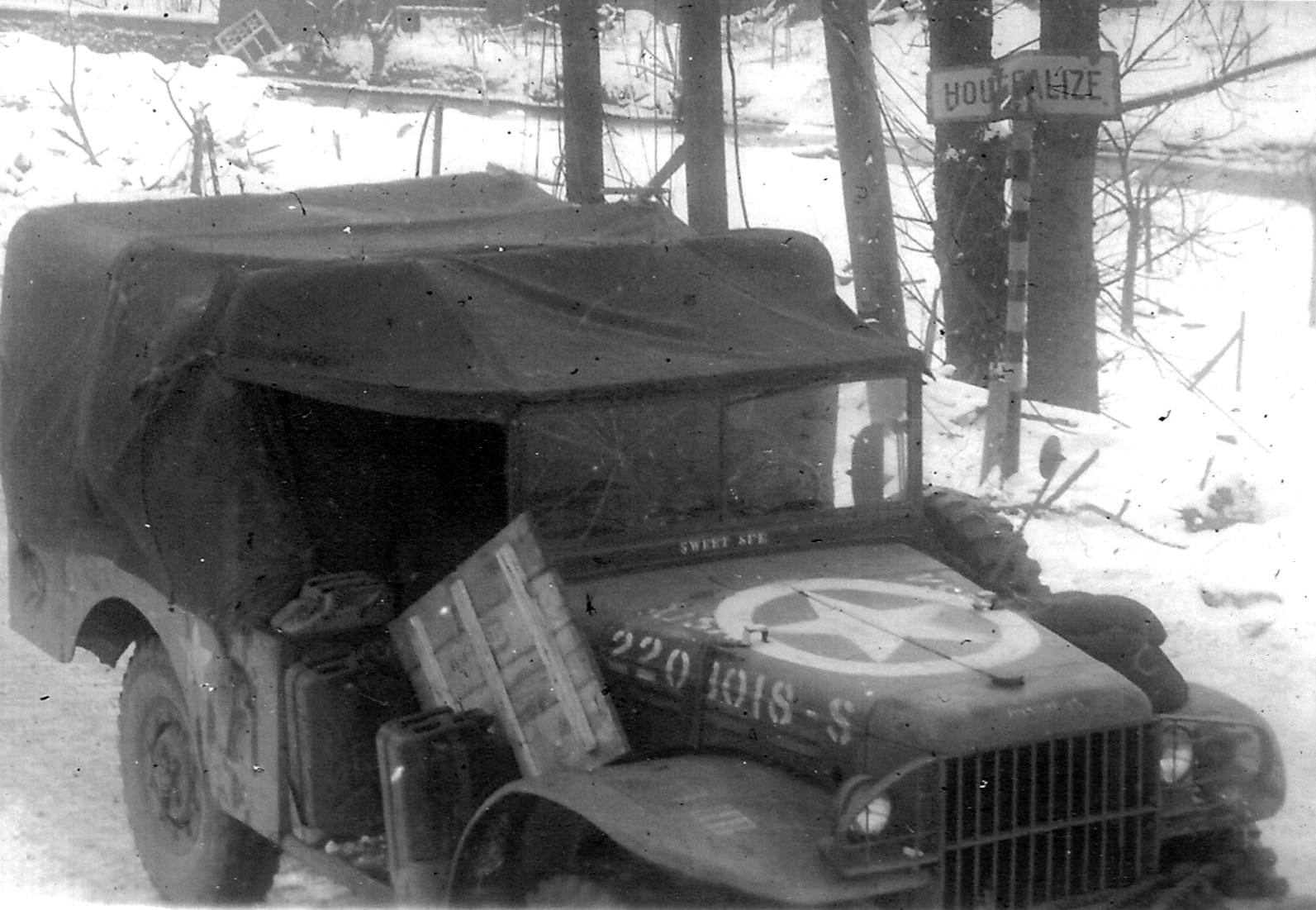
January 2010. A World War II buff, in going thru my photo album, saw a Jan. 31, 1945 picture of me in Sweet Sue going by the destroyed town of Houffalize, Belgium with the battered town sign in the background. He called that picture a classic. Earlier I had actually stayed one night in the little hotel in Houffalize before Dec. 16 but now wanted to see how badly the town had been hit during the battle.
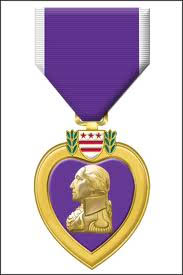 The National Purple Heart Hall of Honor commemorates the extraordinary sacrifices of America’s servicemen and servicewomen who were killed or wounded in combat. The mission of the Hall of Honor is to collect and preserve the stories of Purple Heart recipients from all branches of service and across generations to ensure that all recipients are represented.
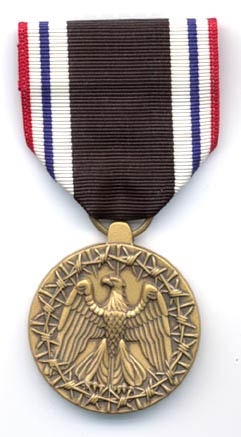 The POW Medal is authorized by Public Law 99-145, section 1128, title 10, United States Code (10 USC 1128), 8 November 1985, and is authorized for any person who, while serving in any capacity with the U.S. Armed Forces, was taken prisoner and held captive after 5 April 1917.
The POW Medal may be awarded posthumously.
Submitted by Gary D., Associate member who attended the Battle of the Bulge Veterans Reunion in Columbus Georgia, Sept 2011. I was searching for members that were in the 535th AAA Battery D. We went because earlier this year I found a diary from a solider from the 535th AAA Btry D. I had it out for display as the Corporal was in the Battle of the Bulge. I am copying the daily logs from the Battle of the Bulge for everyone to read. The diary has hand drawn maps pictures, and more. I plan on getting the diary printed. Both of my grandmothers were French. My paternal Grandma was a war bride marrying a US solider. She was from the village Avaux sur Aisne.
The Diary of John Rafalik, 535th AAA, Battery D
6 June 1944 trip across channel rather quiet broken only by two submarine alerts. depth charges were dropped and we proceeded on towards the coast. at 0800prepared to disembark. final inspection of packs, equipment. ship struck a mine at 0750stern has been badly hit and she is afire amid-ship. 0840 left ship for British destroyer escort. transport is already awash and burning fiercely. many are still left on board.Susan B Anthony rolls over and goes down at 0932 hours left destroyer for landing craft hit the beach sugar red at 1235 minus equipment and rifles. Picket up and used German equipment.dug foxholes 200 yards from beach. enemy artillery fire was very light. ME 109’s were over staffing the area a number were shot down. P47 dive bombed German positions 1000 yards to our right violent explosions resulted. Enemy was over at intervals during the night. snipers were active and paratroopers were reported in the area.Heavy and small arms fire went on all night. 88’s sank a number of ships in the anchor area. Mine fields were very heavy and were many casualties. the navy pounded away at German positions steadily throughout the twenty four hour period
13th dec Heavy concentrations of artillery fire, no air action.
14th dec Krinkelt bombed at 1300 hours, artillery fire continued, no air activity
15th dec 1944 Little of note recons over, artillery fire was light.
16th dec. Enemy artillery fire began at 430 hours continuing all day. Damage was extensive, artillery action was violent.
17th dec. Enemy attack was launched with heavy air and tank support (SS). Intense artillery preparation preceded the assault. General withdrawal began about 1600 as enemy columns broke through. Went into anti-tank positions. Casualties were heavy. Retreat began at 1700 hours, general withdrawal all along the lines.
18 dec 1944 regrouped much material lost set up in new positions with 370th FA A battery at camp Elsenborn. Enemy artillery fire was very heavy all day
19 dec 1944 enemy drive continues artillery fire was particularly heavy all day 16 fw 190’s over at 1700 4 downed
20 dec heavy artillery action all day many hostiles were over
21 dec 1944 inclement weather no air action artillery fire continues
22 dec 1944 bad weather again enemy artillery fire continues
23 dec 1944 enemy aircraft were over heavy artillery fire continues some bombs fell in the area
24 dec 1944 clear weather heavy concentrations of our bombers were over German flak was heavy a number of our aircraft were shot down. P47 strafed our position today.German aircraft were up in strength over our sector
25 dec 1944 large scale air activity by both sides two me 109 were destroyed at 1100 today me 262 and fw190 were over night activity by the germans was reported bed check charley was over at intervals heavy counter battery fire
26 Dec 1944 Continuing air assaults numerous German aircraft up. V1’s and 2’s were over P47machine guns the positions.
27 Dec 1944 Air assaults continue a number of me 109’s over at 1045 three were destroyed. P47 ‘s dive bombed field artillery positions at 1500. Counter Battery fire was heavy.
28 Dec 1944 Heavy German artillery fire. section received two near misses. 50 Cal was knocked out. Enemy aircraft were over during the night.
29 Dec 1944 Enemy aircraft were over , artillery exchanges were sharp.
30 Dec 1944 Enemy aircraft were over at intervals bombing field artillery installations. Heavy artillery fire continued.
31 Dec 1944 two me 262 over at 1100 hours bombed artillery positions. artillery fire was heavy on both sides.
1 Jan 1945 German aircraft were up in strength a a number of ME’s 109 were over at 0835,0850,0910. seven were shot down. Heavy counter battery fire though out the 24hr period
2nd. Bomber and fighter formations were over. numerous German aircraft were up through out the 24 hour period. heavy artillery duals continued.
3rd. Inclement weather single FW 190 over at 1420, FA bombed.
4th. Bad weather prevails bomber formations were over at 1200, 1300-1340 hours. 88mm air burst overhead.
5th. Inclement weather restricted air activity. two p47’s strafed our positions at camp Elsenborn.
6th. Low ceiling again. Hostile aircraft were over during the night. Artillery action was light to medium.
7th. ME 262 over at 1225 hours , bombed 1st division 105’s. Artillery action continued as before.
8th Little of note, continuing artillery action V-1s were over
9th Inclement weather held activity to a virtual stand still
10th Little of consequence. no major action to speak of
11th. Increased counter battery fire, a number of bombers were over
12th. There was heavy artillery coupled with intense small arms fire. German patrols were active.
13th. Four FW 190’s were over at 1407. Intense 88 fire towards Elsenborn. Air activity was increased somewhat.
14th. Inclement weather. two ME 109’s over at 1534 hours.
15th. Bombers and fighters formations over. P38’s bombed enemy installations one mile east. Artillery exchanges continued.
16th. Increased air activity., two MK seven Spits down at 1548, 1615.
17th. Counter battery fire increased during morning hours. Flying bombs over at various intervals.
18th. Driving snowstorm. V bombs were over. Incoming mail was of large caliber 170 or 210mm.
19th Weather again restricting most activity.
20th. Inclement weather. nothing but artillery fire and v bombs.
21th. Enemy aircraft were over at intervals. artillery was limited to harassing fire. V bombs were over
22nd. P47 down at 1010 hours . Heavy aerial activity and an increase in counter battery fire. 2130 V bombs over
23rd. Relatively quiet. Light artillery exchanges.
24th. Light 88 fire, heavy machine gun fire to the east.
25th Nothing of note, sporadic artillery fire
26th. inclement weather, a few fighter bombers were over
The whole situation was terrifying. The Army always is full of rumors. We heard that the Germans had broken through our lines with a major force, and that our line across the Ardennes had collapsed. We had no air cover because of the weather. The l0lst Airborne Division was surrounded in Bastogne. The American Army had tremendous casualties, and we did not know how many had been captured. We had moved across France so rapidly that we thought the war was all but over. We began to think otherwise in the Saar. None of us expected anything like this. We were upset at having to leave Metz and our plans for a pleasant Christmas. We hurriedly repacked our vehicles. Fortunately, I had accumulated a good supply of warm clothes, and I needed them all. My truck had no doors, so that we were exposed to the air. I put on two suits of long underwear, two pairs of socks, wool pants and shirt, a field jacket, an overcoat, two pairs of gloves, and a fur hat covered by my helmet. Still, I was none too warm.
We took off in the dark, driving north into Luxembourg amid sounds of small arms and artillery fire. Around midnight, we got to a small, seemingly deserted town, Boulaide. I spotted one faint light and led my unit toward it. As we drove through the town, we saw a number of German flags. Apparently, the Germans had taken this town during their offensive, but our division had driven them out just before we got there. I heard that some of our men waded through a freezing cold river to get at the Germans. The small light I had seen was in the home of a farmer who was there waiting for us. He had hidden out in his cellar. He had a roaring fire going and had slaughtered a pig. He had brought out a huge sausage. He had large loaves of fresh-baked bread. We did not know how he had been able to provide all of this, but we were grateful, to say the least. We hastened to set up a station, sampling the delicious food as we worked.
We hardly had set up when combat soldiers began coming in. A few were wounded, and all had various degrees of frostbite. Having been in the Ski Troops, I knew how serious frostbite is. The severe cases I put in a warm room, wearing the most dry clothes available and leaving their frostbitten parts exposed, while I kept their bodies warm. I planned to evacuate them. The more mild cases I warmed up and fed. Those, I expected could go back to duty with proper clothing, if I could get it. Finally, after three hours or so, ready to collapse, I arranged shifts to care for whoever came in and found a place to drop my bedroll. Some Christmas Day!
At dawn, I was up. The farmer had been up most of the night. He had cut the coat-of-arms from the center of a Luxembourg coin which he presented to me. He knew we were going to move out; so he gave me this huge sausage which had a very strong odor of garlic. Obviously, I was grateful to this man, and I regretted not getting his name and address. I still have the cutout coin. Just before we pulled out, a full colonel came by to check on wounded. He went around to encourage them. However, when he saw the men that I had planned to evacuate, he asked, “What’s wrong with these men?” I answered, “They have severe frostbite, sir.” “Warm them up and send them back to duty. I need every man I can get.” “I’m sorry, sir. If these men go back to duty, there is a good chance they will loose a hand or a foot.” “I’m ordering you to send these men back to duty.” “I’m sorry, sir, I cant do that.” “I’ll recommend that you face court-martial.” . “Very well, sir.” He left. Later on, these men received Purple Hearts, when at higher echelons it was realized how dangerous severe frostbite was.
We pulled out early the next morning, having arranged for the evacuation of the wounded by leaving one of our ambulances to shuttle and later to catch up. There were sounds of fire fighting all around us. We weren’t sure where the front was, but obviously our division had somehow made progress that morning, and we got word to set up a station in Nagen, a town in Belgium. On the way there, we drove through the beautiful city of Luxembourg with its deep valley going through the middle of the town. The bridges over it were intact. By late morning we were in Nagen, which had been badly battered. There was the rattle of small arms fire and the horrible sound of German burp guns, their rapid-fire submachine guns. We also heard the crunch of landing shells and the clatter of tank treads. We were never sure whether they were the Germans’ or ours. On Christmas morning, the sky suddenly cleared. We began to see our planes with long trails behind them. There were bombers going for the rear and fighter bombers diving. It was a wonderful sight, and we all cheered. This was the first good news in days.
We set up an aid station. Incongruously, superimposed on this clean, peaceful, friendly country was a dirty unpleasant war. The smooth valleys were marred by stacks of ammunition boxes, gun emplacements, shot-up trucks, tanks, and everywhere, miles of communication wire. The wire was strung from trees, from poles, and on the ground. The roads had been torn up by the heavy vehicles of both armies. Here and there, a tree had been violently knocked down. There was a never ending roar of guns polluting the otherwise pristine air. We noticed that the people of this town had taken in citizens of nearby towns that had been devastated in the furious battle as the Germans drove ahead toward Bastogne and, they hoped, to the sea to cut the Allied Armies in half
We had chosen this town because it had sustained relatively little damage and consequently could provide a good site for care of the wounded. Unfortunately, while scouting for a site, one of my fellow medical officers was wounded and evacuated. That left me to deal with the wounded of a regiment of over five thousand. I never worked so hard, even in Normandy.
My main job was to get the seriously wounded in good enough shape to be transported to the rear in ambulances, which meant stopping hemorrhage and often giving plasma. They were brought to my station, a restaurant, by jeeps fitted with litter racks and by ambulances coming from the smaller units. The wounded were all cold, and their wounds were horrible. We saw many of the worst wounded, for many with minor wounds had returned to duty. We were short of men, and the need to break the circle around Bastogne was urgent.
The people of the town were friendly. They had disliked the Germans in the past and hated them even more now. They brought us food and firewood and helped to get us water, so urgently needed in cleaning the wounded. The stove I had brought with me was very useful when added to the one in the restaurant. I had learned always to take a fairly large wood stove tied to the fender of my truck, along with pipe, which we ran from the stove around the room and then outside. This provided warmth, which was so needed.
We had to remove most of the clothing from the wounded in order to care for their wounds. A pile of torn clothes, bandages, sponges, and other debris was a constant problem. But we managed. We soon had a large rubbish heap outside. We hated to open the door; because we would loose heat. We put on adequate bandages. We started plasma often. Many of the wounded were in shock, and frequently I found it necessary to start I.V.s in the femoral vein. I still seemed to be the only one in our unit who could manage that, for this reason, I had the aid men do a lot of the other chores. When wounded were brought in, it was important to evaluate each man and assess the urgency of his condition.
Fortunately, I had been able to load up on supplies in Metz on Christmas Eve. My favorite bit of equipment was the elastic bandage, which in Normandy I had found to be so versatile. We used untold numbers of syrettes of morphine. Fortunately, I had saved a large supply of cigarettes, which were gratefully received by the wounded. We made gallons of hot coffee using the stoves in the restaurant. We were able to get some reasonably decent food, but for us, there was little time to eat. In many ways, it was worse than Normandy. Although we had a better setup for our station, winter made the field conditions worse. It was extremely difficult to evacuate wounded men through the snow even with chains on jeeps and ambulances. There also was the problem of men literally freezing before the aid men could get to them with first aid and evacuation. I taught the aid men to make sleds which had a low profile and moved through the snow easily.
The worst thing about our situation was that we did not understand exactly what was going on. We were frightened and disheartened. We had thought the war was about over, and now we seemed to be fighting for survival. Morale was low. On our first evening, I broke out one of the bottles of Scotch that I had brought from England.. I divided this among my exhausted aid men. I think it helped.
Beginning in Normandy, to keep my sanity, I made a big effort to act as much as possible as though I were in a much better environment. I continued to shave daily. The standard issue Army helmet had a liner that was easily removed, leaving the helmet like a big basin. I warmed water over my little German stove, and with that was able to shave. I also was in the habit of setting up some sort of table on which to eat, even when I was in a foxhole. When possible, I supplemented our simple Gl fare with some wine or Calvados. I tried to wear clean, dry clothes. I brushed my teeth. Whenever possible, I had water heated to a boiling point in a large can and had the men dip their mess equipment into it to avoid gastrointestinal problems by killing viruses and bacteria. In these ways, I tried to set an example for my men, who were often discouraged and inclined to neglect themselves.
One of the most amazing facts of this terrible battle was that our troops could keep fighting on. I dont know how they were able to dig foxholes in this cold ground or how they were able to use their firearms in the miserable weather. They often used abandoned German foxholes, and they sometimes broke the frozen ground with hand grenades. Most of the men were inadequately clothed. They had been issued a type of rubber boot with leather tops. These were good for mud and wet, but not good for real cold. Feet sweated in them, and then when the soldiers stopped to fight, their feet tended to freeze. Our quartermasters had a lot to learn. They had not anticipated the needs of a winter war.
We leapfrogged toward Bastogne. As we got closer, the fighting grew more bitter. The German Tiger tanks were tough to stop. We now faced elite German troops. We even picked up some of their wounded, who actually were better dressed against the cold than our men. They wore helmets lined with fur. Their clothing was of heavier wool than that of our men. They often wore a sort of white jump-suit over their clothes for camouflage. That extra layer added warmth. They often had wool sweaters under their field jackets. They all carried extra heavy wool socks, and many had gloves with provision for freeing the trigger finger. Many of these men had been on the eastern front in Russia.
When we got close to Bastogne, an infantry major came by and said that the troops surrounded in Bastogne were low in medical supplies and in medical officers. Did I think I could help? He said that they planned to force their way into the city, putting some infantry on the outside of tanks, and perhaps we could load a tank or two with medical supplies, a couple of aid men, and an officer, if available. Well, I figured, what the hell-l’ll try it.
They brought a tank to our station, and we loaded supplies onto it. I took two volunteers with me: Volkman, who was a tech sergeant and quite gentle, and Bradford who was a tough veteran and a leader. I put on my full winter gear: two pairs of long underwear, a wool uniform, two pairs of wool socks with leather boots, a field jacket, my overcoat, and my fur hat with ear flaps, covered by my helmet. We moved out.
It was obvious that the tankers were trying to protect me and my men. They put their other tanks in a position to protect us, one on either side of the supply tank onto which we climbed and got as low as possible, using the gear fastened to it as cover. The tankers carried their bedrolls, extra treads, and extra clothing on the outside of their vehicles, while extra ammunition and fuel were protected by armor whenever possible. Much to our surprise, the commander had found a route to Bastogne that was concealed, and we encountered little fire. What there was had a tremendous response from our group which consisted of four tanks, a tank destroyer, and, of all things, a command jeep containing the scouts who had found the route.
I heard a story when we made a brief stop near an infantry company. In this “white jungle” close-quarter fighting in the winter-bound fir forests, soldiers on both sides sometimes had sluggish reactions. T/Sergeant McLaughin of Black Rock, Arkansas, an E Company platoon sergeant, set off at dark to contact G company. He encountered some soldiers digging into the frozen ground. “G Company?” he asked. Just as he spoke he realized these were Germans. “Nix” one of the German soldiers replied as he continued chipping at the ground. McLaughlin pivoted slowly, and trudged off through the snow. He was well back to his company before the Nazis opened up in his direction.
Within a few hours, we were in Bastogne passing cheering troops of the 101st Airborne. We had travelled eighty-five miles in a bit less two days against stiff opposition. Though we had some wounded, we did not have a man killed from Metz to Bastogne. That was remarkable considering the conditions, and it was noted in the news. It was the kind of mobility that our division was known for. During that time, we went through parts of three countries: France, Belgium, and Luxembourg. We had crossed rivers where the bridges had been destroyed, and we dealt with the horrible conditions. We had reason to be proud of the 35th, but we were too busy doing our jobs and staying alive to reflect on our accomplishments.
We set up in the main railroad station. We took over the command jeep to transport wounded and to bring supplies to the various aid stations. Almost immediately wounded poured in. These were the less badly hurt who had been willing to defer care to the more seriously wounded. The wounded had first been attended in battalion aid stations, from which they were transported to our station, which was enclosed, warm, and better equipped. Because of the difficult transport through snow, evacuation of the more severely wounded to our station had priority. There was real danger of those men freezing to death. The less seriously wounded were helped back to the station afterward, unless they were able to get there on their own. The jeep driver worked overtime bringing supplies, transferring wounded, and being a messenger.
By nightfall we were exhausted, but we knew Bastogne had held. The Germans had been stopped. We didn’t know how soon our troops could recover enough to begin to move toward Germany again, and I think we would just as soon have stopped to wait for spring. The next morning, it was obvious that other troops were getting into Bastogne. Their shoulder patches were different from our Wagon Wheels. But fighting was far from over. A medical officer came in. He was fresh, had a clean uniform, and told me he had been bored in a field hospital and he would like to see some action, he had had a good medical education at Cornell, and we had a lot to talk about since I had spent some time at Cornell not much more than a year before. He had been assigned to a battalion aid station of an infantry battalion just outside of town. I thought he was out of his mind to leave that safe place for this. He was brought into the station that evening with the top of his skull blown away. We treated him with care, and he was the first person I evacuated immediately to the rear along a newly opened route. I never knew if he lived. The poor guy did not know how to survive in a combat area. The situation with this man was not unusual for replacements. All of them were inadequately trained. They were assigned to various duties, but there was not enough time to teach them how to stay alive. Few replacements lasted more than a few days.
Our lines having held, our generals, particularly Patton, thought this was an ideal time to destroy the German Army. So, instead of resting and reorganizing, he decided that we would attack. All of us in Bastogne were terribly angry. We and the troops around us were exhausted. The cold and deep snow were terrible. The soldiers we faced were elite Germans who, though defeated in their attempt to cut our armies in half, still knew how to fight and to take advantage of the terrain. They were defending Germany now, and their supply lines were shorter and better than ours. It was difficult to believe that we were entering a battle that for us was worse than Normandy or Bastogne. General Patton wanted to surround the Germans, cutting off their supplies, but Eisenhower the supreme commander, wanted to advance on a broad front. At least that was my understanding. Each had his reasons, but I had learned to respect Patton, even though he was highly demanding of his troops. In retrospect, I think Patton was right.