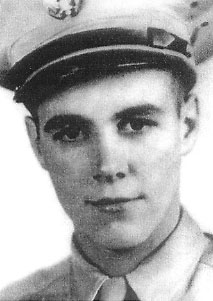
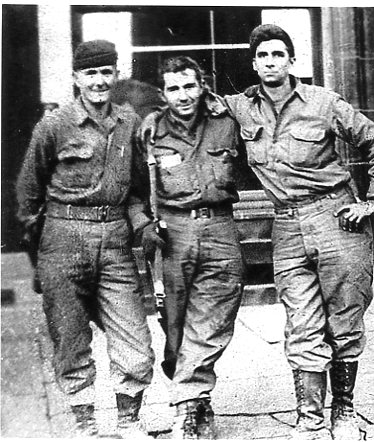
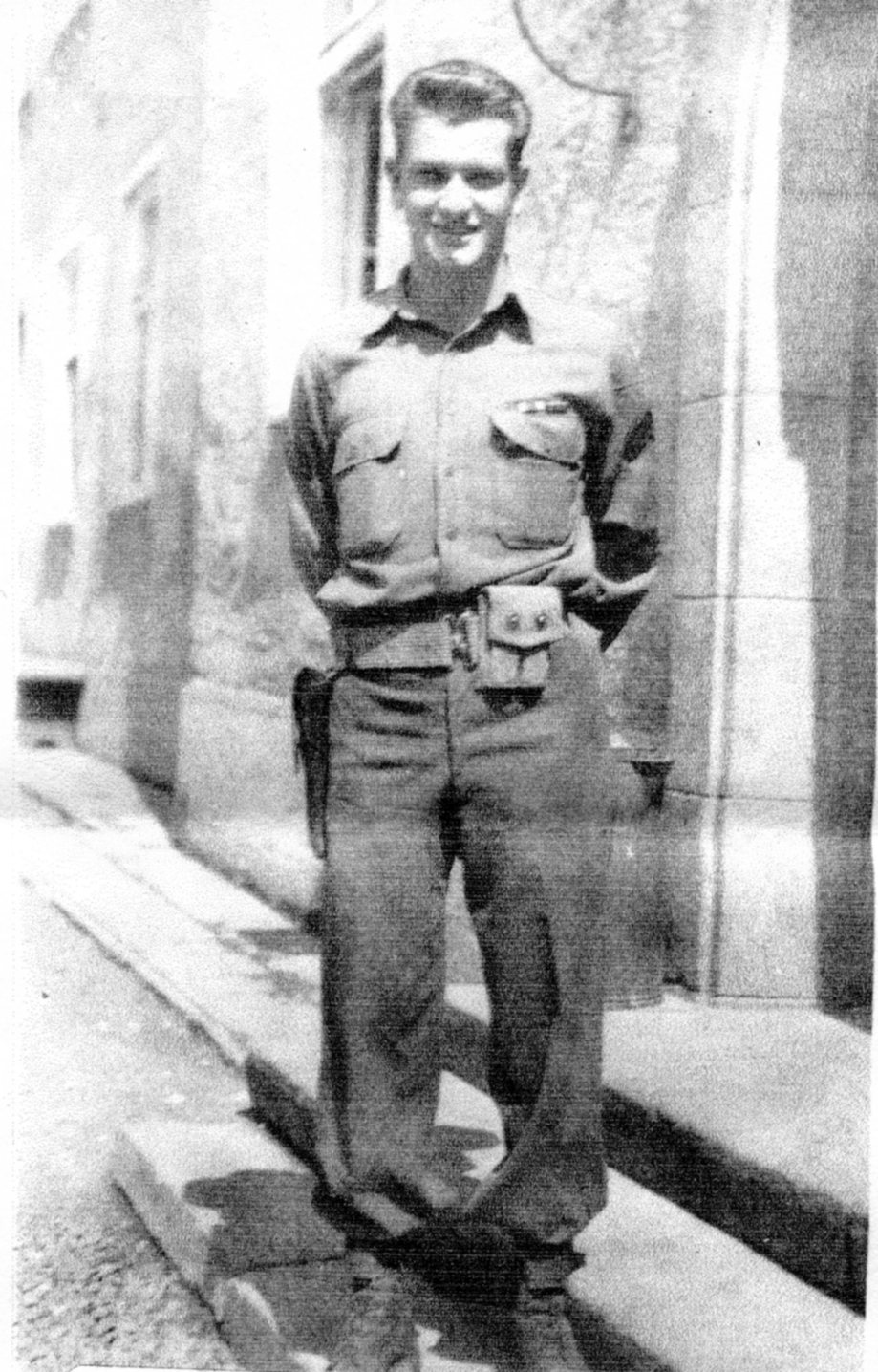
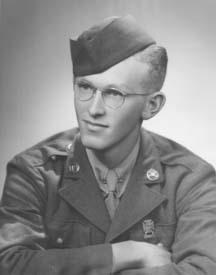
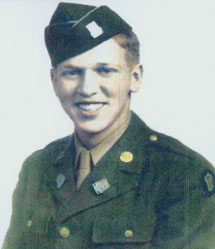
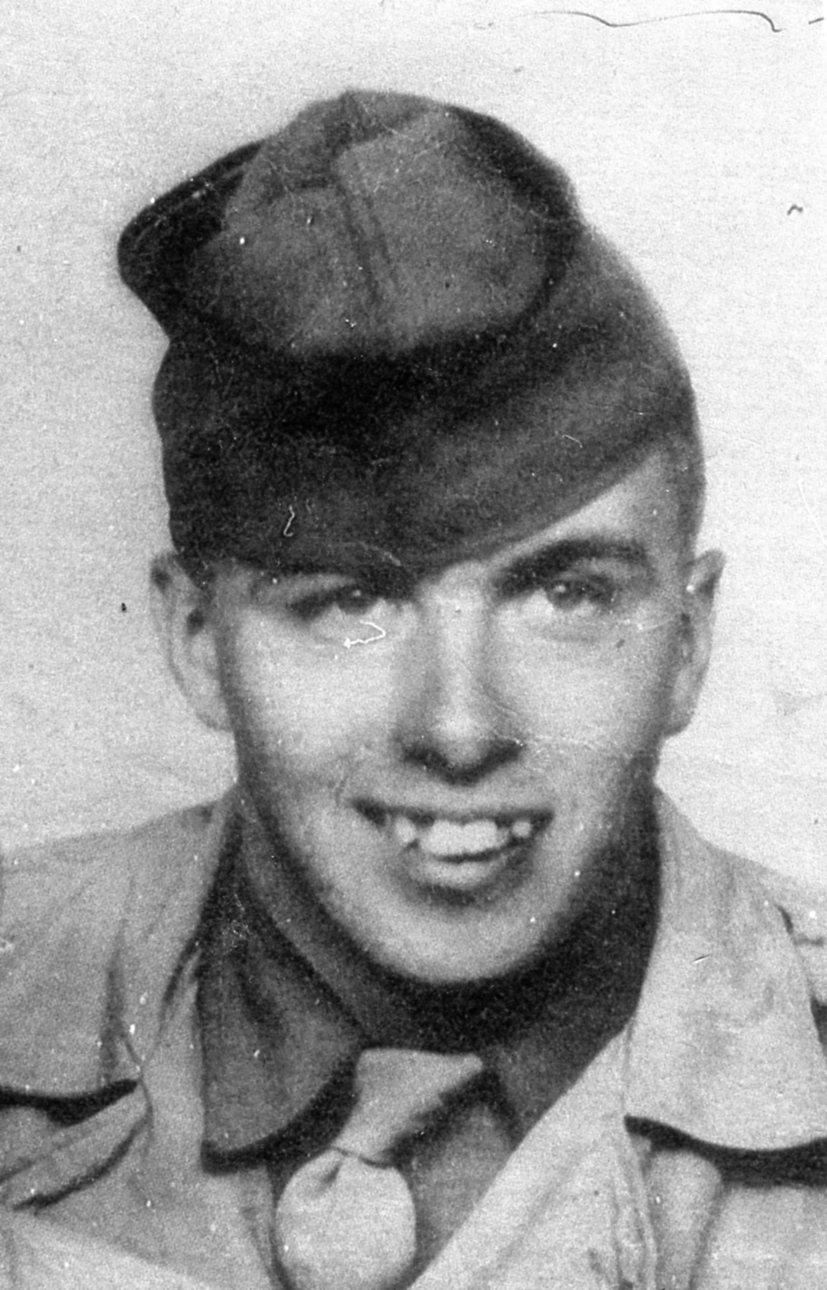
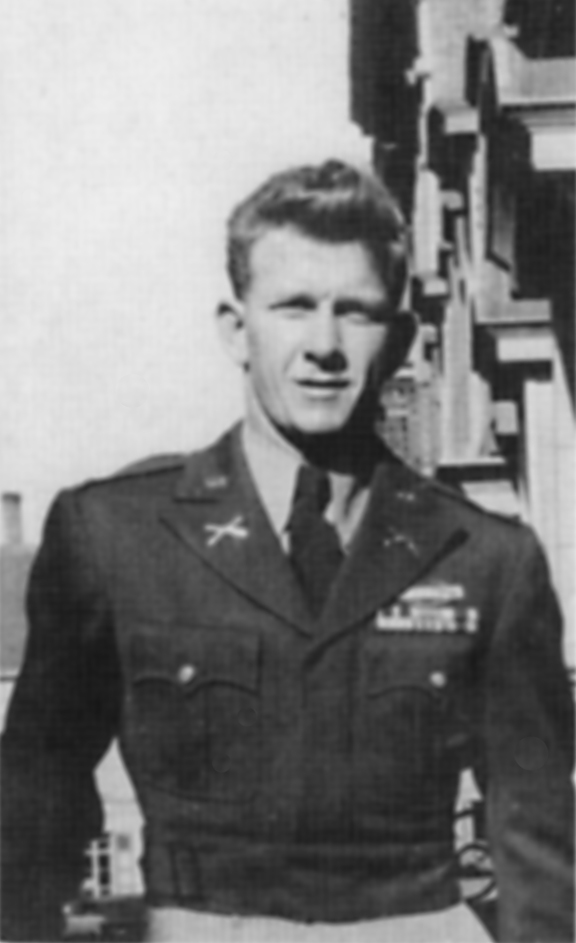
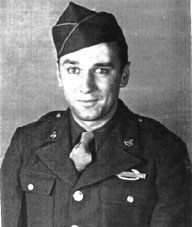
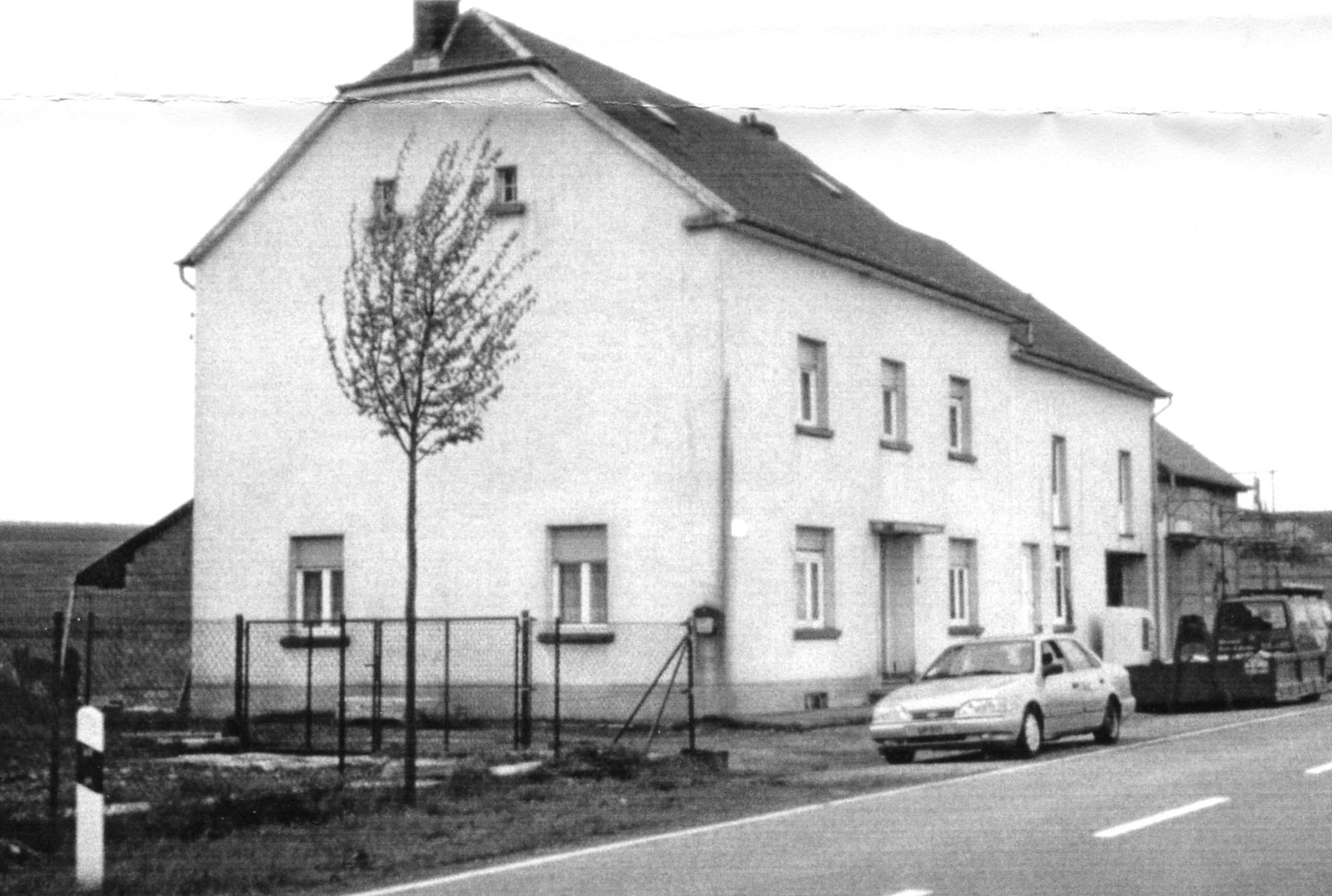
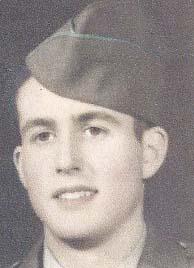
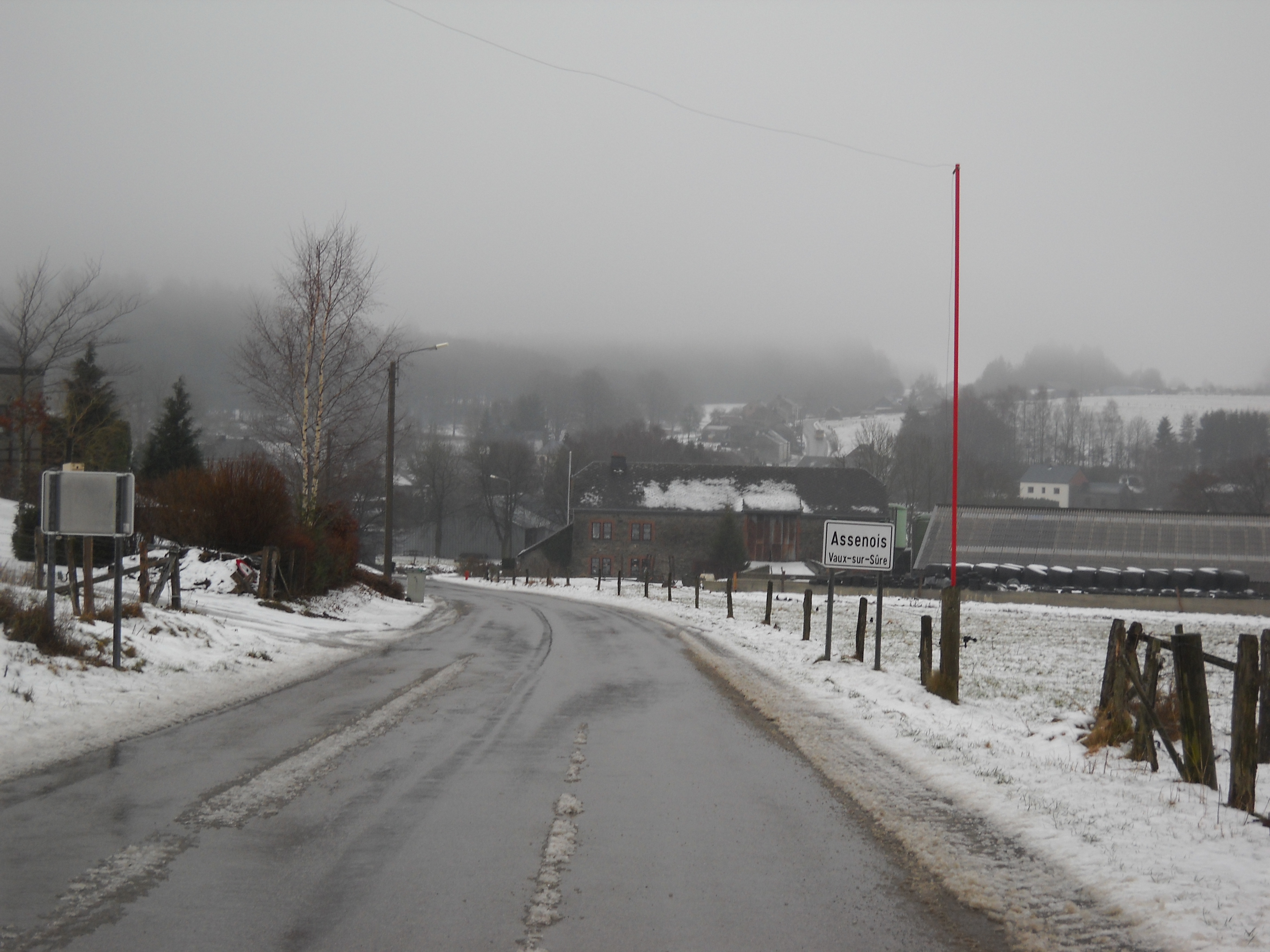
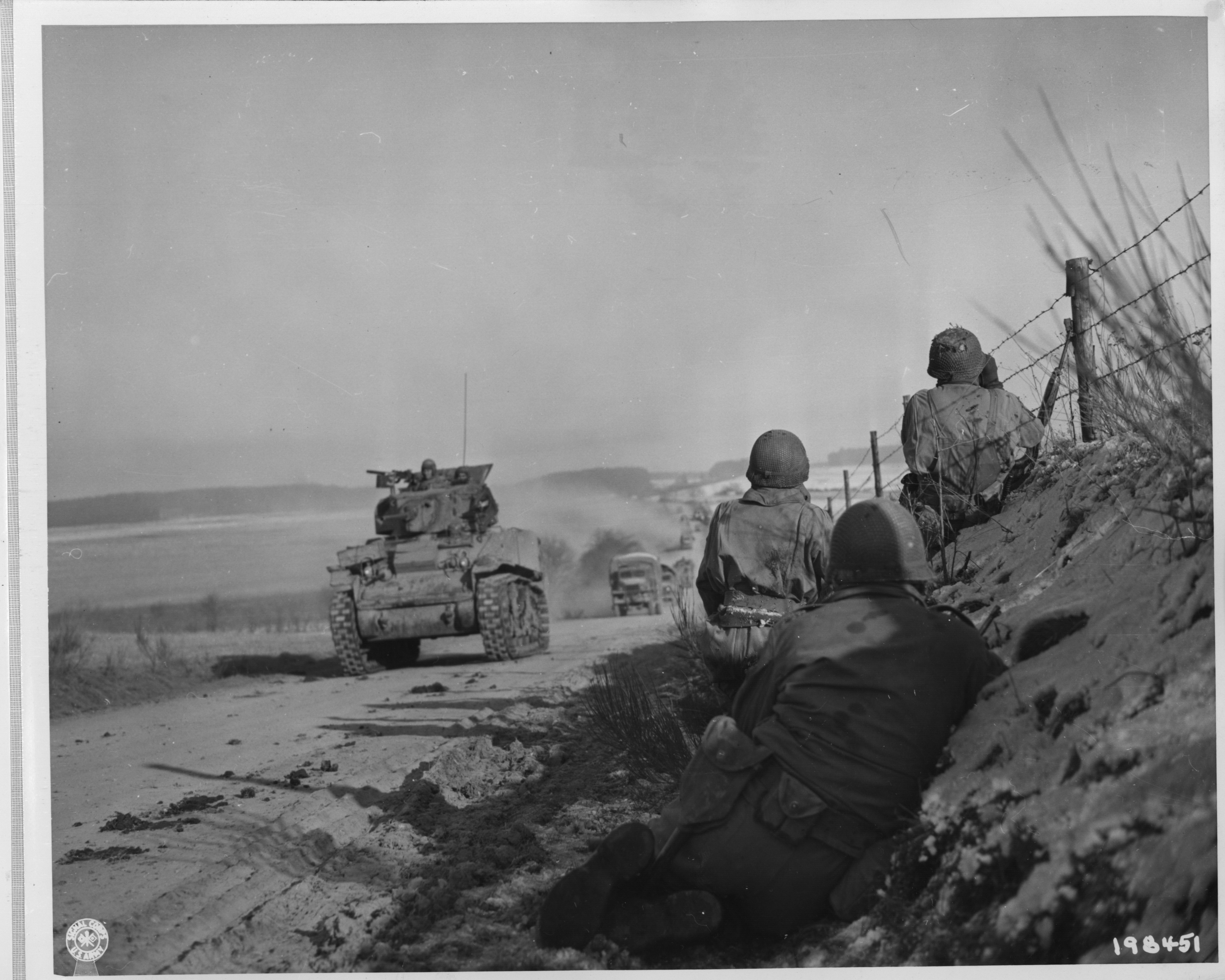
I was in the 16th Field Artillery Observation Battalion, Battery A. We were the eyes and ears of the Field Artillery. We fought our way from Utah Beach to the border of Belgium & Germany at a place named Auw, GERMANY, not a town just a place. We were there in the winter. Our area was considered a light fighting area. The heavy fighting was North of us at Cologne, Germany and South of us in Southern France. We were fired on by German artillery and the German infantry was very close.
The Germans fired Buzz Bombs over us frequently. A Buzz Bomb is an unmanned airplane that flew very low and is filled with flammable liquid and shrapnel. We could near the motor as it flew over us and when the motor stopped, we knew it would crash in seconds. We had three land close to us, but no one was injured. Buzz Bombs killed & injured many Americans.
We were in the Hurtgen Forest in the Schnee Eifel Mountains where the snow was deep, the ground was frozen and we did not have winter clothes. On Dec. 16, 1944 Nazi General Von Runsted made a break thru on a fifty mile front. He came thru with the 5th Panzer Army, the 6th Panzer Army and the 7th German Army. He had brand new King Tiger tanks, new heavy artillery and thousands of infantry, most dressed in white for camouflage. Auw, Germany was in the very center of this onslaught. We lost much equipment and pulled back to St. Vith, Belgium. We were overpowered there and retreated back to Bastogne where we were surrounded Many of the American soldiers there were killed, wounded or went insane from the constant bombardment.
When the Battle of the Bulge started, it was cloudy and very foggy. We could hear Tank treads coming toward us, but could not tell if it was a Nazi Tiger Tank or an American Sherman Tank. General George Patton ordered the 101st and 82nd Airborne up to Bastogne. They could not jump from planes because of the fog. They were brought up in 6×6 Army trucks and it took them two days to reach us. A paratrooper ask me where the front line was and I told him he was standing on it. Somehow our battery escaped the Bastogne encirclement. Three us came upon a Belgium farmhouse in the middle of the battlefield. We went inside and there was a father, mother and two children, a boy and girl about 7 or 8 years old. The mother gave us some soup and black bread and we save them some candy. This was Christmas Eve. We sang Christmas songs that night. We sang Jingle Bells and Silent Night, the words were different, but the music was the same. We were wet and cold, but we dried off that night. We could hear machine guns rattle and Artillery shells bursting all night. We didn’t get much sleep, but we got warm and dry.
We left the next morning and the family didn’t want to see us go, The 16th was badly shot up and the 285th FAOB in the same area was badly shot up. The two Observation Battalions decided to form one unit, so they could be more effective in the war. This did not happen, the Nazi SS Troops captured a Battery of the 285th and herded them into an open snowy field and machine gunned them down in cold blood. This was not war, this was murder and was known as the Malmedy Massacre.
The clouds and fog started to break up and the Air Force flew thousands of sorties over the area. They bombed tank positions, artillery positions and machine-gunned infantry troops and supply lines. We watched C-47 planes fly low over the battlefield and drop by parachute food, guns, gasoline and medical supplies,we were out of everything. We begin to hold our own and gradually fought our way back to Auw, Germany.
On January 30th, 1945 we were at the same location we were on Dec 16, 1944. Up to now were liberators, from now on we will be conquerors. Over one million men fought in the “Battle of the Bulge”, 600,000 Americans, 500,000 Germans, and 35,000 English, French, Canadians and others. This is the largest land battle ever fought by any American Army. We fought our way to Koblenz, Germany, crossed the Rhine River, was at the liberation of the Ohrdruf concentration camp, the first camp liberated on the Western Front, fought thru Nuremberg into Czechoslovakia, met the Russian Army and on May 8, 1945 was V.E. Day. The War in Europe was over. From the time we went ashore on Utah Beach, until we met the Russians, I was on the front lines the whole time. I know that Freedom is not Free!
A Friend in Need is a Friend Indeed
by John P. Malloy, 75th ID, 291st IR
I worried and wondered if my best friend, Dean Lusjenski, had survived the recent vicious fighting at Grand-Halleux. Dean was with L (Love) Company in a machine gun section, in the 291st heavy weapons company. That company had sustained serious casualties in that battle. I decided I should find his company and see if he was still ok.
Dean and I had been called to duty on the same day in March 1943. He was a senior at Creighton University in Omaha, and I was a junior there. We had spent the entire war together and had become fast friends. We looked after one another, as soldiers often do. Now I wondered, and worried, what had happened to him during the vicious battles along the Salm River.
The 291 st Regiment had played an important role in counter attacking the retreating German forces. The Gl’s had suffered severe frostbite and trench foot because of the cold and snow. Huddling for days in a wet, cold, foxhole wore men down. This suffering, combined with battle wounds, had taken a severe toll.
I was lucky I was able to track him down. My job, as wire crew chief, gave me considerable independence and freedom of action. I knew my crew would handle any problems while I was gone. Earlier that morning the Third Battalion, Dean’s unit, had attacked a heavily defended hill-casualties were heavy. I knew the current action was centered in a small village about a quarter of a mile to the east. I took our jeep and headed that way. As I approached the village I stopped and proceeded on foot. When I reached the village center, I could see the German defenders had been forced back, perhaps five hundred yards. There was confusion. Medics evacuated wounded. Tanks slowly ground forward. An artillery spotter moved his vantage point.
Infantry units continued the attack. Apparently another unit had just been relieved. Those men were half hidden in doorways. Others hunkered down, waiting, hoping. They were a disheveled, bearded crew. They were exhausted. Most had not been out of their clothes for days. They hadn’t had a truly hot meal for some time. Artillery fire had devastated the area. Buildings were smoking shambles. Some still stood, in others, men sought what shelter they could find. An improvised aid station was operating. Medics treated bloody wounds. There was the awful smell of cordite-a reminder of death.
A winter sun shone weakly on the chaos. Just a month ago a pristine snow had drifted down, providing a beautiful blanket, covering this remote countryside. Now, brown replaced white. Brown clad warriors brought brown tanks, brown trucks, and brown cannon. Brown buildings burned. Dirty, brown soil lay exposed. It was an ugly place. This was not an unusual sight across France and Belgium. Our War Machine destroyed what little the Germans left when they fled.
There was occasional incoming mortar fire now; this was not a safe area. I tried to identify the units present. I could see that some Third Battalion Companies were involved in the firefight but I could not find L Company. I decided my efforts were futile. I couldn’t find my friend so I decided to return to my outfit. I retreated towards my jeep. The late afternoon light was turning to dusk. I worried about the drive. Driving in pitch black darkness was dangerous. I worried I might encounter a trigger happy Gl. He would shoot first and ask questions later.
Then I saw him. He was slumped in a ruined doorway.
“Dean, Dean is that you?”
He looked at me. I moved closer-he had an unfocused, zombie like, gaze. He stared vacantly.
“Lusienski-Lusienski it’s me, John.”
His only comment was,” I’m cold, I’m cold.”
“Dean I’m taking you with me. You need rest and a hot meal inside you.”
He mumbled,” I can’t. I’ve got to get back to my platoon.”
“You are coming with me and that’s that. Don’t give me a hard time.”
I walked him to the jeep. We took off. A commandeered farmhouse served as the Regimental CP. The wire section’s sleeping bags were on a dirt floor in an adjoining barn. I got Dean out of his overcoat. I removed his boots and put him into my sleeping bag. I covered him with an extra blanket. He slept eighteen hours. I brought him a hot meal. He slept again. When he woke he was a different man. We had a good conversation. We exchanged news. He had another good meal. Then it was time to go. His dry clothes and boots were ready. He got into his overcoat, put on his helmet, slung his weapon over his shoulder. I returned him to his company.
I didn’t see him again for several weeks. After the Bulge, the Division headed south and east to Colmar France near Strasburg. There we continued kitting Germans. Dean, in the weeks following the battles in the Ardennes and Colmar, was promoted to Staff Sergeant and awarded the Bronze Star for his leadership in operations in the Rhine River area.
Epilogue: After the war Dean Lusienski returned to his home in Nebraska. He married and had a family/He used the G\ bill to earn a PhD in Educational Psychology at the University of Nebraska in Lincoln. He served for many years as Principal for the world famous Boy’s Town. In later years, I occasionally traveled to Omaha from my home in Milwaukee. Dean and I would have dinner together. We talked about the early years. Dean died several years ago at the age of seventy.
Dean Lusienski was an outstanding example of Brokaw’s “The Greatest Generation”.
I was thinking about how a status symbol of today is one of those cell phones that everyone has clipped onto the belt or purse. I don’t want one, so I’m wearing my garage door opener.
I also made a cover for my hearing aid and now I have what they call blue teeth, I think.
You know, I spent a fortune on deodorant before I realized that people didn’t like me anyway.
I was thinking that women should put pictures of missing husbands on beer cans!
I thought about making a fitness movie for folks my age, and call it ‘Pumping Rust’.
I’ve gotten that dreaded furniture disease. That’s when your chest is falling into your drawers!
When people see a cat’s litter box, they always say, ‘Oh, have you got a cat?’ Just once I want to say, “No, it’s for company!”
Employment application blanks always ask who is to be notified in case of an emergency. I think you should write 911!
Birds of a feather flock together… and then poop on your car.
A penny saved is a government oversight.
The older you get, the tougher it is to lose weight, because by then your body and your fat have gotten to be really good friends.
The easiest way to find anything lost around the house is to buy a replacement.
He who hesitates is probably right.
Did you ever notice that the Roman numerals for 40 are XL.
If you can smile when things go wrong, you must have someone in mind to blame.
The sole purpose of a child’s middle name is so he can tell when he’s really in trouble..
Did you ever notice that when you put the two words ‘THE’ and ‘IRS’ Together it spells ‘THEIRS’!
And then there’s the question of aging gracefully – eventually you reach a point when you stop lying about your age and start bragging about it. Some people try to turn back their odometers. Not me, I want people to know why I look this way. I’ve traveled a long way and some of the roads had deep potholes.
When you are dissatisfied and would like to go back to your youth, think of Algebra.
One of the many things no one tells you about aging is that it is such a nice change from being young. Ah, being young is beautiful, but being old is comfortable, and thank heaven, you no longer need to take the train in to Manhattan every day to get to work – your wife has enough jobs to do right at home!
I was thinking about how people seem to read the Bible a whole lot more as they get older. Then it dawned on me, they’re cramming for their finals! (Should they be learning Hebrew?)
As for me, I’m just hoping God grades on the curve.
Lord, keep your arm around my shoulder and your hand over my mouth.
Excerpts from “Combat Engineers in WWII”
by Wesley Ross 3rd Platoon, 146th Engineer Combat Bn.
About 10 December 1944, as a nervous tag-along member of a six man patrol from a 38th Cavalry troop–forward of the front and east of Bullingen, Belgium at the German border–we found plenty of German activity across the bottom of a tree-filled canyon. Trees were being cut down with saws and axes, and tanks and other heavy motorized equipment were moving around over straw covered trails, to muffle their sounds. While watching this activity from a concealed position two hundred yards away on the opposite side of the canyon, we listened to the big tank engines for some time and sensed that “something unusual was afoot”.
When information regarding all of this German activity was sent to army headquarters, their response was “this is just a feint to trick us into pulling our troops away from our planned offensive near Schmidt in the Hurtgen Forest”. If it had not been so serious, an almost comical ploy was our leaders attempt to enhance our perceived troop strength in the Ardennes, in order to draw more Germans troops from the front further north at Aachen. They conjured up a non-existent infantry division to further promote the ruse. (Heard, but not verified—WR)
As a result, our high-level commanders were not suspicious when the Germans began bringing in more and more troops prior to the Bulge—this is exactly what our leaders had hoped–and they happily believed that their scheme was working to perfection. There were a few red faces when the axe finally fell! We at the lower levels, were unaware of these machinations, but were kept alert by the persistent rumors that were floating around. On our return trip from our canyon viewpoint, the cavalry used pull-igniters on three Tellermines left by a German patrol that had been chased off the previous night. Several enemy were killed when they tried to reclaim their AT mines.
While I occasionally had patrolled in areas forward of our front lines, I had never patrolled with the audacity of these 38th Cavalry troopers. They were fearless and not concerned that might bump into German patrols. They probably would have welcomed the opportunity! My 3rd platoon had laid AT mines along the road shoulders near Bullingen a few weeks earlier, but that was probably done to deter small-scale penetrations. Bullingen was on the route to be taken by Kampgruppe Peiper and where his forces captured a large quantity of our gasoline, before heading west, towards Huy on the Meuse River. On 14 December the 2nd Infantry Division launched an attack from the Elsenborn Ridge to capture the Roer River dams–to keep the Germans from flooding the Roer River plain and foiling our advance at Aachen. The “Indian Head Division” was making good progress in a flanking action–thus gaining ground that had been denied us in the September to November frontal assaults in the Hurtgen Forest.
V-Corps called off the attack on the second day of the Bulge–to keep our forces from being decimated by the massive enemy infantry and armored forces that were attacking there. The Bulge was considerably more than a feint–it was a giant leap beyond what any of us could have imagined, and it caught everyone by surprise—even those of us at the lower levels, who suspected that “something unusual was afoot”!
On the morning of 16 December, the well-orchestrated German attack in the Ardennes—that they called the “Wacht am Rhein”— was launched. The name was a subterfuge to hide their offensive intentions behind a pretended defense. Hitler suspected a security leak within his Wehrmacht and so he limited disclosures of the attack plans to only his most trusted generals. He was unaware that the British had broken his Enigma Code, even though some of his advisors had suggested that this may have happened. “Impossible” said der Fuehrer!
There were so few radio intercepts concerning the upcoming Ardennes offensive that our top level commanders were caught off guard—even though many of us at lower levels were antsy about all of the enemy activity nearby. In general, the Wehrmacht followed the mandated secrecy orders, but there were enough slip-ups by their air force and civilian transportation units to have given our commanders sufficient insight had they not been so supremely overconfident. The 14 6ECB was bivouacked at Mutzenich Junction, three miles west of the front at Monschau—which was at the northern shoulder of the German build-up. The 38th Cavalry was also at the northern flank of the Bulge at Monschau and just north of the 3rd Battalion, 395th Regiment, 99th Infantry Division–who managed to hold their ground even though the remainder of the division was badly chewed up, and much of their command was shifted to the 2nd Infantry Division.
For several days this small cavalry force—plus 3rd Platoon, A-Co, 112ECB; A-Co, 146ECB; and their attached 105mm and 155mm artillery—fought off several attacks by vastly superior enemy forces. Several times artillery fire was called in on their own positions to thwart the attacks. Canister rounds—a cannoneer’s shotgun—were used with devastating effect when they were about to be overrun. For their stout defense, all three units were awarded the Presidential Unit Citation–the nation’s highest unit award. According to “Cavalry on the Shoulder”, the 38th Cavalry was the only cavalry squadron to be so honored in WWII.
The 14 6th Engineer Combat Battalion had received a Presidential Unit Citation for their D-Day demolition mission on Omaha Beach, so an oak leaf cluster was added to A-Co’s PUC. The battlefield success of the 38th Cavalry Squadron in the Bulge, was due to a number of elements, including a seasoned cadre that had fought from Normandy—but probably the most important factor was their commanding officer–Lt Colonel Robert 0’Brien–a 1936 West Point cavalry graduate. He was a fanatic in his dedication to patrolling the area forward of his lines–to the extent that his Cavalry Squadron eventually came to own that area! Initially, this was not the case but came to pass after several fierce firefights that inflicted heavy casualties on enemy patrols.
This type of aggressive action was repeated often in the Monschau sector, causing enemy patrols to avoid contact and allowing cavalry patrols to make increasingly detailed reconnaissance reports and sketches of enemy positions. More importantly, it left the German commanders ignorant of the details of the cavalry’s defensive positions. The cavalry’s weapons were carefully positioned, so as to provide interlocking grazing fire along all of the likely enemy avenues of approach. They were further tied into obstacles of concertina wire and personnel mines along these likely avenues. Further, extensive use was made of trip flares to provide early warning of enemy approach. Flares were preferred because they prevented friendly casualties in case of mistakes, and they did not give the false sense of security be associated with an extensive minefield.
All of the weapons were dug in, with overhead cover to survive artillery attack, and they were carefully concealed so that an attacking enemy had to literally be on the position to recognize it as a machine gun position. Finally the positions were integrated into the squadron command and control telephone net. A final point on the preparation of the Monschau defense was a typical characteristic of defense common to the United States army—the thorough integration and abundance of artillery support–105mm and 150mm howitzers, augmented by their organic 60mm and 81mm mortars. “The effectiveness of the artillery support was later verified by a German prisoner. He reported that German troops in the Monschau sector were forbidden to leave their bunkers and foxholes during the hours of daylight. They were reduced to observing their sectors through the use of mirrors in order not to attract rapid and deadly artillery fire.
This dedicated defensive preparation was tested at 0545 on the morning of 16 December 1944, when the intense German artillery barrage announced the start of the Battle of the Bulge. On the night of 16/17 December 1944, the 1,500 man parachute force, under Lieutenant Colonel Frederich-August von der Heydte, dropped into the Hohes Venn in “Operation Stosser”. His group had fought several vicious engagements with the 101st Airborne Division in Normandy and again in General Bernard Montgomery’s flawed Market Garden offensive in September 1944–as portrayed in “The Band of Brothers”. The Hohes Venn is a swampy area on the headwaters of the Roer River. In November, three of us tried to cross through this swampy area. With our Jeep flat out in four wheel drive, we traveled about 50 yards, before dropping it down to its axles. We then had to jack it up out of the mud and build a corduroy road to get back on solid ground.
The paratroopers were a day late because of glitches in getting their gasoline delivered and in getting the troops assembled. They were scattered for 25 miles from Malmedy to Eupen because of inexperienced pilots and the minimal advance notice regarding the mission—dictated by Hitler as a security measure. The unsynchronized twin Jumo engines of their planes generated an interesting slow beat-frequency sound. Many parachutes were found after the drop. I rescued an undamaged white one—also a large section from a brown and green camouflaged model. Both appeared to be silk. The camouflaged silk made fine neck scarves and several still reside in my dresser drawer to be worn occasionally, but I finally gave the white one to the Salvation Army, after it had taken up closet space for more than twenty years.
General Dietrich’s 6th Panzer Army—the main German force in the Bulge–included four Panzer Divisions with the latest tanks, weapons and infantry. It included the 1st SS Panzer Division–Leibstandarte S S Adolph Hitler. The lightning strike to the Meuse River near Huy, Belgium was to be led by Joachim Peiper leader of Kampfgruppe Peiper, from this division. They then would move north to Antwerp and enveloping our northern armies, similar to the 1940 French and British defeat there! In the planning, Dietrich’s forces were to have reached the Baroque Michel crossroads—midway between Malmedy and Eupen—on the 16th, which was to have been captured by the paratroopers by then. The 38th Cavalry’s stand at Monschau blunted that effort, so Dietrich’s forces were directed south toward Elsenborn, Bullingen and Malmedy.
Had Dietrich been able to force his way through Monschau, he very well may have rolled up our front and then captured the large gasoline dumps near Eupen. Had this come to pass, their armies could then have moved almost unimpeded north to Antwerp. Despite all of the negative opinions about the stupidity of launching the Ardennes offensive and taking troops and materiel away from the Russian front, honesty must conclude that with a few fortunate breaks, the Bulge could have been a phenomenal German success and Hitler would then have been trumpeted as a great tactician!
At 1520 hours on 16 Dec, V-Corp’s Colonel Pattillo called Major Willard Baker—our S-3 and ordered 146ECB to furnish a company of engineers to serve as infantry–to be attached to the 38th Cavalry Squadron at Monschau. A-Company was in the line at 1700 that evening, where they furnished support for the outnumbered troopers. At 1525 Hours, Colonel McDonough—the 1121st Engineer Combat Group commander—called our headquarters and ordered another engineer company to be deployed as infantry.The three B-Company platoons moved into position the next morning and for several days formed a barrier line, a short distance behind the front between Monschau and Elsenborn. Our purpose was to slow the advance of the the Panzer Army, should they penetrate our lines. The 3rd Platoon covered a 1,000 yard front in the snow, until relieved on 23 December.
We set up three 50 caliber machine guns in defensive positions and patrolled between them, but being in a semi-wooded area we had inadequate fields of fire and would have been captured or bypassed by any enemy attack in force! Several men manned daisy-chain roadblocks on nearby roads. These are AT mines roped together, so they can be pulled across the road at the approach of enemy vehicles, but they are not effective unless they are adequately supported by covering fire. Trees had explosives strapped to their trunks in order to drop them and form abatis, at the approach of enemy vehicles. Engineers have only occasional needs for machine guns, but we had both the WWI vintage water cooled .30 caliber Brownings and the newer air cooled version—as well as the .50 caliber Brownings that were normally ring-mounted on our truck cabs for anti-aircraft fire. Our .30 caliber Brownings were light-years behind the vastly superior German MG-42. In the early hours of the parachute drop, one of our water-cooled Brownings fired one round only and then sat there mute–the water in the cooling jacket had frozen, jamming the action!
While on outpost duty, the 3rd Platoon had no clue as to the enemy’s intentions, or what was actually taking place nearby at the front. We were located in a sparsely woody area away from our headquarters, but the wealth of rumors and the actuality of the paratroopers and reports of Skorzeny’s men in American uniforms kept us alert. Unconfirmed rumors abounded! Anyone moving around was challenged–this included even our easily recognized generals. Lt Leonard Fox—now a C-Company platoon leader–was taken prisoner by a patrol from the 38th Cavalry Squadron. He had not received the password for the day. After six hours, while his legitimacy was being confirmed, he was released. Lt Refert Croon led a patrol of Joe Manning, Marvin Lowery, Warren Hodges and others, looking for the paratroopers. Lowery was killed in an ensuing firefight that killed two Germans and wounded several more–the rest surrendered. Nine paratoopers were killed and about sixty were captured—all by C-Company and HQ-Company—as A-Company and B-Company were deployed elsewhere as infantry. Fred Matthews was captured by the paratroopers, but he managed to escape during another firefight.
The 291st Engineer Combat Battalion set up roadblocks near Malmedy. Even more important than establishing the roadblocks was their contribution in slowing Kampfgruppe Peiper by blowing a number of bridges and thwarting his intended drive to the Meuse River. Some of the bridges were destroyed just as Peiper’s tanks arrived on the scene. I believe that their stout defense was a major factor in blunting Kampfgruppe Peiper’s drive to the Meuse River at Huy. The 291st Engineers, along with the 30th Infantry Division, were bombed three times by our 9th Air Force during their days in Malmedy. Misdirected air strikes were not too unusual an occurrence when mists and clouds mask events on the ground–or when the front is poorly defined. These fatalities were related by Colonel Pergrin–the unhappy commander of a battalion of combat engineers.
Julius Mate–whom I had not seen since before the Bulge-related the following at our annual battalion reunion in 1993: “Early on the morning of 17 December, Sergeant Henri Rioux sent Nettles and another radio man to the battalion headquarters for breakfast. When the radio operators had not returned as expected, Rioux told Mate and James France to go to breakfast and to see what had happened to them. Later we heard that the paratrooper’s planned assembly area was this battalion radio shack, several hundred yards from our bivouac area—located away to keep from drawing artillery fire on our headquarters.” On their way, they saw a parachute with an attached bag hanging in a dead tree. Seeing evidence of the paratroopers was not surprising since they had heard the planes overhead the previous night and our men had seen their green recognition lights. Mate attempted to recover the chute by pulling on the shroud lines, but the rotten tree broke and the trunk fell across his ankle, pinning’him to the “ground.”
“After working free, they continued toward the headquarters and breakfast and then saw Nettles up ahead acting very strange. When they ran up to ask what was happening, six paratroopers with machine pistols stepped out of hiding, took them captive, disarmed them and then threw their M-l Garand rifles into a nearby creek–where they were found later that day by a patrol led by Lt Refert Croon.” “Nettles and Mate were directed to make a double-pole support to carry a paratrooper who had compound fractures of both legs. At the end of the day, Mate’s ankle was swollen and painful, so France and Nettles carried the wounded trooper.” “This small group kept moving during the day and slept under fir boughs at night. After wandering about for two days, they joined the main body of about 150 paratroopers and were then interrogated by a German officer who spoke impeccable English. He had studied at a Texas university and so not only knew the language–but also the American idioms and customs.”
“They were combined with twenty others who had been captured from a laundry unit near Eupen. At night they slept in a tight pile to keep warm, as it was very cold. After a time when the body parts against the ground were growing cold, they all turned at a given signal. They kept up a running conversation to keep telling of the importance of moving toes and fingers to avert frostbite.” “One of the captives, who understood German, heard their captors discussing how they should dispose of the Americans by throwing grenades into their midst while they slept. When a patrol from the 1st Infantry Division engaged the paratroopers, the captives ran up waving their shirts and yelling “Don’t shoot–were Americans”. Early in the Bulge, Earl Buffington—from C-Company–was riding in Blaine Hefner’s truck, as they won the race with a German tank to a crossroad near Malmedy. The tank halted and began firing at them as they scurried away.
Earl’s arm was injured by a low hanging tree limb and he was hospitalized near Spa, Belgium. The limb also brushed off his “Omaha Beach Trophy Helmet” which sported two clean 8mm holes. The bullet had passed from front to back nicking his ear and the side of his head. He was not seriously wounded, so he considered that a good omen and he refused to swap the helmet for a new one. However, his Trophy Helmet was never recovered. Soon after Earl and several others were dropped off at the field hospital in Spa, he was told that the Germans were about to overrun the area, so Earl and a group “af patients scurried out the back. In a similar fashion Mugg Pawless, Julian Mathies and eight others fled out the back door of a hospital in Malmedy just ahead of the attacking Germans and later ended up at a temporary hospital in the Grand Hotel in Paris.
In November—at Vossenack in the Hurtgen Forest—Mugg was wounded in the heel by an artillery round. After returning from that infantry support mission, the wound was periodically sore and treatment was ineffective, so he was finally sent to an evacuation hospital. When German tanks were heard snorting around nearby, he was moved to another hospital in Malmedy. Before his treatment could be completed, the Germans also cut short that hospital stay. Mugg couldn’t don a shoe on his sore foot, so he put on seven socks, slipped on an overshoe and walked out into the snow with his fellow patients. The next morning they wandered into a gasoline dump near Spa that was being evacuated. Mugg and Julian rode atop gas cans to Rheims where the Red Cross fed them doughnuts and coffee and took them to a hospital where Mugg’s wound was dressed.
He was sent by ambulance to Paris where his wound was cleaned surgically and he was given penicillin. After a short stop in a Cherbourg hospital where his wound was again cleaned and antibiotics administered, Mugg eventually ended up in a hospital in England. When that doctor asked what the x-rays had shown, Mugg stated that no x-rays had been taken. The doctor was surprised and the follow-up x-rays showed a small artillery fragment lodged in his heel—cause of the pain that had plagued him for months. It was removed and his recovery was uneventful.
987th FIELD ARTILLERY BATTALION IN WORLD WAR II (From D-Day in Normandy to VE-Day in Czechoslovakia)
by Harlan Lincoln Harner, 987th FAB
The 987th Field Artillery Battalion, minus its 155mm self-propelled guns, left Camp Bowie, Texas 17 February, 1944, and five days later arrived at Camp Shanks, New York, where it prepared for shipment overseas.
On 13 March, the 987th sailed from New York Harbor with several thousand other servicemen and women aboard the converted French luxury liner He de France, bound for an unescorted crossing of the North Atlantic. After outrunning several German U-boats, the He de France, after nine days at sea, arrived at Greenock, Scotland on March 22nd.
Upon debarking, the battalion traveled by rail to Camp Bulwark at Chepstow in the south of Wales, where it remained just three weeks before being sent to Clacton-on-Sea, Essex, on the North Sea coast of England. At that location, it worked with the British 50th (Northumbrian) Division, and waterproofed its vehicles, including its M-12 155mm self-propelled guns mounted on Sherman tank chassis that it received on 2 May, all in preparation for the invasion of Normandy, France.
The First Party, 22 officers and 276 enlisted men, the personnel and equipment needed for operations on the “first wave,” moved 30 miles to Camp R7 at Suffolk, just north of Ipswich, for preliminary briefing, then on 29 May to R6 12 miles south of Ipswich, and on June 1 to Felixstowe, where it loaded onto four LSTs (Landing Ship Tank).
On 5 June, the battalion’s advance party sailed from Felixstowe, past the White Cliffs of Dover and into the English Channel. It arrived on the Normandy coast near La Riviere Harbor at 2000 on D-Day, June 6. Rough seas prevented landing at H hour plus 12, as originally planned. There was a night of fireworks as two Luftwaffe planes attempted to attack along the beach, were fired on from ships and forces on the beachhead, and a British battleship and other naval craft fired on enemy shore batteries and other targets inland. At daybreak, about 30 captured German soldiers were brought aboard and were guarded by members of the 987th prior to their being taken to a prisoner of war camp in England.
The battalion’s first party landed at King Green Beach in the British Gold Beach sector, about 20 miles east of the U.S. Army’s Omaha Beach, in late morning of 7 June, and took up its first combat position three miles inland, one mile south of Ryes, Normandy, attached to the British 50th (Northumbrian) Division. The war had begun for the 987th. The rest of the battalion came ashore in the next few days.
The next move for the battalion was to the outskirts of Bayeaux where it was assigned to 5th AGRA (Army Group Royal Artillery), British 2nd Army. The 987th supported the British forces in their effort to capture Caen. On 30 June 1944, the 987th reverted to U.S. Army command and was attached to V Corps, First Army as corps artillery. In short order, temporary assignment to VII Corps sent the 987th racing up the Cotentin Peninsula to the outskirts of Cherbourg. But when informed it was not needed it quickly returned to the V Corps sector.
The 987th supported the 2nd Armored Division in the 27 July breakthrough at St. Lo and its drive southwest to the coast. The battalion then was part of the race east across France in a major effort to close the Falais Gap and surround numerous thousands of German soldiers to prevent their escape. Many thousands were captured, but other thousands were able to flee east toward the Fatherland. Then, it was on to the French capital. On 30 August the battalion entered Paris with the 5th Armored Division to wild celebration by French citizens dressed in their finest. There were bouquets of flowers and kisses from French madamoiselles. German snipers still in the city fired on the parading troops, but they were quickly flushed out and killed or captured.
Once through Paris, the 987th moved northward with the 5th Armored for that division’s September push through Northern France into Belgium and then to the south and east through Luxembourg and into Germany. With the 5th Armored, the 987th‘s 155mm self-propelled guns were the first heavy artillery to crack the Siegfried Line. A heavy German counterattack on 19 September forced the battalion, as part of a combat command of 5th Armored and 28th Division troops, from Wallendorf back to Cruchten, where they came under heavy enemy fire, and then back into Luxembourg.
Numerous times the 987th‘s guns performed direct fire on Siegfried Line pillboxes, well-dug-in, thick, reinforced concrete bunkers manned with machine guns and heavy anti-tank weapons. It knocked out eleven pillboxes in its first penetration of the Siegfried Line, and overall, including a later penetration, the 987th knocked out about 100 of them.
Platoons and even individual guns of the battalion’s batteries were often separated, supporting different divisions. For instance, at one time one gun of B Battery supported the 8th Division at Hurtgen, while one platoon of A Battery supported the 104th Division at Eschweiler, another platoon of A Battery supported the 1st Division south of Heistein, and the remainder of the battalion was at Rotgen in support of the 78th Division.
When a German counter-offensive struck on 16 December 1944 in the Ardennes, opening what became known as the Battle of the Bulge, the 987th‘s gun batteries were separated, supporting various units at Hurtgen, Krinkelt and Elsenborn. On 20 December the battalion moved to a position near Ster, Belgium, the first time the battalion had been together since 8 October 1944.
It was at this time that the battalion sighted the first German “buzz bombs,” self-propelled flying bombs, which flew over the battalion’s position west of Malmedy on their way to Liege, Belgium. One buzz bomb’s motor cut out prematurely and it landed and exploded on a road less than 100 yards from a railroad station being used as B Battery headquarters. The explosion blew out the windows and knocked down the ceilings in the depot, but it resulted in only two persons being slightly injured from flying debris.
The 987th‘s activity in the Bulge found it supporting the 1st, 2nd, 9th, 28th, 30th and 104th Infantry Divisions and the 7th Armored Division in the drive to take St. Vith. During December 1944, the 987th‘s guns fired 7,108 rounds in 271 missions, the most rounds of any month in combat, and nearly 800 more than the previous high in June 1944. The Battle of the Bulge didn’t end until January 24, 1945
Early March, 1945 found the 987th at Remagen on the Rhine River in Germany helping defend the Ludendorf Railroad Bridge to prevent it from being blown up by retreating German forces. On 9 March, one A Battery gun attached to the 9th Division crossed the Remagen bridge, the only heavy artillery to do so and the first heavy artillery across the Rhine. By 21 March, the entire battalion had crossed the Rhine on pontoon bridges.
It was at Remagen that members of the battalion first saw German jet planes, which attempted to knock out the bridge to deny its use to U.S. troops. One of our 50-caliber machine guns helped shoot down one of the enemy planes. The German pilot who parachuted was captured by B Battery members.
After crossing the Rhine, the 987th raced across Germany with First Army, then with General Patton’s 3rd Army. It moved as far East as the vicinity of Leipzig in eastern Germany. At Werben, near Leipzig, the battalion received its heaviest shelling of the war when German 88mm and 128mm guns of the Leipzig anti-aircraft defense ring turned on our big 155s. On 26 April 1945, the battalion’s two liaison pilots flew two reporters to Torgau on the Elbe River to cover the meeting of the Americans with the Russians.
From Leipzig, the battalion turned south, and on 5 May, crossed the border into Czechoslovakia. On the 7th, B Battery moved with the 16th Armored Division spearhead to capture Pilsen, home of Pilsner beer and the Skoda Armament Works. It was on the tankers’ radios the next day, the 8th of May, that B Battery’s men heard the BBC broadcast that the Germans had surrendered, and the war was over. There was no Pilsner beer to be had, but before leaving Pilsen, a number of B Battery men “liberated” a warehouse full of German brandy, backed up a 2 1/2-ton 6X6 truck and loaded up. The battery commandeer made sure the brandy was shared with the rest of the battalion, which was just outside of the city. The last round fired in combat by the 987th was on May 4th by C Battery on the town of Stiebenreith, Germany.
From 31 May to 1 July, 1945, the 987th was on security guard and road patrol at such places as Mies, Heiligen, Hostice and Horazdovic, Czechoslovakia. It guarded numerous prisoners, including 6,000 members of the SS, and during May, the battalion captured 122 enemy soldiers.
For its part in the war that subdued Nazi Germany, the 987 FA Bn was awarded the Normandy Invasion arrowhead and five battle stars for all the European campaigns-Normandy, Northern France, Ardennes, Rhineland and Central Europe. From 6 June 1944 to 31 May 1945, the 987th in whole or in part, was assigned, attached to, or in support of the following units:
Armies—Second British, First US and Third US Corps-30th British; III, V, VII and XVIIIAB US Infantry Divisions-British 49th and 50th, and US 1st, 2nd, 4th, 8th, 9th, 28th 30th, 69th, 78th, 97th, 99th and 104th. Armored Divisions-US 2nd, 5th, 7th, 9th, 16th and British 7th Airborne Divisions—82nd Field Artillery Groups-5th Royal Artillery, US 187th, 188th 190th, 258th, 351st, 406th and 408th.
The 987th traveled some 1,850 miles from the Normandy beachhead to Czechoslovakia, fired 45,058 rounds, including 1,517 captured enemy projectiles, had 9 men killed in action and 74 wounded, and captured 256 enemy soldiers. Air Ops flew 306 sorties totaling 580 hours. One of the battalion’s observation planes was shot down by Messerschmidts in France.
Men of the 987th were awarded one Distinguished Service Cross, 11 Silver Stars, 90 Bronze Stars, 77 Purple Hearts, 16 Air Medals, one Croix de Guerre avec Palms (French), one Distinguished Service Order (British), and one Military Cross (British). Two sergeants were given battlefield commissions.
Though it was heavy artillery, the 987th‘s mobility resulted in its often being on the front lines with the infantry. One U.S. general in the Hurtgen Forest, who had never seen the M-12 with its big 155mm gun that could fire and move quickly, called it our secret weapon after he observed it in direct fire on enemy fortifications.
The 987th Field Artillery Battalion was one of numerous individual units in the European Theatre that fought courageously, with little time out of the front lines but got little of the credit they deserved because they were not part of a specific division. But the men of the 987th were there when they were needed, impressed not only the enemy but also the American units they supported, and they contributed mightily to victory over an enemy that had brutally killed and enslaved millions.
I was born on March 1, 1925 in Pasadena, California and I am now eighty nine years old. I was drafted in to the United States Army in June of 1943 at the age of eighteen. I was a Corporal in the Sound Section of the 288th Field Artillery Observation Battalion. My job was a Forward Observer and I worked one to three miles in front of my unit. If we were being shelled or I could spot enemy tanks or artillery I would then start the process of getting that information and coordinates back to my unit so they could begin our action against it.
The purpose of my unit was to measure sound and flash and spot the exact location of the enemy’s tanks and artillery. When the location was determined it was phoned to our Artillery Gun Batteries who then fired… If they got a hit our unit got credit for it!
As my unit moved forward from the villages of Condor and Eschdorf in Luxemburg, we stopped at a house that had already been partially hit by shells. The second story had no roof or walls left. We decided to set up a Forward Observation Post there. I was waiting for the telephone crew to run wires upstairs to my phone that I had attached to a 4×4 post. It was snowing and cold, so I started down the stairs, thinking I would wait in the enclosed bottom floor of the house where it was warmer. I was still on the stairs when a German shell came in and exploded on the top floor where I had just been! The impact knocked me all the way down the stairs and after realizing I was still in one piece, I went up to what was left of the second floor and the phone I had put up on the 4×4 post… was blown to pieces! It then hit me, 1 could have been blown to pieces just like the phone! I went down stairs and threw up many times!
Later on the same day, in that same house I heard some weird noises coming from the basement. I went down to investigate and found one of the Army Infantry Sergeants, holding a 45 pistol and crying. I asked if I could help him. He kept saying” I can’t stand this any longer”. I went back upstairs to my First lieutenant, in charge of tagging and sending wounded soldiers back to 1st Aid Stations and asked him if he could send the guy downstairs to the rear lines to get some help. He said “Hell No! If we send everyone back who doesn’t want to be here, there would be no one left to fight this F—– war!” I returned back down to the Sergeant in the basement and he finally gave me his gun. I have often wondered what became of him!
My most vivid recollections of my World War II Service include seeing my first American GIs shot dead and lying frozen in the snow banks, the horrible sounds of the shells, mortars and screaming meemies hitting the snow and turning it black. My most haunting memory is the feeling of the bitter cold, snow and heavy rain. I suffered permanent damage of my toes from frostbite, lying in the foxholes in the middle of winter, in the Battle of the Bulge.
I am blessed to have a wonderful wife of 66 years, two wonderful children, four beautiful grandchildren and six amazing great grandchildren. I was in the building business for over forty- five years and retired several years ago. Through all of these years the great men of “A “Battery Sound Section have stayed in my heart, my thoughts, and my prayers. The experiences we shared can never be forgotten!
The Ardennes Offensive began on December 16,1944. The weather was bitter cold, foggy and dreary. All was quiet until Dec. 16 when the Krauts attacked. There was chaos that slowly resolved itself into grim determination, desperation and numbness…you got it. “The Bulge” refers to the progress of the German offensive and to how far they pushed our lines back. Winston Churchill is quoted as saying, “This is undoubtedly the greatest American battle of the war and will, I believe, be regarded as an ever famous American victory.” Two million men were involved in this the largest land battle the US Army has ever fought.
We were brought down to the St.Vith area. Our missions depended on the targets spotted. We wouldn’t fire non-stop unless necessary. We were limited to the ammunition available to us. Sometimes we’d get a FIRE MISSION at various times day or night. At chow time half of the gun crew would go to the rear to get fed so the rest of us had to carry out the mission. Then, sometimes, by the time we had a chance to be fed, all the food was gone so our dinner was sometimes just a piece of bread and coffee. Or we ate combat rations.
As far as getting any hot food from December 1944 to February 1945 our cooks were able, once in a while, to bring hot food up in insulated Mermite cans. The US Army has a tradition of always trying to get a turkey dinner to the troops on Thanksgiving and Xmas with all the trimmings. Kinda hard to serve it up properly in that cold weather with everything served onto one’s cold mess kit all together with dessert slopped on top. That was special. Night time could be beautiful. The searchlights would go on to create artificial moonlight for our Infantry lads. There would be flares fired and the magnesium flares would light up an area as they came down on little parachutes.. Machine gun tracers from our anti-aircraft guns would make pretty patterns in the sky because every 5th round had the rear hollowed out and packed with a chemical that glowed when fired. All this was to help the gunner zero in on his target. And the sounds that filled the night: Of weapons firing by the Infantry machine guns, mortars going off and other artillery pieces firing. And then the krauts would send over “Checkpoint Charlie” at night. He’d come over, drop a few flares and take, we think, photos, drop a bomb or two, and with his distinctive engine sound disappear back to his own lines. Sounded like the engine needed a tune-up.
One memory I’ve had of this Xmas time was firing a mission and the FDC guys (Fire Direction Center) said, “You guys know that tonight’s Xmas Eve?” That’s how we found out during the winter of ‘44. Since our gun positions were generally in the open or at the edge of trees we were pretty well exposed to the chilling wind. Frostbite casualties were common due to a lack of proper clothing and boots. I wouldn’t know how cold it got without having a thermometer but it was the coldest winter in Europe in 40 years. Records show that temperatures plummeted from 40 degrees down to minus 10 to minus 20 F at night. Brrrr.
Bradley and even Ike felt the war would be over by Dec. 1944 so they had the manufacturing and shipment of winter clothing stopped. Some supplies were in warehouses in France but the rear echelon guys got into those. All we had were leather boots and were supposed to massage each other’s feet to prevent frostbite. The medical Dx was “frozen feet” but in WWI it was called “trench foot”. Not much more than commiseration with my buddies held me together mentally during times of hardship as we were all in it together. Our bedding was just a wool Army blanket each. Yes, just one blanket. In December they issued us a mummy style sleeping bag, which was a blanket with an outer shell and a zipper. Eventually they got wool gloves, a wool scarf, a sweater and galoshes or overshoes to us at the front. It was joked that it was so cold that it would freeze the balls off a brass monkey. Don’t know where that expression came from but it always got a laugh.
After we would get our howitzer into firing position, next we would did a hole for the projectiles and powder charges, and then dig our personal fox holes, then dig a small slit trench, the width of a shovel blade, and thus we could squat and straddle the trench, cover it with some dirt we had dug. TP was slid onto the handle of the shovel, which was jammed into the dirt we had dug out. It was quite an experience to squat in icy cold weather and expose your butt to the cold.
The Belgians generally cleared out as they were fearful of the reprisals from the Germans. Those few who stayed opened their homes to the troops. If we stayed for a few days it would give us a chance to contact a farmer in France, N. Belgium, or Holland for cider, wine, or females. We tried to lure them to our area with promises of food, cigarettes. Not much success. We could not talk with any German for fear of a fine of $65 (a months’ pay for privates). On December 23 the skies finally cleared and all we heard were aircraft engines and saw contrails and there was cheering at the event. Our guys parachuted in ammo, food and medicine to the encircled troops at Bastogne but unfortunately, the Krauts got some of the chutes. After the war a German soldier reported that that he found a canned Hormel ham hanging from a parachute and had dined with a Belgium family that Christmas.
We pushed the Germans back into Germany and the Ardennes Offensive ended the beginning of February 1945. When December weather comes in with its cold and fog, even after 68 years, my thoughts drift to the Bulge experience and I shiver as I remember those Bulge weather days of suffering. We moved eastward quickly and eventually found ourselves below Magdeburg, Germany in support of the 2nd Armored Division and the 83rd ID which both had bridges across and troops on the east side of the Elbe river until we were ordered to hold our positions. This is now April 1945.
We went “scrounging” in Germany but couldn’t go far. Some guys found weapons or other souvenirs. If we found food we feared it might be poisoned. Krauts knew we scrounged for wine and schnapps and would urinate into those bottles. Once in a small town in Germany I went scrounging for a door to put over my foxhole to prevent shrapnel from coming in. The house was untouched with even a beautiful crucifix on the wall and I spotted this grand piano. I was angry at the Germans so, in a fit of adolescent stupidity, I destroyed a good part of the piano with my carbine,so the residents would have something to suffer with. We prepared to move for occupation duties in Giessen, Germany.
We liberated several German concentration camps and witnessed the results of the atrocities. Unfortunately we gave the starving inmates our high calorie rations which caused them distress and even death. This liberating of POW and concentration camps came in our drive to the Elbe River. VE Day came May 8 and the Russians on the east bank of the Elbe River were celebrating. We could hear them yelling and firing into the air with their weapons. Flares were going off and an accordion was playing. I decided to take a lone journey across the pontoon bridge one day and got a ride in a jeep. On the east bank of the Elbe I saw a column of rough looking Mongolian troops, female traffic cops, and their kitchens pulled by horses. I thought, “I sure hope we never have to fight them.” Ourselves, on the west bank of the Elbe River did no celebrating as we were due to ship out to battle in the Pacific.
In Giessen we guarded first the Polish and then the Russian DPs (Displaced Persons) or manned the checkpoints on the Autobahn. One time we took a trainload of Russian DPs packed into boxcars into the Russian Zone. The four of us had a boxcar to ourselves, which was loaded up with Ten-in-One rations. Our journey was overnight to the edge of Czechoslovakia. We’d distribute the ration boxes to each car at mealtime stops. Our unit was broken up based on an individual’s point system and we were sent to one of the “cigarette camps” near La Havre for weeks of idleness while we waited for transportation home by ship.
Days Not Forgotten December, 1944
Wilbur (Web) Halvorsen
6th Armored Division
50th Armored Infantry Battalion
Company A
[The story in the February’ issue by Benjamin A. Goodin, “Time on Target, ” Les Bois Jacques, Bastogne was of great interest to me.] I had tied in with the l0lst Airborne Division. At that time we were spread out mighty thin. We lost more than half the men in our company, including all of our officers. First Sergeant Remmer was acting company commander. All the men in the outfit were being pushed to the limit. We were cold, tired and hungry. For eight days, our half-track with our sleeping bags couldn’t reach us forcing us to take shelter at night in a snowdrift. If we were lucky, we could find a deep dug German foxhole with logs over the top.
While we held this line I could hear German activity in the wooded area 400 yards out in front. The sound of tank engines turning over increased as the day wore on. We sent the word back and hoped for some TD help, but nothing happened. I made the rounds of the men as they huddled in their slit trenches, encouraging them to move to induce some circulation, or at least to work their feet against the side of the trench to keep them from freezing. Many developed frozen feet. I kept a pair of socks in my helmet liner, and changed whenever I had the opportunity. I saw men with frozen feet. It was terrible. We were told to hold the line at all costs, so we waited it out. Night came. We were exhausted, and tension kept building up, knowing that we could be hit at any moment, surely at daybreak.
At night the Germans sent up flares that turned the darkness to day. Artillery fire was heard off and on. Each time we knew the attack was on, but nothing happened. I was one of the few left of those who disembarked from the LST’s at Utah Beach, so I had some battle experience. Some of the new replacements were only there a few days. I can remember to this moment the look of fear and anxiety in their eyes. A young replacement that I put on guard duty could stand it no longer. Thinking he would be sent to the rear, he shot at the tip of his finger. The rifle blast and velocity took most of three fingers. So it was as we waited it out.
Sergeant Remmer came by with orders for everybody to stay put in their holes. He had heard that something was afoot, and would let me know. It wasn’t long in coming. The sound of artillery firing behind us was something I never will forget. The shells from the 105’s and 155’s kept coming and coming, whistling over our heads. I thought it would never stop and it was like music to our ears. All were on target to the wooded area in front of us. No one could survive the intensity of the blasts. That TOT that Benjamin Goodin wrote about saved the day for us. We were lucky.
Shortly after, a patrol was sent to view the damage. 1 am happy to this day I wasn’t on that patrol. The slaughter was indescribable. It was a massacre, littered with broken bodies and random wreckage. Many bodies were hanging from tree branches. It was utter and absolute devastation. Those still living would have minds shattered beyond repair. Men returning from the patrol were speechless. They were sick; I felt sorry for them.
The following incident happened a few days later. The Germans were still probing for an opening along the entire front. We found ourselves again on line at the edge of a wooded area. The Germans had their tanks lined up opposite us. We could see them, through the trees in the woods across from us. I saw one of our own tanks lined up with them. Sergeant Remmer sent back for firing power but it wasn’t promising, so we just waited. Then something very strange happened. A G1 came running out of the woods from the German side, waving his arms in desperation, telling us that we should get out of there as we didn’t have a chance. He said that he was released by the Germans to warn us to move out or we would be annihilated.
His uniform was a mess. He wore no helmet, and his hair was down in front of his face. He spoke good English, and loud enough for every one to hear. Some of our new men did make steps to the rear before they were halted. It didn’t take long for me to figure it out. After calming him down, I backed him against a tree and started asking him questions for him to admit he was German. I sent him to the rear, but not before a couple of our men ordered him to exchange uniforms with a dead German. He was correct in saying that we were about to be attacked.
It wasn’t long before a Tiger tank came moving slowly across the frozen ground in our direction. We had only our Ml rifles. It was strange that only one tank came forward. But, one or ten were at its mercy. However, the good Lord was with us. From the rear we heard a tank destroyer, crashing through the pine trees, dashing in front of us. It stopped, whirled, and fired at the Tiger. He then pulled back after one shot and repeated the operation down the line. The tank with its heavy armor wasn’t knocked out. It went into reverse and made it back to where it started. The attack was called off. After dark we pulled back to a better defensive position. It didn’t allow us any rest or ease the tension.
The 87th Infantry Division was a relative newcomer to the US Army. Most of the
Officers, commissioned and Non-commisioned, were new to the Army and the soldiers were primarily of young college age as the result of a change in approach on the part of the army in which the participants in a program designed to train engineers for the Engineering Corps were transferred to the Infantry when demand for the latter skill intensified as the result of the German Invasion of France.
The Engineering Training Program was known as the US Army ASTP with many
of the participants underage (less than 18 years of age] for the regular army and
were carried in a reserve category known as the ASTRP. The end result was a
division with a preponderance of very young soldiers with most 18 years of age. The
87th and probably the 106th Divisions were probably the youngest soldiers in the US Army.
Members of the ASTP completed their Basic Training at Fort Benning GA and
then were assigned to the 87t [and the 106th] when the ASTP was discontinued. The
87th left Fort Jackson in mid October 1944 and were received on the Queen
Elizabeth and the H.H. T Pasteur for the trip to England. We arrived at Gourock
Scotland on the Firth of Clyde on 22 act 1944 and were transported via train to the
Biddulph Moor area to regroup and reequip. During the 23-27 November period
the 87th departed for France and eventually combat with the German Invaders. We
had a great month with the people of Biddulph.
During our sojourn in England prior to being shipped to France, D Company-
345 Infantry [my company] was billeted in an old stone velvet mill on the moors
outside of Biddulph. There were no sanitary facilities except for an outside latrine.
At night, everyone kept a #10 can underneath one’s bunk to use for middle of the
night nature calls and it would be emptied in the morning when you went to the
latrine for the AM activities. Some unfeeling scoundrels would use their neighbors
can and occasionally would fill it to the point where the rightful owner would find
it full when the need arose at 100 or 200 AM. Needless to say, the language that ensued could not be described in polite terms as the latrine was a good 100 yards outside and it was overcoat weather.
The velvet mill also lacked shower or bathing arrangements and we were transported to a nearby coal mine to use the shower facilities. About 20 or so of us soldiers would position ourselves under the shower heads and the water would be turned on and off from a central spigot. There were no individual controls. It was strictly a case of wetting down, soaping up and then showering off after a quick washup. It worked!! Any alternative was not in the cards and we managed to keep clean especially for the Saturday Night Dance back in Biddulph that the residents arranged for this young group of soldiers. We appreciated the effort and we hoped that the young ladies also received some gratification.
The bus route from town terminated at a crossroads pub (The Rose & Crown] about a mile cross country from the mill and most of us would get a cone of chips in town prior to boarding and have them with a pint or so of good English beer before commencing the trek on foot back to the mill. We had ample opportunity to restock our bladders with this arrangement. The people were very friendly in the Town of Biddulph and I keep fond memories of my sojourn there. I was especially intrigued by the narrow canal boats that hauled coal to the nearby potteries and pottery back. The canal’s were very narrow. I understand that most of these boats have been converted to tourist use.
We were sorry to leave in late November as the people of Biddulph has been so kind to we young soldiers. A number of us returned following the war for a visit and especially a ride on the converted Canal Boats that became so very popular during the post war period. My Wife Carol and myself took advantage of the opportunity later in the 1970’s when we undertook a driving tour of England and Ireland. Biddulph was just as I had remembered it and the Canal Boat ride was wonderful.
Girard Calehuff, 87th ID, 345th IR, Co D
I will always have a fine memory of Happy Days in Biddulph.
December 16, all hell broke loose: the start of the Battle of the Bulge. The Germans were everywhere. They hit us with 1900 heavy artillery, 250,000 soldiers, 100 large tanks, and other assault weapons. On an eighty-mile front we had 75,000 men in this area: the Ardennes. The weather was very cold, 10 to 20 below zero, heavy wind and snow. The sky was overcast so our Air Force could not come to help. Everyone had frozen feet, hands or faces. We were low on food, ammo, gas, and our heavy winter clothing had not arrived. Most of our communications were knocked out. “We were all on our own fighting as single units. We found other units and organized into a unified fighting force as best we could. The Germans at this point were desperate. They were using every combat unit they had left to try to stop the Allied drive into mother Germany.
The SS were inhuman at this point, they killed everyone; old men, women and children. They burned everything and shot POWs. This was the only time I saw American troops kill German soldiers that tried to surrender. If they wore black uniforms of the SS, they were shot. At Baugnez, Belgium, the SS shot over 100 American POWs. This was called the Malmedy Massacre because there was a sign at Baugnez pointing to Malmedy, which was two or three miles down the road.
I cannot describe the cold, hunger and atrocities that the Allied troops were subjected to in the Battle of the Bulge from December 16, 1944, until January 25, 1945. We fired and ran, bled and ran, until we were out of ammo and gas, then we looked for American tanks and trucks that were disabled and took what we could use from them. One day we got lucky, several boxes of K rations were on a truck. With very little food we would heat water (from snow) and drink that.
Our last fire mission in the Battle of the Bulge was to support the 4th Armored Division and the 318th Infantry of the 80th Division, break through, and relieve the 101st Airborne at Bastogne, Belgium. When the Battle of the Bulge ended, 81,000 allied and 125,000 Germans were dead. This battle broke the back of Hider’s army. We met only pockets of resistance after this battle. Christmas 1944 we were still in the Battle of the Bulge just outside of Bastogne, Belgium with snow knee-deep and cold as hell. We had cold K rations for dinner. I would have given anything for a hot cup of coffee and a pair of dry socks. We were hit by mortars and heavy artillery all day. I was sure it would be my last Christmas, but thank God I lived to see the New Year come in. Between Christmas 1944 and New Year’s Day 1945, we were under fire, in fact, we were being shelled continually, until the middle of February 1945, by German tanks and infantry mortars.
After February 1945, the war changed and we went on the offensive. One day when I was on guard duty, I went out to my half-track to relieve the man on guard. He couldn’t get out of the gun turret. His overcoat was wet when he got in and it froze so he couldn’t get out. The day I froze my feet, hands, and face, our half-track hit a land mine and blew the right front wheel off-—it was below zero, windy and snowing. We went into a woods looking for shelter. We didn’t find any so we cut some branches off the evergreen trees to make a windbreak. I went to sleep and when I woke up I didn’t have any feeling in my feet or hands, and my face was gray. It was daylight so we started a fire. Most of the crew had frozen parts. The fire saved us. I know several soldiers froze to death that night.
The next day we destroyed our machine guns, set fire to the half-track, then we walked until we located our outfit 633 AAA in a town. There, we got another half-track that had bad luck also, but that crew was all killed. We fixed two flat tires and we were back in action. Two days later, we helped liberate the 101st Airborne at Bastogne, Belgium, near Pont-a-Mousson, France, on the Moselle River. We heard a very odd sound. This was the first time I saw one of Hitler’s buzz bombs. It went directly over us at about three hundred feet. It was noisy but not as bad as the German screaming meemies. They sounded like a thousand teenagers at a rock concert in a small room.
War is hell—hot and cold. Normandy was hot hell—the Battle of the Bulge was cold hell. You are always cold or hot, it is raining or snowing, you are thirsty, tired, have diarrhea, your feet are sore, you are dirty, itchy and you stink. You hurt all over and chafe, afraid because a few miles away, an enemy artilleryman is about to kill you, or just over the next hill an enemy infantryman is going to try to kill you before you kill him. Before the firefight starts you can step on a mine and blow your legs off. Your buddies are always getting injured, your hands are sore and bleeding, Ups chapped; there is no privacy. Everyday happenings are twisting an ankle, smashing a thumb in the bolt of a weapon, cutting a hand on a ration can, chipping a tooth, tearing off a fingernail trying to shore up the ceiling of your underground hold. You get rheumatism from living in wet foxholes and sleeping in cold water and mud. No one said anything about how you smelled because everyone smelled bad. These are some of the joys of combat living. Get careless and you die. Combat soldiers are very close, they will risk death to save another soldier and think nothing of it.
The last two years, 1942 and 1943, had caused real anxiety in all of us. Choices are very difficult. Many of my friends had left school to join the service–their seats are draped with the service flag. Graduation from Powhatan Point, Ohio, High School was on a very warm day in May 1943. The empty seats made each of us realize the uncertainty for what our future may hold. I graduated with a scholarship to Ohio State University in music. My first love was music, and I played the trumpet in our band. We also had a small dance band which played music throughout the Ohio Valley. What a night of celebration we all had! It was the first time I ever became drunk. When my Dad finally found me, much to my surprise, he never scolded me. I guess he was aware of the danger that laid ahead. The war was escalating, and the Germans were in control of most of Europe. Like so many young, I was ready to serve and save our country and freedom. We went to the nearest recruiting office in Bellaire, Ohio. Upon arriving there, the line was very long with high school graduates all longing for action, to fight the enemy. When my turn came, the recruiter said, “Well, son, what is your preference?” I requested Air Force but he replied “Sorry, this is infantry week, next week is Air Corp”. So I enlisted in the Infantry. Although my parents were very sad, they tried so hard to be brave and proud.
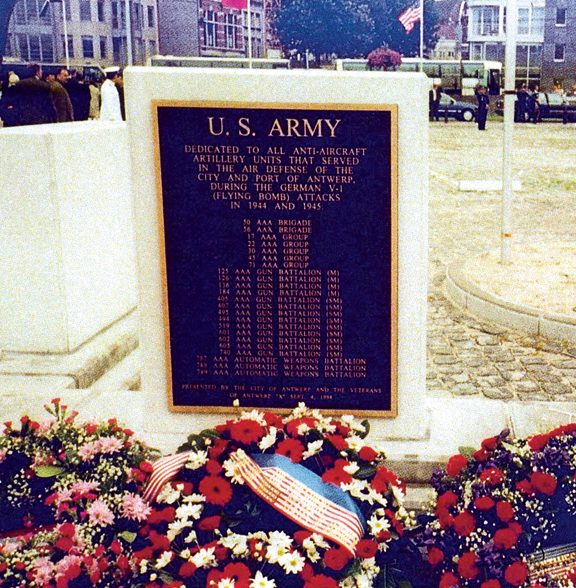
We were sent to Fort Hayes in Columbus, Ohio where we were given physical examinations. On June 18, 1943 I was shipped to Fort Benjamin Harrison in Indianapolis, Indiana, where I was assigned to the reception center. I remember a newspaper took our picture. We all looked like kids on our way to Boy Scout Camp. From there we went by train west to Camp Haan, located outside of Riverside, California, for basic training. Our training was in the desert center (Fort Irvine was gunnery range for anti-aircraft and Death Valley for maneuvers). It was hell in the heat. Some days the temperature was 120 degrees and at night it was cold. There was always a possibility of a rattlesnake curling up beside you in your sleeping bag to keep warm. For a boy from the cool hills of Ohio to 120 degrees, it was an experience beyond belief. Several of us were bitten by a rattlesnake, but we managed to survive. We became very close, and as fate would have it, we stayed together and became part of the 125th Artillery Battalion.
Occasionally we would have a pass to riverside or L.A. They would have a USO dance, which helped make the weekends more enjoyable. One weekend I even went to Phoenix, AZ with a buddy, as his home was there. Phoenix was a cow town in 1943. It had a theater, a store or two and some place to buy beer. Those days at Camp Haan weren’t all that bad. I was assigned to the Headquarters Division of the 125th AAA gun Bn. The men all became family, and many in the 125th were from the Ohio Valley area. My 1st Sergeant was George W. Barber, who was a WWI Vet. He seemed like an old man, but was probably only 43-45 years old. But we were only 17 or 18. My Captain was Dale Nix, a graduate of Texas AM and in the S2 (Intelligence). He was a rancher from Texas, and a good friend and mentor to me. Operations Officer was Captain Mark Lightfoot (S3).
When we left Camp Haan, we went to Camp Livingston at Lake Charles, LA. I knew it wouldn’t take long before we were shipped out. After several weeks there, we went to Camp Edwards outside Boston, MA. It was there that I ran into a friend from home, Henry Bindle, who had joined the Navy. We were able to spend some time together before I was shipped to England. We didn’t see each other again until 1947.
In September, 943 at the port of embarkation, I boarded the SS Mt. Vernon, a large passenger ship made into a troop ship. The voyage across the North Atlantic was rough, and most of us became seasick. We had a submarine warning, while the convoy was forming. One of the ships got hit–we saw the smoke, but never heard what happened. After about seven days, we landed in South Hampton, England. I was put on a train to the Dover area on the English Channel. The English people were very good to us. My unit was stationed at Dover in Liverpool and Folkestone. We soon learned the horrors of war.
The English had been fighting since 1939. The USA had been sending them help with equipment, etc. In 1941, when Japan bombed Pearl Harbor, the US became involved on both the Western and Eastern Fronts. The Germans were bombing London and had set up a strong defense on the Normandy coast. The English had strong Royal Artillery on the Channel area but they were glad to have help from America. Our Field Artillery had the big guns: 105mm and 90mm.
At first it was planes with bombs and then the Germans were sending VI Rockets, propelled rockets without any control called Buzz Bombs. It was our job to shoot them out of the sky before they reached London. The sound of the VI was like no other. As long as you could hear them it was ok. It was the deadly silence when fear would strike. Just before they hit their target, the motor would go out and then a loud crash and the sound of destruction. The 125th AAA Gun Bn. was set up at Folkestone on the Dover coastline. The GIs were well trained and successfully destroyed 97.8% of the VI bombs. We were credited with destroying 269 VIs.
We had to spot the bomb by radar or visualization information for a direct hit by the gun. We didn’t have calculators in those days. It all had to be done by eye and mind, calculating on a crude rangefinder. The air war went on 24 hour a day and gun crews were at their post continuously. The time in England was not all work and fighting. Most of us were 18 or 19 years old and some recreation was guaranteed. The good old American GIs ingenious nature was to make things happen. One day we improvised cowboy rodeo, with the help of Texas born Captain Nix. This was something the English had never seen. I truly treasure the pictures of Nix riding a bull at the Rodeo.
I also had taken my trumpet with me and was invited to play with a dance band organized with seven American Artillery and seven English Royal Artillery guys. We had a great band called The Ameroanglos. The band played for dances in the ballroom at Lea’s Cliff Hall in Dover. The ballroom was carved out of the chalk cliffs of Dover. The band also played for the BBC (British Broadcast network), which broadcast to the Armed Forces. Glen Miller’s band also played there when on a USO tour. In England I was very fortunate to meet Eddie and Pat Wedgwood. They became very dear friends to this day, and we keep in touch. Eddie was a member of the English Royal Artillery. At this time, even with the destruction in London, the people were great and we still had no idea of the Hell that was to come.
On June 6, 1944, General Eisenhower and the High Command decided there would be a landing on Normandy Beaches. The allies had no idea how heavily guarded the Germans had made the beachhead. They had underground bunkers with their best artillery guarding the beaches. Our stay in England ended on D-Day. The invasion of France was to begin. As we boarded the boats to take us across the English Channel, we had no idea what was to come, but each of us was very scared, as well as anxious, to fight the Germans. There was a storm that day and the water was very rough, and many became ill on the crossing. We thought the beach landing would be a piece of cake. Intelligence was not informed on how heavily enforced the beaches were by the Germans.
Rommel had done everything possible to prevent the landing: barbed wire, and mines going off in every direction. The first wave on the beach was mowed down like animals. I remember going off the front area of the boat into water up to my armpits. I had to hold my rifle above the water. Our boat couldn’t get any closer to the beach because the Germans had put tanks in the water to prevent heavy equipment getting to the beach. I remember seeing a soldier in the water. I thought he was alive, so I held on to him until we got to the shore, only to find he had been shot and most of his face was gone. As we beached under fire by the Germans, the beach water was red with blood, and dead bodies of the men who went before us were strewn all around. It was necessary to keep down and crawl over them. Finally, after many hours and cover fire from the ships that took out some German guns, and thousands of dead GIs, the beachhead was made and we were able to move forward. Many of the officers were killed. The GIs didn’t wait for orders–they did what needed to be done for the situation. It took six days to secure the beach. The Allies had a line from Utah to Juno and Omaha. Nine thousand three hundred sixty GIs were killed and five thousand bodies were never recovered at Omaha Beach.
From the beach area we fought our way to St. Lo. The Air Force had been bombing St. Lo and when we arrived, the town was destroyed, the people and Germans gone. The hedgerows were to come. The hedgerows were mounds of dirt the farmers had built as fences surrounding orchards, farms and houses. Many American died here, as the hedgerows made perfect places for the Germans to take arm. They had tunneled in the mounds and set up machine guns emplacements. The Germans had better armor then we had. The Americans had very few tanks that would navigate the hedgerows. Our tanks were like toys compared to the German tanks. It often took 4 or 5 Sherman tanks to take out a German tank. Our tanks were called “moving graves”. Finally the GIs made an adapter to the front of the tanks from junk steel welded together that acted like a snowplow. We were able to uproot the hedgerows.
The way forward was difficult, for there was a problem getting gas and needed supplies from England when the supply ships ran into trouble. On June 16th, a severe storm came to the Channel and many ships with supplies were unable to land, and some even sank. Not all went well, even with the best plans. Unfortunately, General Montgomery made his first big mistake at Caen, France in the Falaise Gap battle. Many casualties occurred when he didn’t head out of Caen. The battle through the hedgerows would not have been necessary. Montgomery took credit for the Cobra breakout, but truly it was General Bradley who was the one to make the difference on the total breakout from the beaches. General Patton was under Montgomery at this time and had to follow his command. Because of this, the German army was able to escape and retreat. They reorganized to fight later. From here we are on our way to Paris. General Patton took command. The Air Force was welcomed and did their job as expected. The Americans moved more in one day than they had in six. Now organization was put into the battles by combining air, tanks and infantry.
1944 Summer/Fall
Upon reaching the outskirts of Paris, the Americans were stopped. The Free French by General de Gaulle were to be the first to enter Paris. The Germans had left Paris without any organized resistance. They left very little damage to the city. However, there were some snipers still present August 25, 1944.
The British went forward to liberate Brussels, Belgium; we went east to Nylan, Belgium and to Antwerp, Belgium. Getting supplies to the troops became more difficult. Trucks were bringing supplies over land. The truck convoys were called “The Red Ball Express”. The roads were not good in Europe, and rain often made the roads very muddy. Also, the distance became so long, we needed another port to receive supplies. Antwerp became a very important supply route. The British fought to secure the port and we were to set up Artillery (the 125th) outside Antwerp to defend it from the VI Buzz bombs that the Germans sent. The operation was known as “Antwerp X”. It was a highly secret mission. The US Government did not allow any information out about this mission until 50 years ago, after WWII was over. During this time (September 1944) a Buzz Bomb Rocket hit a recreation theater in Antwerp. The children were watching a western movie that afternoon, and 500 died. Russ Elliot and I helped carry many of the children out. The success rate for destroying the VI rockets was 90%. But the V2 Rockets were so fast that radar couldn’t pick them up, and there was no defense.
Battle of the Bulge, December 16 1944 through January 25,1945
World War II continued in 1944 and for a rest after Antwerp X, we were sent to the Bulge area located in Ardennes, Belgium. Winter was on the way. It was said that this was the coldest winter on record for many years. The snow was so deep we could hardly walk. Many of the men had frozen feet and needed amputations. My left foot was frozen, and I was told gangrene would set in if not removed. I kept asking for one more day. By the morning of the next day, circulation began to reappear. We were to have winter clothing and boots, but for some reason the boots were for summer and not waterproof, and no winter clothing was given. ‘
Our unit was started at St. Vith. We were assigned to keep the Germans from coming to the crossroads from Houffalize and prevent the Germans from going further west. Thankfully, we had raincoats. We would sleep in our wet clothes, and most of the time in an army blanket. During this time we could not put up a tent, as there wasn’t time. We were always moving and most nights we spent in foxholes in the snow. When we had a chance, we would get into an old building.
The Ardennes forest was so dense they had to have tanks to knock down the trees to get the large artillery through. The large artillery was set up behind the line and would shoot over the line to the Germans. A B-17 crashed near us while on a bombing run. We picked up several men. All were deceased. One was a general, but at the time we didn’t know that. In combat no stars or badges were worn. If taken prisoner, you didn’t want the Germans to know your rank. Later the story was written up in The Stars and Stripes.
The weather stayed bad for days or weeks–I don’t remember which. But I do remember all the frozen feet and sleeping in the snow. Christmas Day 1944, a German jet was strafing us. It was a brand new model (ME262) jet. The attack caused multiple injuries and fatalities to our men. In the Battle of the Bulge, there were 600,000 Americans and 650,000 Germans. It was the largest land battle of WWII. Three American armies and six Corps, 81,000 GI wounded, 19,000 killed. When the weather finally permitted planes to fly, the 101st in Bastogne had supplies dropped by air.
Winter of 1944 – Spring 1945
General Patton’s 3rd Army and tanks were received with much joy, and the battle began in our favor. General Patton was held up from arriving sooner because of the weather and no gas for his tanks. My unit, the 83rd Infantry Div. 329th Infantry, was sent toward the East (Rhine River), crossing it into Czechoslovakia. The Germans knew the Americans were coming and near the town of Pilsen, the Concentration Camp of Nordhausen was liberated. The Germans guards left or wore civilian clothes so as not to be known as guards. The prisoners in the camp were not able to move, because most were too weak or too sick. Approximately 1/3 of them survived. Near the end of the war was the discovery of the Dachau Concentration Camp. Pilsen was the capital of Czechoslovakia and the prisoners were used by the Germans as slave labor. Where the underground VI Missile flying bomb assembly plant was located, the underground factory had multiple miles of tunnels. When the camps were freed, the Occupational Army took the refuges to another camp to be clothed and fed until they were healthy and able to make decisions for themselves. It was found if they were left alone they would eat and eat. Not mentally able to make a decision until the body became healthy.
After leaving this area, we went on to the Elbe River, going through the Hurtgen Forest. The combat lasted about a week to 10 days. Upon reaching the Elbe River (March 13 or 14, 1945) the crossing was made on a pontoon bridge and small boats brought by the engineers. The engineers were great craftsmen. The area was about 35 miles from Berlin. We waited for the Russians, who came on April 13, 1945. The wait was necessary, for President Roosevelt and Winston Churchill had promised Stalin (the Russian Ruler) that the Russians could take Berlin. The Germans surrendered May 8, 1945.
Antwerp, BE monument honoring the American AAA gun battalions
On September 4, 1994, on the 50th University of Antwerp X and the liberation of Antwerp, Belgium, the Belgium Government celebrated. In 1994 Col. Barkie and I, along with the help of the Veterans from the 125th Gun Bn, dedicated a monument honoring the American Artillery, which shot down 481 VI Buzz Bombs in the defense of Antwerp. The Mayor of Antwerp, Mayor Cools, and the King of Belgium did us a great honor and held a ceremony for the group of Veterans attending. I was honored to lay the wreath on the monument and received the Belgium Flag that covered our monument. It was presented to me by Mayor Cools of Antwerp. The wreath from the USA was laid by Hazel O’Leary, Secretary of Energy, who was sent by President Clinton. The third wreath was sent by the Mayor of Antwerp.
AFTER 50 YEARS, A FEARFUL INCIDENT TURNED HUMOROUS
by Sam Ballinger, 3rd Army, 26th ID, 328th IR, Co E
Sam Ballinger
It was Christmas Eve at midnight, 1944, when we started out across a snow covered field to take the town of Eschdorf to relieve the pressure on Bastogne. Our squad walked up a road on the right side of town when all hell broke loose. Heavy and light German tanks painted white started running among us like fire engines looking for a fire. Three of us ducked into a barn filled with cows. The rest of my squad went to the left and took cover behind an old wooden barn. A tank’s machine gun fired right through the barn killing all nine men of my squad.
We were unnoticed in the barn until the afternoon when the three of us were moving in the barn past a large open doorway. Two white clad Germans were approaching to enter the barn. We saw them first and brought them down and dragged their bodies inside where they couldn’t be seen. From then on, all we thought of was an attack on our barn. Surely they would miss those two soldiers, but it was deathly quiet the rest of the day and through the night We survived by drinking milk from the cows and moving around to keep from freezing.
Today this house was that barn
The next morning, my buddy came running to me saying, “Hurry Ballinger, they’re coming!” We all ran to that side of the barn and peered out through the cracks. There was a hedge just beyond the barn, and there they were, white forms moving down along the other side of the hedge towards the barn. They seemed to be coming after us in full force. Fear struck me, but I didn’t panic. My body was numb and my mind was frozen with the thought of being among the casualties, because they weren’t taking any prisoners. The field outside was littered with dead GI’s. I kept peering through the cracks when I saw red parts moving also. After a few seconds, I gave a sigh of relief. Being a farm boy, I realized those white forms weren’t the white clad Germans, they were white leghorn chickens scratching for food. I could have shot my buddy, Gonzales, for scaring the hell out of us.
Soon after this, a battle broke loose at the other end of town. The sky cleared and the P-47’s of the 9th Air Force were bombing and strafing anything that was a target I decided we’d better make a run for it while the enemy was busy and before they bombed our barn. We ran about 1,000 yards across a cow pasture with barb wire fences to distant woods and safety.
Of course there is more to this story about the Battle of Eschdorf, but after reading many books, I still don’t know what really happened to the rest of my Company that Christmas Day. I left the line with trench foot and spent 2 1/2 months in a hospital, and was then assigned to limited service.
Remembering World War II and the Battle of the Bulge by Philip Walsh, 2nd AD, 66th AR, Co C
I was 18 years old when I got my draft notice from President Franklin Roosevelt. It was 1943. The notice read “greetings from President Roosevelt” and went on to say I was drafted to the US Army. I had never been away from home before and I wondered if I would return home to Maine.
I was sent to Fort Devon’s, Massachusetts, for a few weeks where I received my army uniform and medical shots. I recall walking down a narrow hallway and got shots in both of my arms. The fellow in front of me passed out after receiving his. I can still hear the guys who had already got their shots saying “you will be sorry.” They were right. They also warned me to watch out for the square needle that’s left in overnight. I found out to my relief they were just kidding because I was a new recruit.
From there I was sent to Fort Knox, Kentucky, for 21 weeks of tank training. I remember being homesick, went to see the doctor, a major, who gave me some pink pills and said I would be fine. I wasn’t. I was still homesick. When our training ended we were sent to Fort George Meade, Maryland, for advanced training. Then I was sent to Camp Shanks, New York, to board the Aquitania for Europe.
I recall when we landed in Greenock, Scotland some Scottish girls greeted us and gave us muffins filled with meat. I took one bite and threw it out. It tasted awful to me. We left Scotland by train to England. By the time I arrived in England I was no longer homesick. It was more than 6 months since I left Maine. The war was underway, and by this time I figured I’d never get home alive.
When I was sent to France I was assigned to Company C 66 Armored Regimen, 2nd Armored Division. Afterward I was deployed to Omaha Beach in June – six days after D-Day. When I landed I asked the Beach Master if many men were killed. He said if anymore were killed no one would have gotten ashore. I remember one solider, in particular who landed on the beach with me. He was from the southern part of the States and was assigned to another tank because tank commander, Lt. Johnson, also from the south, picked him for his crew because of the connection to the south.
This was the first day in battle for us. Lt. Johnson’s tank was heading down a road between a row of hedges rows and ran over a mine. The explosion blew a track off the tank. The crew climbed out of the tank, started to crawl on the ground and a mortar shell landed on the back of the soldier from the south. All that was left of him was a piece of his fly and belt buckle. It was terrifying. Later I was told that Lt. Johnson was planning to get married in Paris after the war and arranged to have his bride’s wedding dress made from a parachute. Unfortunately he was killed outside of Berlin at close range by one of Hitler’s Youth with a Panzer Faust bazooka after he stepped outside of his tank.
We were never told where we would be deployed or given any details. That was one thing I didn’t like about the Army. After Omaha Beach we were sent to another location in France. We were on the front line for 21 days with the Germans firing at us from a train with artillery guns. I remember it sounded like a freight train coming at us. Three crew members and I barely left tank for the entire 21 days. It was too dangerous to stay outside for any length of time due to the constant shelling from the Germans. We had to be extremely careful.
The ground around the tank was all torn up from shelling and the mud was a foot thick. Every time someone left the tank they would get about two inches of mud on their boots. I remember getting mud dropped on my shoulders whenever the tank commander, a schoolteacher, climbed back into the tank after checking our surroundings. I was seated at the machine gunner’s seat and there wasn’t any room to move. It was very tight quarters inside the tank. I also recall when the lieutenant was injured after a shell struck the side of the tank when he was underneath trying to cook a meal with a Coleman Burner. He was taken to the aid station.
We had an opportunity to take prisoners. Seven Germans waving a white flag tried to surrender to us. One of our crew members fired at them and they took off.
After 21 days in France we were on the move again, this time to Germany. We arrived to a location that looked like a park and were able to sleep outside on the ground. One morning when I awoke, I noticed the tank was leaking. I looked inside and saw about three inches of gasoline on the bottom of the tank. A new replacement had changed the fuel filters incorrectly on both Cadillac engines.
Our next deployment was to Bastogne for combat at the Battle of the Bulge where I remained for the duration of the conflict. It was winter, freezing cold, and I drove an open top half track 100 miles in the pouring rain to Bastogne. Somewhere along the way I drove off the road. I was very tired, soaking wet and it was difficult to see because there were no headlights. I accidentally backed into Captain A.Z. Owen’s tank. He hollered “get that man’s name.” I was afraid he would send me to jail. He didn’t do anything.
When we arrived at our destination near Bastogne we were exhausted and cold. We pitched our pup tents in the freezing temperatures and went to sleep shivering. What amazes me now as I think back about sleeping in soaking wet, heavy Army clothes with my shoes frozen to the ground is that I never caught a cold.
Our tank was parked next to a farmhouse. The family living in the home felt sorry for us staying outside in the cold and they invited us in to dry our clothes and get warm. We stayed with them for several nights. Unfortunately one of the soldiers flirted constantly with the homeowner’s wife. The husband got fed up and told us all to leave.
One time we liberated a couple of chickens and some vegetables from a Belgium farmhouse and I cooked it in a 5-gallon can. You cannot imagine how good this tasted on a cold day especially after living on K and K rations. It was the best chicken soup I had ever eaten. A captain from Georgia said to me, “Walsh where did you get the chickens from?” Another soldier spoke up and said he got a package from the states. This seemed to satisfy the captain who helped himself to the soup without asking any more questions.
Later during the battle I was asked to drive this same captain in a jeep to a command post set up in a house near Bastogne. When we arrived we saw the T/5 Sergeant who had flooded our tank with gas when he was assigned to our crew in France. He was on duty at the command post and did not salute the captain in my jeep. The captained yelled to the T/5 sergeant “Salute me.” He obeyed.
When the Battle of the Bulge ended, I was deployed to Berlin. We were the first troops to arrive in Berlin after World War II ended. I was transferred to the 12th Armored Division and sent to Marseilles, France where I prepared to go home. It was 1946. I am proud to have served my country, but I wouldn’t want to go through this again.
For the citizens of Assenois, the arrival of the German forces was the worst Christmas present imaginable. Assenois had little appreciable military value. It did not sit atop high ground, nor was it a highway hub like its neighbor to the north, the town of Bastogne. Its location was astride a road that linked Bastogne with the town of Remichampagne, which was south of Assenois. Other than that, it was meaningless.
One of the matriarchs of Assenois remembered those dark days. Her name was Madame Denyse de Coune, and she owned a chateau along the northern outskirts of town. With several arched gables and thick stone walls, the great house looked more like a quaint castle. Since it was a large building, it had a several cellars, and as a result, when the fighting drew closer to Assenois, many area families sought refuge under its stone walls. The shelling had started on Wednesday evening, the 20th of December, and for the next twenty-four hours, the battle see-sawed back and forth, but by the morning of the 22nd, the Germans were in control of Assenois and had pushed westward. For all the fighting, the cost was to the town was minor: only one civilian lay dead.
On the 23rd, a German feldwebel (sergeant) from Vienna had approached the matriarch and asked her if they could set up an office within the chateau. Thirty minutes later, he and his staff section were gone, but another unit replaced them. As it turned out, the staff of the 39th Fusilier Regiment also wanted a comfortable locale for their headquarters. With its dense walls and subterranean vaults, the German volksgrenadiers had decided that it was a great spot to command and control their regiment. Oberstleutnant Walter Kaufmann, the commander of the 39th Fusilier Regiment, and a Oberleutnant Specht, the commander of its 1st Battalion, agreed, and they moved in once the phone lines and radio transmitters were active.
Unbeknownst to the Madame de Coune, the 39th Fusiliers were part of a much larger operation. For several days, the 39th, together with the rest of its division, the 26th Volksgrenadier, had been locked in combat with the 101st Airborne Division, trapped inside Bastogne. The Germans needed to capture the town to dissipate the traffic jams, which were clogging up their supply lines. So far, the 101st successfully had resisted every German attempt to seize the vital road net. More important, the Germans were running out of time because Lieutenant General George S. Patton’s Third Army was pushing its way north towards Bastogne. In fact, Assenois was one of the towns that were between Patton and Bastogne.
By the 24th, the Germans were everywhere inside the chateau, as if they had been living there for years. Even worse, the growing presence of German vehicles and troops outside the house made it a tempting target for the American P-47 Thunderbolts, flying above them like birds of prey. As evidence, one group of fighter-bombers strafed the building on Christmas Eve day, but thankfully, the sturdy walls were too much for the bullets, which bounced harmlessly off them like rain drops. Walls, though, would be useless against bombs.
That night, while everyone in the Christian world celebrated Christmas Eve, the German soldiers stole some of the chickens from the de Coune farm for their own Christmas feast. Another landser (German term for soldier), out of kindness, brought American biscuits to feed the hungry children. No doubt, the soldier had found them, since the German soldiers had little food from their own supply chain. To keep up morale, the refugees then sang Christmas carols to each other while the parents regaled their children with stories of the Comtesse de Segur, who was a Russian born, French novelist.
The following Christmas morning started out well. Mrs. Augustus de Coune baked some bread and served it with roasted chicken. As the morning dragged on, more and more refugees arrived, and they were not the only ones seeking shelter. By midday, more German soldiers showed up, demanding sanctuary from the American bombs and artillery. Hearing this, Madame Denyse de Coune shook her head in dismay because she knew the corridors were overcrowded. Someone had to go, and the German soldiers ejected her and the rest of the civilians.
Like Babylonian exiles, they grabbed whatever they could carry. Most only brought a blanket and some bread, and they left for nearby sand dunes, which had been a hideout for the resistance during the long German occupation. When they arrived, they discovered that the shelters were gone. For the next thirty hours, the refugees would be homeless. At least, thought Madame de Coune, the frozen pine trees looked like Christmas trees. That night, they slept under the stars like the shepherds outside of Bethlehem. Nearby, the Germans had set up an artillery battery, and it was firing at the American forces in Bastogne. The paratroopers replied with their own counter battery, and the rounds from the American artillery fell dangerously close to the refugees.
Meanwhile, the tankers and infantrymen of Combat Command Reserve of the 4th Armored Division prepared themselves for combat. They had been fighting almost non-stop since the 22nd of December, and now they were closing in on the prize – the town of Bastogne. While Madame de Coune and the other banished families huddled in the freezing cold, Lieutenant Colonel Creighton W. Abrams, the commander of the 37th Tank Battalion, was leading a combined-arms task force. Several hours earlier, Abrams’ men had captured the town of Remoiville, which was three kilometers south of Assenois.
The following morning, the 26th of December, Abrams began the final drive into Bastogne. First, they overran a German panzergrenadier company in Remichampagne. By noon, Abrams’ forces were just to the south of Clochimont. Only the town of Assenois was between his tankers and the beleaguered paratroopers in Bastogne. Alas, most of the inhabitants of the small village were recent arrivals from the 39th Fusilier Regiment, ensuring that the ride through Assenois would be fraught with danger.
Outside of the town, Madame de Coune watched the beginning of Abrams’ historic assault. In preparation for the final push, P-47 Thunderbolts swept over the town, plastering it with napalm while showering the German defenders with lead from their eight, blazing .50 caliber machine guns. Explosions rocked the forest where the refugees were hiding, causing the trees to tremble and shed their snowy blankets.
After the Thunderbolts, the twenty-six exiles next watched a procession of C-47 transport planes pass over them. Then, like manna from heaven, hundreds of parachutes began to appear, as aircraft crews delivered supplies to the surrounded paratroopers. Luckily for the families, which included seventeen children, many of the para-packs were stuffed with biscuits, cheese, and best of all, chocolate. For the hungry refugees, the food lifted their morale.
The feast did not last long. Towards the end of the afternoon, Madame de Coune watched as a column of American tanks and halftracks lined up south of Assenois. Then, with guns blazing, the column snaked its way through the narrow village streets and broke through to the other side. She described the vehicles as “spitting fire.” Next, she saw the American forces push the German defenders eastward and into her neighbors’ homes. Now, it was the Americans’ turn to surround the Germans. Some fought, but most of them eventually surrendered.
By early evening, Madame de Coune reckoned the fighting was over, and she led the exiled families back into Assenois where they discovered that her home had not escaped the fighting unscathed. Four artillery shells had penetrated the roof, leaving gaping holes for the rain and snow, and the same shells shattered many of the windows. Despite this hardship, the families of Assenois were once again free. The tankers and infantrymen of the 4th Armored Division had liberated them.
We had just ended our first month of combat in and around Prummern, Beeck, Leiffarth, and Wurm. These are villages in the Siegfried line North of Aachen, Germany where our casualty numbers nearly exceeded the initial number of men in the Battalion. As we got ready to leave, December 20, 1944, it turned out to the Bulge; we thought our unit was going to a rest area to reorganize the Battalion. Our convoy traveled for two days stopping for at least two night’s rest. I remember spending a night in a large chateau, sleeping in what appeared to be the upper floor under the roof. The windows in the room were of the so-called dormer type. The large room was unfinished with the roof rafters showing. On returning to Belgium many years later I tried to locate the building but failed. We also slept on a concrete floor in what appeared to be a school. Our truck traveled most of the time with the headlights on. This made us feel that we were many miles from any action. It also somewhat supported the rumor of going to a rest area. We had little information at the squad level. The road signs and village names indicated Belgium or perhaps Luxembourg. We did not know that the German Army was charging toward us. At the end of our two-day drive we stopped in the small Belgian village of Bourdon. There were rumors that Germans had been seen along our route. This I doubt as the route we traveled was North and West of the German advances. On the way to Belgium we passed through Pallenberg, Alsdorf, Aachen, Verviers, Durbury, and then stopped in Bourdon. At the time I never heard anything about Germans posing as GIs in rear areas. Most history books cover this to a great extent. There are claims that it caused much trouble. Actually there were almost no Germans in GI uniforms; it was mostly rumor. Even the German paratroop attack was a failure. The closest German troops to our route were those in Hotton, probably 3 miles away. When we arrived in Bourdon we, at least I, had no idea of why we were there or what was happening.
Bourdon in the Belgian Ardennes seemed remote, safe, and distant from all the living hell we had left a few days before. As usual, there were more rumors than facts. We billeted in a barn and collected rumors. Depending on which were true the German Army was in the next town or miles away. I don’t remember hearing gunfire but I was a very sound sleeper and could have been sleeping through any. In fact the German Panzers were approaching Verdenne just over the hill south of Bourdon.
The afternoon of December 24th, Bob Davies and I were ordered to make up a daisy chain. We used eight mines from the stock carried on our Dodge 6 by 6 truck. A commandeered Belgian rope was used to connect the mines together. Our squad leader led us to a position before the first switch back in the road leading up a hill toward woods to the southeast. Later I found the forest up the hill between the villages of Bourdon, Verdenne, and Marenne was the location of the 116 Panzer infiltration. Our roadblock was only a short distance from the comfortable barn hayloft billet where we spent the previous night. Orders were if attacked; let the first two tanks go by and pull the mines in front of the third tank. Our position was in the open with no possibility of cover. The hillside was totally bare, not even a small bush. This was truly a mission impossible. There were no ditches or structures within 150 yards. Any enemy tank coming down the road would see us immediately on turning the upper switch back a short distance away. It was possible they would have been so startled by our pluck or stupidity that they would have backed off thinking it was a trap of some kind.
Approximately a half-hour before dark a Divisional M8 Greyhound armored reconnaissance vehicle appeared from the direction of Bourdon. An officer was waist high out of the turret hatch. The vehicle went around the first switch back and on up the hill. An M8 Greyhound is a six-rubber tired armored vehicle with a 37-mm gun turret. We wondered where it was going and why. Any way we had no information to give the officer had he asked. It did not even slow down as it passed us and disappeared around the switch back. Within a minute the vehicle came back around the upper switchback and down the hill with the throttle wide open. No one was in sight and when it reached our position. The vehicle stopped sliding all six tires. A small part of the officer’s head appeared in the turret hatch shouting, “there are ten German tanks coming down the road, hold at all costs”. Gears clashed and the engine roared as the vehicle disappeared down the road into Bourdon.
I learned later that the Germans were using captured M8 vehicles to lead some attack columns. This possibility never entered our minds when we saw the vehicle coming past us. We only had a vague idea of which way the Germans might come from. At the time I felt Bourdon was south of Verdenne. I had been given no map or compass; as privates our only responsibility was to take orders and follow the leader. After the report and order from the Cavalry Lieutenant there was no doubt about the direction to the Germans. I have determined since then that we were in the exact center of enemy’s main attack. Orders to the 116 Panzers were to cut the Marché-Hotton Road that was to the north of our position. In fact this road could be easily seen from our elevated position. With heavily defended Marché on one end and Hotton on the other Verdenne and Bourdon were the logical points to attempt a breakthrough.
I have attempted to find an origin for the phrase “hold at all costs”. I could not find any authority that traced the history of the statement. It was used in the American Civil War and in the First World War. I feel that almost all Officers that gave this order immediately left the area in the direction away from the enemy. It is positively un-American to accept a suicide mission. Suicide missions generally involve religion. Persons volunteering for these missions feel they will get some reward in an afterlife. Not wanting to disgrace their family or let the Emperor down was the motivation for the Kamikaze pilots in the Pacific. I had already shown that I was not a coward, but none of the factors leading to a voluntary suicide mission applied to me. I was not going to hold at all costs if my life was the currency. Considering our position the only cost to the Germans would be a few machinegun cartridges.
After the M8 armored vehicle passed I quickly scouted the area for some cover. Digging a foxhole in the possibly frozen and hard ground in the time that seemed available was out of the question. The nearest good cover was down the hill in a railroad track siding. There was a railroad car weighing scale pit. Our rope was too short to reach the pit so we just stood by the side of the road and hoped for the best. If we pulled the rope ahead of the first tank I think we would have had at least a 5% chance of one of us making the railroad pit. If we waited for any tanks to pass the first one would have used its machinegun on us. It was so quiet that we felt the reconnaissance officer may have just been seeing things. We stayed on this position until well after dark but heard no tank engines and no tanks appeared. I knew from my experience in Leiffarth, Germany that tanks could not approach undetected as the noise of the engine and the flop-flop of the treads can be heard from some distance. The road on the hillside had two switchbacks after it came out of the woods. We easily heard the recon-vehicle as it approached the switchback up the hill above us.
The tanks were there, as I discovered many years later, in the area now known as the Verdenne Pocket. It is also reported in Heinz Gunther Guderian’s book, “From Normandy to the Ruhr With the 116th Panzer Division World War II” that their orders were to cut the Hotton-Marché road, which was down the hill and across the railroad track from our position. Our two-man roadblock was the only defensive position in the way of this objective. Since that time I have pondered reasons why an attack was not made down the hill. The most probable is the German Commander Johannes Bayer did not want to sacrifice his men to a lost cause. Fuel and other supplies were also a problem for the somewhat cutoff group. I learned later that they had broken through our thinly manned foxhole line between Marché and Hotton to occupy the woods. Also the 116 Panzer Division had driven our troops out of Verdenne. A rifleman from one of our units described this attack to me. Our heavy 30 caliber water-cooled machine guns were able to each fire only one round. Water in the cooling jackets had frozen so the mechanism could not function. The rifleman escaped down the back yards of a street in Verdenne with a enemy tank following him. He vaulted over the back yard fences, which the tank was easily knocking down behind him.
We reported the incident of the recon-vehicle to our squad leader and as usual, he did nothing. I will probably never know if whoever was directing our movements in this area received a report from the officer in reconnaissance vehicle. However, the action of Company K 333 indicated they didn’t know. As usual, the so-called fog of war was very thick. I also do not know whether any one was on our position when Company K 333 took this road up the hill thinking it was the way to Verdenne. A platoon from company K was assigned the task of recapturing Verdenne. I feel sure that our antitank squad members would have told them about the reported enemy tanks up the road. When the Platoon from Company K came on the German tanks in the woods they thought they were their support tanks to aid them in retaking Verdenne. When one of them rapped on the side of a tank to let them know that they were ready to advance on Verdenne the answer was “Vas ist los”. The excursion of K 333 past our position is covered in the Leinbaugh/Campbell Book. “The Men Of Company K”. See pages134-144
In the fight with the German tanks and their supporting infantry several of the men from K 333 were wounded. However, most of them got back down the hill. Of course the tanks that the reconnaissance officer told us about at least six hours before were the ones found by K 333. Why there was not better transfer of information was probably due to military protocol. The reconnaissance officer was from some attached cavalry unit. He would have reported to his unit commander who would report of someone in division headquarters who might possibly pass it down. Davies and I reported it to our squad leader; we had no other possibility or responsibility.
We left the position when relieved by two others from our platoon around ten. We told them about the reported tanks. I feel they must have left the position, as they would have reported the possibility of German tanks up the hill. We were relieved around two hours before K 333 men passed. The first time I learned of the Company K 333 venture up the hill was when reading Leinbaugh’s book over 50 years after the event.
After a little sleep that night, we were awakened around midnight to prepare for the recapture of Verdenne. We did find the correct road and entered around 0200 December 25 1944. This road went up the hill with the woods on the left that was the location of the pocket (referred to in Guderian’s book as the hedgehog).
Guderian also reported that General Hasso Eccard von Manteuffel, head of the Fifth Panzer Army, was in Grimbiemont two miles to the southeast on December 24, 1944. He was there to order an attack on the Marche Hotton Road. This attack if made would have of course gone through our roadblock.
Draper reported in his book “The 84 Infantry Division in the Battle of Germany”, that the retaking of Verdenne started at 0100 25 December 1944.
“As soon as the German position was sized up a second attack was launched at 0100 25 December.” (Draper wrongly considered the aborted excursion up the hill by K 333 as the first attack on Verdenne. They were more than a mile away.) Draper goes on: “This time by the 333rd’s Company L and the 334th’s Company K, the later down to approximately 40 men. It was now, Christmas morning. Our attack began with a heavy artillery and mortar barrage.
While shelling was still going strong, Company L entered. The first two platoons to go in were temporarily outnumbered and were engaged from three sides. One enemy tank began to move in close. A rifleman S/Sgt. Edward T Reineke, took careful aim, chose the tank commander as his target, and killed him. The tank stopped, Reineke ran toward it, jumped, dropped a grenade into the turret, and finished the job himself. This one-man victory turned the tide. The two platoons swept through the town and dug in on the opposite side while the rest moved to mop up. It was dark and many Germans were left. Another tank showed up and terrorized the town until daylight.”
When we arrived in Verdenne less than an hour after the start of the attack we saw the tank that Reineke had attacked. From the location of the dead Commander we felt he was probably standing on top when hit. It may have been getting ready to move or just standing there waiting for something to happen. Reineke single-handed killed the crew and put this tank out of action. Many have gotten a Congressional Medal of Honor for less. Reineke did get a Silver Star for his aggressive action. At least two Germans were dead inside the tank. One was in the turret and the other in the machine gunners seat. The engine was off. I feel they were getting into the tank and were surprised by the attack. This tank was later started and driven down toward the pocket by a GI with the intention of firing the turret gun at the German positions in the woods (the Verdenne pocket). This never happened and later the tank was disabled by blowing off the end of the turret gun with an explosive. Chuck Car of our platoon climbed in the tank and removed the radio and used it for listing to radio broadcasts from the US armed services network. Later when listening to this liberated radio he was the first in our unit to hear of President Roosevelt’s death. This same tank is pictured in publications covering the 1944 battle in and around Verdenne. the Book was published as part of the 50-year commemoration held in and around Verdenne.
I still don’t know what our mission was during the attack on Verdenne. We were an antitank unit, but were not called on to fight the tank that Draper’s book indicated was terrorizing the town that early a.m. of Christmas day. As usual the rifle platoon leader was not told of our presence. I felt at the time that the German Troops did not expect any action on Christmas and were possibly partying. A lot of prisoners were taken during the 25th and we helped in searching and guarding them. By midday our trucks brought up our 57-mm antitank guns and the trucks were used to transport prisoners to Bourdon. The road from Verdenne to Bourdon passed near the woods occupied by the Germans, the so-called Verdenne pocket. Each time we drove the road we were fired on by automatic weapons. The trips were made after dark and no one was hit.
During the 25 and 26 December most of the Antitank Platoon were in Verdenne on the North side of town. Unknown to us at the time, we were only yards from the Verdenne Castle and the battles around it. Sometime in the afternoon of the 26 a German tank was reported as crossing the field southeast of Verdenne. The time agrees with the German Task Force Bayer’s breakout from the pocket at 1800 hours.
One of the tanks turning right (southwest) was most likely the one reported to us. Our support tanks (Shermans) refused to go southeast down the street to engage the German tank, a Mark IV. Several from the antitank platoon, myself included, volunteered to push our 57mm gun down the street and fire on the tank. We moved our gun around 100 yards to a point where the tank was in sight in the open field to the south. For some reason it had stopped, perhaps it was out of fuel or had mechanical problems. We set the gun trails on the hard surface street and aimed the gun. Several looked through the telescopic sight. I found a stick to fire the shell as without the trails dug in the gun jumps back several feet from the recoil. A 57mm antitank gun is usually fired from a kneeling position. Elevation is by a crank screw and direction from a shoulder frame. Sergeant Cable was about to fire the gun kneeling as I approached with the stick shouting to get back, don’t fire it that way it will back over you. I think then he realized what would happen and moved clear. I hit the firing pad with the stick and the gun jumped at least six feet back from the recoil. Immediately, the view of the tank was obscured by a dust cloud from the muzzle blast. One of the riflemen watching from across the street shouted, “You hit it, you hit it”. Several more shots were registered on the tank from our gun. Then one of our Shermans came roaring down the street fired a round as it came to a stop and then backed rapidly up the street. It was the tank that refused to engage the German tank earlier. I’m sure it reported that it knocked out the tank.
The crew of our gun all received Bronze Star awards for hitting the tank. The citation read as follows:
“For meritorious service in connection with military operations against the enemy in Belgium, December 26, 1944. As a member of a gun crew occupying a position from which effective fire could not be placed on an enemy tank which was firing on friendly forces, Private First Class Harvey, completely disregarding his own safety, in full view of the enemy and under direct fire, together with four other soldiers, moved an anti-tank gun by hand a distance of approximately 50 yards and from this new position delivered fire which destroyed the enemy tank. The dauntless, daring action, disdain for danger and exemplary conduct displayed by Private First Class Harvey enabled his unit to continue its advance and reflect the highest credit upon himself and the service of the United States.”
We were not fired on and I felt other actions that I was in were more worthy of the award. The German tanks that retreated that day had to pass through our defense, which was essentially an ambush. In our sector Hitler’s “Wacht Am Rhein” was stopped and had had gone on the defense.
References:
Draper “The 84th Infantry Division in The Battle of Germany”, The Viking Press, New York, 1946.
Leinbaugh/Campbell “The Men Of Company K” William Morrow and Company, New York, 1985.
Guderian “From Normandy to the Ruhr With the 116th Panzer Division World War II” English Translation, The Aberjona Press, Bedford, Pennsylvania, 2001.