Category Archives: Veterans’ Stories

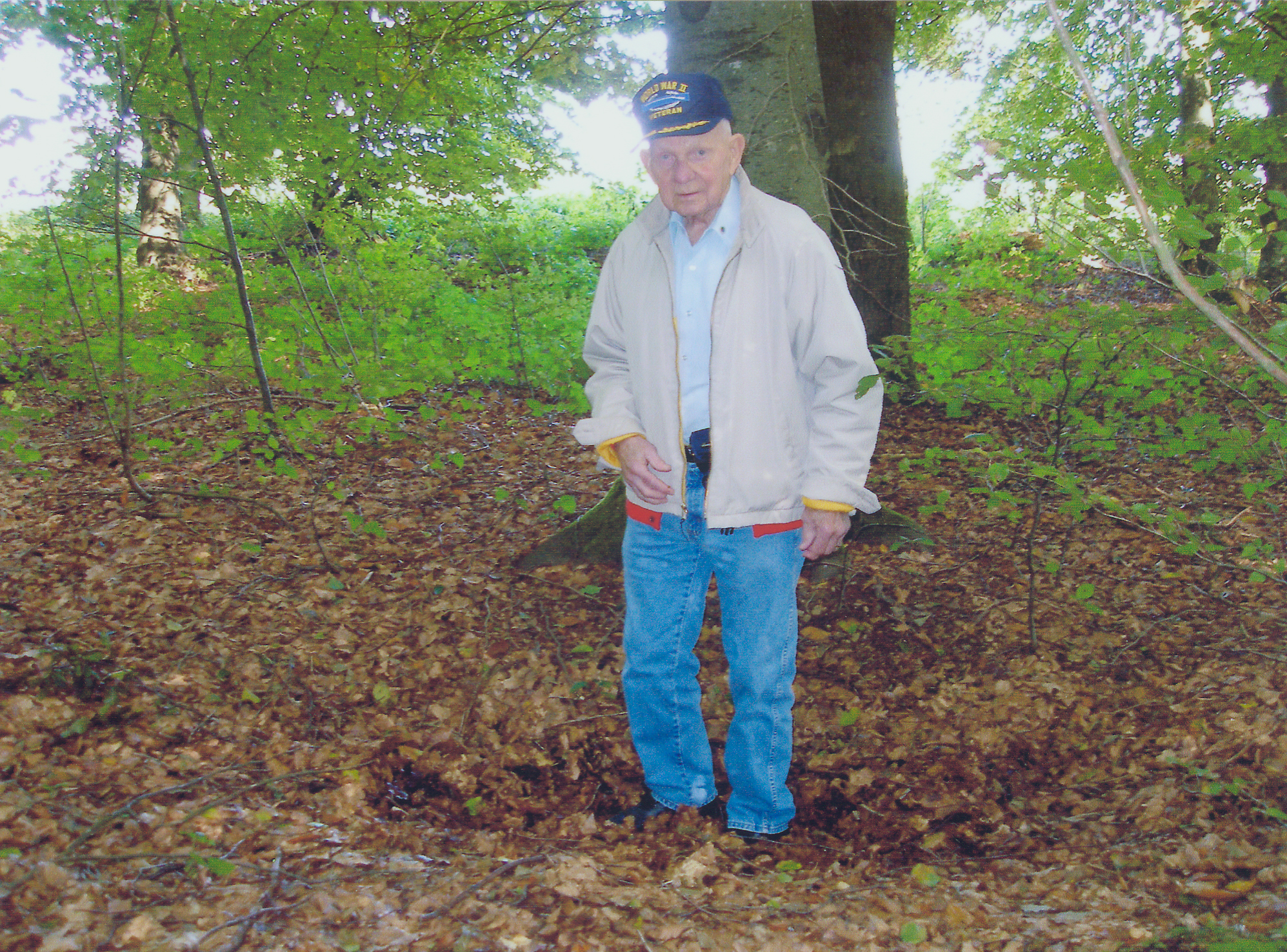
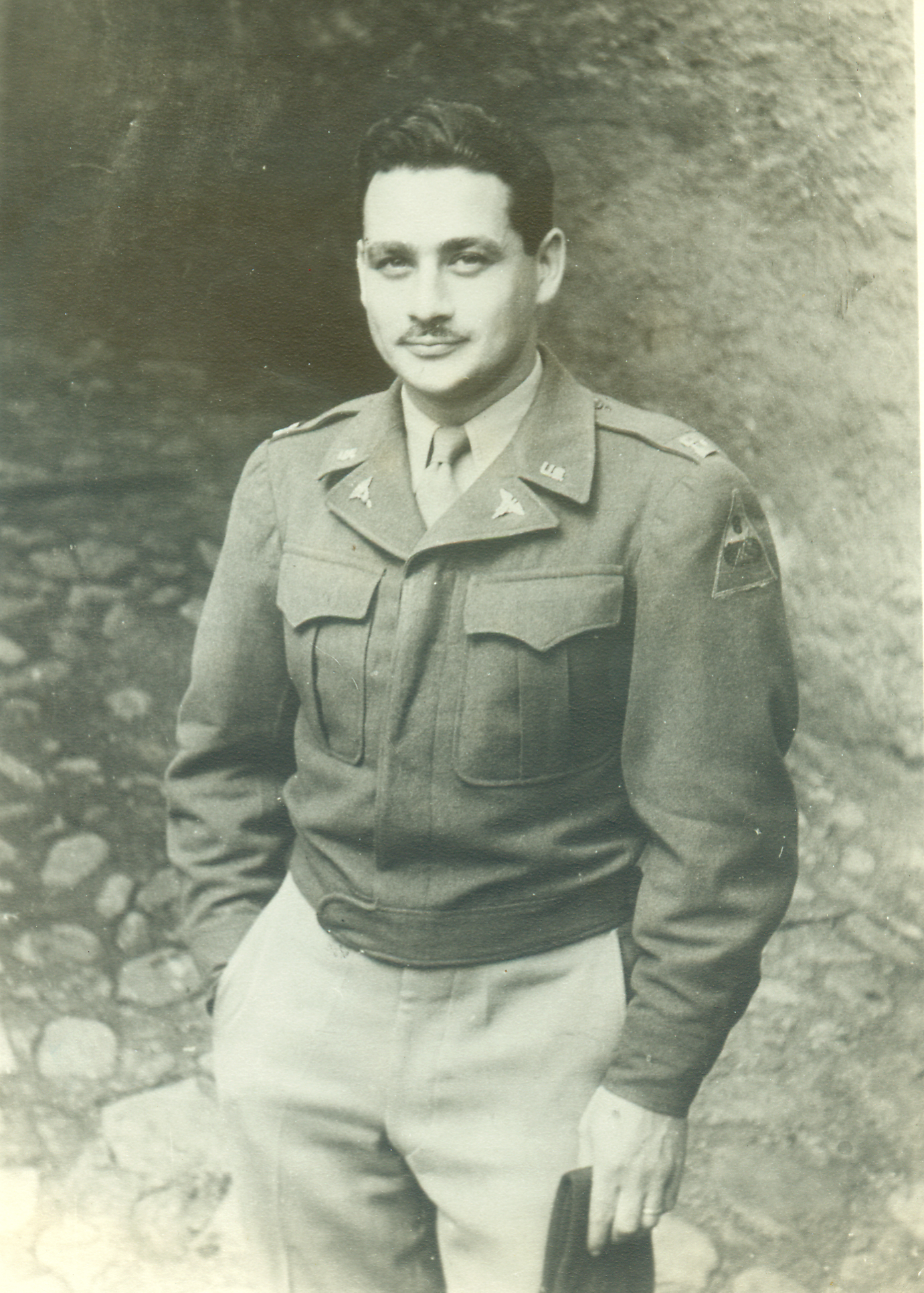
A Medic in Bastogne by John Kerner, 35th Infantry Division

The whole situation was terrifying. The Army always is full of rumors. We heard that the Germans had broken through our lines with a major force, and that our line across the Ardennes had collapsed. We had no air cover because of the weather. The l0lst Airborne Division was surrounded in Bastogne. The American Army had tremendous casualties, and we did not know how many had been captured. We had moved across France so rapidly that we thought the war was all but over. We began to think otherwise in the Saar. None of us expected anything like this. We were upset at having to leave Metz and our plans for a pleasant Christmas. We hurriedly repacked our vehicles. Fortunately, I had accumulated a good supply of warm clothes, and I needed them all. My truck had no doors, so that we were exposed to the air. I put on two suits of long underwear, two pairs of socks, wool pants and shirt, a field jacket, an overcoat, two pairs of gloves, and a fur hat covered by my helmet. Still, I was none too warm.

We took off in the dark, driving north into Luxembourg amid sounds of small arms and artillery fire. Around midnight, we got to a small, seemingly deserted town, Boulaide. I spotted one faint light and led my unit toward it. As we drove through the town, we saw a number of German flags. Apparently, the Germans had taken this town during their offensive, but our division had driven them out just before we got there. I heard that some of our men waded through a freezing cold river to get at the Germans. The small light I had seen was in the home of a farmer who was there waiting for us. He had hidden out in his cellar. He had a roaring fire going and had slaughtered a pig. He had brought out a huge sausage. He had large loaves of fresh-baked bread. We did not know how he had been able to provide all of this, but we were grateful, to say the least. We hastened to set up a station, sampling the delicious food as we worked.

We hardly had set up when combat soldiers began coming in. A few were wounded, and all had various degrees of frostbite. Having been in the Ski Troops, I knew how serious frostbite is. The severe cases I put in a warm room, wearing the most dry clothes available and leaving their frostbitten parts exposed, while I kept their bodies warm. I planned to evacuate them. The more mild cases I warmed up and fed. Those, I expected could go back to duty with proper clothing, if I could get it. Finally, after three hours or so, ready to collapse, I arranged shifts to care for whoever came in and found a place to drop my bedroll. Some Christmas Day!

At dawn, I was up. The farmer had been up most of the night. He had cut the coat-of-arms from the center of a Luxembourg coin which he presented to me. He knew we were going to move out; so he gave me this huge sausage which had a very strong odor of garlic. Obviously, I was grateful to this man, and I regretted not getting his name and address. I still have the cutout coin. Just before we pulled out, a full colonel came by to check on wounded. He went around to encourage them. However, when he saw the men that I had planned to evacuate, he asked, “What’s wrong with these men?” I answered, “They have severe frostbite, sir.” “Warm them up and send them back to duty. I need every man I can get.” “I’m sorry, sir. If these men go back to duty, there is a good chance they will loose a hand or a foot.” “I’m ordering you to send these men back to duty.” “I’m sorry, sir, I cant do that.” “I’ll recommend that you face court-martial.” . “Very well, sir.” He left. Later on, these men received Purple Hearts, when at higher echelons it was realized how dangerous severe frostbite was.

We pulled out early the next morning, having arranged for the evacuation of the wounded by leaving one of our ambulances to shuttle and later to catch up. There were sounds of fire fighting all around us. We weren’t sure where the front was, but obviously our division had somehow made progress that morning, and we got word to set up a station in Nagen, a town in Belgium. On the way there, we drove through the beautiful city of Luxembourg with its deep valley going through the middle of the town. The bridges over it were intact. By late morning we were in Nagen, which had been badly battered. There was the rattle of small arms fire and the horrible sound of German burp guns, their rapid-fire submachine guns. We also heard the crunch of landing shells and the clatter of tank treads. We were never sure whether they were the Germans’ or ours. On Christmas morning, the sky suddenly cleared. We began to see our planes with long trails behind them. There were bombers going for the rear and fighter bombers diving. It was a wonderful sight, and we all cheered. This was the first good news in days.

We set up an aid station. Incongruously, superimposed on this clean, peaceful, friendly country was a dirty unpleasant war. The smooth valleys were marred by stacks of ammunition boxes, gun emplacements, shot-up trucks, tanks, and everywhere, miles of communication wire. The wire was strung from trees, from poles, and on the ground. The roads had been torn up by the heavy vehicles of both armies. Here and there, a tree had been violently knocked down. There was a never ending roar of guns polluting the otherwise pristine air. We noticed that the people of this town had taken in citizens of nearby towns that had been devastated in the furious battle as the Germans drove ahead toward Bastogne and, they hoped, to the sea to cut the Allied Armies in half

We had chosen this town because it had sustained relatively little damage and consequently could provide a good site for care of the wounded. Unfortunately, while scouting for a site, one of my fellow medical officers was wounded and evacuated. That left me to deal with the wounded of a regiment of over five thousand. I never worked so hard, even in Normandy.

My main job was to get the seriously wounded in good enough shape to be transported to the rear in ambulances, which meant stopping hemorrhage and often giving plasma. They were brought to my station, a restaurant, by jeeps fitted with litter racks and by ambulances coming from the smaller units. The wounded were all cold, and their wounds were horrible. We saw many of the worst wounded, for many with minor wounds had returned to duty. We were short of men, and the need to break the circle around Bastogne was urgent.

The people of the town were friendly. They had disliked the Germans in the past and hated them even more now. They brought us food and firewood and helped to get us water, so urgently needed in cleaning the wounded. The stove I had brought with me was very useful when added to the one in the restaurant. I had learned always to take a fairly large wood stove tied to the fender of my truck, along with pipe, which we ran from the stove around the room and then outside. This provided warmth, which was so needed.

We had to remove most of the clothing from the wounded in order to care for their wounds. A pile of torn clothes, bandages, sponges, and other debris was a constant problem. But we managed. We soon had a large rubbish heap outside. We hated to open the door; because we would loose heat. We put on adequate bandages. We started plasma often. Many of the wounded were in shock, and frequently I found it necessary to start I.V.s in the femoral vein. I still seemed to be the only one in our unit who could manage that, for this reason, I had the aid men do a lot of the other chores. When wounded were brought in, it was important to evaluate each man and assess the urgency of his condition.

Fortunately, I had been able to load up on supplies in Metz on Christmas Eve. My favorite bit of equipment was the elastic bandage, which in Normandy I had found to be so versatile. We used untold numbers of syrettes of morphine. Fortunately, I had saved a large supply of cigarettes, which were gratefully received by the wounded. We made gallons of hot coffee using the stoves in the restaurant. We were able to get some reasonably decent food, but for us, there was little time to eat. In many ways, it was worse than Normandy. Although we had a better setup for our station, winter made the field conditions worse. It was extremely difficult to evacuate wounded men through the snow even with chains on jeeps and ambulances. There also was the problem of men literally freezing before the aid men could get to them with first aid and evacuation. I taught the aid men to make sleds which had a low profile and moved through the snow easily.

The worst thing about our situation was that we did not understand exactly what was going on. We were frightened and disheartened. We had thought the war was about over, and now we seemed to be fighting for survival. Morale was low. On our first evening, I broke out one of the bottles of Scotch that I had brought from England.. I divided this among my exhausted aid men. I think it helped.

Beginning in Normandy, to keep my sanity, I made a big effort to act as much as possible as though I were in a much better environment. I continued to shave daily. The standard issue Army helmet had a liner that was easily removed, leaving the helmet like a big basin. I warmed water over my little German stove, and with that was able to shave. I also was in the habit of setting up some sort of table on which to eat, even when I was in a foxhole. When possible, I supplemented our simple Gl fare with some wine or Calvados. I tried to wear clean, dry clothes. I brushed my teeth. Whenever possible, I had water heated to a boiling point in a large can and had the men dip their mess equipment into it to avoid gastrointestinal problems by killing viruses and bacteria. In these ways, I tried to set an example for my men, who were often discouraged and inclined to neglect themselves.

One of the most amazing facts of this terrible battle was that our troops could keep fighting on. I dont know how they were able to dig foxholes in this cold ground or how they were able to use their firearms in the miserable weather. They often used abandoned German foxholes, and they sometimes broke the frozen ground with hand grenades. Most of the men were inadequately clothed. They had been issued a type of rubber boot with leather tops. These were good for mud and wet, but not good for real cold. Feet sweated in them, and then when the soldiers stopped to fight, their feet tended to freeze. Our quartermasters had a lot to learn. They had not anticipated the needs of a winter war.

We leapfrogged toward Bastogne. As we got closer, the fighting grew more bitter. The German Tiger tanks were tough to stop. We now faced elite German troops. We even picked up some of their wounded, who actually were better dressed against the cold than our men. They wore helmets lined with fur. Their clothing was of heavier wool than that of our men. They often wore a sort of white jump-suit over their clothes for camouflage. That extra layer added warmth. They often had wool sweaters under their field jackets. They all carried extra heavy wool socks, and many had gloves with provision for freeing the trigger finger. Many of these men had been on the eastern front in Russia.

When we got close to Bastogne, an infantry major came by and said that the troops surrounded in Bastogne were low in medical supplies and in medical officers. Did I think I could help? He said that they planned to force their way into the city, putting some infantry on the outside of tanks, and perhaps we could load a tank or two with medical supplies, a couple of aid men, and an officer, if available. Well, I figured, what the hell-l’ll try it.

They brought a tank to our station, and we loaded supplies onto it. I took two volunteers with me: Volkman, who was a tech sergeant and quite gentle, and Bradford who was a tough veteran and a leader. I put on my full winter gear: two pairs of long underwear, a wool uniform, two pairs of wool socks with leather boots, a field jacket, my overcoat, and my fur hat with ear flaps, covered by my helmet. We moved out.

It was obvious that the tankers were trying to protect me and my men. They put their other tanks in a position to protect us, one on either side of the supply tank onto which we climbed and got as low as possible, using the gear fastened to it as cover. The tankers carried their bedrolls, extra treads, and extra clothing on the outside of their vehicles, while extra ammunition and fuel were protected by armor whenever possible. Much to our surprise, the commander had found a route to Bastogne that was concealed, and we encountered little fire. What there was had a tremendous response from our group which consisted of four tanks, a tank destroyer, and, of all things, a command jeep containing the scouts who had found the route.

I heard a story when we made a brief stop near an infantry company. In this “white jungle” close-quarter fighting in the winter-bound fir forests, soldiers on both sides sometimes had sluggish reactions. T/Sergeant McLaughin of Black Rock, Arkansas, an E Company platoon sergeant, set off at dark to contact G company. He encountered some soldiers digging into the frozen ground. “G Company?” he asked. Just as he spoke he realized these were Germans. “Nix” one of the German soldiers replied as he continued chipping at the ground. McLaughlin pivoted slowly, and trudged off through the snow. He was well back to his company before the Nazis opened up in his direction.

Within a few hours, we were in Bastogne passing cheering troops of the 101st Airborne. We had travelled eighty-five miles in a bit less two days against stiff opposition. Though we had some wounded, we did not have a man killed from Metz to Bastogne. That was remarkable considering the conditions, and it was noted in the news. It was the kind of mobility that our division was known for. During that time, we went through parts of three countries: France, Belgium, and Luxembourg. We had crossed rivers where the bridges had been destroyed, and we dealt with the horrible conditions. We had reason to be proud of the 35th, but we were too busy doing our jobs and staying alive to reflect on our accomplishments.

We set up in the main railroad station. We took over the command jeep to transport wounded and to bring supplies to the various aid stations. Almost immediately wounded poured in. These were the less badly hurt who had been willing to defer care to the more seriously wounded. The wounded had first been attended in battalion aid stations, from which they were transported to our station, which was enclosed, warm, and better equipped. Because of the difficult transport through snow, evacuation of the more severely wounded to our station had priority. There was real danger of those men freezing to death. The less seriously wounded were helped back to the station afterward, unless they were able to get there on their own. The jeep driver worked overtime bringing supplies, transferring wounded, and being a messenger.

By nightfall we were exhausted, but we knew Bastogne had held. The Germans had been stopped. We didn’t know how soon our troops could recover enough to begin to move toward Germany again, and I think we would just as soon have stopped to wait for spring. The next morning, it was obvious that other troops were getting into Bastogne. Their shoulder patches were different from our Wagon Wheels. But fighting was far from over. A medical officer came in. He was fresh, had a clean uniform, and told me he had been bored in a field hospital and he would like to see some action, he had had a good medical education at Cornell, and we had a lot to talk about since I had spent some time at Cornell not much more than a year before. He had been assigned to a battalion aid station of an infantry battalion just outside of town. I thought he was out of his mind to leave that safe place for this. He was brought into the station that evening with the top of his skull blown away. We treated him with care, and he was the first person I evacuated immediately to the rear along a newly opened route. I never knew if he lived. The poor guy did not know how to survive in a combat area. The situation with this man was not unusual for replacements. All of them were inadequately trained. They were assigned to various duties, but there was not enough time to teach them how to stay alive. Few replacements lasted more than a few days.

Our lines having held, our generals, particularly Patton, thought this was an ideal time to destroy the German Army. So, instead of resting and reorganizing, he decided that we would attack. All of us in Bastogne were terribly angry. We and the troops around us were exhausted. The cold and deep snow were terrible. The soldiers we faced were elite Germans who, though defeated in their attempt to cut our armies in half, still knew how to fight and to take advantage of the terrain. They were defending Germany now, and their supply lines were shorter and better than ours. It was difficult to believe that we were entering a battle that for us was worse than Normandy or Bastogne. General Patton wanted to surround the Germans, cutting off their supplies, but Eisenhower the supreme commander, wanted to advance on a broad front. At least that was my understanding. Each had his reasons, but I had learned to respect Patton, even though he was highly demanding of his troops. In retrospect, I think Patton was right.


The Bulge by Wes Ross, 146th Combat Engineer Battalion

On the morning of 16 December, the well-orchestrated German attack in the Ardennes “Wacht am Rhein” was launched.   The name was a subterfuge to hide their offensive intentions behind a pretended defense. Hitler suspected a security leak within his Wehrmacht and so he limited disclosures of the attack plans to his most trusted generals.  He was unaware that the British had broken his Enigma Code, even though some of his advisors had suggested that this may have happened–“Impossible” said der Fuehrer! There were so few radio intercepts concerning the upcoming Ardennes offensive that our top level commanders were caught off guard—even though many of us at lower levels were antsy about all of the enemy activity in the Ardennes.  In general, the Wehrmacht followed the mandated radio secrecy  orders,  but  there  were  enough  slip-ups  by  their  air  force  and  civilian transportation units to have given our commanders sufficient insight had they not been so overconfident. About then, we heard that Glenn Miller had been lost in the English Channel on 15 December—a sad, sad day! About 10 December 1944, as a nervous .tag-along-member of a six man patrol from the 38th Cavalry Squadron—forward of the front near Bullingen and east of Malmedy—we found plenty of German activity across the bottom of a tree-filled canyon. Trees were being cut down with saws and axes, and tanks and other heavy motorized equipment were moving around over straw covered trails, to muffle their sounds.  While watching this activity from a concealed position two hundred yards away across the canyon, we listened to the big tank engines and sensed that “something unusual was afoot”. On our return the cavalry troopers used pull-igniters to anti-personnel three Tellermines left by a German patrol that was chased off the previous night, while attempting to infiltrate their lines.  Several enemy were killed when they tried to reclaim those mines.

When  information  regarding  all  of  this  German  activity  was  sent  to  higher headquarters, their response was that this was only a feint to trick us into pulling our troops away from our planned offensive in the Hurtgen Forest near Schmidt.  If it had not been so serious, an almost comical ploy at that time was our leaders attempt to enhance our apparent troop strength in this area of the Ardennes to draw more Germans troops from the front further north at Aachen. They conjured up a non-existent infantry division to further promote that deception (HEARD, But NOT VERIFIED).

As a result, our high-level commanders were not suspicious when the Germans began bringing in more and more troops prior to the Bulge–this is exactly what our leaders had hoped—and they happily believed that their scheme was working to perfection.  There surely were more than a few red faces at the higher headquarters when the axe finally fell!  We at the lower levels were unaware of these machinations, but were kept on edge by all of the rumors that were floating around. My 3rd Platoon; B-Co, had laid AT mines along the road shoulders near Bullingen a few weeks earlier, but that was probably done to deter small-scale penetrations or counterattacks.  Bullingen was on the route taken by Kampgruppe Peiper and was where his force captured a large quantity of American gasoline before heading west through Malmedy towards the Meuse River

Our 146th Engineer Combat Battalion was bivouacked at Mutzenich Junction, three miles west of the front at Monschau–which was at the northern shoulder of the German build-up. Captain Arthur Hill–H & S Company commander; CWO Wm Langhurst–Assistant S-l; and CWO Al Sarrach–Assistant Motor Officer; dropped in at their favorite Malmedy restaurant on 16 December for dinner. This was the first day of the Bulge and the situation had not yet been sorted out.  It was still being viewed by higher headquarters as a limited action to offset- the pressure of our attacks further north near Aachen. The restaurant- owner had just gotten in fresh steaks that afternoon so they all ordered steak. While waiting to be served, the owner requested that they move their jeep around to the rear so that the German soldiers who had seen in the vicinity would not shoot up his establishment. They complied, polished off their steaks in a hurry and then took off in a high lope for the bat talion about fifteen miles northeast.  This was a smart move, as Malmedy was on the proposed route of Kampfgruppe Peiper!

At 1520 hours 16 Dec, V-Corp’s Colonel Pattilio called Major Willard Baker our S-3 and ordered 146ECB to immediately furnish a company of engineers to serve as infantry; to be attached to the 38th Cavalry Squadron at Monschau.  A-company was in the Line at 1700 that evening, where they furnished support  for the outnumbered troopers. The 38th Cavalry was at the northern flank of the Bulge and just north of the 3rd Battalion, 395th Regiment, 99th Infantry Division–who managed to hold their ground even though the remainder of the division was badly chewed up, and much of their command was shifted to the 2nd Infantry Division.

The aggressive patrolling of the 38th Cavalry Squadron was a key element in their defense of the Monschau area during the Bulge, when they repulsed a number of attacks by vastly superior German forces. Their aggressive patrolling allowed them to establish the likely enemy avenues of approach, while keeping the Germans from coming close enough to determine the cavalry’s defensive positions. While I occasionally had patrolled in areas forward of our front lines, I had never patrolled with the audacity of these 38th Cavalry troopers. They were fearless and not at all concerned about bumping into the enemy–in fact they may have welcomed the opportunity!

For several days this small force; plus 3rd Platoon, A-Co, 112ECB and attached 105mm and 155mm artillery, fought off several attacks by vastly superior enemy forces.  Several times they called in artillery on their positions to thwart the attacks. Canister rounds (a cannoneer’s shotgun) were used with devastating effect when they were about to be overrun. For their stout defense,  all three units were awarded the Presidential Unit Citation–the nation’s highest unit award. According to “Cavalry on the Shoulder”, the 38th Cavalry was the only cavalry squadron to be so honored in WWII. The 146th Engineer Combat Battalion had received a Presidential Unit Citation for D-Day on Omaha Beach, so this added an oak leaf cluster to A-Company’s PUC.

At 1525 Hours on 16 December, Colonel McDonough—the commander of the 1121 Engineer Combat Group—called our headquarters and ordered another engineer company to be deployed as infantry. The three B-Company platoons moved into position the next morning, and for several days formed a barrier line, a short distance behind the front between Monschau and Elsenborn. Our purpose was to slow the advance of the 6th Panzer Army, should they manage to penetrate our lines.  The 3rd Platoon covered a 600 yard front in the snow, until relieved on 23 December.  We set up three machine guns in defensive positions and patrolled between them, but being in a semi-wooded area we had inadequate fields of fire and would have been captured or bypassed by any determined enemy attack in force.  Sylvin Keck manned a daisy-chain roadblock that was located on a nearby road.  These are AT mines roped together, so they can be pulled across the road at the approach of enemy vehicles;  but they are not effective unless adequately supported by covering fire. Several trees had explosives rigged to drop them and form an abatis on a nearby road.

While on outpost duty, the 3rd Platoon had no clue as to the German’s intentions or what was actually taking place nearby at the front.  We were located in a sparsely woody area away from our headquarters; but the wealth of rumors and the actuality of the paratroopers and reports of Skorzeny’s men dressed in American uniforms kept us alert. Unconfirmed rumors abounded! Anyone moving around was challenged–this even included easily recognized generals.  Lt Leonard Fox,  a C-Company platoon leader,  was taken prisoner by a patrol from the 38th Cavalry Squadron.  He had not received the password for the day.  After six hours, while his legitimacy was being confirmed, he was released. His problem was compounded by having grown up in Cuba and so did not have proper answers for his questioners regarding sports or hollywood personnel.

Lt Refert Croon led a patrol of Joe Manning, Marvin Lowery, Warren Hodges and about ten others, in looking for the paratroopers.  Lowery was killed in an ensuing firefight that killed two Germans and wounded several more—the rest surrendered. A total of nine enemy were killed and about sixty were captured—all of these by C-Company and HQ-Company–as A-Company and B-Company were deployed elsewhere as infantry. In another action, Fred Matthews was captured by the paratroopers, but he managed to escape during a later firefight.

In Operation Stosser, Lieutenant Colonel Frederich-August von der Heydte’s 1,500-man parachute- force dropped into the Hohes Venn on the night of 16/17 December—a swampy area that is at the headwaters of the Roer River,   in November, three of us tried to cross through this swamp. With our Jeep flat out in four wheel drive, we travelled 50 yards, before dropping it down to the floorboards. We then jacked it up and built a corduroy road to get back on solid ground.  His parachute forces had fought several vicious engagements with the 101st Airborne Division in Normandy and again in General Bernard Montgomery’s Market Garden offensive in September 19444-as portrayed in “The Band of Brothers”.

The paratroopers were a day late because of glitches in having their gasoline delivered and in getting assembled.   They were widely scattered from Eupen to Malmedy because of the wind, inexperienced pilots and minimal advance notice of the mission—as dictated by Hitler as a security measure. The twin “Jumo” engines of their planes were unsynchronized–thus giving them a slow beat frequency sound-  We were ordered not to shoot at them, which would give away our defensive positions. Many parachutes were found after the drop- I rescued an undamaged white one, also a large section from a brown and green camouflaged model—both appeared to be silk. The camouflaged silk made fine neck scarves and several still reside in my dresser drawer.

General Dietrich’s 6th Panzer Army included four Panzer Divisions equipped with the latest tanks and weapons—including 1st SS Panzer Division Leibstandarte Adolph Hitler–from which the 30 year old Colonel Joachim Peiper’s Kampfgruppe Peiper was to launch the lightning strike to the Meuse River near Huy, Belgium. He then would move north to Antwerp—thus enveloping our northern armies. Initially Dietrich’s forces were to have reached the Baroque Michel crossroads—midway between Malmedy and Eupen–on the 16th, which was to have been captured then by the paratroopers—but both failed to meet that time-table.

Had Dietrich been able to force his way through Monschau, he very well may have rolled up our front and then captured the large gasoline dumps near Eupen. This would have been a replay of their successful 1940 breakthrough in the Ardennes that had trapped the French and British armies. The 38th Cavalry’s stand at Monschau blunted this effort, so all of Dietrich’s forces were directed south toward Elsenborn, Bullingen and Malmedy. Had they overran Monschau, the German armies could have moved almost unimpeded north to Antwerp, and Hitler would then have been trumpeted as a great tactician. Despite all of the negative opinions about the stupidity of launching the Ardennes offensive by removing troops and materiel from the Russian. front; honesty must conclude that with just a few fortunate breaks, the Bulge could have been a phenomenal German success!

Also, had the Hofen pillboxes not been blown up with TNT and bulldozed full of dirt by our battalion, the enemy may well have reoccupied them during one of their forays into Colonel McClernand  Butler’s  3rd  Battalion,  395th  regiment,  99th  Infantry  Division positions in Hofen and would then have been difficult to dislodge.   Some of these attackers appeared to have been heavily into their schnapps and were oblivious to the withering rifle and machinegun fire. They kept coming until large numbers were killed, wounded or captured–or they may just have been fiercely loyal, highly motivated young soldiers–who is to say?

Early on the morning of 17 December, Sergeant Henri Rioux sent Nettles and another radio man “called Indian” to the battalion for breakfast.  Later, we heard that the paratrooper’s planned assembly area was this battalion radio shack, six hundred yards from our bivouac area. It was located some distance away to keep from drawing artillery fire on our headquarters. When the two radio operators had not returned as expected, Rioux told Julius Mate and James France to go to breakfast and determine what had happened to them.

On their way, they saw a parachute with an attached bag hanging in a dead tree. Seeing evidence of the paratroopers was not surprising since they had heard the planes overhead the previous night.  Mate attempted to recover the chute by pulling on the lines, but the rotten tree broke and the trunk fell across his ankle, pinning him to the ground. After working free, they continued on toward the headquarters and breakfast and then saw Nettles ahead acting very strange. When they ran up to ask what was happening, six paratroopers with machine pistols stepped out of hiding, took them captive, disarmed them and then threw their M-l Garand rifles into a nearby creek–where they were found later that day by a patrol led by Lt Refert Croon.

Nettles and Mate were directed to make a double-pole support to carry a paratrooper who had compound fractures of both legs. At the end of the day. Mate’s ankle was very swollen and painful, so France and Nettles then carried the wounded trooper. This small group kept moving during the day and slept under fir boughs at night.  After wandering about for two days, they joined the main body of about 150 paratroopers and were then interrogated by a German officer who spoke impeccable English. He had studied at a Texas university and so not only knew the language–but also the American idioms and customs.

They were combined with twenty others who had been captured from a laundry unit near Eupen. At night they slept in a tight pile to keep warm, as it was very cold. After a time, when the body parts against the ground were growing cold, they all turned at a given signal. They kept up a running conversation to warn of the importance of moving, toes and fingers to avert frostbite. One of the captives, who understood German, heard their captors discussing how they should dispose of the Americans by throwing grenades into their midst while they slept. When a patrol from the 1st Infantry Division flushed out the paratroopers, the captives ran out waving their shirts and yelling “Don’t shoot-­were Americans”.

The winter of 1944 was one of the coldest in many years, often dropping well below zero degrees Fahrenheit. However, except for those foot-freezing GI boots, we managed-­even when touring around in Jeeps, always with the windshield folded down. Our battalion had few medical problems during this period, although some who failed to change their socks often, contracted trench foot—but none from the 3rd platoon. It was easily prevented by  keeping  a  spare pair  of  woolen  socks  tucked inside  of  one’s  pants.

Body heat dried them out, and they could then be swapped several times a day, while at the same time giving the feet a thorough massage.

During the Bulge our armies lost many men to this malady and especially men from the infantry who—because of an innate desire to keep from being spiculed, could not move out of their foxholes and exercise to keep warm.  Our new battalion medical officer—Captain Goldman—reported several cases of combat exhaustion that he treated with a combination of sedatives and rest, followed by several days of heavy labor within the sounds of battle near the front. Apparently it was successful. To warm themselves, a group of B-Company men built a flimsy cardboard shack with a diesel-fired steel drum stove located in the middle of the floor. When one man tried to force his way into an already full shack, he was unable to do so and no one offered to swap places with him.  Not to be deterred, he yelled “I’ll show you sons of bitches”, and he then threw a clip of M-l ammo into the flames. The mad scramble for the entry almost demolished the shack, after which the perpetrator was run down and pounded.

We must have been a bit odoriferous, as we rarely had an opportunity to shower. Whore baths—water heated in helmets over an open fire—was our only option for washing face, ears, neck, underarms, crotch and feet in that order.  Our helmets then took on a dingy hue. We were usually able to shave daily—though our razors were not the sharpest ones on the planet.  I often fantasized about luxuriating in a tub of steaming hot water, followed by a professional barber’s shave.  When the opportunity arose later for a German barber to do the job, I had to mentally restrain myself to keep from bolting from his chair when I realized how close to my throat his straight-edge razor was operating! At night, I removed my boots and swapped socks before, crawling into a bedroll of several wool blankets, supported by a generous layer of interlaced pine boughs to provide insulation from the cold ground.   During the coldest weather I slept in all of my clothes, changing underwear whenever possible.  One morning I woke to find that a heavy wet snowfall had compressed the pup tent down around my body.  Surprisingly, although we were often half frozen from riding in jeeps—always with the windshield down—or from sloshing about in the snow; few of us were ever sick with colds or flu. After most of the Bulge fighting was over and the weather had improved, we finally were issued insulated shoe-pacs in lieu of those foot-freezing leather boots. In his book “Citizen Soldiers”, Stephen Ambrose said the American command gambled that the war would be over in 1944 before we required shoe-pacs—in retrospect an error in judgment, but C’est la Guerre— you can’t win ’em all!

About 23 December while working on a large anti-personnel minefield near Elsenborn— designed to deny the Germans access to a natural infiltration corridor; a flight of British “Typhoons” came roaring in and rocketed a woods 800 yards to the east. We were a bit jumpy as their flight path was almost directly overhead and we thought that they might have mistaken us for Germans.  That would not have been too unusual, considering the chaotic conditions along the front at that time.  We saw no indication that German forces were there, before or after the strike, but since we were close to the front, that is a distinct possibility. A prominent radiator bulge under the engines gave them a distinctive appearance, and their engines made an unusual roaring noise–not at all like the sharp exhaust crack of the Rolls Royce Merlins in the Spitfires and Mustangs. I was told that these engines had 24 cylinders—four banks of six—as compared to the twelve cylinders of the Merlin. The twenty four exhausts blended the sound into the unusual roar—SINCE VERIFIED.

Christmas day 1944, on the way to our AP minefield, a doe and a yearling crossed in front of our truck 80 yards away.  We stopped and I told the men in back to shoot her. After ten or more rounds had been fired, I yelled “cease fire”,  just as the deer disappeared into the brush, because the firing may have been interpreted as a fire fight with a German patrol that would have initiated a wasteful response.   The doe then wandered back across the road, so I shot her. There was a single hole in her hide–another indication of our superb American marksmanship!

The fresh meat was a welcome change from our recent diet. Several weeks previously, B-Co’s various work parties returned to the company bivouac area one evening with five hogs, two cows, and a deer. Someone had suggested that we have fresh meat, but had not coordinated the effort. The animals were a nuisance around minefields, walking into the trip wires, detonating the mines and killing themselves in the process—we only hastened their demise.  The hogs were fried first and the pork fat was then used to fry the rest of the meat. The meat was chewy and tough—but the change of diet was appreciated. When we were able to get to our company kitchen for a hot meal, I piled most of the food together in my mess-kit (shit-skillet in GI parlance). Breakfast might include stewed prunes, oatmeal with reconstituted dried milk, scrambled powdered eggs, bacon and toast with jam. It did not look too appetizing when so intermingled- -but it tasted better than it looked, and it had a definite edge over those early gruesome K-rations. Also, having the food piled together helped keep it from freezing. Our cooks were artists in their ability to take smelly powdered eggs and powdered milk and turn them into something reasonably palatable. I am not sure what they used to perk up the powdered eggs, but added a bit of vanilla and a pinch of sugar to powdered milk. A vastly improved K-ration showed at about this time. It was far superior to the original—the crackers of which looked and tasted like lightly seasoned sawdust.

On the night of 26 December 1944, our bivouac area was shelled heavily for about thirty minutes.  We were in an area of large trees, so there were many tree bursts. Heading for a safe refuge in a culvert (he called it a tin horn), Platoon Sergeant Homer Jackson ran into a truck tailgate and chipped off the corner of an upper front tooth. It was a tight squeeze as twelve others had beaten him there.  I flattened myself on the ground at the base of a large pine tree away from the direction of most of the tree bursts, and was happy when the shelling ceased. We believed that the damage was done by our captured 105mm howitzers. The shelling probably stopped when the Germans ran out of ammunition. 99th Division 105s were overrun close-by near the Wahlersheid Crossroads and these may have been the culprits.  They must have had forward observers—probably paratroopers—as they took very few rounds to register on our area. We believed that our position may have been pin-pointed by the paratroopers, because their designated assembly point was the forestry shack being used by our battalion radio operators—the three who had been captured.

Several trucks had flat tires and the driveline of one truck was completely severed. A shell fragment smashed through the front panel of a headquarters desk drawer and spinning around inside made a mouse nest out of the papers within. A number of shell fragments pierced the aid station tent—one striking Ernest K Hansen in the chest as he was holding a plasma bottle over one of our wounded. Although a number of men were wounded there were no fatalities. Lt Colonel Carl Isley was the most seriously wounded— wounded as he made the rounds to check on our casualties. He told Dr Stanley Goldman, our medical officer, “that last one really knocked the air out of me”.  He was covered with blood and was given plasma, as blood for transfusions was unavailable in WWII. battlefields.  His recuperation required many months in a stateside hospital.   That night, the battalion was moved to Henri-Chapelle per Isley’s orders, before he was evacuated. Colonel Skorzeny’s “Americans”—who had infiltrated our lines and were captured wearing American uniforms and driving captured Jeeps—were executed by firing squads at Henri-Chapelle a few weeks later.

I arrived late at our bivouac area, but the only cover I could find was in the haymow of a barn.  I did my best to find a spot to spread out, but as the space was completely filled with bodies, I could not find a bare spot. After someone offered to loosen all of my teeth if I didn’t quit stepping on him, I crawled back out and shivered in the Jeep until dawn. The next morning B-Company returned to our original bivouac area, and we continued working on the AP mine field. New Year’s Day morning 1945 was clear and very cold. While we were adding the metal red triangles to the barbed wire perimeter fence—to indicate an American anti-personnel minefield—the sky was suddenly filled with twenty eight Messerschmitt ME-109s flying northwest at 1000 feet. We later learned that they were part of Operation Bodenplatte–the plan to attack our airfields and destroy our planes on the ground—a continuation of the Bulge. A number of our airfields near the front in Belgium and Holland were successfully attacked that day, and several hundred of our planes were destroyed on the ground. German losses were about a third of ours but their losses–and especially losses of trained pilots–were losses that they could ill afford.   Luckily for us, our P-47s were rendezvousing near Liege for a strike of their own, and they caught these Germans by surprise as they were coming in.  It must have been some dogfight, but we saw only the tail end of the action from our work area.

In twenty minutes, as we watched in fascination, five ME-109s were shot out of the sky. The first one fell 1500 yards away, and they kept dropping closer and closer until the last one was only 300 yards from our work area. The script was almost the same in every case. The ME-109 pilots, who were flying southeast and very close to the deck heading for home, were being slaughtered by the P-47s. Our pilots were definitely more aggressive and must have had superior training and experience.  We didn’t see any parts being shot off the 109s, but two were spewing smoke—before they crashed and sent up big black pillars. The fourth downed plane hit 600 yards away, and several of us headed out to see what we could find–such as 9mm Lugers or P-38s!  We had just started off, when another 109 came limping toward us, smoking and losing speed and altitude. The P-47 kept boring in and firing short machine gun bursts. The 109 was hidden by a group of pine trees when the pilot finally hauled back on the stick in an attempt to gain enough altitude to jump.  His plane rose only a few hundred feet and came back into our field of view and then stalled just as he bailed out. We charged down the hill to the crash site, fully expecting to find a dead pilot in or near the wreckage, since we were sure that he had lacked sufficient altitude to eject safely.

The pilot could not be found, but the ME-109 wreckage was on fire and its magnesium castings were burning brightly.  We poked around in the wreckage until the machine gun and cannon shells began to cook off,  and then cleared the  area.  We searched the surrounding area and finally found the pilot’s chute in a pine tree about one hundred feet back in the direction from which we had come.  Landing in the tree surely kept the pilot from being severely injured or killed. The pilot had slipped his chute and had laid low until we passed and then had backtracked up our trail in the snow. We followed his tracks, but lost them at dusk in the area where the snow had been heavily trampled. After escaping death in such a remarkable exit by parachute, we were saddened the next morning to find the young pilot dead within our AP minefield.  He had crawled under the wire barrier and suffered modest wounds when he detonated one of our anti-personnel mines. We surmised that he believed he would freeze to death before morning, so he killed himself with his 9mm P-38. (Mentioned in battalion records of 03 January 1945.)

By early January, we were gaining control after the Bulge had been suppressed; some of the captured Germans dressed in American uniforms from Colonel Skorzeny’s force had been executed by a firing squad at Henri-Chapelle, a few miles north of Monschau; and the paratroopers had been rounded up and shipped off to the PW cages.  Our infantry was gaining control in the St Vith area and we had heard of the successful relief of our troops at Bastogne by General Patton. Although the news that funneled down to us seemed to be more favorable, all that it took to journey back to reality was to observe the graves registration men picking up the dead. One memorable corpse in the snow in front of a nearby pillbox was a big football lineman type infantryman. He was about 6’4” and 2501bs–probably a BAR candidate.  Only stockings were on his feet so he probably was wearing shoe-pacs as no one would have gone to that much trouble to get those foot-freezing G I boots.  At the site of one big tank battle near Bullingen, I had reason to be thankful that I was not a tanker. The bodies that were being removed from knocked out Sherman tanks—Ronsons by their deprecators, since they never failed to light when struck–were wrapped in sheets that looked like oversized diapers.  The corpses were so badly burned that some had no apparent arms or legs.  The stench of burned human flesh is an odor that is not easily forgotten!

General Bernard Law Montgomery’s self-serving news conference to the British press, emphasizing in detail how he had rescued Omar Bradley’s 1st and 9th armies containing eighteen American divisions—finally sifted down to us.  This was during the Bulge, after the German thrust had formed a deep salient into our lines requiring an immediate restructuring of the command, because the Bulge had separated Bradley’s headquarters from his divisions. There is no doubt that Elsenhower’s decision was proper but that—coupled with  Montgomery’s  grand  pronouncements—rankled  Bradley,  causing  dissension  between British and US commanders that almost gave Hitler a victory of sorts by splitting up the allies. Although Montgomery’s presentation was a bit too self-glorifying, it may have been Bradley’s thin skin and wounded ego that was a large part of the problem.’

I was then saddened to learn of Lt Trescher’s death just before the Bulge. He was platoon leader of the 2nd platoon B-Company, and was killed by artillery while attempting to determine the location of that enemy battery by analyzing the artillery burst patterns in the snow.  I found it hard to believe that he was gone.  He was such a fine caring gentleman who watched over his men like a doting mother–thus his nickname “Mother Trescher”.  He was very old—about 32—and was a civil engineering graduate from MIT-Massachusetts Institute of Technology.

Trescher had been at the Assault Training Center near Barnstaple in North Devon when I joined the 146ECB in December of 1943.  He was also the QIC of Gap Assault Team #D on Qmaha Beach at dawn on D-Day, so we had been together for a year.  He was more of a gentleman than the rest of us raunchy lieutenants—and although he usually tried to ignore our dirty jokes, he enjoyed a good laugh and was a fun fellow in his quiet droll way.   R.I.P. “Mother Trescher”—you will be remembered always with fondness.

In January 1945, plans for a new Allied offensive were taking shape. In preparation for a proposed crossing of the Roer River, we built a quantity of duckboards that were to be used over pontoons in that assault. When our infantry outflanked the German positions and captured that area, the duckboards were not needed.  Meanwhile, Ranger patrols were making nightly forays into enemy positions across the Roer River. On one trip, they found three Germans soldiers asleep in a Siegfried bunker. The two men on the outside were knifed, and the one in the middle was left untouched.  Imagine how that poor soldier would feel upon awakening and finding out that he was alive only by a shake of the dice? That was a heavy-duty mind game, and one that would unnerve any normal human being!

In mid-January an infantry lieutenant was wounded near our work area by an “S-mine”–“called a Bouncing Betty”–and his men requested that  our men sweep the area for additional mines.  They became impatient with our slow mine-sweeping technique and ran on ahead down to where their lieutenant was lying. I carefully followed them, stepping in their tracks to avoid being an additional casualty.  We each then grabbed an arm or a leg and carried the lieutenant to safety by retracing our footsteps. He was vomiting and one man kept his head turned to the side to keep the intracranial fluid from running out through the hole in the side of his skull.   He was semi-conscious, and would have remembered nothing. I hope that he had a complete recovery.

That winter, I had seen an almost perfectly formed hemisphere of white brain tissue lying in the snow.  A German soldier had been killed and apparently then had a mortar or artillery round burst nearby, which had blown away the side of his skull and dumped out the delicate white brain tissue.  Had the brain tissue not been frozen, it would not have been so well delineated as unfrozen brains are not all that sturdy. The detail was almost as good as the photographs in anatomy books and was a cause for queasiness in this one, who was not an anatomy major!

After the Bulge had been contained and reduced, our offensive to the Rhine began in early February with “THE MAD MINUTE.” where every weapon along the entire V-Corps front fired toward suspected German concentrations for one minute. This included all of our rifles, machine guns, and mortars firing as many rounds as possible. Divisional and Corps artillery fired TOT (Time on Target), where all of their rounds hit the target area at the same time. This devastating fire did not allow any time for the Germans to take cover—it was all over before they could react.

We then worked our way east toward the Rhine and in March, assisted another engineer battalion in building a floating bridge at Remagen. We then passed through Kassel, Halle, Leipzig and on 05 May passed through Grafenwohr–the German army training camp–where Colonel Skorzeny’s “Americans” complete with American uniforms. Jeeps and cigarettes had prepared for their special Bulge mission. We were nearing Pilsen and “VE Day” was just three days away!


January 13, 1945 by John M. Nolan, 30th Infantry Division

January 13, 1945
by John M. Nolan, 30th ID, 119th IR
This was the worst day of my life, and it occurred in World War II as a member of the First Platoon, “G” Company, 119th Infantry, 30th Infantry Division. This January day during the “Battle of the Bulge” included most of the elements of close combat that can ever be inflicted by the Gods of War. Further, it took place in the bitter cold of a Belgian winter over frozen ground covered with a foot of snow. It was miserable.

The 30th Division had been in fierce combat with advancing German forces since December 18 in the Malmedy-Stavelot sector of the Ardennes. At the end of De­cember we were in a defensive position near Malmedy. Below our dug-in position along a railroad embankment there was a factory complex about a quarter of a mile away. Our platoon was ordered to mount a reconnaissance patrol to search this area for enemy activity. When we arrived we found dead American soldiers lying on the ground with their hands tied behind their backs with wire before being killed by German SS troops. Several dead German soldiers in the vicinity provided evidence of the severe fighting at this location. We found a German Panther tank altered in appearance to re­semble a U.S.Army tank and not wanting it recaptured and reused by the Germans, I took a thermite grenade and put it down the barrel of me 75mm tank cannon. The gre­nade melted most of the end of the cannon tube to ensure the tank would not fire its main gun again.

During this time our company and platoon took a well-deserved rest as we waited for the oncoming action. The German offensive had been blunted and a coun­terattack was planned to drive them out of the Ardennes and restore the battle line to its former location. It was cold and we tried to keep warm in our foxholes along the railroad track. Of all the men in our platoon Ernie King and Edward Knocke were the most inventive when it came to digging foxholes. The longer they were in one defensive location the more elaborate their underground “homes” became. This particular foxhole would have won the prize if any prizes were to be awarded. Their foxhole could ac­commodate about six men was covered with a door they had removed from a nearby house. The door was piled high with dirt to protect the occupants from any mortar or artillery hits. A small table, several chairs, and a small stove had also been “requisi­tioned” from nearby houses. This was heaven! We would sit in their abode at night eating our heated K rations, telling, “war stories.” and reminiscing about home, and our lives prior to our present circumstance. This was a time when we “recharged our bat­teries” and rested up for what we knew would be severe fighting ahead. It was also an opportunity to reassure the green replacements we had received, and hope they would meet the test of the coming combat.

By now we were a veteran outfit. I believe the phrase “hard bitten” could ade­quately describe us. The core group of our platoon had been together since early Sep­tember and was a well honed fighting force. Some members had been wounded and had returned to the platoon in time for combat in the Ardennes. Before Christmas day we had collided with Adolph Hitler’s First Panzer SS Division in a severe “bare-knuckle” firefight that caused their retreat. We knew we had met me test of combat and were ready for what was ahead. “Old timers” like us welcomed the new men that filled our ranks, some of them eighteen years old, and scared to death. We were all scared, and as the saying goes “had seen the elephant.” This knowledge gave us an edge, however slight, over the new men in subduing our own fears.

The intense cold added uncomfortable dimensions to our existence. Unlike die days of September, October, or November when we could get by wearing only a field jacket and combat boots we realized that to survive we needed to pile on more clothes. We all carried a heavy load of clothing and equipment that weighted us down. By De­cember I was wearing two pairs of long underwear, top and bottoms, a wool olive drab shirt and matching trousers. Over this was a field jacket, a wool scarf, and a wool trench coat that was long enough to reach the top of my combat boots. To keep my feet warm two pairs of socks and a pair of four buckle “Arctic’s,” sometimes called “ga­loshes” fit over two buckle combat boots. My steel helmet had a white camouflage cover and a knit wool cap underneath to keep your ears warm. I wore wool knit gloves that fit in a leather glove shell. In addition, I was equipped with a gas mask and a haversack, which held a mess kit, K rations, and a sleeping bag. A canteen with can­teen cup, an entrenching tool and first aid pouch was attached to my ammunition belt. I was one of the fortunate few in the platoon to have acquired a blow torch white in a Belgian town we had occupied and carried it in my left hand. The Army had a small stove to heat rations, and our platoon was issued only one and Mullins, our medical aid man, had that one. We were willing to carry the extra weight of the blow torch in order to have hot meals. These were all the clothes’ one could wear, and still be able to move as an infantryman is supposed to move. I could not run fast or very far with my load, but a steady waking pace was possible.

I was armed with an M-l rifle, 8 round semi-automatic, as well as a 10 inch long barrel Luger 9mm pistol on my belt. The Luger pistol was acquired in October from a German soldier Bill dine had shot one night when we were dug-in on a ridge at Wurselen, Germany. For my rifle there were one hundred rounds of 30 caliber ammuni­tion in 8 round clips, and a few extra 9mm rounds for the pistol. A bayonet was at­tached to my pack, and a rifle grenade bag was slung over my shoulder containing four anti-tank grenades and a launcher that fit over the muzzle of my M-l rifle. Under my wool shirt was a sheath knife carried under my left arm fastened to a string around my neck. Remembering how much weight this added during this campaign it is a wonder how I did it. I weighed about 150 pounds men, and I suspect the weight of the cloth­ing and equipment was at least one half of my body weight.

We received orders to dose the “Bulge” and return the line to its December 16 location. Our battalion would attack, moving south from Malmedy, to seize the town of BeUevaux that was situated behind a high ridge. Company “G” would lead the at­tack and our platoon would be the lead unit to carry the assault up the narrow road to the heights above the town. In preparing for the attack our platoon was told to leave sleeping bags in the rear with the company mess truck. The plan was to bring them for­ward that night after we had captured the objective. I decided to put my gas mask in my haversack instead of carrying it slung under my left arm. For a “GI” the gas mask carrier was considered a good place to “stash” personal belongings. In mine I carried letters received from home, writing paper, a shaving brush, razor and soap, and a coal miner’s carbide canister filled with tea bags.

Our platoon moved to the line of departure in darkness and at dawn the attack began with combat engineers moving forward to remove any anti-tank mines. We then were to clear out any German opposition so our supporting tanks could follow us then deploy in the open ground to support our attack. As we moved forward we learned the engineers had discovered an extensive mine field on the road. It was late in the morning before we could move through a foot path the engineers had opened through the mines. We continued the attack up the road to seize and hold the ridgeline until the tanks could catch up. The platoon slowly trudged its way up the steeply sloped, nar­row road that ran a quarter of a mile to the top of the ridge. The snow was a foot deep and it was slow going as we made our way up the hill with combat boots and our four buckle galoshes.

Ernie King’s squad lead the attack, as the platoon sergeant I decided to be up front with Ernie’s squad; the other two squads in the platoon deployed in single file be­hind us. Cletus Herrig was the lead scout with Bob Friedenheimer the second scout. As the platoon approached the crest of the ridge Herrig spotted German soldiers in foxholes and yelled back that they were dug-in some thirty yards ahead. Cletus could speak German so we told him to call to them and demand that they surrender. I thought I could fire a rifle grenade into their position, but when it landed the deep snow cushioned the impact and it failed to explode.

Cletus kept trying to talk them into surrender, when suddenly all hell broke loose! No one who has ever heard the sound of a MG42 German machine gun open fire will ever forget it. This machine gun was pointed down toward the ditch line where we were crouched spraying us with bullets. The first burst hit four of us before we could find cover in the ditch below the machine gun’s trajectory. Herrig was hit along the top of both shoulders, Friedenheimer was hit through the lung, I took a bullet in the back of my pack and was knocked down to my knees. Behind me was Mflton Cohen, a private, one of the eighteen year old replacements that had joined us two weeks earlier. He was hit in me teeth with the bullet exiting his head behind his right ear, and I will never for­get his plaintive call for his mother. Ernie King was the only one of the first five that was not hit by initial burst of fire from the machine gun.
Having been knocked down I immediately thought, “I just got lucky, I am on my way to the hospital and off this damn hill, and hope my wound is not too severe.” My back was hurting and I assumed that I was bleeding from a puncture in my back. I rolled over and took the pack off my shoulders, to see what had happened. To my sur­prise a German machine gun bullet was lying in the hole on my pack with a shred of rubber attached to it. I picked it up, it was still warm, then put it in my pocket as a souvenir of the occasion. Later I opened my gas mask container and discovered that the pack fabric, the gas mask container fabric, the rubber face mask, the metal gas mask canister, and the handle of my shaving brush had slowed the bullet to a stop on the surface of my field coat. It gave me one hell of a thump on my back that was sore for a few days afterwards. This was the only day in combat I had ever carried my gas mask in my pack and it had saved my life.

That first burst of machine gun fire put our platoon down hugging the ground in the ditch beside the road. We were stunned, and began to assess the extent of our casualties; we were grateful to find that no one had been killed. For the wounded among us immediate evacuation to the rear for treatment at the battalion aid station was made more difficult by the sporadic machine gun fire. The “jerries” had us pinned down and we could not move forward in the face of their machine gun fire on the road and ditch line. The phrase “all hell broke loose” again applied to our situation when the Germans began to drop 81mm mortar rounds on our position. There are few things more fearful to an exposed infantryman than incoming mortar or artillery fire. To compound this fear the “jerries” included in their barrage “screaming meemies,” enemy rockets that made a horrendous noise, and caught us unprepared as targets for mis form of artillery. When they came in on us I perceived their sound was comparable to railroad boxcar flying sideways through the air with both of its doors open. I found out later that the German name for this weapon was Nebelwerfer. As a rocket it did not compare with the accuracy of mortar or artillery fire, but its high pitched screeching noise made it all the more terrifying.

The “screaming meemies” did not get us but me 81mm mortars did. From their defensive positions the German’s were masters at pinning down advancing infantry and then raining mortar rounds on them. The mortar shells were falling on the road behind us and on the remainder of our platoon. An 81mm mortar shell fragment hit Vie Kwia-towski in the head seriously wounding him. Mortar shell fragments hit Bob Heider in the neck, shoulder and back. Jones got hit in the head by a fragment that penetrated his steel helmet, and the mortar barrage also wounded the second squad BAR man, Char­les Holverson, Clarence Overton was killed. Our progress halted, we could not go for­ward and were not going to retreat. The immediate requirement was to evacuate our wounded. Smitty, our platoon leader, was in the middle of the platoon column and organized the effort along with the platoon medic to remove the wounded from the hill. Those that could walk moved to the rear. For the more seriously wounded a door was taken from nearby house and brought forward to use as a stretcher for Vie and others wounded from the barrage.
Ernie King and I stayed to’the front keeping down low in the ditch beside the road. We were concerned that the Germans would mount a counterattack on our posi­tion after their first machine gun burst. Artillery support fire began, but we were too dose to our enemy for the artillery to continue and be effective. Any artillery rounds falling short would have landed on our platoon deployed along the road. The tanks would eventually move forward and up the hill to support us when the minefield was cleared. In the meantime we scanned the hedgerow along the crest of the ridge and a row of trees about thirty yards away that ran down the hill paralleling the road. A German soldier was spotted on the other side of the line of trees crawling down the hill in an attempt to outflank our position. Both King and I shot at him, but at the time we could not see whether we got him. We finally received word that two light tanks had moved through the cleared mine field and would support the Third Platoon in its at­tack through the field on our left flank to knock out the machine gun emplacement.

The attack by the Third Platoon was a sight to behold, with a deafening cres­cendo of small arms fire and cannon bursts. Each platoon of Company G had a slightly different character regarding weaponry preference. Our platoon had no par­ticular love for the Browning Automatic Rifle (BAR); it was a 21 pound load to carry and a weapon that required constant maintenance to keep it operational. Each of our three squads was issued a BAR. However, the 3d Platoon thought the BAR was a great weapon and almost every third man in the platoon carried one. Sergeant Frank Wease, the Third Platoon Sergeant, carried one and encouraged the weapons use.

In the combined infantry and tank attack up the hill Wease deployed his pla­toon abreast in a line on each side of and between the two light tanks. The tanks were armed with a 37mm main gun on the turret and a 30 caliber light machine gun that protruded from the front of the tank where the machine gunner sat beside the tank driver. There were about 14 men with BAR’S in Wease’s platoon and the remainder with M-l rifles. Coming up the hill with the tanks in the middle of the formation, they were all firing as they moved forward. Each tanks main gun, its machine gun, the BAR’S, and the M-l rifles of die third platoon created a sheet of fire concentrated on the enemy position at the crest of the hill. There was no way the third platoon could be stopped by any counter fire from the entrenched German troops. Wease and his men, with their tank support, surged through the enemy line along the trees on the ridge. The German troops that were still alive immediately surrendered. Several minutes had passed when Sgt. Wease brought some prisoners down the road where we were located. All of us were furious at the casualties they had inflicted on our platoon, and wanted to shoot them, but Wease would not let us. Later, after calming down from the days’ events, I was grateful that Wease had restrained me from taking such a rash act. I had never shot an unarmed prisoner, and didn’t want such a thing on my conscience. After the attack King and I went over to the hedgerow where we had shot at the German crawling down the hill. We found him dead. Someone in the attacking third platoon had taken his pistol as they moved up the hill in the assault.

Late afternoon had come by the time our company had seized the ridgeline above Bellevaux. We received orders to set up a defensive position, the days were short in the middle of winter and night would soon fall. The third platoon was to occupy that part of the ridge they had captured earlier in the day. Our platoon deployed in a stretch of open field to their right where digging a foxhole was very difficult. To get beneath the frozen ground required an extraordinary effort. Fortunately, someone in command had realized this problem and before the attack thought to issue a quarter pound block of TNT with a fuse and blasting cap to every other man in our platoon. Instructions have been given on the proper method to assemble the explosive device: dig a small hole in the ground, put the charge in the hole, light the fuse, and move away quickly before it exploded. The resulting explosion broke up the frozen crust so that a foxhole could be easily dug in the softer ground underneath. We were also told that the blasting cap was volatile and could explode if jarred violently, or exposed to excessive heat. This required that every man carrying a block of TNT. with its fuse and blasting cap, carefully wrap each separately, hoping they did not get hit, or in some way inad­vertently ignite the blasting cap and TNT while they were carrying it.

Those of us in the company that survived this day’s combat were faced with enduring a cold winter’s night on a Belgian mountain. Previous to the attack we were told to lighten our equipment load by leaving our sleeping bags in the rear area. Then after the attack our sleeping bags would be carried forward for use that night; this did not happen. Because of the snow cover and the steep incline of the winding road to our defensive position, our company truck could not move dose enough to deliver the promised sleeping bags. We were in for a very long, cold night of lying in the open on frozen snow covered ground, or in hastily dug foxholes. The rifle squads on the defen­sive line got busy, breaking up the ground with TNT then dug their foxholes for the night. We, in the platoon headquarters were not issued blocks of TNT so lying on top of the snow-covered ground was our only option. Lou LeFever, always a great forager, went down the hill and found a barn with some hay in it. He brought as much as he could carry to our position behind the ridgeline. We scattered the hay in the drainage ditch where previously the machine gun fire had pinned us down. We lay on the hay putting the remainder of it on us. Smitty, the platoon leader, Lou LeFever, the platoon runner, Mullins the medic, and me, the platoon sergeant, huddled together in the “spoon position.” I don’t remember who was in the middle, or who was on the outside of our sleeping “formation,” but I do remember that it was very cold, and we were all shivering and hoping for morning to come quickly.

The next morning “G” Company was ordered to advance over the ridge and down the road leading to the town of Bellevaux, our next objective. The Third Platoon would lead the attack, with the Second Platoon in support. The First Platoon having been severely mangled the day before, followed in reserve, with my position being at the rear of our platoon column. It was a cold dark morning as the remaining members of the platoon reluctantly shouldered packs and rifles to prepare themselves for another day of combat against a determined enemy. As we moved single file down the road toward Bellevaux one of the men from the platoon, Samuel Klugman, dropped out of the column. I walked over to find out why. He pulled off his glove and showed me his right hand, saying his hand felt frozen. The hand looked blue and rigid so I told him to go to the rear for medical treatment. This was our last casualty from the attack the previous day, the worst day of my life.

Comment: The combat strength of Company G, 119th Infantry at 0300 hrs. on January 13,1944 was 140 (134 EM, 3 Off, 3 Medics). At 1600 hrs., at the end of the attack, the company combat strength was reduced to 83 (78 EM, 3 Off, 2 Medics). In a 13-hour period Company G lost 57 men, a 41 % loss rate. Of the 57 losses three men were killed, Clarence Overton, 1st Platoon, Lauren A. Gates, Jr., and James W. Phillis 3d Pla­toon; the remainder were wounded in action.

Task Force Davisson by Al Alvarez, 7th Artillery Battalion

“Recon, you find ’em; engineers, you fixjem; tanks, you fight ’em; and TD’s, you finish em!” With these emphatic, but crystal clear adjurations, LTC Henry L Davisson set the tempo for his task force subordnance commanders. It was 16 December 1944, and the yet-to-be-named “Ardennes Offensive” had exploded. This Kraut’s massive tank penetration now was creating this northern shoulder of what was to be its acquired sobriquet, “The Battle of the Bulge”.

In response, hastily thrown together units from the vaunted 1st INF Division, “The Big Red One,” would acquire its title “from the aggressive commander of the 634th T.D. BN.” “Task Force Davisson” was thus quickly formed as a lightly armored, tank-killing reaction force! MAJ Olson, the “TFD” S3 designated the line of march, handed out strip-maps for a southward reconnaissance.    Our armored convey consisted of the 1st Recon Troop heading out with puny 37 mm armed M-8 Greyhound armored cars. Intermingled came the 1st Combat Engineer BN’s “A” Co. riding its soft-skinned vehicles. Now came “D” Co. of the 745th Tank BN with its measly LT Whippert tanks armed also with 37 mm guns, but backed up by its 75 mm assault gun platoon. Spread out and looking for targets came “C” Co. of the 634th TD BN with their 90 mm rifles, claiming the ability to compete with German armor. All ably supported by “the King of the Battlefield,” our four-man “F.O. Chaste” Arty 2 Observation party (with the common capability to call down Divarty and Corps Arty “barrages or serenades”).

Our battery veterans of the “Lucky 7th” Arty BN, who had fought German armor in Tunisia, Algeria, the beach at Sicily, and in the fields of Normandy, spoke out in warning to our little observer party: “Be ready. This TF Davisson is outgunned by the huge Panthers and King Tiger monsters reported coming your way. Remember, your tank-destroying force needs to equal or outgun those battle-tested German Behemoths and also mount sufficient armor to protect themselves from the superior German anti­tank weapons. In other words, you better be ‘killer tanks’ rather than tank killers. If not, you will have to stop ’em with indirect 105 mm or 155 mm Arty concentrations.”

Despite these knowledgeable words, we heard only the spumngs of COL Davisson. Quickly, the “TFD” saddled up and cautiously commenced traveling south through snowy Belgium. The lengthy convoy slid out of SourBrodt and Robertville and clanked into Walk and Weimes, small villages recently vacated by U.S. medical units.  The weather was frigid cold and damp, but the fog was dissipating, and for once, Arty would have wonderfully clear observation! Here we were, “The Lucky 7th’s” forward observation party on high ground, salivating at the abundance of lucrative targets! Spotting from our town’s church steeple with our 20-power scopes, German convoys, to include tanks, traveling west across our front from 863-020 to 863-024—an artillery man’s dream!. Compounding our good fortune, our “Lucky 7th1 Arty BN had recently been supplied with the previously secretive ammo employing “the proximity fuse” constructed around its nose plug, which activated when the emitted radio beam encountered an object within 15 yards! We were going to have the proverbial field day .. and we deserved it!

Our parent organization, “The Fighting First,” was still recuperating from its horrific bloodletting in “The Hurtin’ Forest” this past November, where the Krauts had grounded us into Hurteen Forest and pasi^ Surely now was to be payback time … but the war gods frowned and said no, …. not yet!  The American Artillery ammunition supplies across the entire 1st Army front were dangerously low, contriving to place “quotas” on all “shoots”! Our radio pleas to FDC for fire missions received a “wait out”! Our frantic telephone messages informed us their priority was to our east. There, our sister regiment, the 26th INF “Blue Spaders,” were in continuous battle with German armored thrust at Bullingen and Butenbach. There, LTC Derrill, M. Daniels, and his 2d BN would successfully blunt the German COL Piepers’ rampaging westward drive and dream! That portion of the northern shoulder would remain firm!

So now it was to be our turn. The German 1st SS Panzers, frantically searching for a route on the Rollbahnen to the west, then sideslipped and proceeded to smash at us; “TFD” now intermixed with 3d BN 16th INF at Weimes/ Our front erupted with tank fire and reported INF advancing plus intensified artillery fire in our immediate front. Our first indication was a flying buzz bomb smashing into the battery area and WIAs three gunners—CPL Homer A .Jerome, T/5 Raymond A. Fink, and PFC Erio Baton. We were further alerted by a commotion reported on our eastern outpost which luckily forewarned everyone in town! Speeding down the only street in Weimes came two G.I. jeeps overly loaded with Krauts. Firing madly and careening widely to escape our firing gallery response, they crashed off the road on the west side of the village.

COL Davisson then ordered, “Recon, send a squad to investigate and recover bodies and/or the vehicles”! LT Cangerosi, our F.O., took over the viewing scopes from our lofty OP as the submachine-armed Recon squad gingerly approached the overturned vehicles. They sprayed the area, righted a jeep, and returned with a WIA spreadeagled on the hood! Another German captive was shoved into the co-pilot’s seat, hands on his head. Arriving at the town square, now crowded with a rubbernecking G.I. throng, the Jerry prisoners held center stage! Looking like “right out of Hollywood” with his peaked hat and black leather topcoat and gloves, in excellent English, he demanded medical attention for his men! In response, someone in the crowd belted him with a rifle butt! He was saved further harm by the NCOs who held back the provoked soldiers. It appeared that in breaking through our outpost, the Germans had hailed in English, then fired and killed and wounded the surprised guards. These angry crowd members were old-time buddies of the soldier killed by this “ruse-de-guerre”!

Later, with his head now bandaged, the German officer was carted off to the 16th INF Regimental S-2, where subsequent interrogation divulged he was an officer-courier transporting the photographic proof of this German explosive and successful penetration through the American lines. The following day, angered regimental staff members descended and oversaw a search of the snowy jeep accident area and found this valuable film!

These important photos, immediately developed at the rear headquarters, received prominent world attention as the classic “Bulge” combat film showing smilincL German paratroopers as “successfulwarriors in action”! With our shooting priority reestablished and our observation still A-OK, our ARTY observer party initiated fire missions with visibly outstanding results! LT Anthony Cangelosi, our latest F.O., who would break the “bad luck cycle” of officer casualties and proceed to “make it” to the war’s end in Czechoslovakia, took targets under fire. First, we fired on “enemy troops forming for attack,” then followed a mission on enemy vehicles. Finally, we observed for a Divarty TOT on an enemy assembly area. With the horizon ablaze, we continued with harassing fires throughout the night. CPL Maurice Vacher was our instrument CPL who would be promoted and get the Purple Heart the following week. He would return, bandaged, with three new stripes and stories of great chow in the medical rear. Me, now a Tech 5th (CPL’s pay without the authority) and my cohort, T/5 Rene Cote, our dependable driver, rounded out our crew. At first light, all of us, now professionals after six months on the combat scene, poured destruction on the advancing white-painted enemy armor and accompanying white-clad infantry.   After four missions and 275 rounds expended, we reported “enemy activity ceased and one tank burning”!   Later, during a slow afternoon, CPT Fred F. Chirigotis from the 745th Tanks asked for our indirect fire observing so they could “use up” their 75 mm ammo. With a total expenditure, their tanks would be able to acquire new 76 mm tubes! Jumping at the chance, I got some invaluable and exhilarating shooting experience and contributed some damage, too!

During another quiet period, on Cote’s watch, he asked, “What the hell are those guys doing?” An engineering squad seemed to be laying a hasty minefield n the road leading south into the town of Faymonyille. Apparently, these engineers must have been short of mines because the engineering Sergeant had his squad scrounge up dinner plates from the nearby Belgium homes. His squad, laden with this ample supply of dishes, were pacing off the distances and placing plates face down on the road and adjoining fields. As viewers, our interest peaked. “Look at him now. He’s putting some real mines amongst those kitchen plates!” Finally, the squad members covered these actual metallic mines with large porcelain dinner platters. “Very clever, these Americans!”    Those porcelain covers will inhibit the mine metallic detectors.” Later that afternoon, as it snowed, our forward area was dimpled with the ingenious defensive preparation.  German counterfire re-intensified and seemed to be directed at our high ground and steeple, so we moved into town to the second floor of the town hall or barroom . .. “kaboom”! The biggest tank you ever saw blew our jeep to kingdom come. No one was hurt, but we sure were happy we had gone to church the previous Sunday! We countered with “purple smoke,” our air strike marking rounds as FDC insisted, “No aircraft available”. A couple of more rounds that “landed first, then whistled after” a nd whew, he backed out of view somewhere back into Faymonville. The troops were understandably quiet as we hurriedly plastered the town with HE and WP and set numerous fires, everyone privately hoping he was through with us good guys!

Our Chief of Detail and my boss S/SGT Joseph Desforge and Motor Sergeant “Shorty” Hofer came up during darkness with a replacement jeep. Besides replacing our food and extra radio batteries, they told us we were stopping an enemy armored attack on the northern shoulder of something called “the Battle of the Bulge”! After that illuminating information, we settled back in, but encountered some new problems. Our “posit” rounds were exploding at their maximum ordinate as premature bursts over our heads! Apparently, the sensitive fuses were set off by clouds! As if that was not enough, SGT Ringer’s howitzer, back in the firing battery area, had a muzzle burst and the gun was destroyed, but luckily, with no gunner casualties. Probably the intense cold on the metal tube and the sudden heat of the morning firing caused it. My remembrance of this December is the bitter cold, with all the troops occupied with ways of keeping warm. The approved method was putting on layers of any clothing! Many brainy GIs wrapped blanket strips over straw around their boots and created an incredibly large footprint in the snow—anything for insulation to stave off trench foot while occupying their foxholes.

During our lengthy and boring time on watch, someone mentioned, “Today’s Christmas! This’ll make our 3″^ Christmas overseas for our ‘Lucky 7th‘ Arty BN.” Cote reminisces about Christmas ’42 in Africa and on the moors in England on Christmas of ’43. LT Cangelosi celebrated by knocking out an MG position at 864-013 with two direct hits!! The Doughs cheered and waved their arms and weapons, stamping their cold feet, too, in their exposed foxholes! Afterward, when I sneaked down to the chow line in an adjoining cellar, the cooks told us “Boomers” (Arty observers), “You’re doing a bang-up job.” But more importantly, he slipped me an extra helping of meat and potatoes!

From Christmas to New Year’s, .it was just continuous fire—at “enemy troops in the open” and “enemy tanks.” Our records show we averaged over 1,800 rounds per day during the last days of December 1944! This wall of steel both harassed and hampered the enemy’s efforts to exploit and enlarge his armored thrust. Our uninterrupted night defensive fires, requested by our supported 16th INF, commenced with the coming of darkness and carried over until daybreak! Even so, another strong tank counterattack was repulsed in the vicinity of 053-013 (railroad tracks near Steinback, Belgium) by the direct fire of the 634th TDs and 74 tankers. The blackened hulks of destroyed German tanks stood out against the snow. The bodies of German infantry were not as easily discerned!

New Year’s Day opened with hordes of German aircraft strafing our positions. As usual, the poor bloody infantry suffered the casualties, and as always, it’s the new replacements! We “boomers” hid in our cellar as the bomb explosions rattled around us, watching the LT celebrate by drinking his liquor ration as we under-aged peons looked on!  Rumors were now flying that we would attack Faymonville the first week of January ’45. So we took under fire all possible EN positions in the town. Methodically, we increased the destruction by dropping H.E. rounds through the roofs, then followed 9 up with W.P. to burn the houses. Most of them, however, were constructed of stone and resisted all our bombardments! Still, slowly, Faymonville was now systematically pulverized.

During that first week of January, we carefully, in conjunction with the mortars, fired in support of a patrol attempting to retrieve the body of LT McLaughin of “L” Co. KlA’d days previously.  LT Cangelosi “had the word” and got us ready by checking our equipment, clothing, and footwear. “I want constant commo while on the attack” he said. “The INF is going to get us on high ground every chance they can and protect us, too.” That’s good, but for me, first I must get and be warm! Layering of clothing was the answer. So it’s long underwear, shirts, jackets, many trousers, ponchos, wrapped blanket strips over straw, and joining the “monster footprint brigade”. With a French Foreign Legion “kepi” look, I covered my helmet with a white pillow slip with a flap covering my neck!!   Then I enclosed myself in a white bed sheet, a snow cape, and emerged through the slit for my head. Finally, I connected up the radio and set it on a German wooden sled with a 50-foot on/off switch for the LT’s use. We were “ready for Freddy”! Threw some cardboard ammo cartons filled with coffee, sugar, and cans of cream on the sled and loaded my pockets with “goodies”!

Now, as the last preparation, I ate everything I could of rations: crackers, cheese, meat and beans, cocoa, sugar, candy—anything for energy! “Now bring on those Krauts. I’m warm, full, and have dry feet. I can shoot, scoot, and communicate!”  On 14 January 1945 with heavy snow falling, the 16th INF Regiment’s 3rd BN commanded by LTC Charles T. Homer co-mingled with portions of T.F. Davisson’s tanks assaulted Faymonville! We (with me pulling the radio sled) accompanied “I” Co., than later “L” Co. As we slowly trudged into the northeast portion of Faymonville, mines in the snow took out some of “A” Co.’s 745th tanks, but the “Doughs’ continued despite incoming mortars. The first reports were 2 KIA and 15 WIA for our 3rd BN. We stopped at nightfall and ran a line to the nearest Co. To hear reports of 70 casualties for the 3rd BN. We fired harassing missions and kept everyone awake! The next morning dawned crisp and sunny, and LT Cangelosi returned from BN briefing: “We are going to take Schoppen, the next town to the southeast. Let’s move it!” Trudging again through the snow, we encountered some woods where MG fire erupted. LT Cangelosi quieted it with an H.E. concentration! We held up in these woods with no fires, no hot chow, and tried stomping our feet all night to stay warm! Only good thing was a can of sliced peaches (kept warm in my armpit) for breakfast from my food stash!

The following day (maybe the 15th of January), we accompanied the 3d BN’s “L” Co., which seemed to be in reserve since we stepped in the footprints of the lead company! The snow was knee deep and snowing fiercely with drifts piling up. Someone passed the word down the line, “We are in a blizzard!” Observation was impossible—we cannot see anything, but better still, the Germans cannot see us either! My day consisted of struggling through the snow, laying a line back on the road, and finally meeting our Arty liaison wire crew; then splicing the line with frozen fingers and hearing the two parties conversing. We, tried bumming rides on the only vehicles moving, “Weasels,” some type of a lightweight covered track vehicle. They seem to be ambulances carrying WIA and flying their Red Cross flags. Everyone on the road now piled on a tank Dozer for a slippery, dangerous ride back, and I followed my line back into a house. Thank God, the troops had fired up a stove, and it was crowded and cozy! While LT Cangelosi and SGT Vacher observed upstairs, I dried up and tried heating my radio batteries on the stove to restore their strength: “Eureka, I think it works!”

The Arty liaison bunch gave me the bad news that “Jonsey,” “A” Bty radioman, was KlA’d when we hit Faymonville. The word was he was hit by a sniper. We were losing a lot of “Doughs,” but they were strangers to me. “Jonsey” was an Arty buddy doing my same job on the |?.0.! I had just returned a quarter-mile reel of commo wire I’d borrowed from him.

We continued through the snow at the proverbial “snail’s pace,” the “Doughs” plodding through snowdrifts, the tanks sliding and slipping off the roads. Noticed sometfops had wrapped barbed wire around their boots for traction; they claimed it worked! My salvation was my sled and wrapped boots. The LT is pleased with his constant commo as I dragged the sled. The troops were pleased with his instantaneous fire mission at any obstacle, seen or unseen. I was pleased with my available food on the sled!  We entered Modersheid and fired normal missions on enemy troops, and then strangely, we gave them four missions of propaganda shells! We continued with 13 missions on enemy troops at CPs and OPs with approximately 70 hits on houses containing troops, with resulting fires. Then we continued with harassing fires throughout the night—nobody sleeps!

The next morning—don’t know the date—we commenced preparation fires prior to forward displacement, meaning “move out and drag the sled”! It seemed to be getting lighter in weight—probably from eating the rations and throwing away the used batteries. Great news! The 16th INF was squeezed out of the advance by the 18th INF, so for us, immediate support became general support, and another team took over. We were lucky—the food just about ran out! SGT Vacher quartered us in a large barn while LT Cangelosi checked with 3d BN for hot scoop! We cleaned up the equipment, gassed up the jeep, set up a stove, and cooked some liberated food!  We were in heaven: no observation duties, in a warm barn, bellies full, just radio watch and waiting for the LT to take us home. . . . “kaboom”! A round came through an opening in the front wall and OUT the back wall—with a startling, crackling explosion that showered us with debris. Straw flew everywhere, and we were covered with shards of wood, powdered stone, and animal droppings! No one was physically hurt, but someone had to change their laundry! We moved next door to another barn, smaller, but with stone walls!

It was 31 January 1945, and we were pulling radio watch only while putting in land lines to Arty Liaison. Listening on the Arty net, we heard a rare command given to the guns: “BTY C, continuous fire to the right at 5-sec intervals with a converged sheath” for an expenditure of 45 rounds at the same target! Contact by telephone to my old buddies at Arty BN FOC discloses that a subsequent 18th INF patrol reports a German 6-gun battery of 150 mm abandoned their positions and guns at the coordinates of that strange concentration!

It was the beginning of February; the sun came out, and it seemed that Task Force Davisson, having halted, then chased the Germans out of Belgium, then simply faded away with the spring thaw!

John R. Schaffner – 106th Infantry Division

ARMY DAZE – A FEW MEMORIES OF THE BIG ONE AND LATER RETURNS

By John R. Schaffner

PREFACE

The following narrative of my time spent with the 106th Infantry Division is made possible, in part, as far as dates and times are concerned, by reference to a short history of the 589th Field Artillery Battalion written not long after the end of the war by Francis H. Aspinwall, who was assigned to Headquarters Battery, and either kept a diary and/or had access to records prior to writing his booklet titled “History of the 589th Field Artillery Battalion”. I also used part of Frank’s text as a reference where other units and events are mentioned that I had no knowledge of at the time. We all were cautioned to not keep a journal of our activities, lest it slip into enemy hands and give them intelligence about our unit. A totally unnecessary precaution in my opinion, since upon our arrival at the front we were welcomed to the war by a radio broadcast direct from Berlin. The Germans probably knew as much about us as they needed to, long before we got there. I often wished that I had disregarded this order and written a daily account of my activities. I trust that Frank will not begrudge me the use of his historic material for reference.

Download the Full Story Here (PDF 128kb)

James Triesler, Associate Member interviews William Gillen a Bulge veteran

The interview is in the 2nd Armored Division Bulletin – December 2011 issue

James E. Triesler, a history and government teacher at Clover Hill High School in Chesterfield County, VA has 14 years experience as an educator and holds dual endorsements in English and history/social science. He also has coached softball, forensics, and debate and served as yearbook sponsor. Students often say they “hate history” but Mr. Triesler has found avenues for students to connect to history in a personal way. He brings in antiques, written documents, and artifacts to augment lessons and encourages students to engage in history by using the tools of historians such as census records, genealogical documents and special library collections.

Floyd Ragsdale, 106th Infantry Division returns to his 1944 foxhole

A Trip to Belgium – September 2010 Imagine that you are a WWII Veteran planning a trip to Belgium, a country where you fought in the Battle of the Bulge, 66 years ago. You have made flight reservations and have paid the fare. The journey will not be a group tour. You will be going alone. At 85 years of age you begin to have reservations, concerning your judgment about that journey. The flight is not non-stop. A change of planes is required at Detroit, Michigan and Amsterdam, Holland. Flight time is four months away. Consequently there is plenty of time to fret about your decision of planning, a two-week, journey 6,000 miles from home. Why all the anxiety now that you have committed yourself to go?
Reason No. 1 – Travel by Commercial Airlines is a 1st for you.
Reason No. 2 – How will you get from point A to Point B at the Air Terminal in Detroit, MI and Amsterdam, Holland?
Reason No. 3 – What if yon become sick along the way? After all you’re 85 years old. And if you do become ill; what then?

As departure time draws closer and closer, more doubts and questions pop up. Medicare, you learn, will not pay one dime of medical expenses outside the continental limits of the U.S.A. Purchasing insurance, which will cover medical & hospital expenses overseas, solves that issue. Advice is offered by someone with past experience, “Don’t take too many clothes and, be careful what you put in your carry on bag. At Airport Security Check Points, even a pair of fingernail clippers can be rejected.”  You are advised, don’t forget to obtain a passport and, put it in something that will hang around your neck. As a soldier, going overseas in l944, details were so elementary that you shouted your name, rank, army serial number and up the gang plank you walked; no other questions asked. A week before your departure you, by chance, acquire a travel companion who is an experienced air traveler. Then for the 1st time in weeks, you have a good nights sleep. The day of departure comes and with a travel companion riding with you to the Air terminal, you feel very much at ease.

A puzzle is encountered at the Moline Airport; however, an extra fee of fifty dollars solves the mystery. A similar issue faces you at the first stop in Detroit, MI. Although the Airline personnel admitted the error was theirs, they only wanted $2,000 to correct their blunder. The situation, here and now, is your travel Companions’ flight, to Amsterdam in Europe, is four hours ahead of your flight The circumstance, of flying alone, has been dumped back in your lap. However, your would-be travel companion is a resourceful person, and not a bit shy. Locating the boarding gate for my delayed flight is accomplished and at once we go to that zone. Two fellows are already at the gate. Immediately, your companion asks them, “Where are you guys going?” “Amsterdam, Holland” was the reply. My friend said, pointing a finger at you ”So is he. Will you see to it that he and his carry on bag get on the plane; and look after his needs during the flight”?

They warmly agreed to be of assistance in any way they could. Bingo! A predicament is solved. “I’ll see you in Amsterdam, Holland were the de­parting words of your now ex-travel companion, who then scurried off to another gate for an earlier flight to Amsterdam. Now you have two travel companions plus four hours before flight time to get acquainted with them. One of them observes the words WWII Veteran on your cap and inquires, “Where did you serve during the War?” Apparently, your cap is an excellent advertisement. His question is a good base for interaction between you and your new fellow travelers. The three of you immediately became friends. Your new companions, are headed for Ukraine, Russia for the purpose of erecting some farm buildings in that area. They will change planes in Amsterdam. At flight time the three of you board the plane with no concerns. Before long, at 39,000 feet the earth below you looks like a plaything.

On the back of the seat in front of you is a monitor screen. It is displaying some interesting statistics showing the plane (an Air Bus) is flying over the Atlantic Ocean, at an altitude of 39.000 feet. The ground speed is 550 mph.; there is a tail wind of 70 mph and the outside temperature is minus 70 degrees; departure time from Detroit, MI is X number of hours ago and an E.T.A. in Amsterdam Holland is XX hours Amsterdam time.  Curious about the Air Bus now, you ask a flight crew member about the passenger capacity of the plane. She replies, “255 passengers and a crew of 30.” In other words 285 people are zooming through the sky at 550 miles per hour. Scarcely a dream 66 years ago when you were crossing the same ocean at 23 knots an hour. Finally, that little screen in front of you indicates the plane is approaching the coast of Ireland. Before long, you will be in Amsterdam, Holland. As objects on the ground become more distinguishable coupled with the sound of the landing gear rumbling out of the belly of the plane it is apparent that Amsterdam is only minutes away. The clouds are hugging the ground, yet glimpses of the runway meet the eye as the huge Air Bus makes its9 final approach to the Amsterdam Air Terminal.

Wow, here you are, in Holland.   Your two companions assist in carrying your hand luggage off the plane. You bid them farewell and they blend into a crowd of people as they seek their next flight gate.  Success!  There’s your original travel partner coming to welcome you to Holland. Before long, by pre-arrangement, another couple from the state of Washington arrive at Amsterdam on another flight. Now your group is complete. There is a two hour wait for another flight to Luxembourg, a city only a few miles from Belgium. An airline, named City Hopper, flies the four of you to the Luxembourg airport where a car is rented and away you drive to the country of Belgium.

Road signs, along the way, point to towns whose names you became acquainted with 66 years ago. Transportation modes for civilians in 1944 were by two wheeled open aired carts drawn by oxen or horses. In most instances people were fleeing a war zone. Fathers would lead the cart and mothers were walking along side of it; looking after the needs of their children, who were bundled up inside, surrounded by the family’s possessions. A scene that, easily, brought a lump to your throat and tears to your eyes. An infantry soldier usually hiked, by road, or across country. Often his path would be through mine fields, and over open country with artillery missiles exploding overhead and on the ground in every direction. What a contrast compared to Belgium and now.

One thing that hasn’t changed is the Ardennes Forest and the terrain. It reminds you of the Smoky Mountains back home. Yet, in Belgium the Ardennes forest is probably 90 percent fir-trees that are very tall and erect. The first item on our schedule is getting settled at the Bed & Breakfast Home, just a few miles west of St. Vith, Belgium, where reservations were made several months ago. What a delightful reception the proprietors give you. Soon all are located in spacious, comfortable rooms. Then you assemble in the inn’s reception room to become familiar with the area. A schedule had been prepared in advance that will permit all to tour the Battle of the Bulge region of 66 years ago. Several days are left open in case extra time is needed in some sectors.

However, a good nights sleep is necessary to recover from jet lag. Your first night in Belgium, 66 years ago, mother earth was your mattress. Your cover was an inadequate sleeping bag. An unwelcome wet snow added to the misery of the night. That wasn’t an evening a person cares to remember, nevertheless, many years later it is still permanently etched in your memories. In the morning of your first day in Belgium all of you go to St. Vith, a small city six miles from your home base. St., Vith was the Headquarters location for your Division in December 1944. In the center of St. Vith there is a visitor center where a friendly attendant is a great help in outlining points if appeal, in and around the area. On your to do list that morning is to exchange some dollars into Euros which is accomplished at a nearby bank.

Before noon your party, now nine people, is motoring to Malmedy, Belgium; a small village were ninety some American soldiers were massacred by German troops during the B.O.B. A museum there portrays some very authentic scenes of that tragedy.   In an open field nearby a monument verifies the site where the outrageous event came to pass so many years ago. Your Army outfit was only about five miles from Malmedy when that atrocity occurred in 1944. In less than 24 hours most American troops up and down the front lines became aware of that incident. If anything, it certainly solidified your resistance to the massive German offensive against your Division.

It’s now lunch time, consequently, before touring Malmadys’ museum the nine of you break for lunch. Earlier, you observed that restaurants in small Belgian towns are only open for several hours at meal time. After your museum tour all of you visit the massacre site just a short distance away. On the itinerary is a plan to locate your first foxhole in the early days of the B.O.B. While driving to that area, you pass through the small hamlet of Wereth, Belgium. A ceremony is about to be held there for eleven black Soldiers whom the Germans massacred in December 1944. Your party paused long enough to attend the event and take part in the procession to the site of the atrocity.  A lunch was served afterward and all of us were invited to attend. That afternoon you arrive at the site where your Army Outfit was when the B.O.B. commenced. In about 15 minutes you locate your first foxhole.

Floyd standing in his 1944 foxhole

Although the elements of nature partly filled it in you have no trouble recognizing the site and while standing it, you describe the action that happened there 66 years ago to your group.

This region of Belgium and Germany is situated in very hilly country and is named Schnee Eifel, which stands for “Snow Mountain” in German. In the wintertime, it is a popular ski resort. A burst of German gunfire almost terminated your life during the Bulge Campaign, yet you survived the incident. Consequently, you were hospitalized for a while. Just before going back to the front you are in a convalescent   hospital in Dinant, Belgium; a beautiful location on the Meuse River. Dinant is on your itinerary and the next day four of you sojourn to that city. You have fond memories of the hospital in Dinant because the luxury of shaving and bathing every day was yours. That hospital was where you discovered fifty-four holes in your clothing caused by German machine gun fire. That incident and your dream for-wantng of the event is still very vivid in your mind.

The town of Dinant, Belgium is situated at a beautiful location in the Meuse river valley. The day is ideal for lunch at a sidewalk cafe alongside the river. We enjoy viewing the scenic river sights in addition to the sheer cliffs that rise as high as several hundred feet above the town; a sight which you were not able to admire many years ago when you were in the hospital there.  Monday the 27th of September a surprise awaits you at the Burgemeister’s office in St Vith Belgium. He has been made aware of your presence in the area; hence he prepared a presentation concerning St. Vith for for your group to view. You are invited to his office for coffee. That’s all you know. The surprise is a slide presentation regarding the town of St. Vith, Belgium from December 1944 to the year 1958.

December 1944, St Vith, a town of 10,000 inhabitants, became a focal point in the B.O.B. Five major roads led in and out of this community. The German Army desperately needed to seize the town because of those principal thoroughfares. The American Army was determined to stop the German advance right there in St. Vith. When the B.O.B. ended there were only four buildings left standing in the community. St. Vith, once a thriving city, was a pile of war debris when the battle ended. The Burgemeister’s slide presentation pictures the story of rebuilding the city from 1946 to 1958; in a period of twelve of years St. Vith is restored almost like it had been before WWII.

Saturday the 23rd of September three of your party drives to Henri Chapelle Cemetery where almost 8,000 American soldiers, most of whom died in the B.O.B are buried.  A ceremony by Belgian officials, honoring those Soldiers, will take place that morning.     Surprisingly, yon and two additional American WWII Veterans become involved in the program. Although it is done in the German language, you recognize your name as well as those of the two other American WWII veterans when it is read; then the three of you are guided forward to place a huge wreath in a designated place on the cemetery grounds. When the ceremony ends, you visit the grave site where some of your fellow soldiers are buried.

The Burgemeister of Veilsalm, Belgium, a town your outfit liberated in 1945 requested you and your group to visit his office. As your group proceeded to that municipality, you thought this was part of the itinerary. Consequently, as your party entered a Municipal Building there you automatically assumed it was to obtain some brochures about the area. However, all of your group is escorted into a very official looking majestic like office. A gentleman entered the room and introduced himself as the Burgemeister of the town. He then declared that the reason for this rendezvous was for the intent of recognizing a person present in his office to be named as an Honorary Citizen of Vielsalm, Belgim.

As your name is read you are surprised and overwhelmed by this proclamation. The composed words read in part:
Certificate of honorary citizenship.   In recognition of his involvement and his sacrifices for our liberty, the communal College of Vielsalm has awarded the Veteran FLQYD RAGSDALE. G. Company. 424t’ Infanry Regiment. 106 Infantry Division the Honorary Citizenship of the Town of Vielsalm the 26th of September 2010.

After the formalities, refreshments, consisting of beer, wine and cheese are served to everyone present. Indeed, even at eleven of clock on Sunday morning, everyone participated in the festivities. You glance at a wall clock and tell yourself at this hour back home, ” You would be in church.” Although you kept a journal each day that you were in Belgium, at the moment, you are hesitant to elaborate on details about those days, except for one matter.

The cap you wear indicates that you are a WWII veteran. Because many folks in Belgium can read and speak English they acknowledged you as such when they observed those words on your cap. Many days a Belgium citizen shook your hand and said to you, “Thank you for giving our country and freedom back to us. That in its-self made your trip to Belgium in September 2010 worth the effort to go it alone.

The trip home was a good one, yet jet lag was just as much a problem as when you flew to Belgium two weeks before.


Poem – A Brief History of the Bulge – by Jacob G. Zimmerer

On September 16th, 1944, Hitler had five confederates swear to his last offensive plan through the Ardennes to split the Allied powers.
He promised fifteen hundred tanks, one hundred trains of ammo and a force of 275,000 men to strike in November’s waning hours.
Everyone available from cooks, to U-boat sailors, to band members were to be retrained for this unholy crusade Without its’ success to sue for peace, the Nazi movement of “Gott Dammerrung” would fade.
All new equipment from Albert Speer’s factories build with slave labor would come into
play Finally, these troops were posed to strike on a sixty mile front on December’s 16th day.
With overcast skies the 106th and 28th Infantry Divisions received the starting thrust at the German border.
Allied engineers slowed the German advance by blowing many bridges to stem the initial slaughter.
At a conference in Verdun, General Patton stepped forward with a plan to disrupt their
infantry and tanks,
The 4th Armored, 80th and 26th Infantry Divisions would attack their vulnerable southern
flank.
The German plan was to move on the main highway through Bastogne toward the
Meuse River, splitting General Bradley’s command in the west,
The 101st Airborne stood in its’ way at Bastogne and this held up any chance for
success.
This surrounded town, the key to the German salient, was relieved by the 4th Armored
on Christmas day,
The skies cleared and 3,700 planes, bombers from England and pursuits from France
came into play.
The infantry and artillery followed the tanks while the quartermaster delivered the
needed supplies for an endless fire power display.
The German supply train of depots beyond the Rhine were bombed and the front line
strafing took many lives,
Artillery batteries fired nonstop with a tremendous pounding from 155s and 105s.
On the northern sector Stavelot and St. Vith’s, stubborn resistance hurt their panzers
thrust, plus a critical shortage of gas.
Colonel Peiper’s brutal killing at Malmedy is as an example of frustration after the initial
clash.

The 82nd Airborne having motored to Marche led a steadfast defense causing a German
offensive halt,
Their efforts were hampered by superior power, air attacks and leadership faults.
By mid-January the Bulge was a narrow salient through Hauffalize with the Germans in the jaws of the U.S. Army’s vice,
The remnants of General Von Mantueffel’s panzers were in desperate straits to save their lives.
There is one phase of the battle that U.S. leadership regrets, a stain for life,
For the first time ever American troops were under the orders of Britain’s General
Montgomery for the northern sector’s fight.
The former German colossus was badly beaten and should have surrendered to the
Allies.

Instead the following three months only increased the devastation and agony for
everyone who survived.

This dictatorship was stomped on the aurora of arrogance and superiority acquired
since the time of Fredrick the Great and it did not last.
Finally at the Bulge its’ invincibility on the battlefield came to pass.

Jacob G. Zimmerer 39th Signal Corp. 26th Infantry Division

Read the poem

Edmund Marks-AntwerpX-Secret-Weapon

The longtime Weymouth, MA resident was one of many troops who were hurriedly sent to Belgium’s Ardennes Forest in December 1944 to stop a desperate German desperate offensive. But Marks was among a handful who took a secret weapon – radar.
Now 88, he fought the war as a radar operator with the 126th AAA (anti-aircraft artillery) battalion, one of a few special Army units stationed in England and then Antwerp, Belgium, to shoot down German V-1 rockets.

Edmund Marks

Article by Lane Lambert-Patriot Ledger
Click here for details


Switzer brothers meet in the Bulge

Prior to the Battle of the Bulge the last time the two brothers saw each other was in 1943 when Daniel was shipped over seas to England in preparation for the Normandy invasion. Richard was shipped overseas late in 1944. Each knew the unit in which their brother served. In January of 1945, during the Battle of the Bulge the 7th Armored Division, in which Daniel was assigned, arrived in Luxembourg. Daniel recognized the markings on several supply trucks as belonging to the 99th Infantry Division, the division in which Richard was assigned. He asked if Richard, his brother was here and shortly thereafter the two brothers met.

Richard Switzer on left - Daniel Switzer on right

Gerald Pankop Remembers the Bulge

Pankop recounts combat experience at Battle of the Bulge
By Danielle Smith, The Paper-Wabash, IN – June 1, 2011

Gerald Pankop, 85, is one of the lucky men that returned home after spending time in combat at the Battle of the Bulge in Belgium during World War II. After being injured by a mortar, he was honored with the Purple Heart and Bronze Star for his bravery and sacrifice. Pankop voluntarily enlisted at 18 years old in 1944. “They rushed me through training and sent me over to the Battle of the Bulge,” Pankop said. “They needed men because they were losing so many.” Pankop entered the First Army, 99th Division, 393rd Infantry, as a buck private and came out as a private first class. He explained that part of the reason he moved through the ranks so quickly is because they were losing soldiers at such an alarming rate.

“There are 2,000 men in a regiment, we lost about half of our men,” he said. Pankop credits his survival to his short stature. He was offered an opportunity to make sergeant, but that would have required him to move to the front of the platoon. Surprisingly, the officer allowed him to decline the offer, which earned him the right to stay in his safer position in the back. “I was short so I was always in the back, sergeants are up front in danger,” he explained. Short men were placed in the rear of the platoon because they tend to walk more slowly. “That’s probably what saved my life is being in the back all the time.”

During his time in Belgium, Pankop only received three hot meals, two of which were boxed meals. The third was on Christmas Eve. An officer sent Pankop and other men to a church where they were served a full Christmas dinner, complete with steak and mashed potatoes. Following the meal, Pankop complimented the cook. “I said ‘That’s the best meal I’ve had for I don’t know how long’, and the cook said ‘Oh, you like horse meat, huh?,” Pankop recounted. A disbelieving Pankop looked behind the church where he was greeted with the sight of the heads, skin and bones of the horses they had just consumed.

Pankop also recalled seeing a steam-powered truck traveling up a hill in Belgium. The truck had wooden wheels and a boiler in the back to contain the fire that powered it. Pankop and his companions watched as the driver exited the truck and threw more wood on the fire to allow the truck to continue up the hill. “I said ‘Man, we don’t have anything like that back home,” he recalled.

During Pankop’s time in Belgium, they slept in snowdrifts and never had an opportunity to change their clothes. He was there in December during intense combat. He recalled an instance where he and some comrades were standing nearby while some , searched a recently captured German bunker in the ground. “There were seven or eight of us standing outside leaning on our rifles and the Germans threw a big mortar shell in there and it knocked all of us on the ground. I had two phosphorous grenades and it knocked the bottom off of one of them. Phosphorous burns you something terrible, you can’t hardly stop it. I was laying there and I hurt so bad I couldn’t even throw it away and I kept hollering for someone to come get it. Finally one guy did come over and grab it and throw it as hard as he could,” he recounted. “After things quieted down a little bit the medics came up and they only took two us and left the rest of them lay.”

After 30 days in combat, Pankop returned home. “There’s a Henri- Chapelle Cemetery in Belgium that has 9,000 of our troops that got a Purple Heart but didn’t get to come home. I don’t know why but I think of that so often. I guess I just got a little blessing along the way and I got to come home and get married and raise four children,” he said. Much of Pankop’s war memorabilia is on display in the Northfield Jr./Sr. High School’s library.