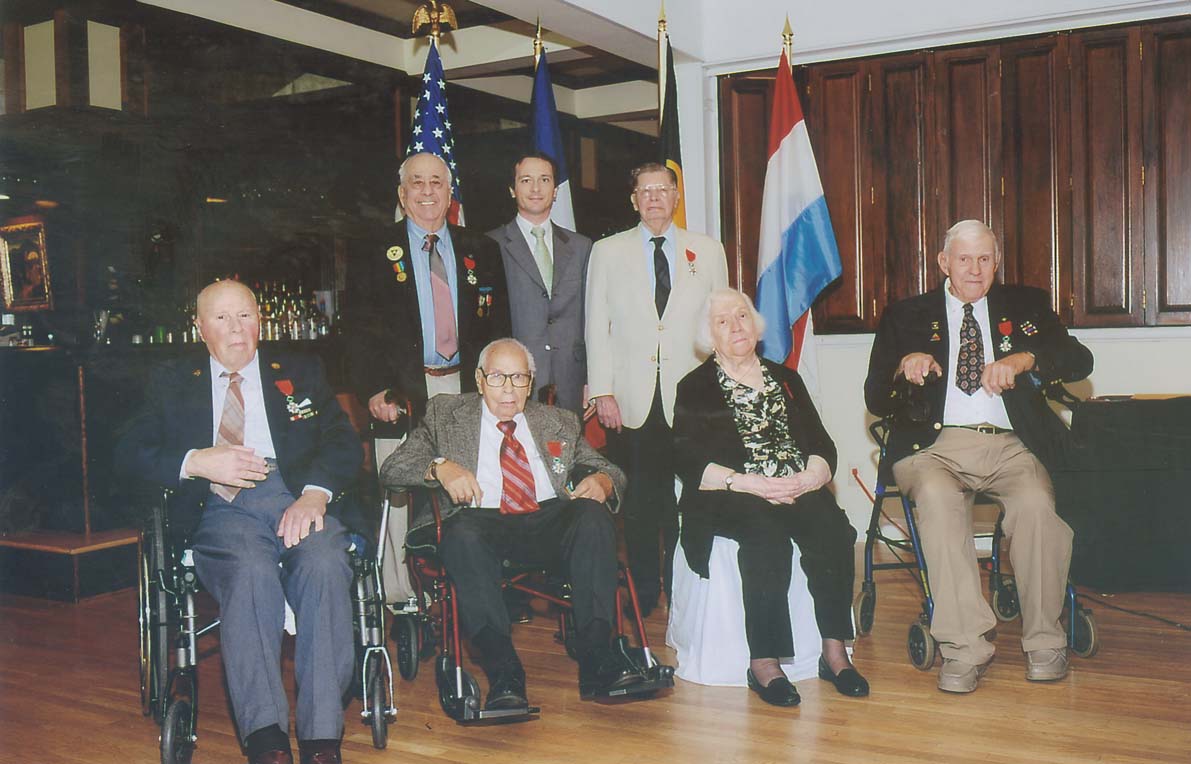
Six members of the Veterans of the Battle of the Bulge who are also members of the Lamar Souter Chapter of VBOB were awarded the French Legion of Honor on October 23, 2012.
(l-r standing)
Robert Nordgren – 83rd Infantry Division
Fabien Fieschi – Consul General of France
Frank Woolridge – 90th Infantry Division
(l-r sitting)
Armand Descoteau – 80th Tank Battalion
Edward J. Pizzetti – 75th Infantry Division
Margaret Hammond Walenski – 16th General Hospital
Roger Wheeler – 702nd Tank Destroyer Battalion
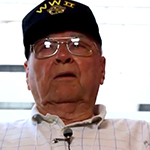
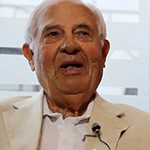
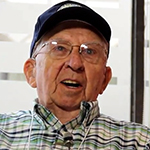
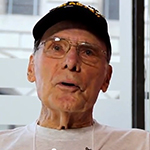
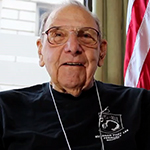
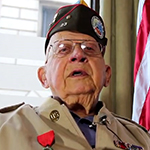
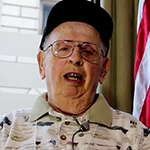
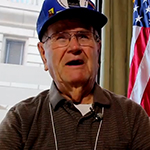
Jim Sharp tells of an eery discovery while on patrol in the Ardennes. This story is one of many he has as author of two books: Diary of an Infantryman & Sgt. of the Guard at Nuremberg. Jim served with the 1st InfD, 18th Inf, 1st Bn, Co B.
A member of the Parachute Infantry, Bruce Waldo entered the war via England in mid December 1944. In early January, in Belgium, his Company was surrounded and captured. Bruce served with 17th AbnD, 513th PIR, 1st Bn, Co HQ
The 81st Chemical Mortar Battalion employed classified weaponry in WWII. Clint Longnecker, Jr. recounts his time in this little known battalion, the 81st Chem Mortar Bn, Co A, and its crucial role in the Battle of the Bulge.
After two passes through the Maginot and Siegfried lines, Dick Williams describes his mission in crossing the Saar River under fire and capturing and holding a bridge in sub-freezing weather. Norval “Dick” Williams served with the 80th InfD, 318th Inf, Co I
After battling 1st SS Panzer division, Richard Stone recounts his capture while attempting to take Haverhill outside of Malmedy, Belgium. Richard served with the 30th InfD, 526th AIB, Co B.
Veteran of the Battle of the Bulge, Richard Rizzio tells of two close calls with incoming ordinance, and a run in with a battlefield chicken. Richard served with Patton’s Army in the 274th Armd FA Bn, Co B & S Btry.
VBOB Member Dick Switzer recounts a chance meeting with his brother. A journalists photo of the two brothers makes it back home to the local news paper. Dick served at The Battle of the Bulge (The Ardennes) with the 99th InfD, 39th Inf, 2nd Bn, Co H
VBOB Member Charles W. Early relives a very close call while on a mission in Luxembourg. Charles served at The Battle of the Bulge (The Ardennes) with the 80th InfD, 905th FA Bn, Btry C
VBOB partnered with the National Infantry Foundation
VBOB made an agreement with a publisher to produce a book, “The Battle of the Bulge—True Stories from the Men and Women Who Survived,” compiled from The Bulge Bugle
Warren M. Jensen, XIX Corps Artillery, 793rd Field Artillery Bn, A Battery
I was born and raised in San Francisco and enlisted in the Army’s Field Artillery at age 18 in 1942. Unlike many others who forged parental signatures until turning 21, the legal age, I finally got my folks to sign when I turned 18 in Oct. 1942 and enlisted Oct. 27, 1942. I trained at Fort Bragg, N. Carolina and embarked for England in December 1943.
We had no sense of time or calendar and knew the invasion was on due to the tremendous amount (10,000) aircraft overhead. We moved, we moved, closer and closer to South Hampton until boarding the LCT and embarked for France from South Hampton in flat-bottomed LCTs (landing craft tank). Much seasickness ensued that day.
By D+1 and D+2 the invasion fighting had moved off the beach and up into the hedgerow country. Can’t tell you exactly when we landed at Omaha “Easy Red” beach. I do know XIX Advance Corps Party landed like D+6 to set up the HQ people but we had nothing to do with them. We were Corps Artillery so I would guess we landed about D+10. We supported the 29th Infantry and 30th Infantry and 2nd Armored Divisions throughout the war.
If you Google up LCT (landing craft tank) you’ll see the flat-bottomed craft we came over in with two of our howitzers, the M-4 Tractors that pulled them and a jeep and 3/4 ton truck. When the LCT came to a halt we went off into four feet of water. The Jeep was covered over with water. All of our equipment had been waterproofed by us with snorkels for air intake. The Krauts were sending over occasional artillery shells. (Google up M-4 Tractor to see what we rode in)
When LCT beached we never left our howitzer and we proceeded up an exit way to the top of the beach, went inland a ways and fired the first mission on the roads leading to St. Lo that the Krauts were using.
We were involved in the battles at Mortain & Falaise Gap. I was a gunner and machine gunner on an 8-inch howitzer gun section, recognized as the most accurate artillery piece in the US arsenal. Our unusual howitzer accuracy allowed us to knock out enemy tanks and positions especially in the fighting in the hedgerows of Normandy. We were set up in an orchard so when we fired the green apples rained down. Click on the following link to see a video about the 8 inch M115 towed howitzer. www.youtube.com/watch?v=BhIoBhga2Zs
We moved to new positions constantly. Stay maybe overnight on missions or sometimes go into position ready to fire and the front had moved forward so, without firing a shot, we’d pack up and move to a new position. We never went thru the night with uninterrupted sleep—we either pulled our turn manning the phone to the Fire Direction Center or turning out for Fire Missions. That gets tiring after a while, month after month with no rest.
We passed to the north of Paris and entered Belgium Sept. 3, proceeded into the Netherlands and began firing on Aachen, Germany, from Herleen, NL. We were next involved in the bloody Hurtgen Forest battle where thousands of our lads were unnecessary casualties. This was late November/early December.
The Ardennes Offensive began on December 16,1944. The weather was bitter cold, foggy and dreary. All was quiet until Dec. 16 when the Krauts attacked. There was chaos that slowly resolved itself into grim determination, desperation and numbness…you got it.
“The Bulge” refers to the progress of the German offensive and to how far they pushed our lines back. Winston Churchill is quoted as saying, “This is undoubtedly the greatest American battle of the war and will, I believe, be regarded as an ever famous American victory.” Two million men were involved in this the largest land battle the US Army has ever fought.
We were brought down to the St.Vith area. Our missions depended on the targets spotted. We wouldn’t fire non-stop unless necessary. We were limited to the ammunition available to us. Sometimes we’d get a FIRE MISSION at various times day or night. At chow time half of the gun crew would go to the rear to get fed so the rest of us had to carry out the mission. Then, sometimes, by the time we had a chance to be fed, all the food was gone so our dinner was sometimes just a piece of bread and coffee. Or we ate combat rations.
As far as getting any hot food from December 1944 to February 1945 our cooks were able, once in a while, to bring hot food up in insulated Mermite cans. The US Army has a tradition of always trying to get a turkey dinner to the troops on Thanksgiving and Xmas with all the trimmings. Kinda hard to serve it up properly in that cold weather with everything served onto one’s cold mess kit all together with dessert slopped on top. That was special.
Night time could be beautiful. The searchlights would go on to create artificial moonlight for our Infantry lads. There would be flares fired and the magnesium flares would light up an area as they came down on little parachutes.. Machine gun tracers from our anti-aircraft guns would make pretty patterns in the sky because every 5th round had the rear hollowed out and packed with a chemical that glowed when fired. All this was to help the gunner zero in on his target.
And the sounds that filled the night: Of weapons firing by the Infantry machine guns, mortars going off and other artillery pieces firing. And then the krauts would send over “Checkpoint Charlie” at night. He’d come over, drop a few flares and take, we think, photos, drop a bomb or two, and with his distinctive engine sound disappear back to his own lines. Sounded like the engine needed a tune-up.
One memory I’ve had of this Xmas time was firing a mission and the FDC guys (Fire Direction Center) said, “You guys know that tonight’s Xmas Eve?” That’s how we found out during the winter of ’44.
Since our gun positions were generally in the open or at the edge of trees we were pretty well exposed to the chilling wind. Frostbite casualties were common due to a lack of proper clothing and boots. I wouldn’t know how cold it got without having a thermometer but it was the coldest winter in Europe in 40 years. Reords show that temperatures plummeted from 40 degree days down to minus 10 to minus 20 F at nite. Brrrr. Bradley and even Ike felt the war would be over by Dec. 1944 so they had the manufacturing and shipment of winter clothing stopped. Some supplies were in warehouses in France but the rear echelon guys got into those. All we had were leather boots and were supposed to massage each others feet to prevent frostbite. The medical Dx was “frozen feet” but in WWI it was called “trench foot”.
Not much more than commiseration with my buddies held me together mentally during times of hardship as we were all in it together. Our bedding was just a wool Army blanket each. Yes, just one blanket. In December they issued us a mummy style sleeping bag which was a blanket with an outer shell and a zipper. Eventually they got wool gloves, a wool scarf, a sweater and galoshes or overshoes to us at the front. It was joked that it was so cold that it would freeze the balls off a brass monkey. Don’t know where that expression came from but it always got a laugh.
After we would get our howitzer into firing position, next we would did a hole for the projectiles and powder charges, then dig our personal fox holes, then dig a small slit trench, the width of a shovel blade, and thus we could squat and straddle the trench, cover it with some dirt we had dug. TP was slid onto the handle of the shovel which was jammed into the dirt we had dug out. It was quite an experience to squat in icy cold weather and expose your butt to the cold.
The Belgians generally cleared out as they were fearful of the reprisals from the Germans. Those few who stayed opened their homes to the troops. If we stayed for a few days it would give us a chance to contact a farmer in France, N. Belgium, or Holland for cider, wine, or females. We tried to lure them to our area with promises of food, cigarettes. Not much success. We could not talk with any German for fear of a fine of $65 (a months’ pay for privates).
On December 23 the skies finally cleared and all we heard were aircraft engines and saw contrails and there was cheering at the event. Our guys parachuted in ammo, food and medicine to the encircled troops at Bastogne but unfortunately, the Krauts got some of the chutes. After the war a German soldier reported that that he found a canned Hormel ham hanging from a parachute and had dined with a Belgium family that Christmas. We pushed the Germans back into Germany and the Ardennes Offensive ended the beginning of February 1945.
When December weather comes in with its cold and fog, even after 68 years, my thoughts drift to the Bulge experience and I shiver as I remember those Bulge weather days of suffering. We moved eastward quickly and eventually found ourselves below Magdeburg, Germany in support of the 2nd Armored Division and the 83rd ID which both had bridges across and troops on the east side of the Elbe river until we were ordered to hold our positions. This is now April 1945.
We went “scrounging” in Germany but couldn’t go far. Some guys found weapons or other souvenirs. If we found food we feared it might be poisoned. Krauts knew we scrounged for wine and schnapps and would urinate into those bottles. Once in a small town in Germany I went scrounging for a door to put over my foxhole to prevent shrapnel from coming in. The house was untouched with even a beautiful crucifix on the wall and I spotted this grand piano. I was angry at the Germans so, in a fit of adolescent stupidity, I destroyed a good part of the piano with my carbine so the residents would have something to suffer with.
We prepared to move for occupation duties in Giessen, Germany. We liberated several German concentration camps and witnessed the results of the atrocities. Unfortunately we gave the starving inmates our high caloric rations which caused them distress and even death. This liberating of POW and concentration camps came in our drive to the Elbe River. VE Day came May 8 and the Russians on the east bank of the Elbe River were celebrating. We could hear them yelling and firing into the air with their weapons. Flares were going off and an accordion was playing. I decided to take a lone journey across the pontoon bridge one day and got a ride in a jeep. On the east bank of the Elbe I saw a column of rough looking Mongolian troops, female traffic cops, and their kitchens pulled by horses. I thought, “I sure hope we never have to fight them.” Ourselves, on the west bank of the Elbe River did no celebrating as we were due to ship out to battle in the Pacific.
In Giessen we guarded first the Polish and then the Russian DPs (Displaced Persons) or manned the checkpoints on the Autobahn. One time we took a trainload of Russian DPs packed into box cars into the Russian Zone. The four of us had a boxcar to ourselves which was loaded up with Ten-in-One rations. Our journey was overnight to the edge of Czechoslovakia. We’d distribute the ration boxes to each car at mealtime stops.
Our unit was broken up based on an individual’s point system and we were sent to one of the “cigarette camps” near La Havre for weeks of idleness while we waited for transportation home by ship. Finally I arrived home and was discharged December 13, 1945. Upon discharge I enlisted in the Army Reserve and the University of California at Berkeley and eventually received a BS degree in Business. My commission in the Army Reserve was from the battlefield according to the War Department Circular 32 for those who had been involved in combat. This authorized the commissioning of enlisted individuals who had high AGCT (Army General Classification Test) scores and combat experience. I had the 2nd highest score in the entire battalion. I was offered officer candidate school and ASTP (where enlisted were sent to a college in the US and lived there). I advanced through the ranks to become a Captain in 1950 with a total active and reserve time of 23 years.
I slowly healed from “battle fatigue” after the war (now it’s termed Post Traumatic Stress Disability) by repressing the memories of my WWII experience. I was wounded twice and the VA has declared me 100% disabled due to PTSD and wartime injuries which plague me still. I was awarded the Purple Heart medal and the European Theater of Operations medal with battle stars for Normandy, Northern France, the Ardennes, Rhineland, and Central Europe campaigns.
After seven years I entered San Francisco State University where I studied for and received two MAs in Psychology and Business, with postgraduate work at Stanford University. I taught for a number of years before being assigned as a Guidance Counselor at Woodside High School on the San Francisco Peninsula, and retired in 1964.
I belong to:
Military Officers Association
Military Order of the Purple Heart
Veterans of the Battle of the Bulge, Golden Gate Chapter, N. Calif. Bay Area
Third Thursday Veterans Lunch Bunch, Concord, Calif.
Veterans of Foreign Wars (VFW)
Remembering World War II and the Battle of the Bulge
by Philip Walsh, 2nd AD, 66th AR, Co C
I was 18 years old when I got my draft notice from President Franklin Roosevelt. It was 1943. The notice read “greetings from President Roosevelt” and went on to say I was drafted to the US Army. I had never been away from home before and I wondered if I would return home to Maine.
I was sent to Fort Devon’s, Massachusetts, for a few weeks where I received my army uniform and medical shots. I recall walking down a narrow hallway and got shots in both of my arms. The fellow in front of me passed out after receiving his. I can still hear the guys who had already got their shots saying “you will be sorry.” They were right. They also warned me to watch out for the square needle that’s left in overnight. I found out to my relief they were just kidding because I was a new recruit.
From there I was sent to Fort Knox, Kentucky, for 21 weeks of tank training. I remember being homesick, went to see the doctor, a major, who gave me some pink pills and said I would be fine. I wasn’t. I was still homesick. When our training ended we were sent to Fort George Meade, Maryland, for advanced training. Then I was sent to Camp Shanks, New York, to board the Aquitania for Europe.
I recall when we landed in Greenock, Scotland some Scottish girls greeted us and gave us muffins filled with meat. I took one bite and threw it out. It tasted awful to me. We left Scotland by train to England. By the time I arrived in England I was no longer homesick. It was more than 6 months since I left Maine. The war was underway, and by this time I figured I’d never get home alive.
When I was sent to France I was assigned to Company C 66 Armored Regimen, 2nd Armored Division. Afterward I was deployed to Omaha Beach in June – six days after D-Day. When I landed I asked the Beach Master if many men were killed. He said if anymore were killed no one would have gotten ashore. I remember one solider, in particular who landed on the beach with me. He was from the southern part of the States and was assigned to another tank because tank commander, Lt. Johnson, also from the south, picked him for his crew because of the connection to the south.
This was the first day in battle for us. Lt. Johnson’s tank was heading down a road between a row of hedges rows and ran over a mine. The explosion blew a track off the tank. The crew climbed out of the tank, started to crawl on the ground and a mortar shell landed on the back of the soldier from the south. All that was left of him was a piece of his fly and belt buckle. It was terrifying. Later I was told that Lt. Johnson was planning to get married in Paris after the war and arranged to have his bride’s wedding dress made from a parachute. Unfortunately he was killed outside of Berlin at close range by one of Hitler’s Youth with a Panzer Faust bazooka after he stepped outside of his tank.
We were never told where we would be deployed or given any details. That was one thing I didn’t like about the Army. After Omaha Beach we were sent to another location in France. We were on the front line for 21 days with the Germans firing at us from a train with artillery guns. I remember it sounded like a freight train coming at us. Three crew members and I barely left tank for the entire 21 days. It was too dangerous to stay outside for any length of time due to the constant shelling from the Germans. We had to be extremely careful.
The ground around the tank was all torn up from shelling and the mud was a foot thick. Every time someone left the tank they would get about two inches of mud on their boots. I remember getting mud dropped on my shoulders whenever the tank commander, a schoolteacher, climbed back into the tank after checking our surroundings. I was seated at the machine gunner’s seat and there wasn’t any room to move. It was very tight quarters inside the tank. I also recall when the lieutenant was injured after a shell struck the side of the tank when he was underneath trying to cook a meal with a Coleman Burner. He was taken to the aid station.
We had an opportunity to take prisoners. Seven Germans waving a white flag tried to surrender to us. One of our crew members fired at them and they took off.
After 21 days in France we were on the move again, this time to Germany. We arrived to a location that looked like a park and were able to sleep outside on the ground. One morning when I awoke, I noticed the tank was leaking. I looked inside and saw about three inches of gasoline on the bottom of the tank. A new replacement had changed the fuel filters incorrectly on both Cadillac engines.
Our next deployment was to Bastogne for combat at the Battle of the Bulge where I remained for the duration of the conflict. It was winter, freezing cold, and I drove an open top half track 100 miles in the pouring rain to Bastogne. Somewhere along the way I drove off the road. I was very tired, soaking wet and it was difficult to see because there were no headlights. I accidentally backed into Captain A.Z. Owen’s tank. He hollered “get that man’s name.” I was afraid he would send me to jail. He didn’t do anything.
When we arrived at our destination near Bastogne we were exhausted and cold. We pitched our pup tents in the freezing temperatures and went to sleep shivering. What amazes me now as I think back about sleeping in soaking wet, heavy Army clothes with my shoes frozen to the ground is that I never caught a cold.
Our tank was parked next to a farmhouse. The family living in the home felt sorry for us staying outside in the cold and they invited us in to dry our clothes and get warm. We stayed with them for several nights. Unfortunately one of the soldiers flirted constantly with the homeowner’s wife. The husband got fed up and told us all to leave.
One time we liberated a couple of chickens and some vegetables from a Belgium farmhouse and I cooked it in a 5-gallon can. You cannot imagine how good this tasted on a cold day especially after living on K and K rations. It was the best chicken soup I had ever eaten. A captain from Georgia said to me, “Walsh where did you get the chickens from?” Another soldier spoke up and said he got a package from the states. This seemed to satisfy the captain who helped himself to the soup without asking any more questions.
Later during the battle I was asked to drive this same captain in a jeep to a command post set up in a house near Bastogne. When we arrived we saw the T/5 Sergeant who had flooded our tank with gas when he was assigned to our crew in France. He was on duty at the command post and did not salute the captain in my jeep. The captained yelled to the T/5 sergeant “Salute me.” He obeyed.
When the Battle of the Bulge ended, I was deployed to Berlin. We were the first troops to arrive in Berlin after World War II ended. I was transferred to the 12th Armored Division and sent to Marseilles, France where I prepared to go home. It was 1946. I am proud to have served my country, but I wouldn’t want to go through this again.
 Six members of the Veterans of the Battle of the Bulge who are also members of the Lamar Souter Chapter of VBOB were awarded the French Legion of Honor on October 23, 2012.