In conjunction with Memorial Day, the students and staff of Old Turnpike School in Tewksbury, NJ have planned a day-long celebration to honor the men and women of the Armed Services. The event will begin at 8am with an opening ceremony and conclude at 2:30pm with a closing ceremony. Throughout the day, students and staff will hear first-hand accounts of your experiences.
Plans are moving forward as the celebration date, May 22, 2015, quickly approaches. In order to bring awareness to the sacrifices our service men and women make, Remembrance Day was created to bridge the gap of understanding while connecting in a patriotic manner. While an eighth grade teacher, I created Remembrance Day and ran the program on three occasions: 1999, 2002, 2005. At the height of the event, 75 Veterans attended with a myriad of activity during the day. With that said, my students have expanded the program to include Operation Shoebox, The Wounded Warriors Project, and “Thank You For Your Service Campaign” where students hand a Veteran a band that they wear on their wrist. The following narrative will lay out the program/event in order to bring clarity to the immense scope of the day; it will be broken down into three parts:
Opening Ceremonies: We will kick off the event in the Gym. All attendees will have a seat of honor amidst the band, chorus, Remembrance Wall, and the student body (approx. 400). The band has been working hard too on a few selections, and the chorus has equally prepared a variety of patriot songs. Also, students have prepared short speeches on the meaning of Memorial Day, Operation Shoebox, and Wounded Warriors Project to name a few. Additionally, each grade, fifth, sixth, seventh, and eighth, will prepare a Remembrance Wall which will include patriotic symbols while incorporating a letter of thanks from every student in the school. In the past, a color guard has attended; however, at this point, one has not been secured.
Classroom Visitation: This is the most important part of the program. In small groups (15), the students will have an opportunity to move from classroom to classroom to visit with a variety of Veterans. There will be approximately six sessions, each session will last 30 minutes. Note: If there are a large number of Veterans, the number of classes you present to will lessen. Within these sessions, the Veterans can share their experiences. In the past, groups of Veterans have presented together while others have done individual presentations. Each Veteran will have a student chaperone to attend to their needs throughout the day, for example, introduce you to the students, be a guide, provide water and food to name a few. During the Classroom Visitation periods, the MTA (Military Transport Association) will have vehicles on site for the students to view. At this point, I have confirmation of one vehicle with the hopes more will RSVP as we get closer to the event. In addition, during past three programs, a helicopter from Picatinny Arsenal has landed on site. My hope is we will be able to secure the helicopter again this year; however, it has been difficult.
Closing Ceremonies: The program will conclude around the flagpole in front of the school. The Veterans will, again, have a seat of honor. After a few short speeches, the boy scouts will lower the Flag and fold it properly. Then, they will hand it to the Veteran who will lay it to rest in a cauldron of fire with a Nine Gun Salute. Taps will then be played. If a helicopter is secured for the event, there will be a “fly over”.
My students have create various social media sites. They are as follows:
Instagram: @otsremembranceday
Snapchat: @remembranceday1
Twitter: @otsPBL2015
Pinterest: @oremembranceday
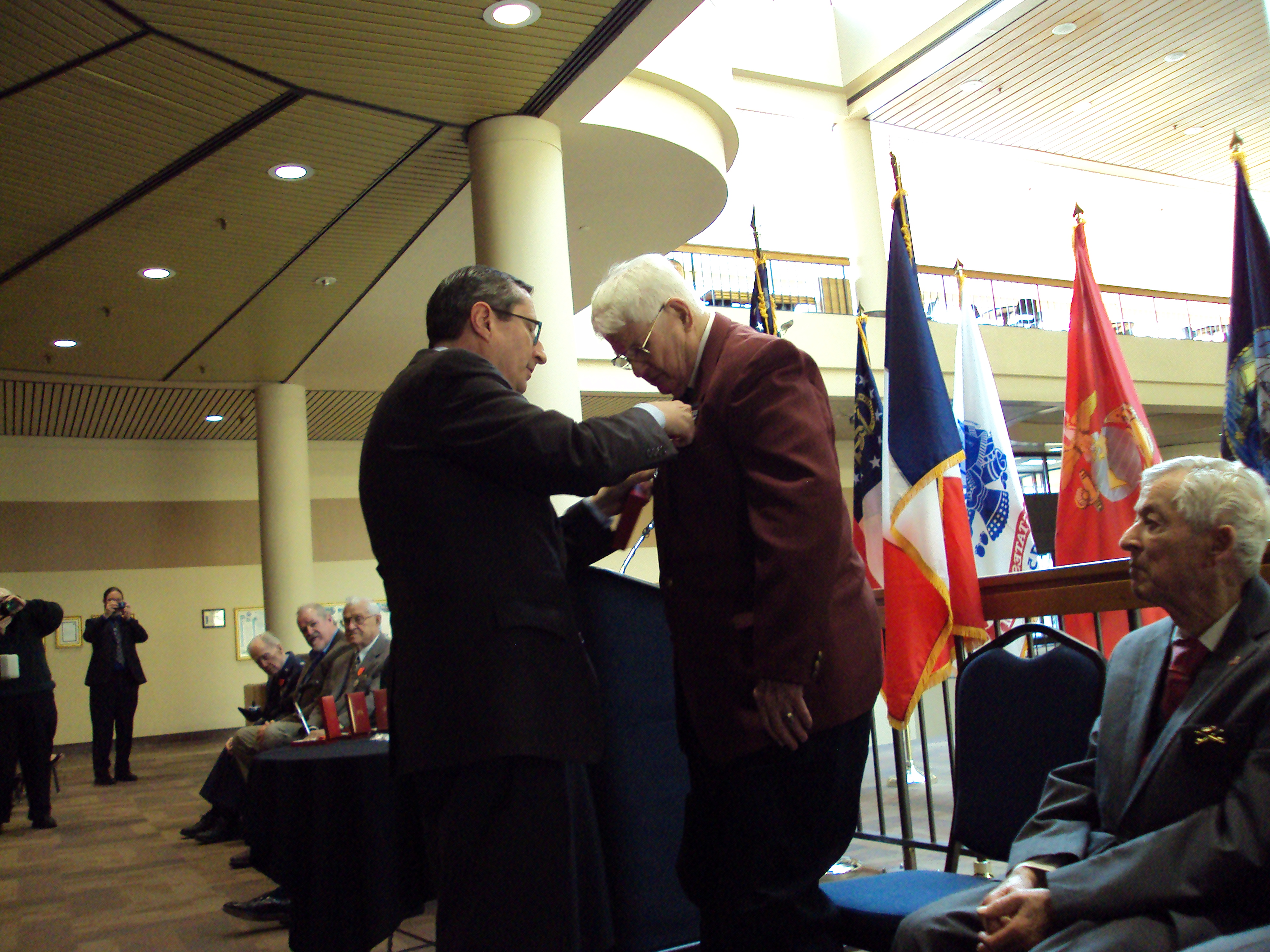
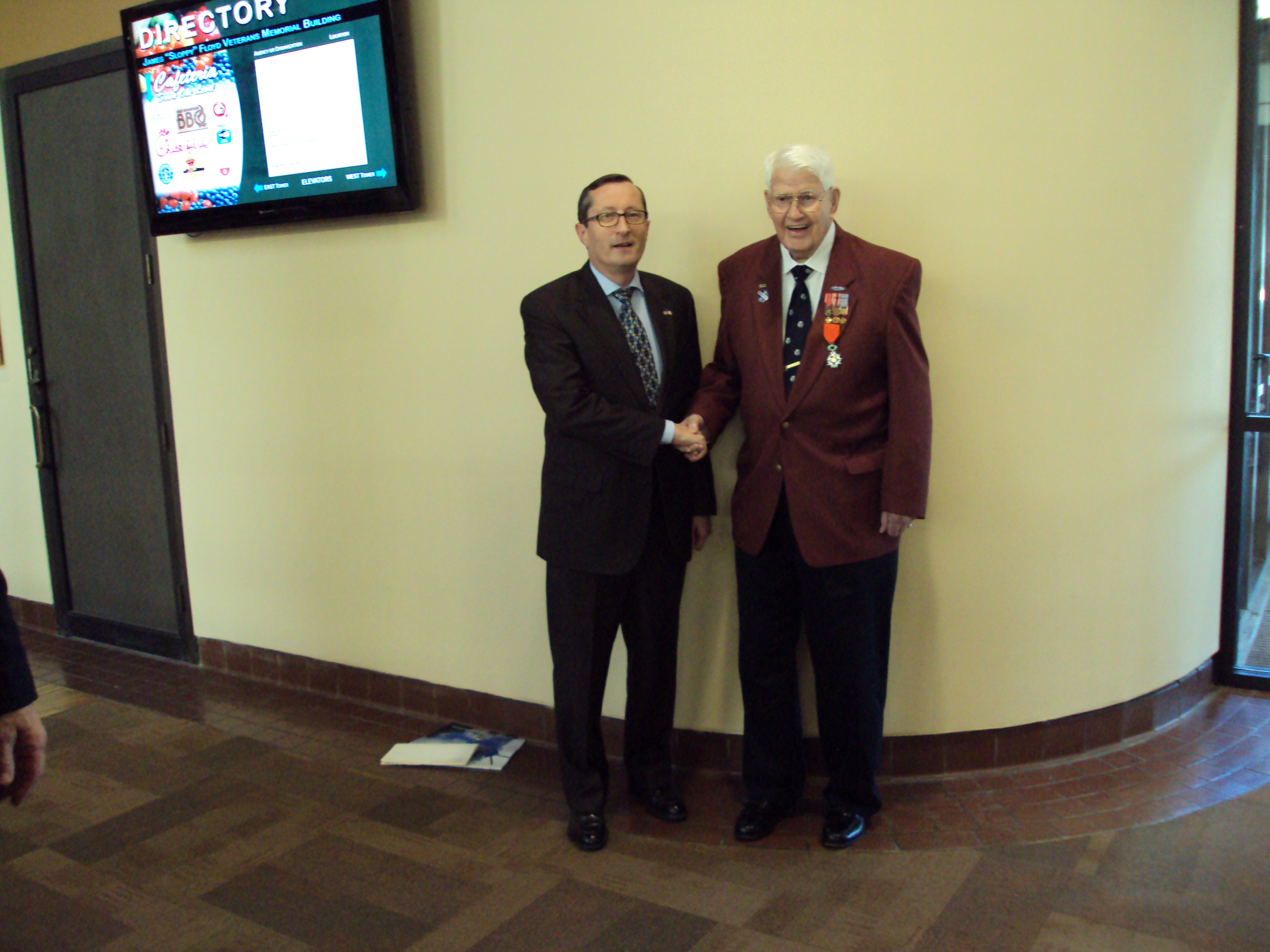
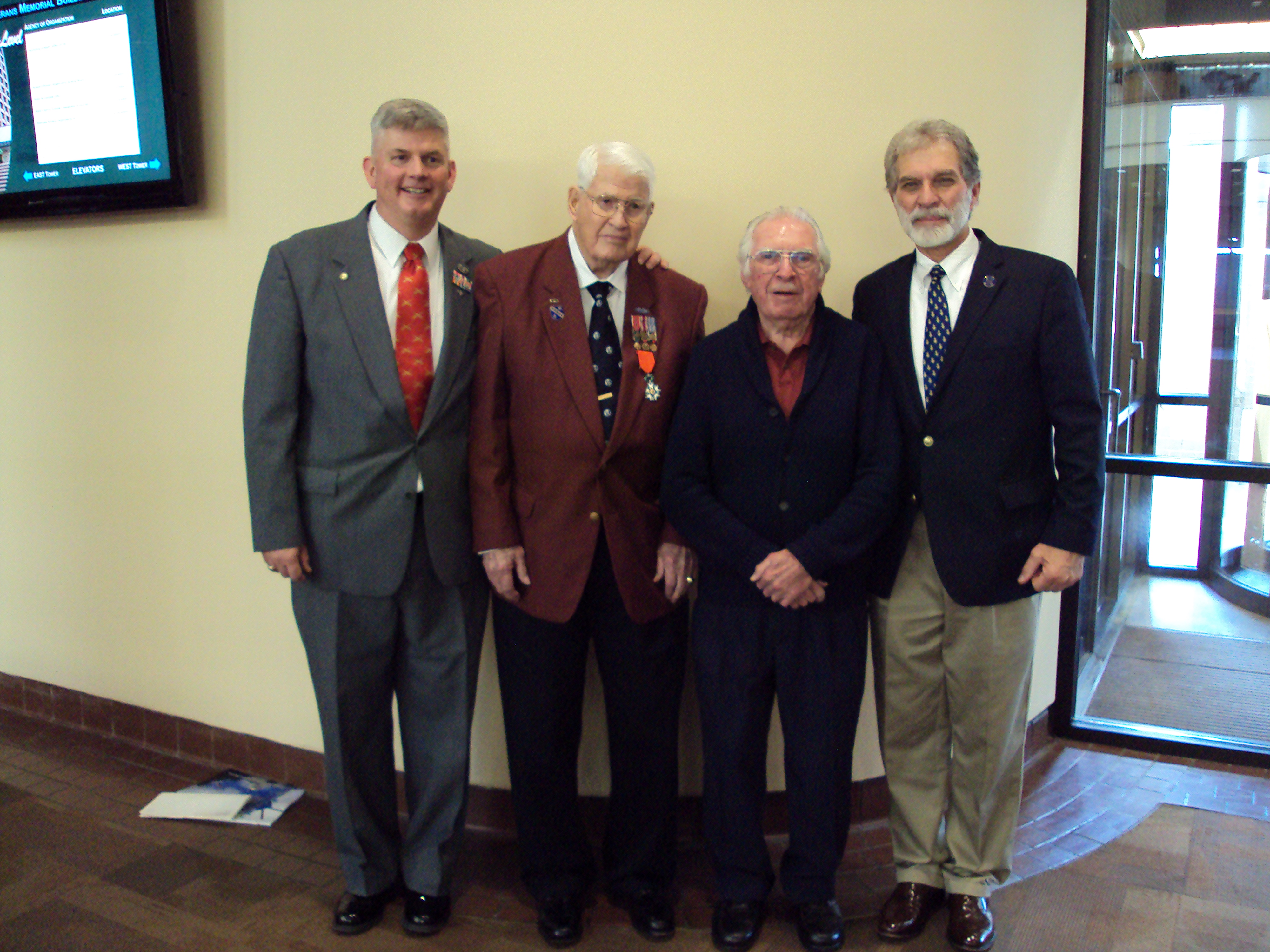
In order to express France’s eternal gratitude to those who liberated it from oppression from 1944-45, the Consul General of France in Atlanta, Denis Barbet, bestowed the Legion of Honor upon 11 American WWII Veterans, including VBOB members Art Mohor and Phil Pollock, from Georgia on January 27, 2015 in Atlanta, GA.
VBOB member Art Mohor, 94th ID; receiving the Legion of Honor medal from the French Consul General Denis BarbetFrench Consul General Denis Barbet and Art Mohor, 94th ID(l-r) John Mohor, Associate (Art’s son); Art Mohor, 94th ID; Phil Pollock, 87th ID; Duane R. Bruno, Associate/Treasurer
On September 8, 2002, my father passed away. He was 85 years old, but forever young at heart. My father was the finest person I have ever known. The first man I ever fell in love with, and still the best. All the qualities of a true gentleman, a true hero, he embodied. He was a caring, quiet, brave, strong, selfless, and a giving man. He was finely tuned, just like the violin he played in his youth. He stood tall and straight and always looked so distinguished and handsome and well-dressed. Growing up, my girlfriends had ‘secret’ crushes on him. My dad taught a daughter how a real gentleman treats a lady. He was a man of faith, and a faithful husband and father. He was talented and a lover of the fine arts. I know I get all of that from him. I am grateful. His smile was beautiful, and had a light of its own – everyone always said that. It was a smile that radiated goodness. He was a successful businessman, treating people fairly and kindly, a success, even though he never really learned the art of the deal. He didn’t care. He could never say no to a request, and sometimes people knowing that, could take advantage. But that was okay because he knew it, and chose to help anyway. Maybe he died on that Sunday because, oh maybe, his wonderful heart just wanted to rest now. Maybe his mission had been completed. He had fought heart disease so valiantly and for so long, much like the way he lived – quietly, strongly, never ever complaining, not giving in but with an inner understanding, and yes, even a kind of acceptance. I know he still wanted life, but it was not to be. And our family misses him beyond any reality we know. Our hearts weep.
Leonard J. Fazio, 1st Infantry Division
This story, his Belgian story, is to honor him. My dad was a disabled World War II Veteran, 1st Infantry Division, PFC., Anti-Tank, fought in D-Day, Northern France, Battle of the Bulge, Rhineland, recipient of the Purple Heart, EAME Service Medal, World War II Victory Medal, Good Conduct Medal.
For all of his life since the Battle of the Bulge, my father had a deep love and respect for the Belgian people. For a couple of months he was with the Meyntjens Family, a relationship that ended up lasting a lifetime and touching many lives. On the outskirts of Antwerp stood three small houses next to one of the bridges by the strategically crucial locks. The Meyntjens lived in one of those houses. There were Mom & Pop, their three daughters, Angeline, Alida, Maria, and little eleven-year-old, Frans. Their oldest child, Peter, in his early twenties, had been taken away by the Nazis. My father had been gravely injured in France, and after being released from a hospital in England, was sent to Antwerp to recuperate. He was to stay for a couple of months guarding those Antwerp locks. He was stationed near the bridge. My father’s leg injury did heal, but he sustained permanent hearing loss that continued to deteriorate to over 90%. When he came home, and for the rest of his life, he wore a hearing aid. It was a large box positioned in a halter that went around his shoulders and his back, and hung in the middle of his chest. The ear mold was connected to a tube which connected to a wire to the hearing aid box. He also relied a lot on lip reading. This old-fashioned hearing aid, and the only model that could even help my dad at all, was his connection to a hearing world. Not ever, ever was there a word of complaint, not ever was there self-pity. I think a lot of men were like that from that Generation. Ordinary people called upon to be extraordinary. The men who really saw the hardest action of the War seemed to remain the quietest about it. No bragging.
During this three month time, my father bonded forever with his Belgian family. The Nazis were all around, always looking for Americans, and so they would regularly have to hide. Mom & Pop (that is what my dad always called them) hid my father in different spaces in their little house, at risk to their own lives. And always around him, staying close, protecting him just the way a little boy would want to do, was Frans – always Frans. The Nazis didn’t give up – bayonets poised, shouting in German, threatening the Belgians, always searching – but they did not find those Americans guarding that bridge. The Meyntjens shared their home, their food, their lives with my father. He was their tall, quiet American. How little Frans loved and clung to him! He wanted to always stay with him; I guess he so missed his big brother. The family didn’t speak English, and my father of course didn’t speak Flemish, but it did not seem to matter. Their understanding of each other was somehow not just about language. It was about the need for family, to feel cared for, to have a little of the gentleness and love left behind at home in America. Frans did learn to say, ‘my brother’, in English to my father. That was enough. Not ever did this family think of themselves. Perhaps Mom and Pop felt that if they couldn’t help their son, they would help another mother’s son. And so my dad became like theirs. How brave they were! No matter what their fear of the Nazis, it never stopped them from watching out for ‘their American’. When my dad did get some free time, he stayed at home with them. He could have, but chose not to go to the local night spots.
So the weeks of guarding the locks and of his own recuperation passed. It had been about three months, and the time had come to go back to the frontlines. My father always told me that that day of leaving his Belgian family was one of the hardest. As the trucks pulled away and my father was looking out from the back of one of them, they began running after him crying aloud and screaming his name over and over. Little Frans kept calling for, ‘my brother, my brother!’. They were losing him. The War went on, and my father was back on the frontlines. When he did get a furlough, he visited. And then the War was finally over. My dad went home to my mother. His ship, the USS Washington, braved a huge and ferocious storm at sea to be one of the first ones home. Its captain did not turn back when other ships decided they would. He said these men had seen the fiercest fighting, and deserved to go home as fast as the ship could take them. They had earned the most battle stars which meant they had earned their place to be the first ‘batch’ home. Their captain said they’d make it, they’d been thru too much not to, and they did – Christmas Eve. My mother had moved back home with her parents for the duration of the War, and on Christmas Eve 1945, the doorbell rang. There stood my father! My aunt screamed out his name, and my father walked thru the hallway, and there he saw my mother. It was a kiss that had been waiting for years to be delivered. He was safely home. Merry Christmas, everyone! And life went on. I was born in 1948, my sister, Donna Lee, in 1958, and my brother, Leonard, was born in 1963.
My father always wanted to go back to Belgium to the Meyntjens to thank them, to see them again. Thru the years, there were cards, letters, and Christmas gifts. I can still remember my Belgian doll they had sent me one year. The families communicated as best as they could. My dad so loved anything Belgian, that when the New York World’s Fair opened in the early 1960’s, we would go as a family every Sunday, and guess where we would always end up? Yes, at the lovely and authentic-looking Belgian Village, sitting at a table on cobblestone streets, and eating of course, Belgian waffles! My father would sit there with his beautiful smile, sheer nostalgia radiating from his face. Sometimes we’d be there and a Belgian band would begin playing. Then you could see tears glisten in his eyes. He felt Belgium’s essence come to him on those happy Sundays. It’s a wonderful family memory. In ways of the heart, he was still theirs.
Finally in 1973, my dad and mother, and another couple, who were their best friends, did just that. My dad felt he had to be there right then; it turned out to be quite prophetic. Their visit was so wonderful, three days of somehow stepping back in time, and yet so enjoying the moment. When they entered their house, my parents were overcome with what they saw. All around and on their walls were pictures of my father and their son, Peter. Nothing had changed, my father was still a part of them. Peter had actually survived the War and the forced labor in Germany, only to die one night while taking a shortcut home. He was walking on the railroad tracks and was killed instantly by an oncoming train. The War was recently over, Peter was 26 years old and home. What tragedy!
Their three day visit was very happy, but sad too. No one had ever forgotten the tall, quiet, calm, young American soldier. But Mom and Pop were gravely ill. Mom was bedridden, and my father knew they were both dying. The whole Meyntjens Family had gathered, grown-up now, the three daughters and dear Frans. My parents got to meet their spouses, and some of their children. The visit was all it should be. Dad had kept his promise to return someday with his wife, Ann. He had been given that last chance, a gift to see their faces again, sit down at their table, and embrace them for the last good-bye. Within just a few days of my parents leaving Belgium, both Mom and Pop passed away. From time to time after my parents came home, my father would send cards to their home hoping to reach someone and hear from one of Mom and Pop’s children. There might be a card – but only sporadically. Then we never heard from them again. My father sadly thought Belgium was gone for him. We thought so too. And life went on.
But we were wrong. Happily, Belgium was still to be a part of our lives. After about 27 years, in late March 2002, just a few months before my father passed away, a phone call. Imagine! Someone named Luc DeRoeck had been searching thru various internet search sites looking for the phone number of the American he had always heard about. He finally found my father thru a service of The New York Times – some kind of computer search site that traces people. Little did he know then that my sister and brother-in-law both work for the newspaper, and had he just looked under our last name, he would have found us quite easily. So Luc located a number of an office where my father had worked, the lovely lady and friend who took the call from him then called my mother, who then called me, and I had the number of a Belgian named, Luc DeRoeck, who was looking for the American soldier named Leo or Leonard. I called. Luc spoke perfect English
My grand parents on Dad side emigrated from Belgium to Chicago, Illinois in the late 1800. Dad was raised and educated in Chicago. During World War One he was in Belgium and was injured in combat near Ypres, Belgium. He worked for various American companies and in the early thirties he met Lawrence Hammond , who invented the Hammond Organ, which were manufactured in Chicago. Dad was asked to become the general manager of Hammond Organ International, responsible for Europe and Africa.
While in Belgium he met Mother, who was born a Belgium and was one of the youngest Belgians decorated by the King of England for act of valor during World War One. Since Mother was born in 1903 and the war ended in 1918, what ever Mother did was within her first fifteen year. I was born an American citizen and registered at the U.S. Embassy in Brussels Belgium on January 24, 1928. I am the oldest of nine (9) children. Of the four boys, Louis (# 5) and Peter (# 6) finished Captains U. S. Air Force, Peter was a F-100 jet fighter pilot. Butch (#9) last I.D. card read Brigadier General Beaudouin de Marcken, he finished as U.S. Ambassador to Madagascar appointed by President George Bush senior.
I was trained as an infantry soldier in the 9th Infantry Division. For us World War Two started on May 10, 1940, when the Germans attacked Belgium. We were in the second line of defense called the K-W line, we had 18 pill boxes ( small concrete bunkers) on the property. At the entrance of the driveway we had a main anchor of the long line of anti tank barriers called the “Cointet Barriers”. The next think we saw were the British Royal Artillery, they installed a Battery of sixteen (16″) inch guns on our lawn. These were monsters, every time they fired we expected the roof of the house to jump off the foundations. Then came the ” French Zouave” these were fearless fighter coming from Algeria. These infantry soldiers came running bare feet, they had fixed bayonets, and were shouting :” Ou sont les boches ?.” = ” Where are the Krauts ?”.
As a young twelve year old these men literally fascinated me. They carried their booth, which were tied by the shoe laces, around their necks; however they also carried a necklace, it was a string with odd brownish and shriveled pieces strung on the string. After a while I asked one of them :”What is this…?” the response was amazing. The proud Zouave pointed to the rubber looking pieces and said : “Every time I kill a German, I cut off his hears, so I can keep track of my kills.” No need to tell you that these men were not ordinary soldiers. Within four days we were forced out of the house and we were on the road towards France. Dad drove a Pontiac and Mother an Opel. We were very lucky, the German “Stukas” did on purpose to strafe the civilian vehicles, this created havoc and stopped all military traffic, the German planes strafed in front or at the back of us, we were never affected.
By the time we arrived in Azy-le-Vif, in central France the Germans caught up with us. We were forced to head back to Belgium. The first night was spent at our grand mother’s house in Buysingen, Belgium. The next morning Dad and I left to see if our home was still intact. We arrived in the woods of the Chateau de l’ Etoile, were we lived, to find the home occupied by the German air force motor pool. The little German Lieutenant stood on the entrance steps to look down on us. He pointed his arm towards the driveway and shouted in German, by the way Dad knew German fluently, “Germany a big country…the United States a small country… Raus…! In other words get the hell out. Dad drove to the U. Embassy in Brussels, Belgium to ask for assistance and be able to reacquire the house. After all America was not at war with the Germans, we were neutral. It took eight days before we ere allowed back in to the rented house.
The lousy krauts had plugged all eleven toilets, defecated in all the beds, urinated all over the house, and broken all our furniture. What a mess. It took two weeks of cleaning and repairing before we children were allowed in the house. Of course as United States citizens we were not harassed by the German, who were not allowed on our property. Obviously all that changed suddenly on December 7, 1941, when the Japanese attacked Pearl Harbor and four days later Hitler declared war on the United States. Now we were enemies. It did not take long for the Germans to arrest Dad as he was coming back from work. Luckily the German placed Dad temporarily in a Belgium Gendarme cell.
He Belgian having suffered a great deal during World War One, (Read the book: ” The Rape of Belgium.” Written by Larry Zuckerman. this book has the ISBN – 0-8147-9704-0 ), are very patriotic and anti the German oppression. Two Gendarmes came on bicycle in the dark to notify Mother that her husband would not come home. They told mother to prepare a bundle of warm clothes and some dried food; they also told Mother to enter the Gendarmerie through the back gate, which would be left open for her. At least this way Dad would not be without some change of clothes. Early the next day the Germans moved Dad to the infamous prison of Saint Gilles in Brussels; however when Mother tried to find out where Dad was kept, they refused to answer her questions. Mother knew the stupidity of the German race, which was brainwashed by Hitler, who told every woman that it was her duty to build a large family.
Hitler of course was always looking for more young men to become soldiers. After a whole day searching from one German office to another, Mother got angry and said to the next German paper pusher : ” I am the Mother of Nine (9) children and I wonder what your fuehrer would say if he saw you!” Immediately the German soldier jumped up, he saluted and said ” Nine children ?” “Yes ” said Mother, then the soldier thumbed through a roster and told Mother that Dad was a prisoner at Saint Gilles. A month later was transferred to the Beverloo Camp, which was considered a very lenient camp. While there the Swedish Embassy got a pass for most of the families of the American and British civilian prisoners to once see some members of their family. While Dad was a member of a neutral country he enjoyed the fact that no German was allowed on the property. He was the only person in the village who had a vehicle, which was a small Italian Lancia. Dad and Mother were very patriotic and courageous and obvious took advantage of being protected by the U.S. Government.
On the front door of the house and on the back side window of the car they had a formal affidavit issued by the U.S. Embassy stating that this was property of the U.S. Government. As a result my sister Anne (# 4 ) and I remember very well certain afternoons, when members of the underground would come to the house, they would wait until dark and disappear. We would stay awake and listen, then we heard a plane pass very low over the valley and fly away. We found out after the war that a British plane would come and drop weapons and ammunition over the cow pasture located in the valley. The shipment was hidden and in the next few weeks Dad would deliver them to different underground cells all over Belgium. This of course stopped as soon as the United States became Hitler’s enemy number one. Dad had also built chutes in the rafters of the fourth floor, which was in reality an attic. These were hiding places for allied airmen and other men moving from place to place in their attempt to go through France, cross Spain without being arrested by the Spanish police, who were funded by the German Nazi party, and reach Portugal.
The Portugal people were always ready to help allied airmen get back to England. Dad was weighing 184 pounds when he was arrested the first time, he came home more than two years later weighing 109 pounds. While in the German camps of Tittmoning and Laufen he was never beaten or tortured, the Germans were always afraid of U.S. reprisal; however they did not feed the prisoners, many died of lack of nutrition. The prisoners survived on U.S. special parcels for prisoners and some dry food sent by their families. Mother tried once in a while to send a package of macaroni. One of these packages was never eaten by Dad. Why ?? In Belgium the Italian soldiers were not known for their courage, according to the Belgian the Italian Army had a motto : Fight and run away so as to be able to fight another day !! The Belgians had a pejorative name for Italians, who always waited for the last minute to join the German invaders in 1914 and again in 1940, they were called “Macaronis”. Dad hid the pack of macaroni until the day the Italian Army capitulated, that morning Dad cut up the macaroni in little pieces, he gave them to every prisoner, who stuck the piece on their clothing.
When the German saw this display at roll call, they were furious. It took them a few days to figure out who was the culprit. Dad was punished by being place in an outdoor dark cell for three days with no food and only water to drink. Why was he shipped home ?? As the Germans were wining in Africa, they did not care if American prisoners died in camp; however as the German lost Africa and were not doing well in Italy, the Germans became afraid of reprisals. If a U. S. citizen was ready to die, he or she would be sent home to die. Dad had a kidney removed in 1936, in camp he survive but was not well, this prompted one of the prisoners, namely, Doctor Bobea to tell Dad :” Gus the next time I find out that the Germans have a medical check of the prisoners, I will let you know, you will try not to drink for three days before the test, the last drop of urine will show that your last kidney is deteriorating and the Germans might send you home. The ruse worked. We of course had no idea of this subterfuge. We were at church that Sunday early in November 1943. Note that by respect for any one taken away by the Germans, their seats were never occupied; one has to understand that in Belgium the Churches do not have benches as we have in the States, each individual has his own chair.
This Sunday as always Dad’s chair was empty, Mother was on the next chair and some of the older children, who could walk more than a mile in the cold were also in attendance. During the service a very skinny, hunched, and bearded man, who was wearing a dirty khaki coat came in church and sat in Dad’s chair. Obviously Mother kept her eyes on the altar, while us kids were not that polite, we looked and wonder why this beggar looking fellow would sit on Dad’s chair, when many other chairs were free; within thirty second the hobo looking man took his elbow and shoved it in Mother’s ribs and said in English :” Are you going to kiss me ??” Note that Mother and Father always spoke English amongst themselves. No need to tell you that this was very emotional reunion. Mother did a great deal of sacrifices to get back in half decent health. They resumed their involvement in the ” AL ” = Army of Liberation, which was a well respected underground organization involved in sabotaging the German rail road, the power lines, and communication system, etc… This time Dad was betrayed by a Spanish women working for the Germans. She told the enemy that she had seen Gustave R. de Marcken helping allied airmen escape out of Belgium. The Germans picked up Dad on August 2, 1944. He was condemned to death by firing squad that same evening. However the Germans are very rigid in their bureaucracy, he was scheduled to be executed on September 12, 1944, as far as the Germans are concerned, that order cannot be changed.
So Dad was sent to the infamous prison of Saint Gilles in Brussels, he was on death row in a small one man cell with two other Belgian men, who were also condemned to death for sabotage of German equipment. Dad was again very lucky. The United States troops entered Belgium on September 2, 1944. At two AM the next day the Germans took all the Saint Gilles prisoners, they were about 1,500 women and men all condemned to death, these prisoners were packed up to 108 prisoners per little Belgian Box Cars called 40 and 8. The name of these box cars came about because the Belgian Army had painted on all the RR box cars:” Forty men or eight horses”. Again dad was lucky the Germans had packed his box car with only ninety two (92) prisoners. To compound the luck the three Belgian engineers, ordered by the Germans to conduct this train towards Germany, were all three members of a Flemish underground cell; they knew the Belgian Rail Road system like the back of their hands, the German guards never realize that these three heroes were sabotaging the German orders.
First they leaked out the water out of the steam engine, which force the train to stop to replenish the water tank. Then they told the Germans that one of the wheel bearing was damaged and had to be replaced. During that time they were able to notify their underground headquarters that this train was not a German train but rather a train full of Belgian heroes, as a result the train was never strafed by the P-47 Thunderbolts. Originally what the U.S. History Channel calls the “Belgian Ghost” train, was directed towards Malines, Belgium, from there it was supposed to head for Germany; however the train came smack into the escape route of the German Divisions trying to get out of France. A German General ordered the “Ghost Train” to head back to Brussels, the three train engineers were Flemish speaking Belgians’ who were members of a underground resistance cell, they knew that the train should never end at the Brussels North or South Stations, which had direct tracks towards Germany.
These three heroes manipulated the switches to head the train into the repair shop called ” La Petite Ile.” This shop was known to be a “Cul de sac”, it had a very large turntable capable of redirecting the engines towards the incoming/outgoing track. By the time the German Wehrmacht guards realize the situation, it was too late and they were more interested in saving their own skins than getting the prisoners to Germany. They unhooked the box cars and took off with the flat bed car carrying machine guns. It did not take too long for the prisoners to bust the floors of their box cars and free themselves. They all scattered into Brussels and disappeared. Dad decided to walk back home, roughly fifteen miles through the Soigne Forest. Note that Dad had just gone through exactly one month on death row, he was in a one man cell of the infamous Saint Gilles prison in Brussels. In this little cell the Germans kept three (3) prisoners all of them condemned to death for sabotaging the Nazi armed forces.
Dad was fifty three (53) years old and in very poor heath. By the time he reached roughly two and a half miles from the house, he heard what he thought was a terrible battle, machine gun fire, explosions, etc… Effectively it was not a battle, but rather a beating of the Germans. A long column of German Wehrmacht soldiers were coming from the village of Rixensart and heading for the village of Bierges- lez-Wavre, Belgium. These troops were trying desperately to get back to there father’s land. Their trucks had literally ran out of fuel, they were pulled by beautiful Belgian draft horses, the Germans had stolen from the farms located along their path. Mother, two of my brothers, one sister and I were in the wood, roughly two hundred feet from the road, when suddenly I recognized the sound of U.S. Air Corps P-47 Thunderbolts. Sixteen of them in flights of four came swooping down to strafe the German column.
We ran back home, as we reached the farm yard the P-47 were at tree top level, each plane firing their four 50 caliber machine guns; it was sunny and the sun reflected on the bullets coming out of the machine guns. It was as if copper bars were heading for the ground. The planes flew right over our heads, the noise was unbelievable. Pete and I hugged a large beech tree hoping that the pilots would not mistake us for the lousy krauts. We were so close to the road that we could hear the German soldiers and the horses scream of pain as they were hit by the 50 caliber shells. Obviously after four and a half years of Nazi oppression, hunger, and being scared, all this noise and the trucks full of ammunition exploding were simply music to our ears. During a lull we rushed in the kitchen for more protection. By the way the kitchen was in the cellar,however it could be reached from the out side by means of outside steps, the kitchen also had a window, which was open because it was very warm on that day. We were all in that big kitchen and I will never forget my baby brother “Butch”, who was just four (4) years old at the time, shouting in English :” The next American plane will bring back Daddy.” Difficult to believe, but at exactly the same time the next flight of P-47 passed over the house , Dad came running down the steps. Dad literally fell on the floor of the kitchen, he was green, he looked awful, and he rolled and wiggled in pain.
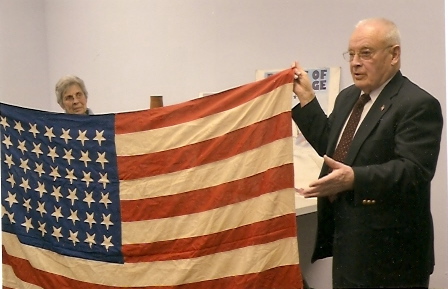
Poor mother knelt at his side trying to calm him down. We all thought that Dad passing away in front of our eyes. It took months for Dad to slowly recover, his liver had been badly affected and he had to be very careful as to what he was eating. Two days later we were liberated. What a joyful yet scary day!! We children did not know that Mother had made a vow to sew a Unites States Flag, which would fly on the house at liberation. We found out after liberation that at night, when she was sure that the German guard was asleep, she would pull out her little foot pedal activated “Singer” sewing machine and would sew parts of the U.S. Flag, which she would hide under the floor of her bedroom, she had loosen a board in the floor and had a small piece of furniture sitting over the loose board. Mother knew the Flag had thirteen stripes and forty eight stars,(Hawaii and Alaska were not States at that time) however Dad being a prisoner in Germany could not tell Mother that the U.S. Stars were to point up. So I have the only U.S. Flag made during WWII and hidden from the Germans, which has Stars pointing down. What a treasure !!
On 5 September 1944 Mother came back on bicycle, she was all excited. She had heard in the village that the U.S. troops were coming, she rushed home and told me to go in her room, slide a certain piece of furniture aside, lift a floor board and find a U.S. Flag and raise it on the third floor over the front entrance. All of us were so proud to see our Flag on the house for the first time in more than four (4) years. She then quickly went back to Wavre to find the first American soldiers. Within an hour or so she came back in total perspiration, she was pedaling her bicycle as fast as possible. She shouted to me : ” Christian take the Flag down, they are three German tanks at the end of the driveway; luckily for us the driveway was in the woods and was sinuous, the Germans could not see the house from the road. You never saw a skinny sixteen year old climb up three stories as fast as I did. I can tell you that Mother’s Flag was taken down and I did not fold it according to the Flag rules, it was rolled in a ball and shoved under the floor as fast as my two legs could get back in my parents bedroom.
That was a close one !! If the Germans had seen this Flag they would have blown the house down and Mother would have been executed on the spot. In October two (2) Batteries of British Ack-Ack = Anti Aircraft Artillery were moved one in front of out home and the other about a mile at the back of the house. The Battery in front of the house was about fifteen hundred (1,500) feet from our home, this Battery was run by men, while the other Battery was run strictly by British women, who did not know that our home was in the woods. The first morning they fired their three point five (3.5″) inch guns, which have to be cleared every morning, right over the house, what a surprise to suddenly receive a rain of shrapnels. Luckily none of us were injured. Mother took her bicycle and went to see Major John Spence, the commander of the closest Battery, she offered the house as billets for the men. Mother was astonished to see this very young Major pull out his map and very politely say :” Sorry Lady no house is located on my map.”. Mother who was known to be a crack shot and good hunter, was very familiar with maps. She pointed out to the Major that his map was dated 1917 and that her home had been built in 1923. was not there, however I do remember Mother’s comments about her first interaction with Major Spence.
He was most polite, however Mother could read his body English, which said :” This lady does not know what she is talking about. She offering to lodge the men of my battery at her home.” Apparently Major Spence said :” Would you mind if I followed you to the house? He called corporal Ginger and asked him to get the “Jeep” to follow the lady on bicycle. Mother was waiting for the moment he would see the house. It was a huge four (4) story castle with full cellar. Mother always chuckle about John Spence’s reaction when he got out of the “Jeep”. From that day on and until mid December, at six thirty (6:30) AM lorries would come and pick up the day shift of soldiers and at seven fifteen (7:15) AM the lorries (British way to call a truck) would be back in front of the house and the night shift would unload November 1944 saw a great deal of activity. The “V1″ = Buzz bombs were increasingly passing over our area and the two British Royal Ack-Ack batteries were very busy firing their 3.5 inch guns. Christmas eve was very exciting, it was cold, foggy, and very dark, when around six (6) PM we heard a V1 coming at excessively low level, the explosive propulsion device ( It had not engine) was blasting the noise was very unusual. All the British soldiers were shouting :” Get a long the walls…protect yourself…” All occupied rooms has black out curtains so as not to give out our location to the German planes.
We presume, however we will never know, that due to the atmospheric conditions, the freezing mist must have iced up the stubby wings of this unmanned Buzz Bomb. Resulting on the weight of ice forcing the “V1” to slowly propel itself down. My brother Louis jumped on the dining room window sill and placed himself between the curtain and the window pane, while my brother Peter and I ran out the house. Within seconds the “V1” flew at tree top level over the castle and crashed unluckily a half mile down the valley, hitting three (3) little game keeper’s houses, which simply disappeared. We never found a trace of the bodies, which were blown to pieces. When the V1 blew up I saw my brother Pete’s hair go straight in the air; the deflagration was so powerful, it was similar to a sudden wind. We ran back in to the house to find Louis still standing on the windowsill, he was white as a sheet and was covered with glass. The V1 blew many windows that evening. The miracle was to see Louis standing in front of a wide opened space and without a scratch
The news from the battle areas were not encouraging. The von Rundstedt offensive was in full swing, thousands of United States soldiers were severely affected by the intense shelling of Saturday !6 December 1944, these men had lost the ability to speak, they were human zombies, it was so sad to see human bodies both exhausted physically and mentally. The very large “Petit Seminaire” High School in Basse-Wavre, which was only five (5) miles from our home, had sent all their boarding students home and every dorm, class room, and study rooms were full of “Shell Shocked” soldiers. I remember going to Basse-Wavre and not being able to understand the tragic sight. It was awful. At the same time we saw our Ack-Ack batteries dig deep holes and relocate the 3.5 inch guns so that their gun barrels were able to traverse to a level, which would permit them to become anti tank guns.
In other words the allies honestly thought that the Germans were going to cross the Meuse River and head for Brussels and Antwerp. Thanks to the fighting spirit of small teams of United States soldiers, the von Rundstedt Offensive also called the Ardennes Battle or the Battle of the Bulge, by the end of December the German advance was stopped. As an historian I could spend days recounting the exploits of many of these teams; such as such as Lieutenant Lyle Bouch of the 99th Infantry Division, the eighteen men (including Chester Wenc) of the 106th Infantry Division who fought in Spineux, the 82nd Airborne Division ( Including Herbert H. Adams) battle in Cheneux, etc… One should know that I personally disagree with the Washington, DC. “Desk Jockey” who declared in 1945 that the Battle of the Bulge ended on 25 January 1945.
We all know when it started, namely, Saturday December 16, 1944, when the von Rundstedt Offensive started around 5:30 AM. by an intensive shelling of our thinly spread front lines. The end of the Ardennes Battle = Battle of the Bulge was to occur on the day the U.S. Army had pushed the German army back to their original line of attack, which by the way was along and in some place beyond the Siegfried Line, Since I was in Belgium and toured on bicycle most of the Battle Fields and since I know the Belgian language fluently,even to the point that Belgians have a hard time believing that I was born a United States citizen on January 24, 1928, I can assure you that the Battle of the Bulge ended on February eight ( 02/08/1945) 1945, that was the day the last German was pushed out of Belgium and the Grand Duchy of Luxembourg.
World War Two ended on May 8, 1945 or two days short of five (5) years of war for us civilians. Dad returned to the States in November 1945 to restart the Hammond Organ business. At the time one had to turn in his or her passport on arrival and ask to have it back so as to be able to leave the United States. As he asked for his passport Mr. Silverman a typical Washington bureaucrat of the State Department, told Dad that he had been too long out of the States and needed to prove his devotion to Our Country; therefore he had to live at least two years in the States before getting his passport back. Luckily Dad was a good friend of senator Brian McMahon, who accompanied Dad to Mr. Silverman’s office. It should be known that the Senator had a good old Irish temper and his language was full of words usually not used in the company of ladies, The Senator entered the office, slammed his fist on Silverman’s desk and shouted at the top of his lungs : ” Tell me sir what you were doing all through the war, while this man was in concentration camp in Germany and later condemned to death for helping U.S. airmen escape out of Belgium and back to England??.
Let me answer that question for you. You were sitting on your big fat … behind this …… desk doing nothing. Now you get this passport to this hero in two minutes or I will see to it that you are fired.” Dad told us that this bureaucrat only words were ” Yes Senator, Yes sir !” and he handed the passport to Dad. In 1946 Dad built a large manufacturing facility in Bierges. This was an American plant with the very first fluorescent lights in Europe, it consisted of a very modern foundry and a large machine shop, where he manufactured and assembled refrigeration compressors. The name of the company was National Electro Construction, which later sold to Phillips the well know company, whose headquarters are in The Netherlands. Dad would come back to the Unites States at least twice a year. On one of his trips he contacted Mr. Smith the CEO of National Milkers in Des Moines, Iowa and made an agreement to manufacture and sell milking machines in Europe.
Dad built another factory on the outskirts of Wavre, Belgium along the highway leading to Namur. This plant was also called National Electro Construction. In 1952 the U.S. Embassy in Brussels notified Dad that he had been very lucky in WWII, however he was advised to take his family and leave Belgium. At the time the communist regime in Russia was threatening to invade western Europe. Dad decided he had spent too much time behind barbed wires. This was terrible for poor Mother, she would have to leave two daughters, who had married Belgian citizens. In March 1953 the family moved to Lakeville, Connecticut, by June 1953 they had bought a home in Taconic, Connecticut.
By that time the nine children were in or heading for the following: (1) Christian was working as a farm hand in Mill River, Massachusetts. (2) Francoise was married to Ghislain de Halleux, a Belgian Agricultural Engineer, (3) Myriam was married to Jean Moncheur de Rieudotte the youngest mayor of Belgium, (4) Anne was accepted at the University of Connecticut, (5) Louis had been accepted at M.I.T. in Cambridge, MA. (6) Peter had been accepted at M.I.T. in Cambridge, MA. (7) Beatrice was registered Salisbury Regional High School, (8) Jacqueline was registered at the same High School, (9) Baudouin (Butch) was in Brule, Wisconsin completing the eight grade. Dad passed away on March 10 1984 in Taconic, Connecticut Mother passed away on February 6, 1986 in Taconic, Connecticut. Respectfully submitted by Christian W. de Marcken, who has been for the past decade the Secretary & Historian of Chapter XXII, Major Lamar Souter M.D., Central Massachusetts Veterans of the Battle of the Bulge, whose President is Doctor John E. McAuliffe, DDS Ret.
Jerry remembered that while flying towards Utah Beach in Normandy in the very early hours of 6 June 1944, he saw two paratroopers at the door of his plane being sucked out of the plane by the deflagration caused by the exploding German Flack shells = anti aircraft artillery shells. They were never seen again.
At one point during the battle of Saint Mere Eglise on 8 June 1944, an Officer was calling for three men and a Medic to volunteer for a very special mission, Gerard Baszner was chosen not only because he was a Medic, but also because he was small and skinny; the task required a Medic capable of going into the Church tower and climbing out a narrow church window, where the stain glass windows had been before they were blown out during the bombing of the area.
Most people remember seeing pictures of the Sainte Mere Eglise church steeple, where still today a fake U.S. Paratrooper is still hanging by his parachute. Soldier John Steele was injured by the German as he was coming down over Sainte Mere Eglise in Normandy on “D” Day. His parachute unluckily hooked itself to the church steeple.
Gerard Baszner was the Medic who went to the rescue of the paratrooper, who was injured in the hip and the ankle, the injured soldier was dehydrated, Jerry immediately gave him an I.V. ( Intravenous) shot, then he dressed his injuries the best he could and with the help of the other paratroopers cut the parachute lines and brought down soldier John Steele, who survived the ordeal.
Gerard J. Baszner remembers fighting in the Normandy “Edge Rows” These are little fields and pastures surrounded by raised earth, which with time have been covered by bushes and trees, These edge rows were a nightmare for our Infantry and Armored vehicles, they were literally natural anti tank barriers; the Germans could hide machine gun nests and ambush our infantry soldiers. He was going from one injured soldier to another, he was taking care of their injuries, when all of a sudden his patient said: ” Look this German soldier just slit the throat of one of our fallen men and he is pulling a ring off the finger and going through his personal belongings, take my rifle and kill him” Jerry answered :” I cannot fire a weapon, I am a Medic”.
The response of the injured soldier was :” Your job is to save my life ! “Are you going to let this German kill us ?” Jerry realized that he had no choice, he took the rifle and fired three bullets in the German’s chest. Jerry then ran to see what the German was really doing, sure enough he found out that the Kraut had slit the throat of one of our soldiers and had already collected watches, rings, etc.. from dead Americans. Then Gerard Baszner added ” I had no remorse, I had done my duty to protect my injured fellow soldiers.” After the battle of Normandy the 505th P.I.R. was sent back to Nottingham, England for more parachute training. On the second training jump Jerry was badly injured, a knee injury which was serious enough not to allow him to be a paratrooper. He was transferred to the 130th General Hospital, which specialized in treating “Shell Shocked” infantry men.
Before ending the Paratrooper episode, I should mention that the original encounter between Gerard J. Baszner and the 82nd Airborne Officer was at Nottingham, England. Also it should be known that they were two reasons Jerry was injured during his last training jump. First the wind was much too strong and secondly paratrooper always carried excessive loads because they were always landing behind enemy lines. In this case Jerry was carrying extra medical supplies in a special leg bag, unluckily due to the wind and the prop-wash his leg bag wrapped around his leg and when the parachute snapped open all the muscled above and below the knee were stretched and damaged. Jerry was a patient of the 312th General Hospital. As he could not run and kneel he was removed from combat duty and transferred to the “Red Ball Express”. This very large outfit was a transportation unit, created by General George S. Patton, who wanted to give top priority to the transportation of supplies to the front line troops. General Patton wanted to have fuel, ammunition, weapons, and food provided on a twenty four hour per day system. He ordered a circle “Red” steel plate attached to the front of each vehicle assigned to the “Red Ball Express.”
The MP ( Military Police) soldier, assigned to any intersection, was given orders to wave through any vehicle carrying this insignia. Example: If a jeep carrying a General and a “Red Ball Express” truck arrived a the same time a any crossroad, the MP waved the truck to pass first. Gerard Baszner remembered driving a two and half ton truck, he was assigned to move gasoline and ammunition from Omaha Beach to the front lines. One day one of the front wheels of his truck slid off a LST (Landing Ship Tank) ramp, he had to have his truck towed off the ramp. As his knee muscles improved Jerry was reassigned to the 130th General Hospital, which specialized in treating “Shell Shocked” soldiers. He remembered going to Spa and also to Liege to get supplies from the 98th General hospital. The 130th General Hospital was moved to the Mont de la Salle Seminary in Ciney, Belgium, where it stayed until VE Day, which means Victory Day in Europe or 8 May 1945. Because of his experience Jerry was assigned to the operating room and he was also responsible for the central supply of the unit.
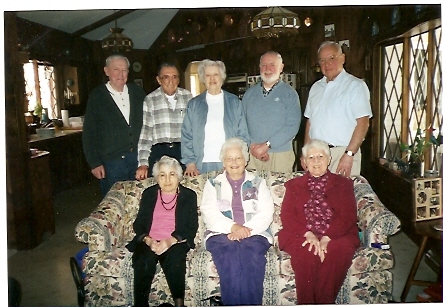
Standing (l-r):
Woody Ford, Medic, 107th Evacuation Hosp
Gerard Baszner, Medic, 505th PIR
Rose Dewing-Young, Nurse 130th Gen. Hosp.
John Delmore (Brother was in the 99th Inf. Div.)
Christian W de Marcken in our kitchen in Paxton, MA
Sitting (l-r):
Helen Najarian-Rusz, 59th Evac. Hosp.
Dorothy Taft-Barre, 16th General Hosp
Marjorie Baszner
LAKELAND | Seventy years ago today, 200,000 German soldiers and 1,000 tanks went across a 75-mile stretch of land in Belgium, Luxemburg and France, catching off guard four divisions of the U.S. Army.
by Bill Rufty, The Ledger read story
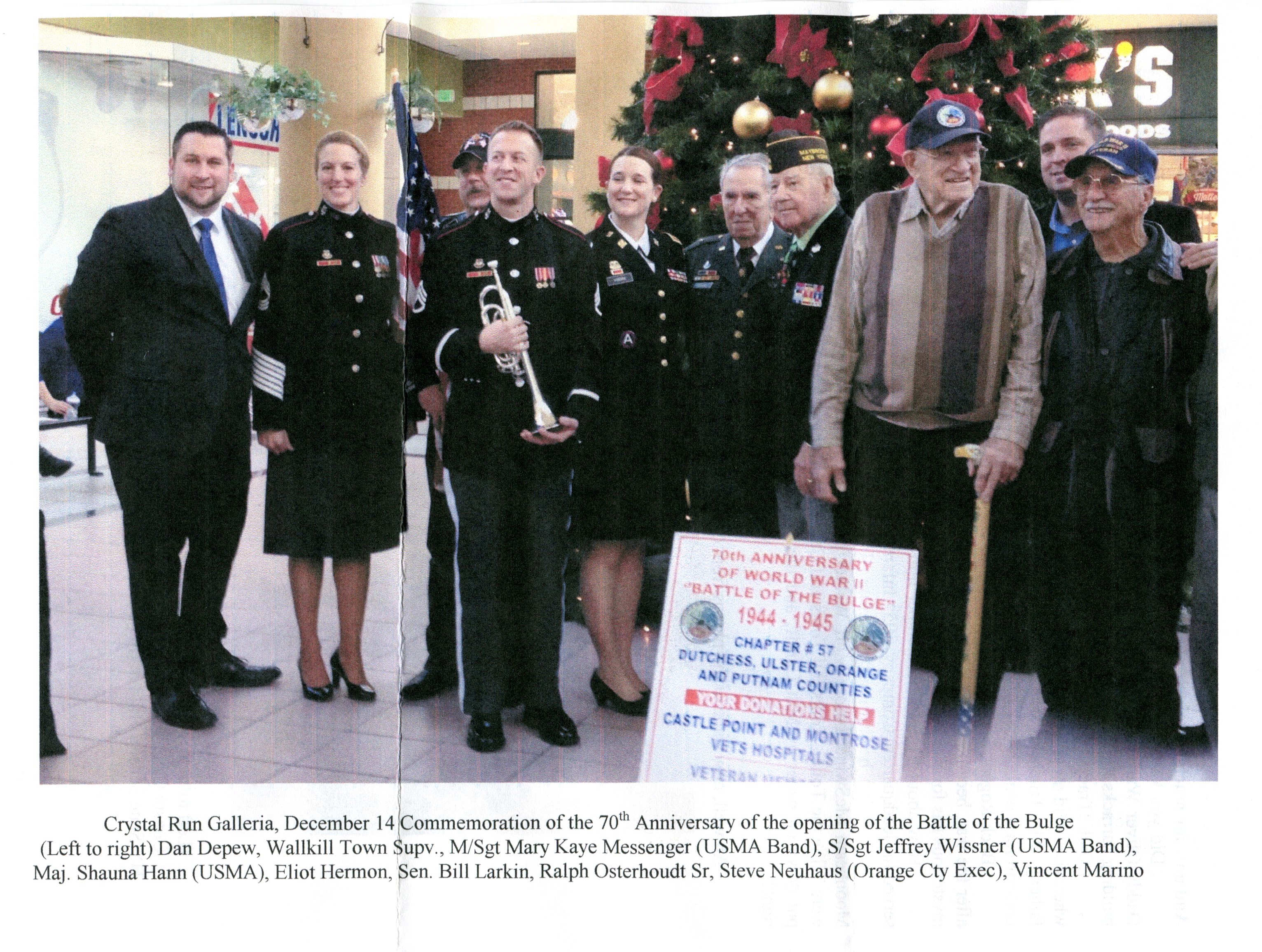
Chapter XXII was created by Doctor John E. McAuliffe, roughly twenty two years ago. Doctor McAuliffe was a Dentist and has devoted his retirement years to educate the general public not only by writing articles concerning the Fallen Heroes and the Veterans of the Battle of the Bulge: but also in the past twenty and some years he has been the President of Chapter XXII. He has led his team to hold at least three annual formal meetings a year, he planned, and organized special events, which were dedicated to erect Memorial Monuments, such as:
(1) VBOB Monument at the Massachusetts Veterans Memorial Cemetery in Agawam, Massachusetts.
(2) VBOB Monument at the Massachusetts Veterans Memorial Cemetery in Bourne, Massachusetts.
(3) VBOB Monument at College Square in Worcester, Massachusetts.
(4) VBOB Monument at the Massachusetts Veterans Memorial Cemetery in Winchendon, Massachusetts.
(5) VBOB Monument in Honor of the “Wereth Eleven”, who were tortured and massacred by the German SS on Sunday 17 December 1944 in Wereth, Belgium. Monument was inaugurated on August 20, 2006 at the Veterans Memorial Cemetery in Winchendon, Massachusetts.
In the past six months Chapter XXII had:
(1) A regular meeting at the Museum of Fort Devens, in Devens, MA.
(2) A very special meeting at the Winchendon Cemetery initiated by the Commonwealth of Massachusetts State Representative S. Harrington, attended by five State Representatives, the State Commissioner of Veterans Affairs, and all branches of the Services in uniform.
(3) A rededication of the Holy Cross VBOB Monument on November 11, 2014 Attended by six State Representatives, one of whom was a guest speaker, the Navy Commander of the Holy Cross ROTC, also Lt/Colonel Ciro Stefano, Commander of the W.P.I. Army ROTC in Worcester, MA., who was the main guest speaker, and the President of the Holy Cross College and many veterans.
Beside the above the Secretary of Chapter XXII was invited by the Junior Air Force ROTC to participate in five question and answer sessions pertaining to the Battle of the Bulge; each session lasting an hour, these were held at the South High School on Apricot Street in Worcester, MA. On March 4, 2015 Chapter XXII was asked to participate in a question and answer session by the West Boylston Historical Society. twenty eight members asked questions from 7:00 to 8:45 PM. This coming Friday March 20, 2015 Chapter XXII will be at the Fort Devens Museum to answer questions from the students of the eight grade class of the Brookline High School, who will be coming from Brookline, New Hampshire. In the last two years Chapter XXII members have attended ceremonies and High School programs at:
South High in Worcester, MA
Shirley, MA. High School,
Ayer, MA. High School,
Paxton, Ma. Junior High School,
West Boylston, Ma. High School
Littleton High School.
Respectfully submitted. Christian W. de Marcken Associate member # A015390 National VBOB, Associate member Chapter XXII VBOB, As a young U.S. citizen was in Belgium all through WWII, Retired Manufacturing Manager, Tufts University Mechanical Engineer 1960, U.S. Army veteran.
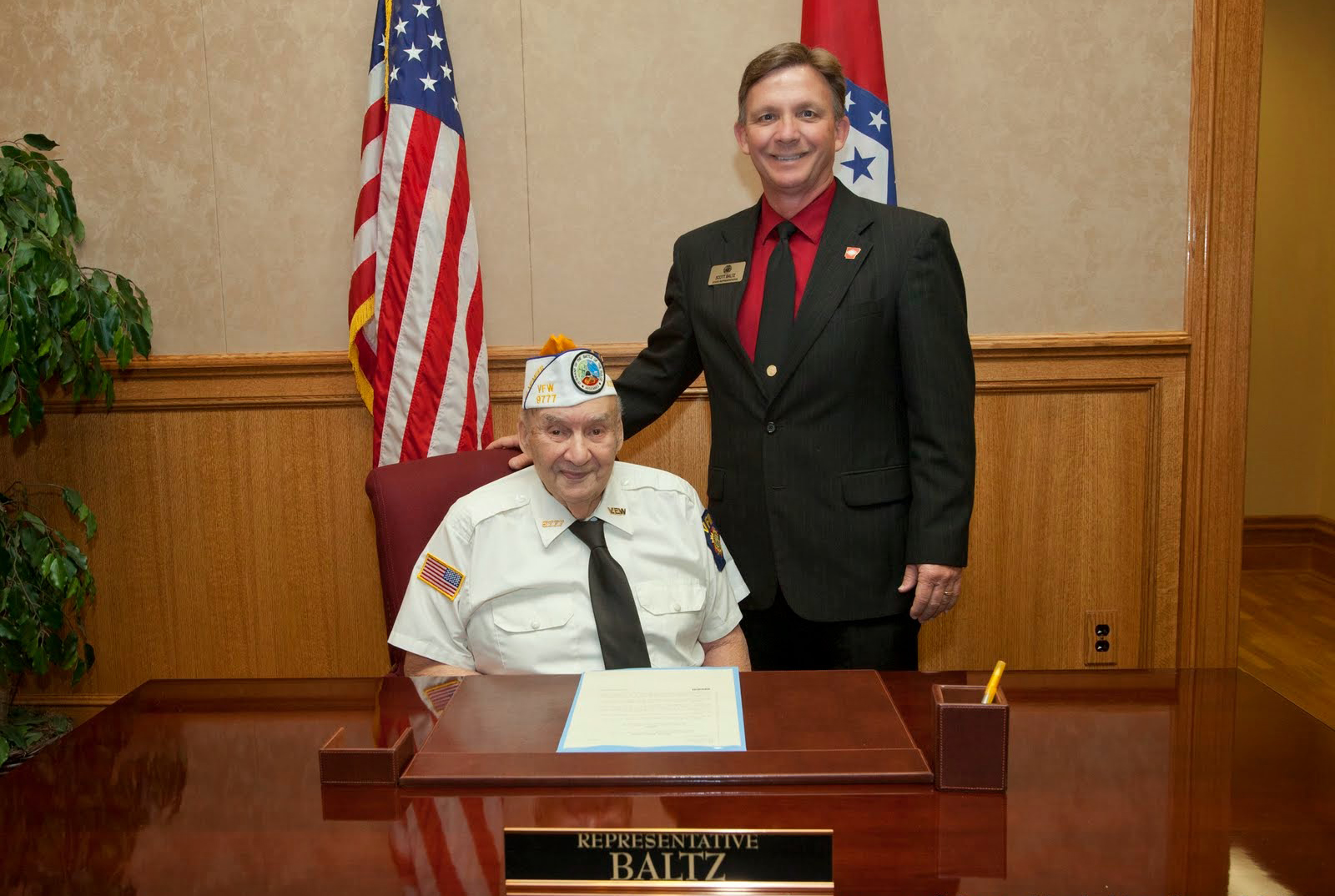
On January 27, 2015, Rep. Joseph Scott Baltz, of the Arkansas House of Representatives, presented House Resolution 1003 to honor VBOB member William J. Strauss, 73rd Field Artillery Battalion, 9th Armored Division, for his service during WWII and the Battle of the Bulge.
Our father, Private First Class Nicholas Zillas, was a proud member of the 285th Combat Engineers in the Battle of the Bulge. Dad lived his life with a love of God, country and family. Dad instilled a deep degree of patriotism in his four children.
Dad marched yearly in the New York Veterans Day Parade, as well as in the Memorial Day Parade in Douglaston, New York well into his seventies until medical issues prevailed. Dad was also a secretary for many years for the 285th Combat Engineers, as well as the editor of their newsletter.
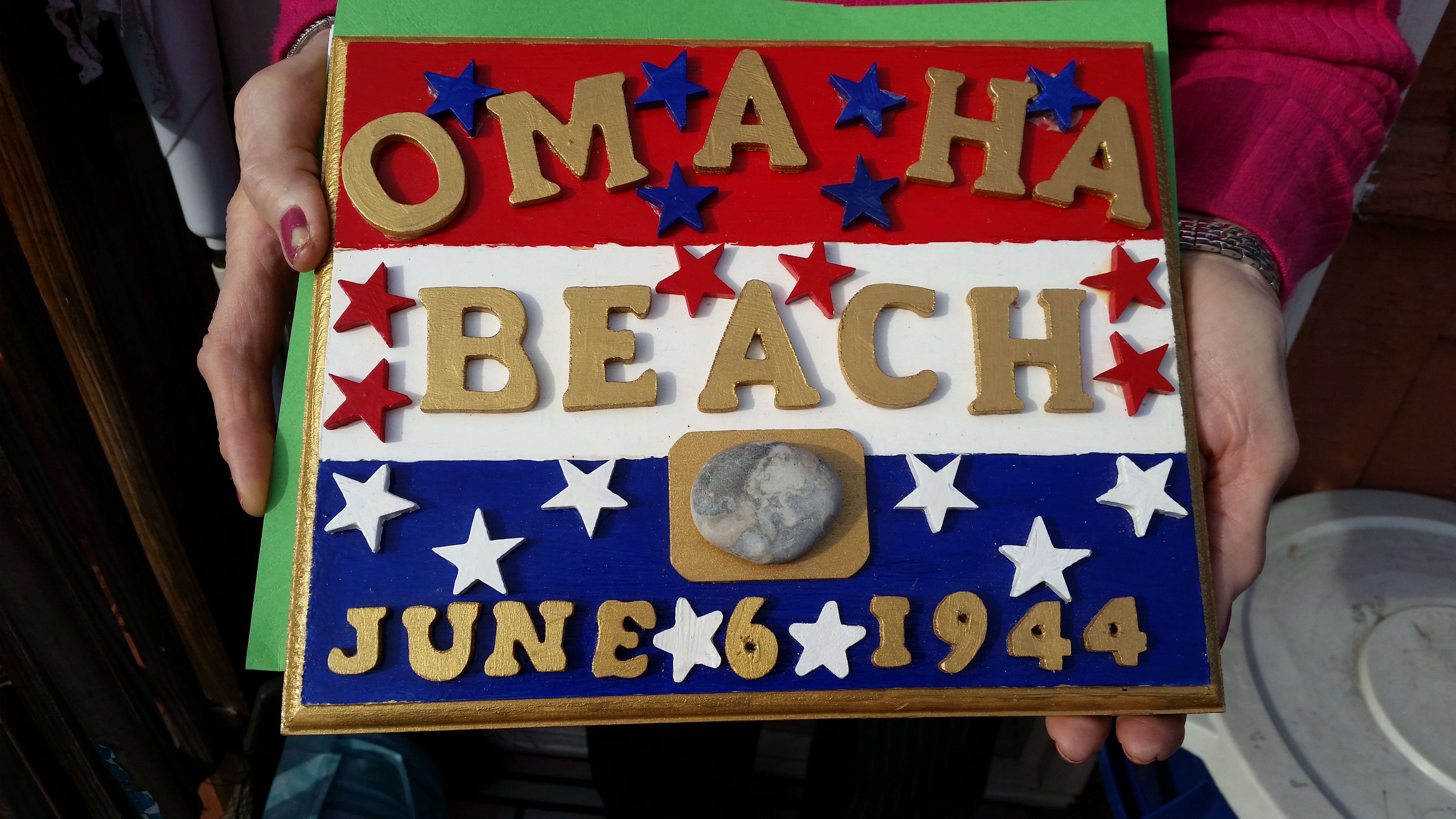
After the horrific events of 9/11, Dad was upset and saddened by what had occurred, not only to New York, but to the country. Dad began to channel his energy into creating patriotic wooden plaques, which he gave to family and friends. Dad began to create one that he was dedicating to Omaha Beach.
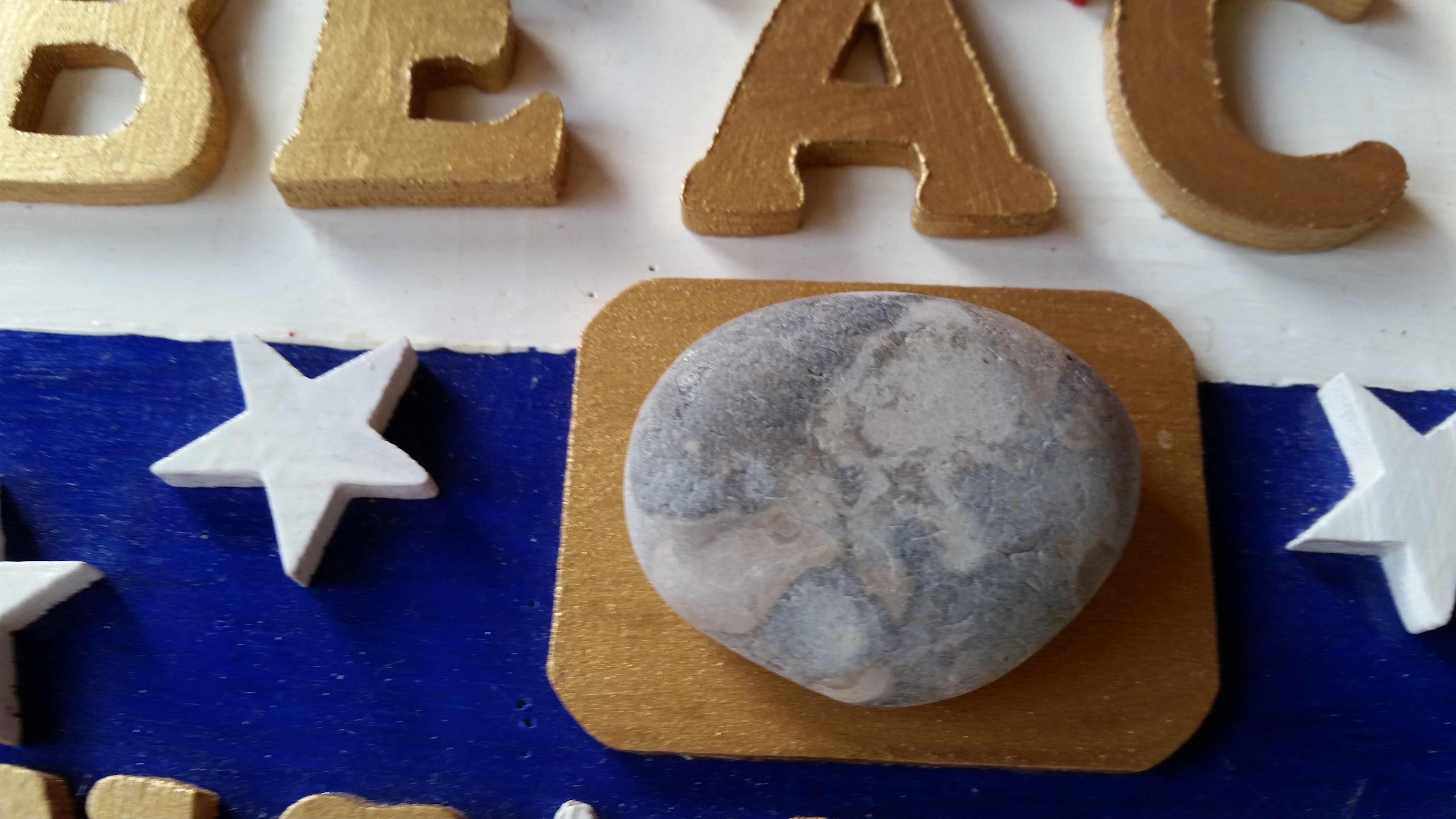
Years prior, a friend of Dad’s had gone to Omaha Beach and returned with some stones he brought back as mementoes. He gave the stones to another gentleman who then gave them to Dad, as he knew of Dad’s abiding patriotism.
Our mother, Bessie Zillas, related to us that Dad had asked her which of the two stones should he place on the Omaha Beach plaque. Mom chose one of the two and Dad proceeded to create the plaque.
Days later, he brought the completed plaque to Mom and she was startled by what she saw. On the stone was a figure of a soldier complete with both his jacket and helmet. Mom thought that perhaps what she was seeing was a figment of her imagination, but as she showed it to other people, they all agreed there was a figure of a soldier on the stone.
Mom feels, to this day, that a solider left a part of his soul on the stone from Omaha Beach.
Dad passed away on October 14, 2011. Dad was very adamant that he wanted to be laid to rest in a military cemetery and he was. We salute Dad and all veterans both past, present, and future. May God bless them and our country and may their memories be forever eternal.
The above was submitted by Athena Zillas Carr, daughter of Bessie and Nicholas Zillas. Bessie welcomes callers and may be reached at her home number of 718-463-1321.
Gerard (Jerry) Baszner was born in Whitinsville on 8 May 1925. His mother was Aurore M. Lapierre and his father was EdgarP. Baszner, who was the Controller at the Foundry Office of the Whitin Machine Shop, which manufactured textile machinery. Gerard had one brother, who was one year older and one sister ten years younger. Gerard and Marjorie (St. Andre) married on 21 September 1946. They have two daughters, Andrea Mae born in December 1949 and Gail Marie born in October in 1951.
It should be noted that the U.S. Army records are mostly incorrect, they list Gerard J. Baszner as “Gerald J. Baszner.” Marjorie Baszner recalls that young married they could not afford a home, they lived with his parents; they survived on her “Minimum wages” while Jerry was attending the College of Pharmacy at Wentworth Institute in Boston. He pursued a Degree in Pharmacy thanks to the G.I. Bill of Rights. He later transferred to the Boston School of Pharmacy on Beacon Hill. He graduated from the New England College of Pharmacy in 1950.
Gerard was inducted on 20 August 1943 and entered active service on 20 August 1943 at Fort Devens, Massachusetts. From there he was moved to Camp Grant located in Rockford, Illinois; from there he was sent for further training as a Medic, from 7 January to 1 April 1944, at Walter Reed Hospital in Washington, DC., where he successfully completed the ” Enlisted Specialist Course for Medical Technician”. Then he was assigned to a Rep. Dep.,( Replacement Depot.) Unit, which left for England on 29 April 1944. His unit crossed the Atlantic Ocean on the SS Washington.
He was a member of a large group of Medics, who were shipped to England, where the Medics were assigned to various U.S. Army units spread all over England. Finally only six (6) Medics were left of the roughly four hundred who had arrived in Liverpool, England. The handful of Medics were kept busy by performing non medical duties, such as KP (Kitchen Police = Cleaning trays, dishes, pots and pans.) Jerry told his buddy that he had enough of this nonsense and was going to volunteer for the next job, what ever it was. He did not have to wait too long and a call came for a volunteer. At this time it should be noted that Gerard J. Baszner was a very young man, he was not very tall, he could even be called skinny, and he wore glasses.
The sergeant in charge ordered Jerry to gather his gear and get into the back of two and a half ton truck, which the soldiers called “Deuce and a half”. Dusk crept in and the truck drove off to “Who knows where ?” After quite a while the truck stopped and Jerry was told to get off and jump into another truck, again he was not told where he was heading for.
Some time during night the truck stopped in front of an “Orderly room”, which is usually the main office for a Company. A sergeant ordered Jerry off the truck then opened the door of the Orderly Room, and Jerry faced an Officer sleeping at his desk. As he woke up the Officer looked at Gerard Baszner and said :” What are you doing here?”. Jerry responded: ” I do not know Sir, I have no idea where I am Sir.” Gerard was asked if he always wore glasses. His answer was :”Only when I want to seen Sir!” The Officer immediately shouted :” No one in my unit wears glasses.”
At that time Jerry realized he was facing an 82nd Airborne Officer, who then asked him what was his MOS, ( Military Occupational Specialty.) which is the specific number assigned to each and every enlisted man’s military skill; in this particular case it was the MOS assigned to all “Medics” When the Officer heard this number, he immediately knew he was talking to a “Medic”. It should be noted that very few Medics volunteered to be paratroopers. The Officer’s next sentence was :” You are now a paratrooper!”.
This of course was not at all what Jerry wanted to hear. The next morning he was shown how to drop and roll, then ordered on a truck, which had the tail gate open, as the “Deuce and a half reached the speed of five (5) miles per hour, Jerry was ordered to jump off the truck. This went on in increments of five miles. By the time he successfully jumped out at thirty five (35) miles per hour, he was tapped on the shoulder and declared a “Paratrooper”. That was the total extend of Jerry’s ground training. Since he never had any formal training, another paratrooper folded the parachute for him. An ingenious sergeant took some good old American “Duck tape” and taped Jerry’s glasses to his face.
The criss-crossing of the tape only left two (2) little holes through which Jerry could see. The next he knew was that he was fitted with a parachute and was told to climb in a C-47 “Dakota” twin engine transport plane. Jerry told us that he was scared to death and was not at all ready to jump out of the plane. He was shown how to hook up to the cable stetched along the ceiling of the plane, this would assure that his parachute would be pulled out as soon as he left the C-47. Jerry went on to say that he was more than frightened and was not about to jump out, when the jumpmaster literally kicked him in the butt, and that really hurt, said Jerry. He was thrown out of the twin engine and fainted. He only woke up as he hit the ground.
This very scary training was repeated another time. Again Jerry suffered through the same exercise. He now was officially a Paratrooper/Medic of the 505th PIR = Parachute Infantry Regiment of the 82nd Airborne Division. His third (3rd) Jump was early morning ( around midnight) over Utah Beach, Normandy on 6 June 1944 also called ” D Day.” Usually the C-47 flew between 600 and 800 feet above ground level; on 6 June 1944 the German “Flack” = anti aircraft artillery at Omaha and Utah beaches were so intense that the C-47 planes were flying at 400 feet. Jumping at that altitude is very dangerous, the parachute has barely enough time to deploy before the paratrooper hits the ground.
This very exceptional story was told to us at 2:00PM on 27 September 2001 by Gerard and his wife Marjorie Baszner, who lived at 100 Benson Road in Whitinsville, Massachusetts, 01588-1202, U.S.A.