Monthly Archives: August 2018

Wading Endlessly Through Mud and Snow

By Carl Hall, 99th INFD, 395th Inf. Regt., Co. C, HQ Co. 1st Bn

It was a cold six hours that we spent on the pier at Southhampton, and to many of us it seemed like we had been there a week. Just before noon we boarded the Queen Emma for our trip across the channel. Most of us slept in hammocks for the first time in our lives that night. We were all worried about falling out, but I guess we were so close together that we couldn’t have turned over if we tried.

Those of us who didn’t get to see the results of the blitz in London got our first glimpse of the destruction brought by war when we sailed into Le Havre, France. There wasn’t a building left untouched. We landed on small boats and made our way through the rubble of the harbor to the trucks that were waiting. That night we travelled in convoy to La Feuillie, where we went into a bivouac area. We stayed there one night and on Nov. 5th (1944) at 0600 we entrucked again and travelled 256 miles to Aubel, Belgium. In a woods just outside of Aubel, we set up a bivouac area.

On Nov. 9th, we again entrucked for the ride that brought us to Elsenborn, and the front lines. It was a miserable day, and before it was finished we found ourselves walking around in a foot of snow. It was the truck ride and the next few days without overshoes that gave many of us a headstart for a bad case of trench foot. As time went on, we came to find out that trench foot and frostbite were going to give us more trouble than the Jerries. On Nov. 9th we relieved the 102nd Cavalry and took up a defensive position in the snow-covered foxholes of Elsenborn. We were on line now and there was an enemy to our front who would kill us all at their first opportunity. Yet the snow seemed so clean and the woods so quiet and beautiful that it was hard to believe at first.

It became a reality, however, on Nov. 11th, Armistice Day, when a recon patrol of 13 men and one officer made contact with the enemy a few hundred yards beyond our positions. In the firefight that followed, 12 of the enemy were killed or wounded and our patrol returned unharmed. The patrol was the first unit in the division to make contact with the enemy, and they were personally commended a few days later by Maj. Gen. Lauer and Col. McKinnsey.

We did a lot of patrolling while we were dug in this defensive position, and only through the good leadership of the officers and non-coms and by the expert soldiering of the men were our casualties kept so low.

The 393rd relieved us on Dec. 11th. We withdrew to an assembly area and on the following day we jumped off into the attack. For the first few days the going was exceptionally rough. In the first day A Co. was in battalion reserve. The battalion advance was made through heavy woods that were littered with fallen trees. The area had been pounded with artillery fire many times when C Co. was giving support to our patrols, and the trees were twisted in every direction. The weather was cold, the terrain was rough, and the ground was covered with a heavy blanket of snow. On “Purple Heart Hill” the artillery fire was extremely intense. At this time, we had no roads up to us and the ammo and rations had to be forwarded by carrying parties.

It has been said that the people who have never been over there and actually been in combat can’t begin to imagine what it was really like. Such a remark is truly an understatement. Probably it is because there hasn’t been a person yet who could write an article and really portray the scenes as they actually happen.

We can say that there was snow on the ground, but we can’t visualize men with wet, cold, swollen feet trudging through the snow-covered woods, expecting any minute to be shot at and maybe killed. We can say that the hill was steep, but we can’t imagine men climbing almost straight up. Wiremen struggling along with rolls of wire, taking one step forward and sliding a half step back. Medics carrying dead and wounded on stretchers, and taking hours to go up or down over the snow-covered hills. Many a wounded man has died because the terrain was so rough that an ambulance couldn’t get to him to evacuate him immediately.

We can say we crossed a small stream, but we can’t imagine how cold it was for the men who waded through the cold water up to their waist, and then shivered and froze the next few days because there were no dry socks or clothes for them to change into. They say in the papers that the action on a certain front was confined to patrols, but they don’t add that half of the outfit were on patrols, and their buddies were sweating out whether they would get back or not. The records read that we withdrew seven miles, but they don’t say that it was at night, in pitch blackness and that the men were stumbling and falling every few steps, and that the fellows hadn’t slept in 24 hours or eaten in just as long. It doesn’t tell about the big fellow who says he can’t go another step and then looks around and wonders what is keeping the little fellow next to him from falling out. It says seven miles, but it doesn’t mention about going cross country, being lost and wading in mud another five miles, or about receiving an inaccurate order and adding another extra three miles more. All those things were omitted, because it is hard to write them and write the truth.

At 0600 on Dec. 17th word came down to prepare to move out. There were many rumors around about a counter-attack that had not been stopped yet. As time went on, we found out that this unchecked counter-attack in reality was the famous Von R. winter offensive, or as it was later called, “The Bulge”. The breakthrough came all along the 99th and 106th division sectors on our right flank. It left us sticking out into Jerryland like a sore thumb, and we were ordered to withdraw before we were cut off. Our next few days were to show us some of the roughest going that we experienced in the entire winter campaign.

The snow was knee deep, all the men were wearing overcoats, overshoes, three or four sets of clothing, and they were carrying two bandolier of ammo, two hand grenades, and full field rolls. At about 1000 we started our withdrawal. It was very orderly when we first started out, but as we went up and down one hill after another, the men became tired and began to lag. The men carrying the machine guns, mortars, flamethrowers and those carrying ammunition began to drop back. The equipment began to get awfully heavy and the men started leaving it along the way. Bed rolls and overcoats were the first things that were discarded, and then some of the men ditched their overshoes. We couldn’t throw away any rations because we didn’t have any. For two days and nights we walked. The first day and most of that night, we withdrew from Hellenthal to Rockerath.

The men were dead on their feet. You heard no bitching, though, nor any of the usual bellyaching. You could have fallen out any time you cared to, but there were no medics behind you to pick you up — just Jerries. It is really amazing what a man can do when all his energy is gone. He can still go a long way on “guts”, and that is what we were travelling on then. We ate what we could pick up along the road. K ration crackers that had been thrown away and trampled on by those who had left before us all tasted good. We passed near an old kitchen dump, and if there was any food at all that looked edible, we picked it up. In one dump, a dog beat me to some hotcakes that were sitting on top of the garbage. Whenever we stopped for a few minute break, we looked in all the foxholes along the way and picked up whatever we could find to eat. All during the retreat we had no water, and water was obtained from the most unhealthful places. Halazone tablets were used to purify the water. I imagine that all this sounds a bit fantastic to some people, but nevertheless it is true. It doesn’t compare, however, with what the men went through who were withdrawing and fighting at the same time.

On the second day, we withdrew another five miles to the outskirts of Elsenborn. It was then we learned that the Jerries had cut our communications and had given us the order to retreat. When this information was received, we turned and traced our steps that night to within a few hundred yards of where we had been that morning. Towards mid-day we ran into sniper fire, but it was soon silenced. We moved again, this time to within sight of our former positions before we jumped off. That night at about 1800 we started out cross country back to Elsenborn. It was the last leg of our rearward journey but at the time we didn’t know it.

The 1st platoon of A Co. was the point for the battalion, and as we withdrew, we passed a few engineers and a couple of tanks. The tanks were to protect our rear and the engineers were laying mines. In combat we were all buddies. Seeing a Col. carrying a Pfc’s BAR didn’t astonish most of the guys. Early the next morning we reached Elsenborn. The houses were silhouetted against the sky that was lit up from the burning villages that we left to the advancing Germans. We can thank our artillery for saving us that night. They threw everything but the kitchen stoves at the Jerries.

Our spirits rose when we saw the houses in Elsenborn. Just think — houses with nice soft, dry, wooden floors. No snow, and walls to break the wind. “This would be great,” we said to each other — but was it? We marched, or should say struggled, down the main street of town. “Our houses must be on the other end of town,” we thought, but we were still going and the houses had disappeared behind us. What now? We just couldn’t go any farther and they said that we were going to Elsenborn. Just out of town, we turned and started across a field. When we reached the other side, they said, “OK men, this is it.” We were stunned. We couldn’t comprehend what was going on, but we were cold, our hands and feet were numb and swollen, so we didn’t try. We just laid down, three or four of us in a bunch to help keep each other warm, and we went to sleep.

In the morning we got a hot meal. I wish that I could write the way we felt, but I can’t. We had the same feeling that morning as we had the day we overran a German POW camp and liberated our American fliers. You get goosebumps all over you, and you try to say something, but you can’t. Instead, you just stare and maybe say a little prayer and thank God that He has brought you safely through the unbelievable nightmare.

When we had finished eating, we read our mail that the mail clerk had brought up on the chow truck, and then we spread out and started digging in. It was a good thing we did, too, because we no sooner had a hole dug than some Jerry planes came over and bombed and strafed us. We stayed in the field another night while the Jerries threw in 88s at their leisure, and on the following day, Dec. 22nd, we moved to the outskirts of Elsenborn and dug in a defensive position around the town. We dug our OP’s in on high ground covering an open field of about 1700 yards. Beyond that were woods and Jerries. On the first two days that we dug in, the weather was foggy and the observation was poor. But when the fog lifted and our movements were observed, the Jerries began to shell us whenever three of us bunched up.

When the weather cleared, our Air Force came out and gave the Jerries a terrible pasting. It was the good weather and the continual bombing and strafing of the German supply lines that turned the Von R. dream into a nightmare. When the “Bulge” was stopped, the job of pounding it back into a pimple began. We were dug in on the northern vein of the “Bulge” and for the next month we remained stationary, while the units on our right pounded the Jerries back against defense.

As the days passed, we improved positions and before long, all the men had made their holes fairly comfortable. Usually the holes were long enough to lay down in and deep enough to sit up in. They were covered with boards or whatever else we could get together to make a roof out of. For Christmas, we had 88s for dessert. We were right in the middle of chow when they started coming in. Some of the fellows hit the snow and spilled their mess kits, with meals going into the snow.

On Jan. 12th (1945), we strung a double apron fence and put up some concertinas in front of our positions. That night it snowed a little, about a foot or so, and it drifted bad. In the morning, the barbed wire entanglements were out of sight and the concertinas were blown around like feathers in the breeze. It was necessary on many occasions for one of the fellows to dig his buddy out in the morning, because in some of the storms, the snow blew into your hole faster than you could shovel it out.

From our positions, we saw a few dogfights in the early morning when the Jerry air force dared to come out. Our ack-ack outfits did a bang-up job and quite a few Jerries came down to earth in flames. One morning, an FW 109 was hit and the pilot parachuted in front of our positions. He got out and started running for his own lines, but when we opened up on him with everything from machine guns to carbines, he quickly changed his mind and surrendered.

On Jan. 26th we left our comfortable quarters and, under cover of darkness, traveled about two miles to relieve the 60th Inf. of the 9th Div. We were still under enemy observation, but this time within rifle range of each other, and it was necessary to stay below the ground during the day.

On the night of Jan. 31st we were alerted, and at 0345 the next morning A Co. moved off into the attack. It was very difficult to see across the open space, covered and drifting with snow. Each man had on a snow cape and some even had their rifles covered with white rags. Reliefs from the different OP’s would occasionally wear white capes when making changes during the day. Movement was generally made at dusk.

At 1500 on Feb. 3rd we entrucked and traveled to an assembly area near Rockerath. The woods along the roads were ruined from artillery, and the fences were lined with crosses of German dead. We were now going back through the places that had been hit the hardest during the “Bulge,” and there was nothing left. Knocked-out German tanks, wrecked vehicles, dead cows and horses, and dead Jerries littered the roads. As the snow melted, there were bodies of Yanks revealed — men who had been killed and snowed under before they could be found.

At 0730 on Feb. 4th we started moving to Hollerath. We were now just before the Siegfried Line. We heard the mission for the day. Twelve pillboxes; six for C Co. and six for A Co. That’s all, just twelve pillboxes. We passed through the many tiger’s teeth and tank obstacles, and by 1715, we had taken our objectives. We spent the night in the pillboxes and at 0800 in the morning we started forward again. At 1700 we again had our objective for the day taken and that night, we dug in on a hill overlooking Hellenthal. We were under direct enemy observation again and couldn’t move from our foxholes in the daytime. We were relieved by the 3rd Battalion and we withdrew to the pillboxes in reserve and remained there until Feb. 11th. After 94 days on the line, we were relieved by the 69th Div.

On Feb. 12th we entrucked and drove to Meyerode, Belgium on the first part of our journey back for a rest. At 0915 on Feb. 20th the company moved out from Meyerode and walked 17 miles to Malmedy. Here we entrucked and rode to Chapelle Des Anges in Belgium. We moved in and before long, we were enjoying the hospitality of the Belgian people.

We left the rest area on Feb. 27th and proceeded to Stolberg, Germany. On the way to Stolberg, we saw Aachen and Duren and they were everything that the papers said about them – just one big pile of destruction. The next morning we rode to an assembly area at Alsdorf, and made preparations for the attack. We all dug in and tried to get as much rest as possible. At 2400 we started out for the forward assembly area near Bergheim, Germany crossing the Erft Canal at dawn. We took up positions in trenches awaiting further orders.
At the time we were in reserve, the 2nd Battalion was pinned down, and the 1st was committed and went out to relieve them. With Baker Company leading, our objective was to clear the woods and then take the town of Hol Fortuna. We passed through the 8th division, and the 3rd armored was deployed on the open terrain behind us. It took us two hours to relieve Fox Company and then on to relieve Easy Company.

Early the next morning, the attack again started and we sent up a platoon to aid in the capture of the town. At about 1200 a factory had to be taken and the two platoons were sent up to take it. As they completed their operation, they noticed the 3d Armored moving across the field on the next objective. It was really a sight to behold, and the armor was on its way to make a mad dash for Cologne and the Rhine.

On March 4th we moved to the town of Anstel and between two moves, we had cleaned up various towns that the armor had gone through. After intense delaying action by the Jerries in front of the town of Delrath, the 1st Battalion finally got to the banks of the Rhine on March 7th.

We remained in this town the next two days and had a chance to get cleaned up and work on our equipment. At various times we would send a platoon out to clear a town that had been overlooked. Then on March 8th we received orders to move, not knowing where, only hoping that it would be a chance to cross the Rhine at Remagen, where a bridge had been established. On the tenth we arrived at Fritzdorf and awaited further orders. They came early the next morning and we started to walk south and east.

At about 1400 we saw the bridge. Shells were coming in fast and aircraft were strafing continually. As we approached, we received orders to run across, and after a twelve mile hike with full equipment, we knew this was the supreme test. Finally, we reached our destination of Ohlenberg —our division was the first full division to get across the Rhine.

On the twelfth of March, B Co. set up a second line of defense behind the 9th Division about 1200 yards out of Ohlenberg. Here we had the flak buzzing around us, in addition to a few bombs dropping around Ohlenberg. Several patrols were then sent to the Wied River from this point, to find a place to cross the river. No such positions could be found, so we waited until a more suitable crossing could be found.

On the 22nd of March we were relieved by the 99th Recon and we moved behind the 2nd Battalion, waiting for them to cross the Wied and follow them up until they hit opposition. Crossing the river early in the morning, the battalion set up roadblocks outside of Rossbach.

On the twenty-fourth we moved from Rossbach to the town of Hochscheid, which was to be a forward assembly area. As the 3rd Battalion finished its objectives, our battalion was given Wallroth to capture. This was an important town as it would cut the superhighway and enable our armor to cut loose. By the next night we had the town, and the armor was well on its way. It was one of those things where one goes to sleep and then wakes up finding himself fifty miles behind the line.

On the night of March 26th we moved to Seishahn and from there we reached out to capture the towns of Roden, Wallinerd, Millsberg, and finally to Wissmar, a town of large size and one that had not been devastated by war. The woods were patrolled, and near the woods a few POWs were flushed out.

The next morning we moved to Heimbach, a point in the drive, and set up outpost and waited for the armor to resupply and break loose again. Then our orders were abruptly changed, and we were shifted to the famed Ruhr Pocket, where the Jerries were not giving up and had plenty of artillery and men, as we soon found out.

Our first objective was the town of Kurlshutte, a factory and several hills. This was the first place that we had very much flak used against us, and it seemed like regular machine-gun fire, until it started to burst. On the succeeding days we captured Kickenback, Allenhunder, Megen and Trichenbech, all against negligible opposition. Then we found ourselves following the 7th Armored again all the way to Kuntrop. Here we shoved off again and ran into opposition outside Imhert, where the pocket gave up. The prisoner toll was immense.

On the 18th of April we received orders to move to the Third Army along with the rest of the Third Corps. We went by truck some three hundred miles. Arriving at Pruppbach, we took a couple days off for care and cleaning and resting. We also received some training for river crossing, which was planned for the Danube in a few days.

This time we found ourselves following the 14th Armored until we hit rivers and canals. Many towns were captured, and by this time every man had a pistol and was a fighting fool. Finally, we hit the Danube at Marching and we were waiting until the 2nd Battalion made a crossing, which unfortunately was not made. We finally crossed where the 393rd had crossed, so we went down there and fought our way back to Setting and Neustadt.
The town of Biebenstetter was taken after a fight with use of tanks. Waking up in the morning, we found ourselves again several miles behind the armor, which had broken loose. We did not catch the armor until we entered Mossburg and found the River Isar to cross. It was a great experience to talk to the liberated prisoners at Mossburg, some from our outfit. The battalion crossed the Isar on April 30th.

On the third of May we moved to Langenvils awaiting further orders — which we knew could not be much, for everyone knew the war was almost over. Then on the 9th of May the news came. I don’t think many of the fellows celebrated— rather, we gave thanks for being alive and were hoping that this war will be the last one.
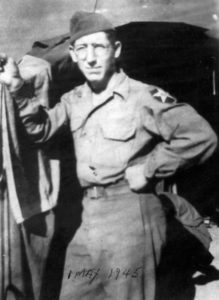
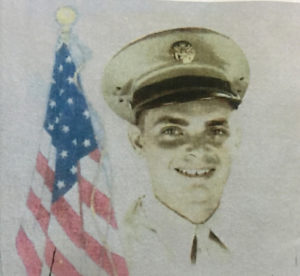
A Pearl Found In the Army

by Gerald White, 2 INFD, 23 REGT, CO M

Gerald White, 2 INFD, 23 REGT, CO M

It was a very tough, long basic training in the sands of Florida, very difficult for a young, dumb, skinny kid. There were lots of snakes and wild boar. In mid-November 1944, I was given a fifteen-day leave, then reported back to Fort Dix for shipment overseas. On 8 January 1945, we left New York harbor on the Queen Elizabeth with approximately twelve thousand troops. On the ocean trip, we had two sub alerts. We landed at Glasgow, Scotland on 13 January 1945, and were sent directly to a port in southern England for transfer to a port in France. We were loaded on cattle cars (forty and eight) for assignment to forward units.

I was assigned to M Company of the 23rd Infantry of the Second Division on 15 January 1945 someplace in Belgium. It was very cold, with lots of snow. Sometimes there was a lot of shelling by the Germans, and many battles around the Omdemolivildengin Pass near St. Vith, Belgium as part of the Battle of the Bulge. We would cut trees down with C-4 to use for bunkers, as the ground was so frozen that we couldn’t dig foxholes. I was assigned as an ammo bearer, mostly mortars.

On 31 January, while on the Siegfried Line near Wehlerscheid, Germany, I was wounded. I was working KP, but don’t remember that I had done anything wrong to have to be there! I was told to burn up some excess food. So I finished piling up the food, applied some flammable fluid to it and lit it. A tremendous blast resulted, likely because there was an undetected mine beneath where the food had been piled. I was blown away from the food pile. I suffered burns and plenty of singed hair, and was evacuated to Beaujon hospital in Paris, France. Two officers reported that I was MIA, and this was reported to my family. Ten days later I was back with the unit, but my family was never told that I had been located, leaving them in complete darkness about my status!

Our unit crossed the Ruhr River 2 February 1945 on pontoon boats, with lots of action. I rejoined my unit, and we pushed ahead. On 21 March 1945 we crossed the Rhine River five miles south of the famous Remagen Bridge. At this point we were moving fast. I received some advanced training and became a mortarman. We were on mechanized vehicles: half tracks, tanks, etc. We had a major battle outside of Leipzig. Then the tide turned, really turned. We took out a lot of the enemy. At one point, I looked up at an Allied bombing formation. There were so many airplanes that it looked like a big cloud passing over us. We advanced to the Mulde River where we met up with the Russians. The unit moved south to Pilsen, Czechoslovakia. At this point, most of the Germans were giving up. On 8 May 1945 the war was over.

On 10 July 1945 the Division traveled by train to a port in France. On 13 July we were loaded on a ship and departed France. We arrived at Camp Kilmer, New Jersey. We were given thirty days leave, then were to report to Camp Swift, Texas. At Camp Swift the Division was to be regrouped for extensive training for assignment to an unknown location. I was home on leave on VJ Day. Happy Days! On 23 August, I reported in at Camp Swift, Texas and started advance training. The day before Thanksgiving, the complete division moved to Camp Stoneman, California by train. On Thanksgiving day, the division marched in a ticker- tape parade through San Francisco. There were very large crowds. The next day trainloads of equipment and troops—me included—were on the way to Fort Lewis, Washington. The division received new people, as the home of the division would be at Fort Lewis. I was at Fort Lewis until 28 June 1946. A long trainload of GIs was loaded for shipment across the USA for discharge. We arrived at Fort Dix on 2 July and I was discharged on 4 July 1946. AMEN!!

I left the service and went to Morrisville College on the GI Bill. I went to work at the Seneca Army Depot as a civilian, working in the surveillance office. I became a munitions inspector, QA Specialist (QASAS), and did this for 37 years. I also served the Army in Korea as a civilian. It was while I was at Seneca that I met Pearl Johnson, the woman who became my wife. Of all the good things that happened to me while serving in or working for the Army, Pearl was the best!

I retired as a QASAS-S Chief of the Missile Branch in May 1985, at Anniston Ordnance Depot, Alabama.

The Wallet that Saved a Life!

On August 14, 1937, Mrs. Elizabeth Dorsey gave her youngest son a leather wallet as a present on his 16th birthday. She never knew that wallet would save her son’s life in WWII.

Sgt Raymond Dorsey told the story:

Raymond Dorsey, 4 INFD, 22 REGT

“I’d joined the 22nd Inf. of the 4th ID a few weeks before Christmas. We were in the Hürtgen forest of Germany during the Battle of the Bulge. There was lots of snow [Sgt. Dorsey likes to understate things] and so cold there’s just no way to describe the cold!” [Mr. Dorsey said that it was so cold the soldiers had to take socks and other clothing off of the dead to keep warm-those memories still haunt him.] “If it wasn’t the Germans trying to kill us, it was the weather. I fought through the Bulge until mid-January ’45, when it was over. This is when the prisoners started turning themselves in – they were glad to be out of it. There were more of them than there were of us. The fighting was over and they were surrendering. By the middle of Jan ’45, my outfit started to receive a lot of German prisoners. I had to search them – lined ’em up – and they all had wallets full of German money, which was worthless. I didn’t have any money. There was nothing for them to buy, nowhere they could spend it. So I traded them anything I could give them for their money. I ended up with so much of their money that my wallet was full, and I couldn’t carry it in my back pocket, like normal, so I moved it to my shirt front pocket. We took artillery fire during the fighting of the Bulge and up until this time I had several close calls, yet was never hit.

We were moved to the city of Prüm, Germany around Feb 14th 1945. We were told to set up a staging area at the edge of town. The enemy was waiting for us near late evening. They were dropping shells all around us. We had to set up a command post in a house, with two medics in the basement. I was on guard duty when they dropped a shell real close. I was a little away from the house and hadn’t been hit. After those shells dropped, I moved nearer the house to find some cover. I took one step into the house, and when I turned around, a shell landed right in front of me. That’s when my lights went out! The fat leather wallet in my shirt pocket, now over my heart, caught the main hit of shrapnel. That wallet (full of German money which was useless,) that my mother gave me years before, saved my life. I was unconscious and the medics helped save me by stopping the bleeding. When I came to, I was on the floor of a big building, maybe an airplane hangar. The whole floor, from what I could see, was covered with soldiers like myself. Just full of soldiers like me. I wanted a drink of water, but they wouldn’t give it to me. But they did give me a shot of morphine. I hadn’t had a shave or bath since I’d arrived. I must have been a sight! I don’t know how long I was there or where it was – they kept me knocked out. They loaded me into an ambulance, and I remember hearing them say that we were passing the Eiffel Tower, so we must have been near Paris at this time. When I woke up next, I was clean, shaved and in a clean bed with sheets. I don’t know how long I was in France. I next remember waking up in the hospital in England, and they handed me my belongings, including the wallet. It was full of American money. Someone had changed all the German money for American! I felt blessed, because there was enough money in my wallet to send $100 to my wife (which was a lot of money in 1945,) and I kept the rest. My buddies in the hospital were the ones to point out the hole in my wallet and I realized that wallet saved my life! My right thigh was all bandaged up, and they started to unwrap it. They rolled me outside for a long way to the operating room. That’s when they sewed up my leg wound and put it in a cast. When the cast was removed, my doctor came around and asked, ‘How you doing today, soldier?’ I said, ‘Well, they just removed my cast, but I can’t move my knee.’ He went to the bottom of my bed, grabbed my right foot and gave it a heave – like a pistol shot, you could hear it – but after that I could bend my knee again. I can still see shrapnel in my thigh, my ankle and I’ve got a little in my face around my left eye.”

Sgt Dorsey was never able to tell his mom that she had saved his life with that birthday gift. When he was medically fit to be sent home, his mother was terminally ill, and as Dorsey said, “I was able to see my mom just before she passed, as I’d finally been released. She was a good mother. I didn’t talk about the war, never showed them wounds. It was too soon, and people didn’t want to know. I still have to live with it.”

A Gunner’s Story

This is a selected excerpt about US Army soldier Charlie Sanderson from My Father’s War: Memories from Our Honored WWII Soldiers, a book of first-hand narratives and photos chronicled by BOBA Member Charley Valera.

Charlie Sanderson, 78th INFD, 552 FABN, AAA AW BN

Unlike most soldiers who finished their training and were selected to be shipped overseas, [Charlie] Sanderson was rushed over as a replacement and completed his basic training in Salisbury Plains, England, near the white cliffs of Dover—not a pleasant or safe place to be in early 1944.

Sanderson was now official property of the US First Army, 552nd Field Artillery Battalion, 78th Infantry Division, AAA Automatic Weapons Battalion under Major General Edwin P. Parker. Sanderson soon found himself landing on Omaha Beach and would eventually end up in the Ardennes Forest.

Moving forward into Normandy and other parts of France, the troops fired on the towns of Saint-Lô and Sainte-Mère-Église. “Return fire was nonstop. Everything was coming at us.

One time, I looked up over the hill and saw all the tanks lined up,” Sanderson said. “I thought they were American tanks. They were Germans and they started firing at us. We were laying out a position and didn’t know we had gone too far.” The land between the two fighting sides is known as no-man’s-land. Sanderson’s troop had gone too far into German-occupied territory; they had to get out of there in a hurry.

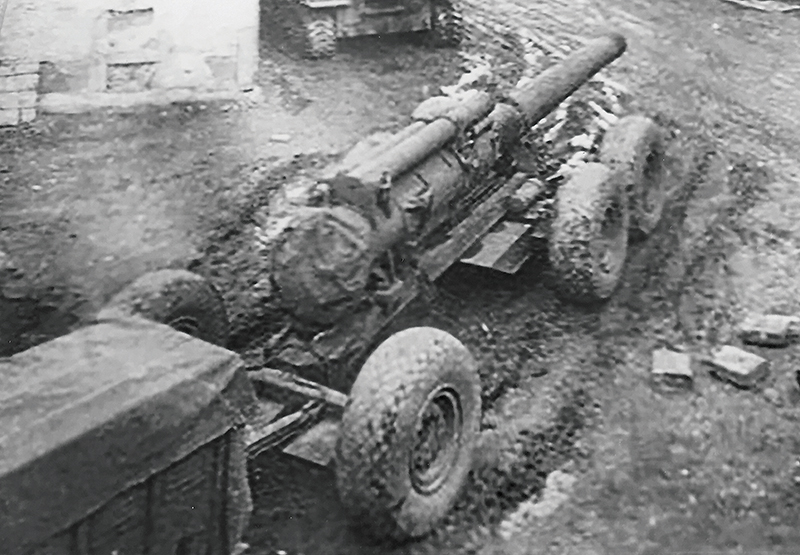
Again, Sanderson was part of the 552nd Field Artillery Battalion. They had three gun batteries: A, B, and C Battery. Their weapon was the enormous, American-made 240 mm Howitzer Cannon that would shoot a 365-pound projectile within a twenty-mile range, using eighty-five pounds of gunpowder per shot. This big weapon of war could also be moved around as needed to advance.

Once a position was established and laid out, Sanderson began to empty his truck for action. He took a big canvas and put it down exactly where the massive Howitzer gun was to be located. The canvas had holes in it with metal grommets, and it took three men to lay it out. Assigned to a twenty-one-man crew, Sanderson was up front first. They’d put the large steel spades attached to the sides of the gun into the ground for support, but needed large enough holes to accommodate the recoil based on the gun’s nose’s aim. When the other part of his crew showed up, all they had to do was start digging. After that, they placed “a thousand sandbags around it,” Sanderson said. “Sometimes you had soft or sandy soil to work with.”

They used prime movers to move the Howitzers around—not a tank. A prime mover is a specialized heavy-duty gun tractor used to tow artillery pieces of various weight and sizes. They took two prime movers and put them at 45 degrees on either side of the Howitzer, cabling the gun to them for further stability.

Each man had his own job. A gunner would sit on a metal seat on one side of the gun and did quadrant lateral settings. Another sat on the other side, configuring the elevation settings. The two spun the big steering wheels for accuracy. When ready, the gunner got on a phone with the commander and yelled, “Set,” then “Ready” and the commander on the other end of the line would tell them when to fire. To work just the gun, “There would be two men on the gun; seven on ram-staff and four to bring the projectile out.”

With seven men on the ram-staff, a twelve-foot manual push rod got the projectile into the gun. “They’d yell, “One, two, three … ram!’ and slam the 365-pound bullet into the barrel of the Howitzer. It all went as fast as you could go … to have a round in the air every minute.”

There was a sergeant in charge of maintenance for all this equipment. The prime movers were all covered in camouflage to hide from reconnaissance planes. “The noise was tough,” explained Sanderson. “You were supposed to stand on your toes, open your mouth, and block your ears. How you gonna do that when you had to measure the recoil on the gun? The gun would recoil sixty-five inches,” he remembered. “The hotter the gun got from firing, the farther back the gun would recoil.”

“We needed cooks, truck drivers, mechanics, and others soldiers’ efforts of the unit to make it all work. Some of the others would be guarding the trucks and facilities during the shooting. You had guard duty, two “on and four off, and sometimes we’d agree to four on and two off to give more people a break or [to] sleep more at night. But you had to be close to your gun. Your pup tent was very close by the gun. When they called a fire mission, you had to be quickly available. Or, if there was a fire mission and you were sleeping … well, at least trying to sleep during all of that.”

Further inquiry about his crew continued. “The sergeant is like the head mechanic; he knows what’s to happen and when to move on. Everything is camouflaged and ready to go when needed. They all carried the carbine rifles with a sling over their shoulders.” He shook his head. “Nobody could believe what it was like.”

In front of the guns was a six-foot pile of loose grass or dirt caused by a vacuum from the firing. “One time, “on and four off, and sometimes we’d agree to four on and two off to give more people a break or [to] sleep more at night. But you had to be close to your gun. Your pup tent was very close by the gun. When they called a fire mission, you had to be quickly available. Or, if there was a fire mission and you were sleeping … well, at least trying to sleep during all of that.”

Sanderson’s 240 MM Howitzer, covered in mud, as usual.

Further inquiry about his crew continued. “The sergeant is like the head mechanic; he knows what’s to happen and when to move on. Everything is camouflaged and ready to go when needed. They all carried the carbine rifles with a sling over their shoulders.” He shook his head. “Nobody could believe what it was like.”

In front of the guns was a six-foot pile of loose grass or dirt caused by a vacuum from the firing. “One time,” Sanderson recalled with a smile, “there was a half dozen sheep close by. We fired over them and there was a whole pile of loose wool in front of the gun. It didn’t pull it out of them, but loose wool from their bodies was in with the grass. It was kind of funny.”

The food was mostly K rations. The only time their cook was able to provide decent meals was when they got into a quiet zone where they could kind of lie back, with not much going on. They sometimes took the big kettles, which looked like metal garbage cans, and set four of them out. They then took extra gunpowder bags and threw them onto a fire—which got the water boiling in just a couple of minutes. They threw C rations into the water so they could have hot food. But most of the time, it was K rations. The benefits of K rations were for quick eating meals and maximum energy while C rations were more for sustained daily food intake.

K rations were individual portions of canned combat food and provided breakfast, lunch, and supper. According to Wikipedia, a day’s menu consisted of the following:
Breakfast Unit: canned entree (chopped ham and eggs, veal loaf), biscuits, a dried fruit bar or cereal bar, Halazone water purification tablets, a four-pack of cigarettes, chewing gum, instant coffee, and sugar (granulated, cubed, or compressed).

Dinner Unit: canned entree (processed cheese, ham, or ham and cheese), biscuits, fifteen malted-milk tablets (in early versions) or five caramels (in later versions), sugar (granulated, cubed, or compressed), a salt packet, a four-pack of cigarettes and a box of matches, chewing gum.

Sanderson shared some of his memories of the Battle of the Bulge: “During the Battle of the Bulge, the Germans spearheaded around us. We were in the middle, and they had us surrounded. The lieutenant told us, ‘We’re going to fight until the last man. The first man to turn around, I’ll shoot him in the back.’ That’s what the lieutenant told us. Blood and Guts, General Patton, came in with his tanks. When he came by, you could see those tanks rolling around. He saved our ass, you know. We were surrounded.” When asked if he’d ever met General Patton, Sanderson responded with a smile. “I drove past him once. I knew who he was, but he didn’t know who I was.”

From a distant memory, Sanderson remembered another interesting story, detailing what the Ardennes Forest looked like. “Did you ever see land when a tornado’s come through? Did you ever see trees and stuff, twisted and broken off? The whole friggin’ forest was like that. I drove down a road and there were horses hooked to cannons—German horse-drawn artillery. Our men came down through and strafed them. We just had to push them off the road so we could get through. Imagine that—using horse-drawn artillery in World War II. Everything the Germans had, they used. That was the Ardennes Forest.” Sanderson was stunned to see the once-mighty Third Reich reduced to using horse-drawn artillery.

“They called them battles, but to me it was a battle all the way through.”

Sanderson got plenty of special detail. They took him and his assistant driver to a huge field at night so they could run a wire for their phones. “A jeep would drive the wire across the field. They’d say, ‘Here, this is your position.’ It was right next to a row of turnips. The Germans planted huge rows of them. A row of turnips covered in brush used to feed their animals and troops. We were out there to report if they [the German troops] came in by parachute. We were sitting ducks out there in the middle of the friggin’ field. All by ourselves, you know. These kind of details, you don’t mind when you’re back with your men. But when you’re all by yourself, those kinds of detail kind of get scary.”

Sanderson added, “They’d come by and drop those personnel bombs. They’d drop them all over the place and they’d go pop, pop, pop all over the friggin’ place like popcorn. They also dropped flares so they could see. They’d see us sitting ducks next to the pile of turnips camouflaged like it was something else. I was probably nineteen years old.”

“When you can’t see it, you get scared. You don’t know where it’s coming from. Anyone who said they weren’t scared is a damn liar.”

The war had been over for more than seventy years when Charlie and I spoke about his life. The memory of his war efforts is etched in his mind as though they had happened yesterday—just like the others I’ve interviewed, they all seem to remember the war in great details. There was lots of smoke, fire, guns going off, aircraft strafing; it was war, with people being killed on a regular basis.

Charley Valera is the author of My Father’s War: Memories from Our Honored WWII Soldiers, which includes photos and personal stories of a dozen more veterans from every branch and both theaters of WWII. Copies are available at Amazon.com and BN.com. Signed copies of the book are available only at www.charleyvalera.com. You can view many of the 
actual interviews on YouTube at https://goo.gl/4Q1919.

The Calendar that Changed Sides

by Benjamin Mack-Jackson, Member

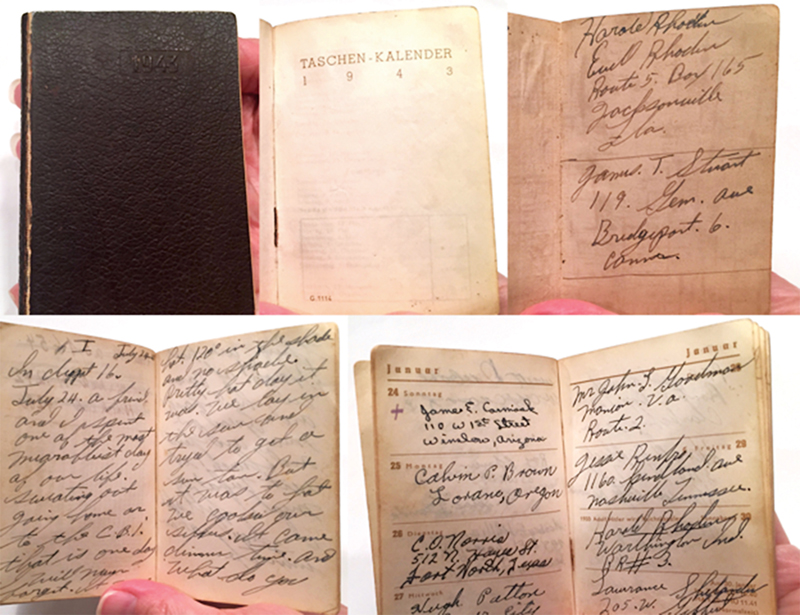
German soldier's calendar captured by Harold Rhoden, 106 INFD 424 REGT CO F.
German soldier’s calendar captured by Harold Rhoden, 106 INFD 424 REGT CO F.

At the 2017 106th Infantry Division Reunion, I was entrusted with an incredible historical artifact by the family of WWII veteran Harold Rhoden. Harold Junior Rhoden served as a Private in the 106th Infantry Division, 424th Infantry Regiment, Company F. He enlisted in the army on November 19, 1943, in Camp Blanding, Florida.
Private Rhoden wrote his wartime thoughts, as well as the names and addresses of his buddies, in this captured German soldier’s pocket calendar. The “Taschen-Kalendar” was most likely taken from a German soldier by Rhoden himself. Before being used by Rhoden, a German soldier had made several entries throughout the book in purple ink, including numbers, names, and dates.
On December 16, 1944, Rhoden and the 424th Infantry Regiment were plunged into the Battle of the Bulge, the largest and bloodiest battle fought by the United States in World War II. Private Rhoden undoubtedly saw fierce
 combat in late 1944 and early 1945, and this pocket calendar was with him all the way. Seeing ferocious and bloody combat for several months, Private Rhoden was awarded 
the Combat Infantryman Badge, a prestigious Army award.
On February 7, 1945, the 424th Infantry Regiment was moved to the vicinity of Hunningen, Germany to conduct defensive patrols. Eleven days after arriving in Hunningen, Private Rhoden was wounded in action, which resulted in him receiving the Purple Heart.
This pocket calendar ultimately survived the war and was brought home from Europe by Private Rhoden as a memory of his time in service. It is a true honor to be the caretaker of this incredible piece of history for educating future generations, and I am humbled that the Rhoden family chose me to do so.
Benjamin Mack-Jackson is the 16-year-old founder of the non-profit organization WWII Veterans History Project (WW2VeteransHistoryProject.com). Throughout the past three years he has interviewed over 50 WWII veterans and created the Traveling Museum of WWII, a mobile history display using artifacts donated by veterans and their families. He has spoken to thousands of people of all ages about the importance of history and remembering the past.