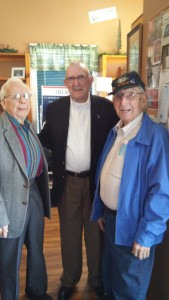
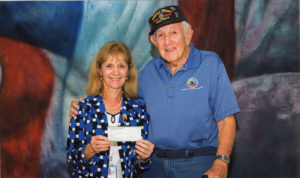
South Carolina Chapter members Chris Carawan (90, left) and Gerald White (turning 90 in May, right) help Joe Watson celebrate his 93rd birthday at The Nut House, Joe’s pecan store in Ridge Spring, South Carolina on 9 April. Joe served as a mortar platoon officer in the 75th Infantry Division during the Battle of the Bulge. He was recognized for participation in the Ardennes, Rhineland, and Central Europe Campaigns. Joe began his pecan business after returning home from World War II and now grows and sells pecans, pastries, and related items from The Nut House, a renovated service station in the heart of Ridge Spring.
This is an excerpt from Fague’s book of the same title, published by The Shippensburg Historical Society, 2008.
The plan was for us to attack the hill in front of us. The battalion moved out from the road in basic training fashion, leaps and bounds and rushes, everything according to the book. We charged across the open ground and up the hill until we were ordered to stop. And now the officers decided that we were attacking the wrong hill! The Krauts were not up there. Somebody had made a miscalculation. I was told later that the tank commander yelled to battalion commander, Lt. Col. Hoffman, and asked him if he felt qualified to lead his men. His reply was, “I guess not.”
Later I understood that Col. Hoffman accidentally let the tank hatch drop on his shoulder and he had to be evacuated. That took care of that problem. Col. Hoffman was succeeded by Major Tansey, a dashing West Point officer. I remember him walking around with his 45-caliber pistol strapped to his waist, screaming orders in his high-pitched voice, walking where the fighting was the thickest.
Since we had blundered in attacking the wrong hill, Major Tansey and Capt. Fabrick led our company along a railroad track around the hill. We walked down the railroad tracks in a column of two for several hundred yards and then cut cross-country up over the hill. I noticed several knocked out American tanks on the hill, but nothing more. Although I didn’t know it then, we were heading toward the town of Chenogne, Belgium, which I presume was our original objective. This town was to witness the bloodiest fighting of our campaign in Belgium. Our company came across the hill in scattered formation, the first platoon leading the way. I remember wading through snowdrifts and crawling under several barbed wire fences. As I came over the top of that open hill, I little suspected the trap into which we were to be caught. Several times, shells burst in the pine trees 150 yard to my left and some shrapnel hit the snow around me. I couldn’t figure out then if that was close support from our artillery or enemy fire. I guess it was the Jerries because they had spotted every move we made.
Suddenly I had an experience of horror. Again I got that sudden sickening in my stomach. There in front of me were two-man foxholes. I could make out the forms of American boys, C.I.’s slumped over in a sitting position, dead. The snow had drifted over their bodies so I could hardly distinguish their features. I then realized there was something wrong with this place. Someone yelled that the 9th Armored Division had been driven out of here a few days before.
As we walked along, Capt. Fabrick yelled for someone to fire a few rounds into a haystack in front of us. Someone fired a few rounds, and this turned out to be very fortunate. The Jerries figured we had spotted them and they opened up with their machine gun. The sound of that gun I will never forget. The German machine gun has a much faster rate of fire than our gun and so they are easily distinguished. The sound of that gun echoed across the snow and everything in me seemed to stop. There were six of us in the first rank as we passed over the crest of the hill. We could see the town of Chenogne 300 yards in front of us. All of us instinctively dove for cover in the snow. I looked for a hole to crawl into, but there was none.
The first burst of gunfire had killed two men and wounded three, leaving me the lucky one. As I raised my head to look around, I saw boys to the left kicking and writhing in the snow. I knew they were hit and I wanted to get to them but I couldn’t. I knew approximately who they were, although I could not see their faces. Sgt. Carl E. Petersen from Oregon and William Kidney from Toledo, Ohio were dead. Bill Bassert and Charles Hocker from Philadelphia were badly wounded. Johnny Kale, who was lying near me, began to whine in pain. He yelled to me that he was hit. I crawled on my stomach through the snow to him. I found a bullet had hit him in the calf of the leg but it wasn’t bleeding badly. It looked like a clean wound. I took the Carlisle bandage from his belt and bandaged his wound. I gave him his sulfa tablets to prevent infection, but the water to take the pills with was frozen in his canteen. I told him to eat snow with the pills. Remembering my basic training, I took the clips of rifle ammunition from his belt and told him to crawl to the rear. As soon as Kale was gone, my attention was again drawn to that Jerry machine gun. It was still spitting out death across the snow. I knew I had to get into a hole somewhere or that gun would get me. I spotted a hole 20 yards down the hill and made a run for it. It was filled with snow, but I flopped in.
My protection was just a shallow slit trench. Every time I heard that machine gun rip off a burst, I tried to draw my buttocks more into the hole or pull in a leg. At this time I experienced the loneliest and most desolate feeling I had ever gone through. I looked back and could see none of the rest of the platoon behind me. The few boys on my right had either been killed, or were lying face down and very still. On my left and in front there was nothing but Krauts. A few yards to my right lay a dead German. He must have been killed the day before, as he was frozen stiff.
The idea came into my head that maybe the company would withdraw and leave me there. I thought to myself, “Well Fague, it looks like the end is very near.” My morale was at the lowest it had ever reached.
I had a weapon in my hand and I was determined to use it whatever happened. I saw some activity in the house ahead, Krauts running around. I opened up with my rifle. I fired one shot and my rifle jammed. While I had been giving Kale first aid, I dragged my rifle through the snow and got snow and dirt in the receiver. I had trouble drawing back the bolt, but I could still operate my rifle one round at a time. I doubt if I hit anything but it made me feel good to be shooting and doing something.
My isolated little battlefield soon came to life. I heard machine gun fire coming from my rear, and it was a wonderful sound. I saw those beautiful red tracer bullets from our guns arch across the snow into the Jerry position in front of me. I heard our tanks coming from the rear and I knew I was no longer alone. What a wonderful feeling the sight of our tanks gave me! I felt like jumping up and charging the enemy position alone. I was so excited I was no longer afraid. Behind me I heard voices yelling, and commands. I saw buddies from my platoon moving over the bodies of those who had just been killed. They were moving in leaps and bounds from bushes to snowdrifts. When they came abreast of me, I went along with them. I rushed to an abandoned German tank 75 yards in front of me and took cover behind it.
At the tank I was soon joined by Frank H. Holquist. He brought his machine gun and set up for business. The next arrivals were Robert A. Fordyce, from Erie, Pennsylvania, and Paul L. Gentile. They were carrying ammunition for the machine gun. The sergeants soon joined us. Holquist now gave us a tune on his machine gun. He was keeping the Krauts busy, who were dug in around the house 50 yards in front of us. I decided this was the time to take my rifle apart and get the snow out of it.
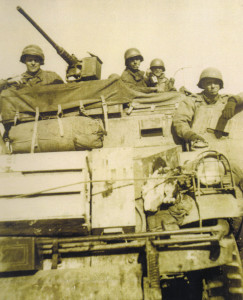
From left to right: S/Sgt John Fague, PFC Donald E. White, PFC Dock E. Deakle, and driver of the “BAT,” T/5 Orvin P. Rasnic
The West Palm Beach VA Medical Center has created a program to create “welcome kits” for returning US Troops. The kits contain toiletry articles and the program is funded by donations. Pictured is George Fisher, President of the Veterans of the Battle of the Bulge Southeast Florida Chapter, presenting a donation on behalf of the chapter to Charlene Szabo, director of the Medical Center.
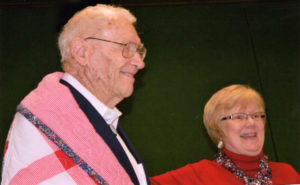
Founded in 2003 by Catherine Roberts, mother of an Army soldier deployed to Iraq who wanted her son and others welcomed home with love and gratitude, Quilts of Valor has spread nationwide. As of the first of 2016, nearly 200,000 Quilts of Valor have been presented to veterans. From her sewing room in Seaford, Delaware, Catherine’s idea of linking quilt top makers with machine quilters has achieved her goal of awarding healing quilts to returning service men and women touched by war.
On February 3, 2016, quilts were presented to about twenty-five veterans in North Carolina by the local Group in Cabarrus County. Group is the designated term for local area quilters who make the quilts and arrange the presentation programs. Quilts are all made by local volunteer groups and are sewn with materials provided at no cost by the QOV Foundation now headquartered in Lilburn, Georgia.
The Veterans honored included myself and only one other WW II veteran, who was a 97-year-old former WAC whose service assignment was de-coding of messages! Other veterans there served from Korea to Afghanistan. The Certificate presented with the Quilt reads:
On behalf of the Quilts of Valor Foundation, In recognition of your service and sacrifice for
This nation it is a privilege to serve Honor and comfort upon you through The award of a Quilt of Valor Though we may never know the depth of your sacrifice to Protect and defend The United States of America, as a gesture Of gratitude from a grateful nation We award this Quilt to Valor to Thomas L. Burgess
Tom Burgess
Each Quilt of Honor is an individual work of art and no two are alike. Before the presentation program began, each veteran was asked to pick the quilt we wanted to receive from a large display. When presented, the quilt was wrapped around our shoulders with the expressed hope that it would give us a warm feeling of appreciation from the QOV Foundation and the volunteer who made the quilt.
Go to www.QOVF.org/group to locate and contact the nearest group to learn of plans for future presentations and provide names of WW II veterans for award consideration. Consider donating at www.QOVF.org/donate
On Dec. 16, 1944, German General von Rundstedt made his famous counterattack into Belgium, starting the Battle of the Bulge, which was to be the biggest, bloodiest and most decisive battle of World War II.
Muriel Engelman
Our tent hospital, located on the outskirts of Liege, was one of the closest hospitals to the fighting lines, and the destination for the German army to reach in order to cross the Meuse River there and head for the Port of Antwerp, where they could cut off all Allied supplies.
The week before Christmas, a sudden heavy dense fog fell over all of Belgium, creating an eerie, gray silent landscape. The only sounds we could hear were the muffled sounds of buzz bombs dropping as they flew over every twelve to fifteen minutes, twenty-four hours a day, each one carrying 2000 Ibs. of explosives. Our hospital had already suffered two hits and was to soon receive a third, creating casualties among patients and hospital staff. This fog was so thick we couldn’t see five feet in front of us, but the German tanks and infantry were able to move forward on the ground, and our planes couldn’t get off the ground to bomb them.
Two days before Christmas, the Germans were ten miles from Liege and German paratroopers had already been dropped into the city. Many of the American hospitals in the area had already evacuated to France or Luxembourg, and we felt like sitting ducks, hoping and waiting for orders to evacuate that never came. Instead, we nurses were ordered to pack our musette bags with the warmest clothing we had and any first aid supplies, in the event we were captured by the Germans, and to be prepared to move out with ten minutes notice.
Of course we were scared. I was a little more so than the other nurses, because I had an “H” for Hebrew on my dog tags, the very ones Hitler wanted to annihilate. Our patients were furious that American women were so far up front. When we did get orders to evacuate our sickest bed patients to the rear, as we loaded them into trucks and ambulances, they begged us to change places with them.
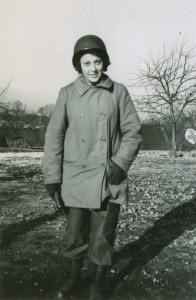
One of my patients who was so concerned about my possible capture by the Germans constructed a blackjack for me to carry with me at all times, and believe me, I did. You can see it in the enclosed photo, in my right hand. This was a ten-inch length of hosing, stuffed with lead sinkers and suspended from my wrist by a leather thong. His instructions were as follows: “If a Kraut gets near you, take this blackjack, slam it across his face and aim for the eyes.”
Another patient gave me a spring-blade knife, which you can see outlined in my left pocket, and his directions were: “If a Kraut approaches, take this knife blade, plunge it into his belly and then run like hell.”
On Christmas Eve, the fog that had hung over all of Belgium for the past week had dissipated, and a full moon arose, lighting the sky with an almost daytime light. A lone German plane flew over our hospital tents and the enlisted men’s tents that night, dropping anti-personnel bombs and strafing the tents, killing and wounding scores of patients and hospital personnel. Our planes were out in full force the following morning and soon outnumbered the German planes.
No, I never had to use my “weapons of protection,” though I kept them in my possession for years, mementos of our wonderful, caring G.I. Joes.
Russell Hathaway from Ada, Ohio, spent 15 months in European Theatre and fought in The Battle of the Bulge. Russell went across the English Channel in LST (flat open barge) to Normandy November 1, 1944. Back home in Ohio, a son ( Larry) was born to Russell and his wife Mable November 5, 1944.
Russell was a Private First Class with the “Railsplitters”—Anti Tank Company, 3rd Platoon, 335 Infantry Regiment, 84th Infantry Division. He had seen a lot of destruction from the war, but had not been in combat until they got orders December 24, 1944 to “get out the best way you can.” His unit had been held up in Bastogne, Belgium. They had been staying in a basement of a deserted house with their truck backed into the garage, out behind the house. He had one trip to the garage and no time to take his duffle bag. The truck radiator had two holes from shrapnel. Russell whittled wood plugs to fill the holes. Two men rode on the front bumper to keep filling the radiator with water. They had gotten the order at 4p.m., and at 5p.m. six men plus the driver drove the truck out of the garage (pulling a 57 millimeter anti-tank gun like a trailer) while under fire from the enemy. A German tank (60 ton) had made deep tracks. This was Russell’s first time in a combat situation.
EPSON MFP image
The men got out of the truck and into the tracks. Russell was laying in the track, head to head with Mac McQuin. Mac was shot in the head with a 30 caliber machine gun. Russell and other soldiers got him to back to the command post. They never heard anything more about Mac. They followed half-track tracks until until dark, using black-out lights to travel after dark. Lt. Kelso got injured in leg (his driver was killed). Kelso ended up on Russell’s truck.
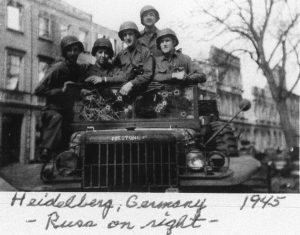
This battle continued until January 31, 1945 and Russell’s unit was there until the end. The unit crossed the Rhine for the final offense in Germany, ending up in Heidelberg, with temporary headquarters.
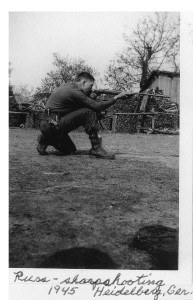
While waiting to return to the U.S., Russell competed in sharpshooting contests and qualified for several medals. On November 23, 1945, Russell headed for home from France on a small victory ship. A terrific storm was on them for three days after leaving the Mediterranean Sea and entering the Atlantic Ocean. The ship tipped 37 degrees during those days. (They capsize at 45 degrees). Most of the men were sick, but Russell was not. Russell received Honorable Discharge December 8, 1945.
Russell had never talked much about his wartime experiences until he acquired and read the book: The 84th Infantry Division in the Battle of Germany from Nov. 1944-May 1945, by Lt. Theodore Draper. With the help of this book, Russell could track his unit at different locations and time periods, and this made it easier for him to share his own experiences.
Russell went on the Honor Flight from Columbus, Ohio to Washington, D.C. on April 21, 2007.
On December 12, 2011, Russell and his wife Mable celebrated 69 years of marriage, shortly before his death on December 25, 2011. He passed away in their Ohio home at the age of 92. He was surrounded by his family on that Christmas evening—67 years after spending his Christmas in The Battle of the Bulge.
—Submitted by Drena Hathaway Metzger, his daughter, and Mable Hathaway, his wife, Associate