Note: We, Jan Ross and Brad Peters, have created a comprehensive web site over the past 10 years to recognize Jan’s father’s unit that fought in the Battle of the Bulge. The web site is www.300thcombatengineersinwwii.com . The following story was published in our winter 2016 300th Quarterly newsletter and was the result of a recent inquiry to the web site.

Again we have been contacted through the web site asking for information about a member of the 300th. In January, we received a brief e-mail inquiry as follows. “My name is Roy Sweet. Roy Leslie Sweet was killed on Dec. 23, 1944. I am trying to contact anyone who might know him or what happened on the day he was killed. Any help would be great. Roy.” The name was familiar to us and our records on the web site confirmed this information about Roy Sweet. Since he was in Company B, we contacted Don Richter who was clerk for B Company and a significant contributor to the web site. Don came through as he always does and his detailed memory of 70+ years ago gave us the information requested and more.
What follows is Don’s response.
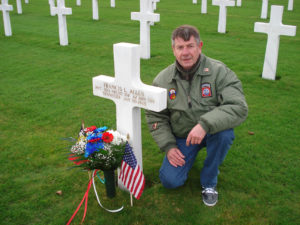
This is regarding Roy L. Sweet, Tec 4, killed in action Dec. 23, 1944 and buried in Henri-Chappelle Cemetery in Belgium. Roy Sweet was not a close friend of mine but I recall that he was a very quiet man who stayed pretty much to himself always working with the Company B radio equipment. He was Company B mail clerk in addition to being the company radio operator, the primary communication for the company. He always rode in the back seat of Company B Commander, Capt. Falvey’s jeep [Capt. Gene P. Falvey] where all of the company radio equipment was installed.
I do know that when Companies A & B were out in front of the main US Army & British Army defense line along the bank of the Meuse River, we encountered forward elements of the Germany Army advancing through the Ardennes Forest. We had roadblocks with bridges set for destruction upon the approach of the enemy. On December 23, 1944 Capt. Falvey, with his jeep driven by McGowan [Tech 5 Willie D. McGowan] and radio operator Sweet, were out checking on our various defense installations when they were approached by what appeared to be a US Army Sherman tank.
When it began firing on them, they quickly realized that it must be a tank that was captured by the Germans and was now the enemy. The jeep came to a sudden halt and McGowan and Capt. Falvey bailed out and took cover though both were wounded. Roy Sweet was mortally wounded and remained in back seat of the jeep. McGowan though wounded returned to the jeep, found Sweet dead and recovered the map case in which the defenses of Companies A & B were recorded. Capt. Falvey, though wounded, shot and killed a German soldier with his pistol. The two survivors were able to return to B Company where medics treated their wounds. McGowan was hospitalized but later returned to duty.
I know these to be true facts as some weeks later, after I became B Company clerk, I took and typed depositions from both McGowan and Falvey. Both accounts of what happened to them and Sweet on Dec 23, 1844 were almost exactly the same. McGowan received a Bronze Star for returning to the jeep and recovering the map case while under enemy fire and also being wounded he received the Purple Heart. I am sure that Falvey also received the Purple Heart.
After Roy Sweet was killed, B Company clerk Kenneth Funk became B company mail Clerk, I became B Company clerk because I was the only one who could type having learned in West High School and was given MOS Clerk Typist at Camp White. Jerry Barton was transferred from H&S Company to B Company to become radio operator. It took two men to replace Roy Sweet.
I am glad to be able to help with the inquiry about Roy Sweet. I, along with all who knew Roy, mourned his death. Cpl. Don Richter, Company B, 300th ECB”
Footnote: Warren Chancellor (300th ECB) Remembers Roy Sweet
In December of 2004, Suzy and I [Warren Chancellor and his wife], along with about 150 other veterans of the Battle of the Bulge, went on a tour of Belgium and Luxembourg to commemorate the 60th Anniversary of the Battle of the Bulge. The tour was sponsored by the governments of Belgium and Luxembourg. One of the stops on the tour was Ettelbruck, Luxembourg to visit an American WWII Museum. I was wearing a military style cap with 300th Engr., Combat Bn. embroidered on it. While walking around the museum, the curator noticed my cap and asked me if I was a member of the 300th. I replied I was. He told me that the museum had an article on display that had belonged to a member of the 300th and his name was Sweet.
My reply was, “Roy L. Sweet, a radio operator and he was killed by machine gun fire from a tank somewhere near the Belgium/Luxembourg border.” He took me to a glass-covered display of smaller articles of American equipment and there was a canteen cover imprinted Roy L. Sweet, 300th Engrs. I wanted to take a picture of it but I had left my camera on the motor coach and it was parked away from the museum. What a surprise! Here I was in Luxembourg and the curator happened to notice that I was a member of the 300th and he remembered that one particular item being there. Small world!”
In March, the younger Roy Sweet wrote: Thank you so much for the newsletter. It is wonderful to have a clear understanding of that day. I will share this with my entire family. Please keep me on the list. I would like to attend any events possible. On behalf of my uncle, my father, his father and mother. Thank you for keeping Roy alive through your organization.
Sincerely
Roy Sweet
submitted by Jan Ross, Associate Member





 He and his grandson Steve visited the exhibition of the local tourist information center, trying to discover any souvenirs of his time in Gouvy. He was very surprised to find a photo of him and three of his fellow soldiers, standing at the remainders of a V1 rocket. He shared his personal story about the Lallemand family with the staff of the tourist information center. They were very grateful to George and his family for visiting and sharing his story.
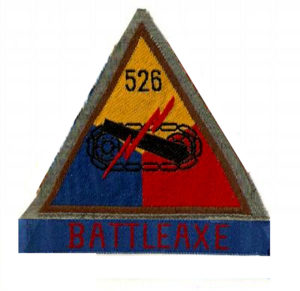 We are sorry to report that the 526th Armored Infantry Battalion Association has disbanded, as announced in the November 2015 [final] issue of The Pekan Newsletter. We thank Glenn Damron, President, and Sherrie Morrison, Editor-Secretary/Treasurer, for the great job they have done in keeping the legacy of the 526th alive all these years. We thought it fitting that we reprint these articles from The Pekan Newsletter.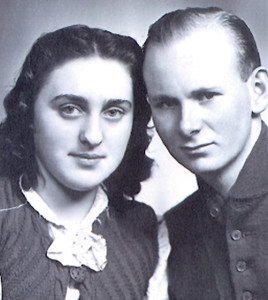
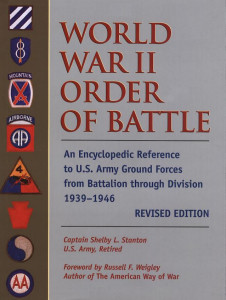 WORLD WAR II ORDER OF BATTLE By Capt. Shelby L. Stanton
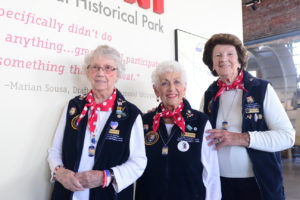
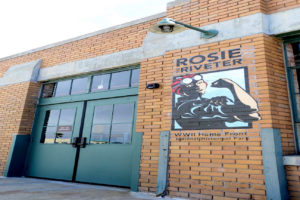 On August 21, 2015, I visited the Rosie the Riveter/World War II Home Front National Historical Park in Richmond, CA (north of San Francisco). This was my 2nd visit there. I highly recommend a visit to this park Visitor Center.
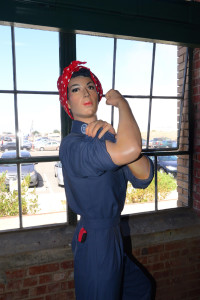 Richmond played a significant and nationally recognized part in the World War II home front. The four Richmond shipyards produced 747 cargo ships, more than any other shipyard complex in the country. Richmond was also home to over 56 different war industries, more than any other city of its size in the United States. The city grew from less than 24,000 people in 1940 to nearly 100,000 people by 1943, overwhelming the available housing, roads, schools, businesses and community services. At the same time, Executive Order 9066 forcibly removed Japanese and Japanese-American residents from the area, disrupting Richmond’s thriving cut-flower industry. The war truly touched every aspect of civilian life on the home front. Through historic structures, museum collections, interpretive exhibits, and programs, the park tells the diverse and fascinating story of the WWII home front.